IPhO 2013, Теория — Задача 1. The Maribo Meteorite
The Maribo Meteorite · 7 юли 2013 г. · 9 т.
Условие
Introduction
A meteoroid is a small particle (typically smaller than 1 m) from a comet or an asteroid. A meteoroid that impacts the ground is called a meteorite.
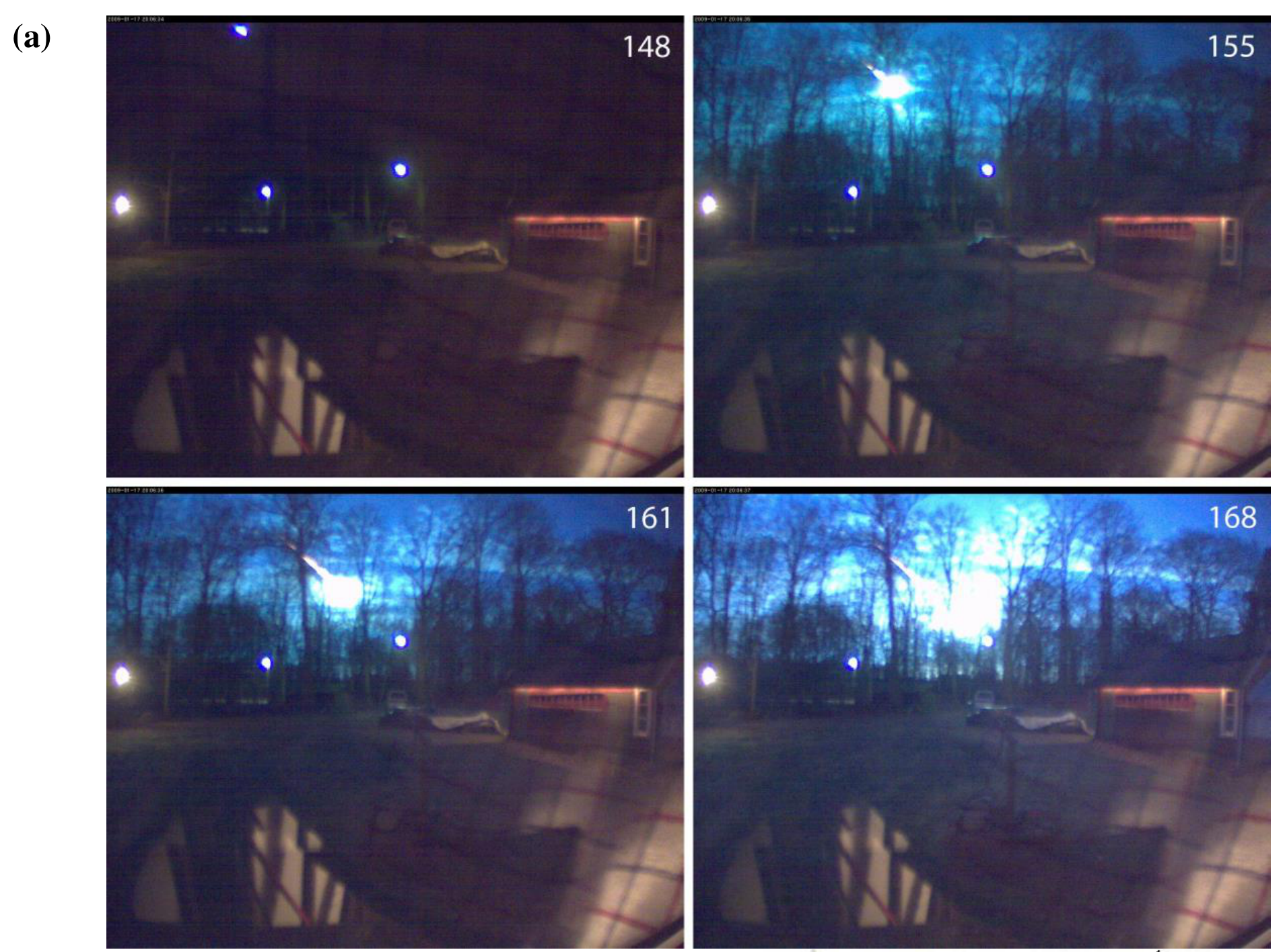
On the night of 17 January 2009 many people near the Baltic Sea saw the glowing trail or fireball of a meteoroid falling through the atmosphere of the Earth. In Sweden a surveillance camera recorded a video of the event, see Fig. 1.1(a). From these pictures and eyewitness accounts it was possible to narrow down the impact area, and six weeks later a meteorite with the mass 0.025 kg was found in the vicinity of the town Maribo in southern Denmark. Measurements on the meteorite, now named Maribo, and its orbit in the sky showed interesting results. Its speed when entering the atmosphere had been exceptionally high. Its age, year, shows that it had been formed shortly after the birth of the solar system. The Maribo meteorite is possibly a part of Comet Encke.
The speed of Maribo
The fireball was moving in westerly direction, heading 285° relative to north, toward the location where the meteorite was subsequently found, as sketched in Fig. 1.1. The meteorite was found at a distance 195 km from the surveillance camera in the direction 230° relative to north.
(b)
| Frame | Time | Azimuth | Altitude |
|---|---|---|---|
| 155 | 1.46 s | 215° | 19.2° |
| 161 | 2.28 s | 221° | 14.7° |
| Landing at M | 230° | 0.0° |
Figure 1.1 (a) Azimuth is the clockwise angular position from north in the horizontal plane, and altitude is the angular position above the horizon. A series of frames recorded by the surveillance camera in Sweden, showing the motion of Maribo as a fireball on its way down through the atmosphere. (b) The data from two frames indicating the time, the direction (azimuth) in degrees, as seen by the camera (C), and the height above the horizon (altitude) in degrees. (c) Sketch of the directions of the path (magenta arrow) of Maribo relative to north (N) and of the landing site (M) in Denmark as seen by the camera (C).
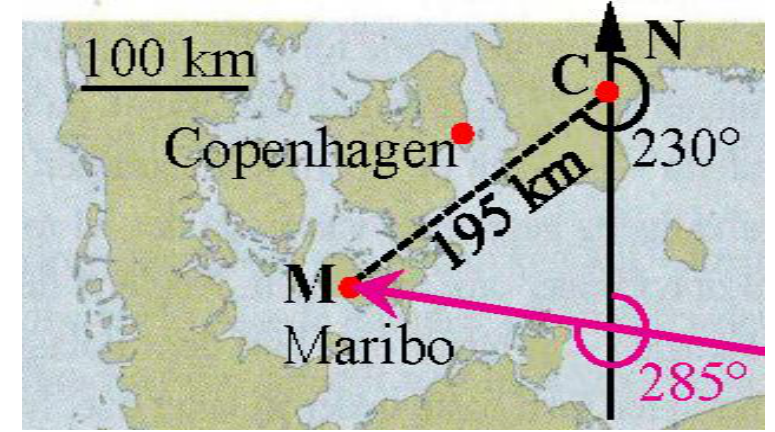
1.1 Use this and the data in Fig. 1.1 to calculate the average speed of Maribo in the time interval between frames 155 and 161. The curvature of the Earth and the gravitational force on the meteoroid can both be neglected. [1,3 т.]
Through the atmosphere and melting?
The friction from the air on a meteoroid moving in the higher atmosphere depends in a complicated way on the shape and velocity of the meteoroid, and on the temperature and density of the atmosphere. As a reasonable approximation the friction force in the upper atmosphere is given by the expression , where is a constant, the density of the atmosphere, the projected cross-section area of the meteorite, and its speed.
The following simplifying assumptions are made to analyze the meteoroid: The object entering the atmosphere was a sphere of mass , radius , temperature , and speed . The density of the atmosphere is constant (its value 40 km above the surface of the Earth), , and the friction coefficient is .
1.2a Estimate how long time after entering the atmosphere it takes the meteoroid to have its speed reduced by 10 % from to . You can neglect the gravitational force on the meteoroid and assume, that it maintains its mass and shape. [0,7 т.]
1.2b Calculate how many times larger the kinetic energy of the meteoroid entering the atmosphere is than the energy necessary for melting it completely (see data sheet). [0,3 т.]
Heating of Maribo during its fall in the atmosphere
When the stony meteoroid Maribo entered the atmosphere at supersonic speed it appeared as a fireball because the surrounding air was glowing. Nevertheless, only the outermost layer of Maribo was heated. Assume that Maribo is a homogenous sphere with density , specific heat capacity , and thermal conductivity (for values see the data sheet). Furthermore, when entering the atmosphere, it had the temperature . While falling through the atmosphere its surface temperature was constant due to the air friction, thus gradually heating up the interior.
After falling a time in the atmosphere, an outer shell of Maribo of thickness will have been heated to a temperature significantly larger than . This thickness can be estimated by dimensional analysis as the simple product of powers of the thermodynamic parameters: .
1.3a Determine by dimensional (unit) analysis the value of the four powers , and . [0,6 т.]
1.3b Calculate the thickness after a fall time , and determine the ratio . [0,4 т.]
The age of a meteorite
The chemical properties of radioactive elements may be different, so during the crystallization of the minerals in a given meteorite, some minerals will have a high content of a specific radioactive element and others a low content. This difference can be used to determine the age of a meteorite by radiometric dating of its radioactive minerals.
As a specific example, we study the isotope (element no. 37), which decays into the stable isotope (element no. 38) with a half-life of year, relative to the stable isotope . At the time of crystallization the ratio was identical for all minerals, while the ratio was different. As time passes on, the amount of decreases by decay, while consequently the amount of increases. As a result, the ratio will be different today. In Fig. 1.2(a), the points on the horizontal line refer to the ratio in different minerals at the time, when they are crystallized.
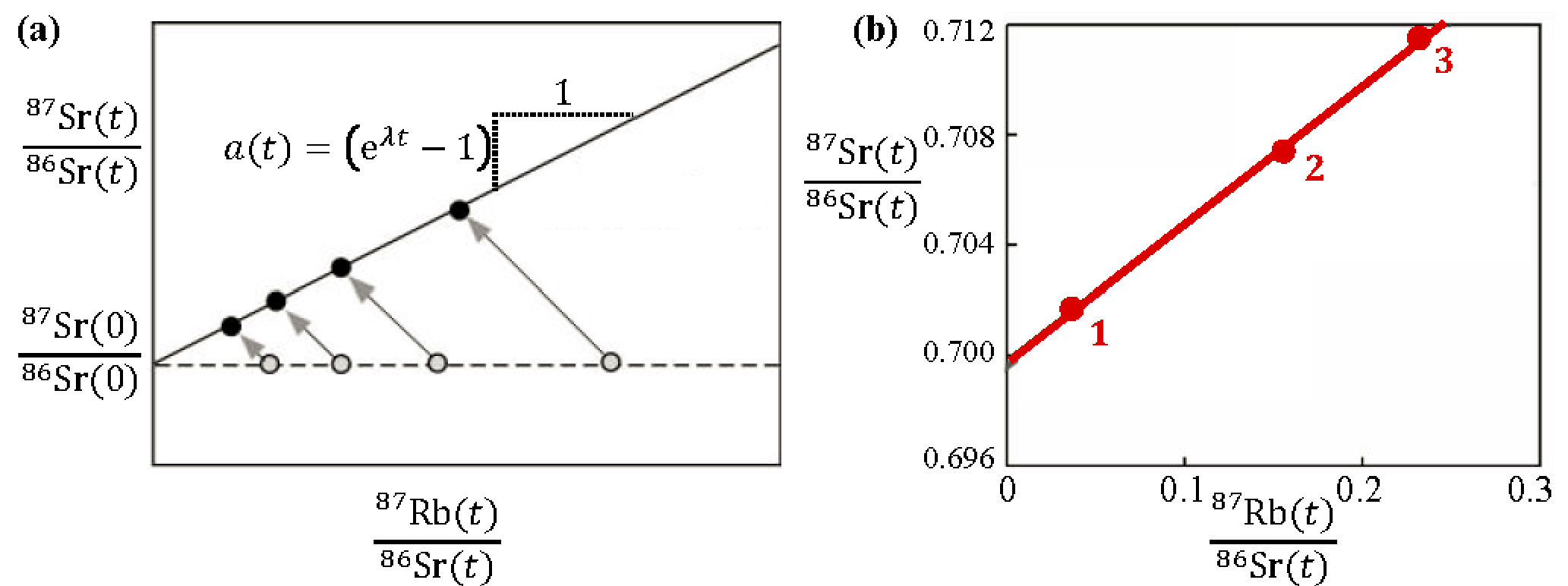
Figure 1.2 (a) The ratio in different minerals at the time of crystallization (open circles) and at present time (filled circles). (b) The isochron-line for three different mineral samples taken from a meteorite at present time.
1.4a Write down the decay scheme for the transformation of to . [0,3 т.]
1.4b Show that the present-time ratio plotted versus the present-time ratio in different mineral samples from the same meteorite forms a straight line, the so-called isochron-line, with slope . Here is the time since the formation of the minerals, while is the decay constant inversely proportional to half-life . [0,7 т.]
1.4c Determine the age of the meteorite using the isochron-line of Fig. 1.2(b). [0,4 т.]
Comet Encke, from which Maribo may originate
In its orbit around the Sun, the minimum and maximum distances between comet Encke and the Sun are and , respectively.
1.5 Calculate the orbital period of comet Encke. [0,6 т.]
Consequences of an asteroid impact on Earth
65 million years ago Earth was hit by a huge asteroid with density , radius , and final speed of . This impact resulted in the extermination of most of the life on Earth and the formation of the enormous Chicxulub Crater. Assume that an identical asteroid would hit Earth today in a completely inelastic collision, and use the fact that the moment of inertia of Earth is 0.83 times that for a homogeneous sphere of the same mass and radius. The moment of inertia of a homogeneous sphere with mass and radius is . Neglect any changes in the orbit of the Earth.
1.6a Let the asteroid hit the North Pole. Find the maximum change in angular orientation of the axis of Earth after the impact. [0,7 т.]
1.6b Let the asteroid hit the Equator in a radial impact. Find the change in the duration of one revolution of Earth after the impact. [0,7 т.]
1.6c Let the asteroid hit the Equator in a tangential impact in the equatorial plane. Find the change in the duration of one revolution of Earth after the impact. [0,7 т.]
Maximum impact speed
Consider a celestial body, gravitationally bound in the solar system, which impacts the surface of Earth with a speed . Initially the effect of the gravitational field of the Earth on the body can be neglected. Disregard the friction in the atmosphere, the effect of other celestial bodies, and the rotation of the Earth.
1.7 Calculate , the largest possible value of . [1,6 т.]
Отговори
1.1 28.6 km/s
1.2a 0.88 s
The alternative solution printed in the official solutions gives 0.87 s.
1.2b 210
1.3a
1.3b x(5 s) = 1.6 mm; x/RM = 0.012
1.4a
1.4c year
1.5 3.3 year
Printed also as 1.04 × 10⁸ s.
1.6a rad
1.6b 0.0000684 s
1.6c -0.00362 s
1.7 72.8 km/s
Решение
1.1 [1.3]
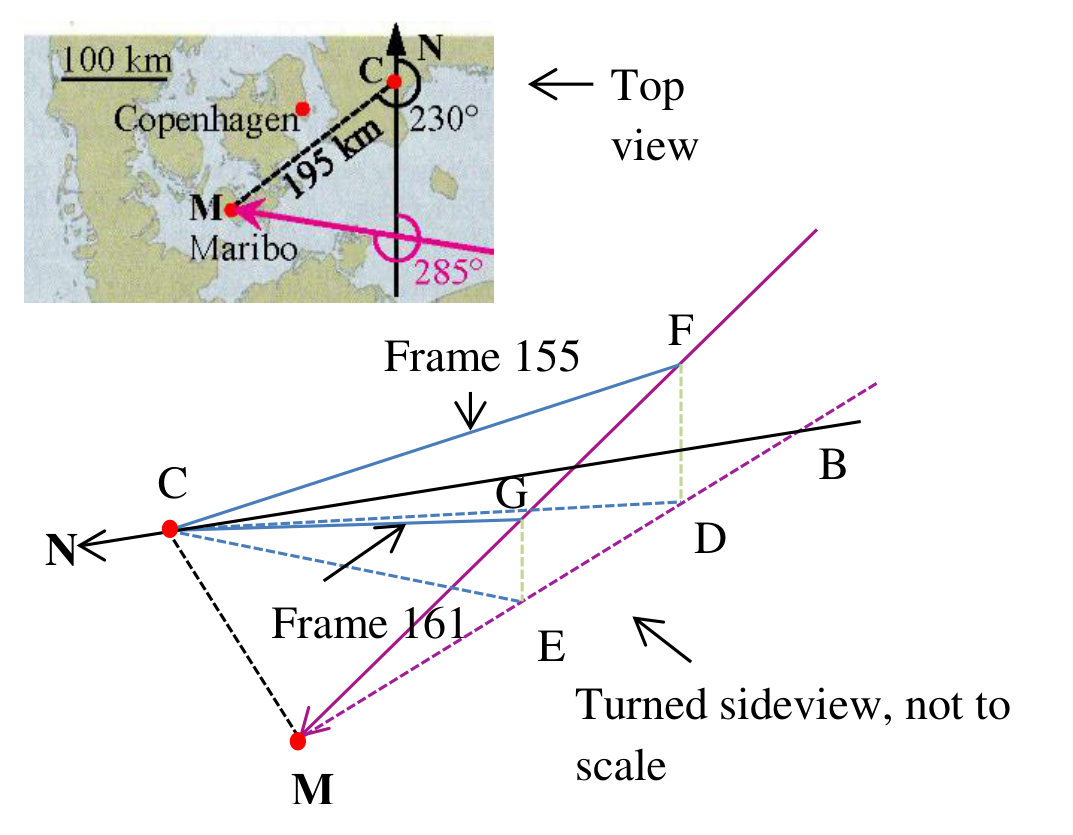
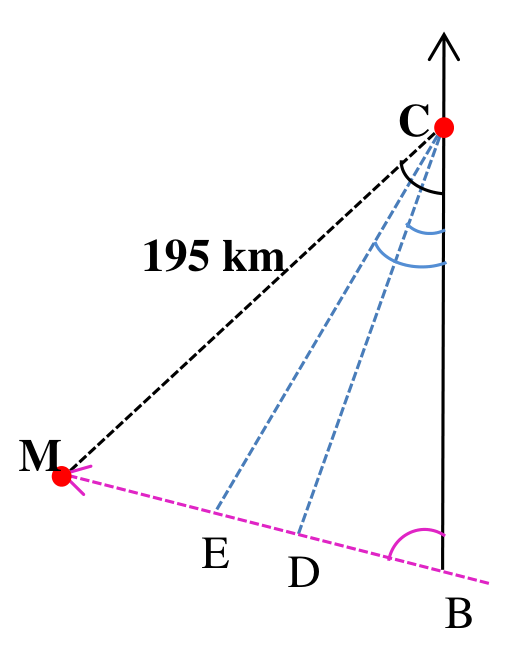
Top view: Triangle MBC: , , and , so .
Then .
Triangle DBC: , ,and , so .
Then .
Triangle EBC: , , and , so .
Then .
Triangle EDC: . Horizontal distance traveled by Maribo:
Side view: Triangle CDF:
Triangle CEG:
Thus vertical distance travelled by Maribo: .
Total distance travelled by Maribo from frame 155 to 161:
.
The speed of Maribo is
1.2a [0.7]
Newton's second law: yields .
By integration .
Alternative solution: The average force on the meteoroid when the speed decreases from to can be estimated to . Using that the acceleration is approximately constant, , results in .
1.2b [0.3]
1.3a [0.6]
, so .
Thus , , , and .
From which and .
1.3b [0.4]
.
1.4a [0.3]
Rb-Sr decay scheme:
1.4b [0.7]
and Rb→Sr: .
Thus , and dividing by we obtain the equation of a straight line:
1.4c [0.4]
Slope: and year.
So year .
1.5 [0.6]
Kepler's 3rd law on comet Encke and Earth, with the orbital semi-major axis of Encke given by . Thus .
1.6a [0.7]
For Earth around its rotation axis: Angular velocity .
Moment of inertia .
Angular momentum .
Asteroid: and angular momentum . is perpendicular to , so by conservation angular momentum: .The axis tilt (so the North Pole moves ).
1.6b [0.7]
At vertical impact so . Thus , and since we obtain . The change in rotation period is .
1.6c [0.7]
At tangential impact is parallel to so and thus .
1.7 [1.6]
Maximum impact speed arises from three contributions:
(I) The velocity of the body at distance (Earth orbit radius) from the Sun, .
(II) The orbital velocity of the Earth, .
(III) Gravitational attraction from the Earth and kinetic energy seen from the Earth: .
In conclusion: .
Total [9.0]