Plasmonic Steam Generator T2 · 7 юли 2013 г. · 12 т.
Условие
Introduction
In this problem we study an efficient process of steam production that has been demonstrated to work experimentally. An aqueous solution of spherical nanometer-sized silver spheres (nanoparticles) with only about 1013 particles per liter is illuminated by a focused light beam. A fraction of the light is absorbed by the nanoparticles, which are heated up and generate steam locally around them without heating up the entire water solution. The steam is released from the system in the form of escaping steam bubbles. Not all details of the process are well understood at present, but the core process is known to be absorption of light through the so-called collective electron oscillations of the metallic nanoparticles. The device is known as a plasmonic steam generator.
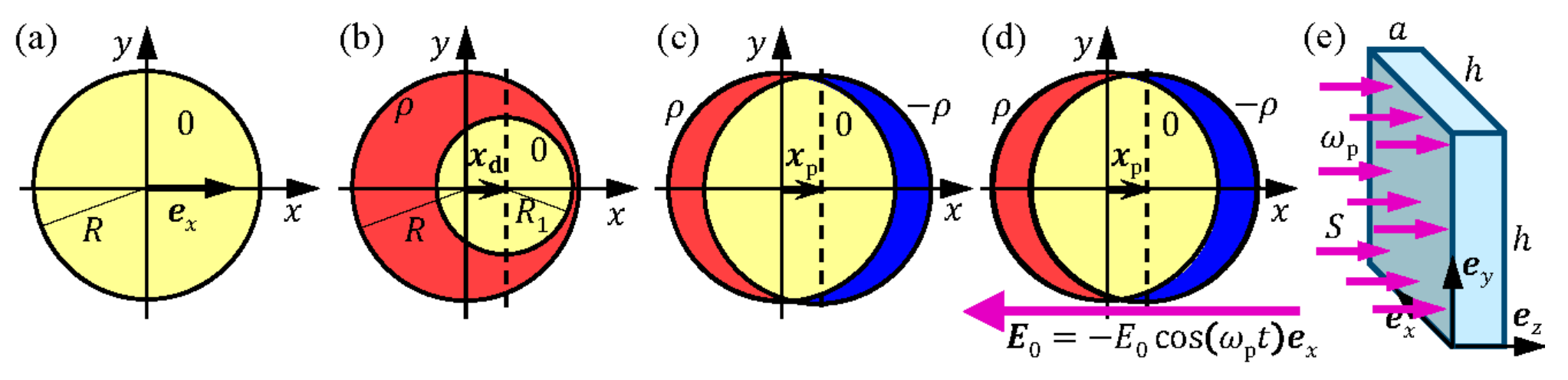
Figure 2.1(a) A spherical charge-neutral nanoparticle of radius R placed at the center of the coordinate system. (b) A sphere with a positive homogeneous charge density ρ (red), and containing a smaller spherical charge-neutral region (0, yellow) of radius R1, with its center displaced by xd=xdex. (c) The sphere with positive charge density ρ of the nanoparticle silver ions is fixed in the center of the coordinate system. The center of the spherical region with negative spherical charge density −ρ (blue) of the electron cloud is displaced by xp, where xp≪R. (d) An external homogeneous electric field E0=−E0ex. For time-dependent E0, the electron cloud moves with velocity v=dxp/dt. (e) The rectangular vessel (h×h×a) containing the aqueous solution of nanoparticles illuminated by monochromatic light propagating along the z-axis with angular frequency ωp and intensity S.
A single spherical silver nanoparticle
Throughout this problem we consider a spherical silver nanoparticle of radius R=10,0nm and with its center fixed at the origin of the coordinate system, see Fig. 2.1(a). All motions, forces and driving fields are parallel to the horizontal x-axis (with unit vector ex). The nanoparticle contains free (conduction) electrons moving within the whole nanoparticle volume without being bound to any silver atom. Each silver atom is a positive ion that has donated one such free electron.
2.1 Find the following quantities: The volume V and mass M of the nanoparticle, the number N and charge density ρ of silver ions in the particle, and for the free electrons their concentration n, their total charge Q, and their total mass m0. [0,7 т.]
The electric field in a charge-neutral region inside a charged sphere
For the rest of the problem assume that the relative dielectric permittivity of all materials is ε=1. Inside a charged sphere of homogeneous charge density ρ and radius R is created a small spherical charge-neutral region of radius R1 by adding the opposite charge density −ρ, with its center displaced by xd=xdex from the center of the R-sphere, see Fig. 2.1(b).
2.2 Show that the electric field inside the charge-neutral region is homogenous of the form E=A(ρ/ε0)xd, and determine the pre-factor A. [1,2 т.]
The restoring force on the displaced electron cloud
In the following, we study the collective motion of the free electrons, and therefore model them as a single negatively charged sphere of homogeneous charge density −ρ with a center position xp, which can move along the x-axis relative to the center of the positively charged sphere (silver ions) fixed at the origin of the coordinate system, see Fig. 2.1(c). Assume that an external force Fext displaces the electron cloud to a new equilibrium position xp=xpex with ∣xp∣≪R. Except for tiny net charges at opposite ends of the nanoparticle, most of its interior remains charge-neutral.
2.3 Express in terms of xp and n the following two quantities: The restoring force F exerted on the electron cloud and the work Wel done on the electron cloud during displacement. [1 т.]
The spherical silver nanoparticle in an external constant electric field
A nanoparticle is placed in vacuum and influenced by an external force Fext due to an applied static homogeneous electric field E0=−E0ex, which displaces the electron cloud the small distance ∣xp∣, where ∣xp∣≪R.
2.4 Find the displacement xp of the electron cloud in terms of E0 and n, and determine the amount −ΔQ of electron charge displaced through the yz-plane at the center of the nanoparticle in terms of n,R and xp. [0,6 т.]
The equivalent capacitance and inductance of the silver nanoparticle
For both a constant and a time-dependent field E0, the nanoparticle can be modeled as an equivalent electric circuit. The equivalent capacitance can be found by relating the work Wel, done on the separation of charges ΔQ, to the energy of a capacitor, carrying charge ±ΔQ. The charge separation will cause a certain equivalent voltage V0 across the equivalent capacitor.
2.5a Express the systems equivalent capacitance C in terms of ε0 and R, and find its value. [0,7 т.]
2.5b For this capacitance, determine in terms of E0 and R the equivalent voltage V0 that should be connected to the equivalent capacitor in order to accumulate the charge ΔQ. [0,4 т.]
For a time-dependent field E0, the electron cloud moves with velocity v=vex, Fig. 2.1(d). It has the kinetic energy Wkin and forms an electric current I flowing through the fixed yz-plane. The kinetic energy of the electron cloud can be attributed to the energy of an equivalent inductor of inductance L carrying the current I.
2.6a Express both Wkin and I in terms of the velocity v. [0,7 т.]
2.6b Express the equivalent inductance L in terms of particle radius R, the electron charge e and mass me, the electron concentration n, and calculate its value. [0,5 т.]
The plasmon resonance of the silver nanoparticle
From the above analysis it follows that the motion, arising from displacing the electron cloud from its equilibrium position and then releasing it, can be modeled by an ideal LC-circuit oscillating at resonance. This dynamical mode of the electron cloud is known as the plasmon resonance, which oscillates at the so-called angular plasmon frequency ωp.
2.7a Find an expression for the angular plasmon frequency ωp of the electron cloud in terms of the electron charge e and mass me, the electron density n, and the permittivity ε0. [0,5 т.]
2.7b Calculate ωp in rad/s and the wavelength λp in nm of light in vacuum having angular frequency ω=ωp. [0,4 т.]
The silver nanoparticle illuminated with light at the plasmon frequency
In the rest of the problem, the nanoparticle is illuminated by monochromatic light at the angular plasmon frequency ωp with the incident intensity S=21cε0E02=1.00MWm−2. As the wavelength is large, λp≫R, the nanoparticle can be considered as being placed in a homogeneous harmonically oscillating field E0=−E0cos(ωpt)ex. Driven by E0, the center xp(t) of the electron cloud oscillates at the same frequency with velocity v=dxp/dt and constant amplitude x0. This oscillating electron motion leads to absorption of light. The energy captured by the particle is either converted into Joule heating inside the particle or re-emitted by the particle as scattered light.
Joule heating is caused by random inelastic collisions, where any given free electron once in a while hits a silver ion and loses its total kinetic energy, which is converted into vibrations of the silver ions (heat). The average time between the collisions is τ≫1/ωp, where for silver nanoparticle we use τ=5.24×10⁻¹⁵s.
2.8a Find an expression for the time-averaged Joule heating power Pheat in the nanoparticle as well as the time-averaged current squared ⟨I2⟩, which includes explicitly the time-averaged velocity squared ⟨v2⟩ of the electron cloud. [1 т.]
2.8b Find an expression for the equivalent ohmic resistance Rheat in an equivalent resistor-model of the nanoparticle having the Joule heating power Pheat due to the electron cloud current I. Calculate the numerical value of Rheat. [1 т.]
The incident light beam loses some time-averaged power Pscat by scattering on the oscillating electron cloud (re-emission). Pscat depends on the scattering source amplitude x0, charge Q, angular frequency ωp and properties of the light (the speed of light c and permittivity ε0 in vacuum). In terms of these four variables, Pscat is given by Pscat=12πε0c3Q2x02ωp4.
2.9 By use of Pscat, find an expression of the equivalent scattering resistance Rscat (in analogy with Rheat) in an equivalent resistor-model, and calculate its value. [1 т.]
The above equivalent circuit elements are combined into an LCR series circuit model of the silver nanoparticle, which is driven by a harmonically oscillating equivalent voltage V=V0cos(ωpt) determined by the electric field E0 of the incident light.
2.10a Derive expressions for the time-averaged power losses Pheat and Pscat involving the amplitude E0 of the electric field in the incident light at the plasmon resonance ω=ωp. [1,2 т.]
2.10b Calculate the numerical value of E0, Pheat, and Pscat. [0,3 т.]
Steam generation by light
An aqueous solution of silver nanoparticles is prepared with a concentration nnp=7.3×10¹⁵m−3. It is placed inside a rectangular transparent vessel of size h×h×a=10×10×1.0cm3 and illuminated by light at the plasmon frequency with the same intensity S=1.00MWm−2 at normal incidence as above, see Fig. 2.1(e). The temperature of the water is Twa=20∘C and we assume, in fair agreement with observations, that in steady state all Joule heating of the nanoparticle goes to the production of steam of temperature Tst=110∘C, without raising the temperature of the water.
The thermodynamic efficiency η of the plasmonic steam generator is defined by the power ratio η=Pst/Ptot, where Pst is the power going into the production of steam in the entire vessel, while Ptot is the total power of the incoming light that enters the vessel.
Most of the time any given nanoparticle is surrounded by steam instead of water, and it can thus be described as being in vacuum.
2.11a Calculate the total mass per second μst of steam produced by the plasmonic steam generator during illumination by light at the plasmon frequency and intensity S. [0,6 т.]
2.11b Calculate the numerical value of the thermodynamic efficiency η of the plasmonic steam generator. [0,2 т.]
Отговори
2.1 V = 4.19 × 10⁻²⁴ m³; M = 4.39 × 10⁻²⁰ kg; N = 2.45 × 10⁵; ρ = 9.38 × 10⁹ C m⁻³; n = 5.85 × 10²⁸ m⁻³; Q = 3.93 × 10⁻¹⁴ C; m0 = 2.23 × 10⁻²⁵ kg
Volume of the nanoparticle: V=34πR3=4.19×10⁻²⁴m3.
Mass of the nanoparticle: M=VρAg=4.39×10⁻²⁰kg.
Number of ions in the nanoparticle: N=NAMAgM=2.45×10⁵.
Charge density ρ=VeN=9.38×10⁹Cm−3, charge density ρ=en.
Electrons’ concentration n=VN=5.85×1028m−3.
Total charge of free electrons Q=eN=3.93×10⁻¹⁴C.
Total mass of free electrons m0=meN=2.23×10⁻²⁵kg.
The electric field in a charge-neutral region inside a charged sphere
2.2 [1.2]
For a sphere with radius R and constant charge density ρ, for any point inside the sphere designated by radius-vector r=rer(r<R) Gauss's law yields directly 4πr2ε0E+=34πr3ρer, where er is the unit radial vector pointing away from the center of the sphere. Thus, E+=3ε0ρr.
Likewise, inside another sphere of radius R1 and charge density −ρ the field is E−=3ε0−ρr′, where r′ is the radius-vector of the point in the coordinate system with the origin in the center of this sphere.
Superposition of the two charge configurations gives the setup we want with r′=r−xd. So inside the charge-free region ∣r−xp∣<R1 the field is E=E++E−=3ε0ρr+3ε0−ρ(r−xd) or E=3ε0ρxd with pre-factor A=31
The restoring force on the displaced electron cloud
2.3 [1.0]
With xp=xpex and xp≪R we have from above that approximately the field induced inside the particle is Eind=3ε0ρxp. The number of electrons on the particle’s border that produced Eind is negligibly smaller than the number of electrons inside the particle, so F≅QEind=(−eN)3ε0ρxp=−9ε04πR3e2n2xpex (note the antiparallel attractive force is proportional to the displacement that it is similar to Hooke’s law).
The work done on the electron cloud to shift it is Wel=−∫0xpF(x′)dx′=21(9ε04πR3e2n2)xp2
The spherical silver nanoparticle in an external constant electric field
2.4 [0.6]
Inside the metallic particle in the steady state the electric field must be equal to 0. The induced field (from 2.2 or 2.3) compensates the external field: E0+Eind=0, so xp=ρ3ε0E0=en3ε0E0.
Charge displaced through the yz-plane is the total charge of electrons in the cylinder of radius R and height xp: −ΔQ=−ρπR2xp=−πR2nexp.
The equivalent capacitance and inductance of the silver nanoparticle
2.5a [0.7]
The electric energy Wel of a capacitor with capacitance C holding charges ±ΔQ is Wel=2CΔQ2. The energy of such capacitor is equal to the work (see 2.3) done to separate the charges (see 2.4), thus C=2WelΔQ2=49ε0πR=6.26×10⁻¹⁹F.
2.5b [0.4]
Equivalent scheme for a capacitor reads: ΔQ=CV0. Combining charge from (2.4) and capacitance from (2.5a) gives V0=CΔQ=34RE0.
2.6a [0.7]
The kinetic energy of the electron cloud is defined as the kinetic energy of one electron multiplied by the number of electrons in the cloud Wkin=21mev2N=21mev2(34πR3n).
The current I is the charge of electrons in the cylinder of area πR2 and height vΔt divided by time Δt (or simply the time derivative of charge −ΔQ), thus I=−envπR2.
2.6b [0.5]
The energy carried by current I in the equivalent circuit with inductance L is W=21LI2 is, in fact, the kinetic energy of electrons Wkin. Taking the energy and current from (2.6a) gives L=3πRne24me=2.57×10⁻¹⁴H.
The plasmon resonance of the silver nanoparticle
2.7a [0.5]
From the LC-circuit analogy we can directly derive ωp=(LC)−1/2=ne2/3ε0me. Alternatively it is possible to use the harmonic law of motion in (2.3) and get the same result for the frequency.
2.7b [0.4]
ωp=7.88×10¹⁵ rad/s, for light with angular frequency ω=ωp the wavelength is λp=2πc/ωp=239nm.
The silver nanoparticle illuminated with light at the plasmon frequency
2.8a [1.0]
The velocity of an electron v=dtdx=−ωx0sinωt=v0sinωt. The time-averaged kinetic energy on the electron ⟨Wk⟩=⟨2mev2⟩=2me⟨v2⟩. During time τ each electron hits an ion one time. So the energy lost in the whole nanoparticle during time τ is Wheat=N⟨2mev2⟩=34πR3n⟨2mev2⟩. Time-averaged Joule heating power
Pheat=τ1Wkin=2τ1me⟨v2⟩(34πR3n).
The expression for current is taken from (2.6a), squared and averaged
⟨I2⟩=(enπR2)2⟨v2⟩=(4R3Q)2⟨v2⟩.
2.8b [1.0]
The average time between the collisions is τ≫1/ωp, so each electron oscillates many times before it collides with an ion. The oscillating current I=I0sinωt=πR2nev0sinωt produces the heat in the resistance Rheat equal to Pheat=Rheat⟨I2⟩, that together with results from (2.8a) leads to Rheat=τ⟨I2⟩Wkin=3πne2Rτ2me=2.46Ω.
2.9 [1.0]
For equivalent scattering resistance Rscat=⟨I2⟩Pscat and for harmonic oscillations we can average the velocity squared over one period of oscillations, so ⟨v2⟩=21ωp2x02. Together it yields Rscat=12πε0c3Q2x02ωp49Q2⟨v2⟩16R2=27πε0c38ω02R2=2.45Ω.
2.10a [1.2]
Ohm’s law for a LCR serious circuit is I0=(Rheat+Rscat)2+(ωL−ωC1)2V0. At the resonance frequency time-averaged voltage squared is ⟨V2⟩=ZR2⟨I2⟩=(Rheat+Rscat)2⟨I2⟩. And from (2.5b) ⟨V2⟩=21V02=98R2E02, so Ohm’s law results in ⟨I2⟩=9(Rheat+Rscat)28R2E02.
The time-averaged power losses are Pheat=Rheat⟨I2⟩=9(Rheat+Rscat)28RheatR2E02 and
Starting with the electric field amplitude E0=2S/(ε0c)=27.4kV/m, we calculate Pheat=6.82nW and Pscat=6.81nW.
Steam generation by light
2.11a [0.6]
Total number of nanoparticles in the vessel: Nnp=h2annp=7.3×10¹¹. Then the total time-averaged Joule heating power: Pst=NnpPheat=4.98kW. This power goes into the steam generation: Pst=μstLtot, with Ltot=cwa(T100−Twa)+Lwa+cst(Tst−T100)=2.62×10⁶Jkg−1. Thus the mass of steam produced in one second is: μst=LtotPst=1.90×10⁻³kgs−1.
2.11b [0.2]
The power of light incident on the vessel Ptot=h2S=0.01m2×1MWm−2=10.0kW, and the power directed for steam production by nanoparticles is given in 2.11a. Efficiency of the process is η=PtotPst=10.0kW4.98kW=0.498.