IPhO 2014, Теория — Задача 1. Problem 1
Theoretical competition. Tuesday, 15 July 2014 · 9 т.
Условие
This problem consists of three independent parts.
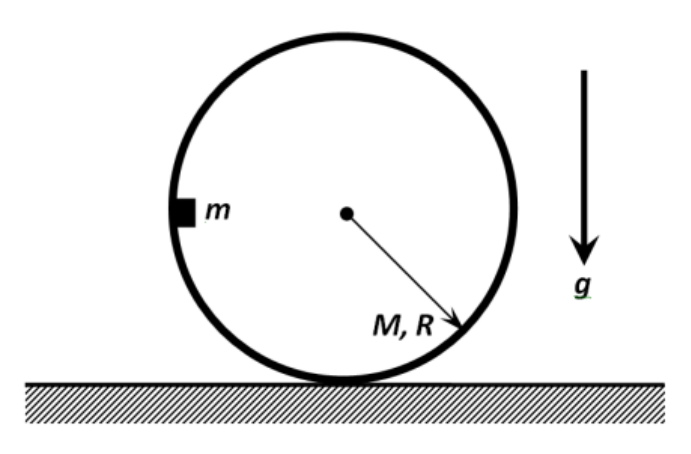
Part A A small puck of mass is carefully placed onto the inner surface of the thin hollow thin cylinder of mass and of radius . Initially, the cylinder rests on the horizontal plane and the puck is located at the height above the plane as shown in the figure on the left. Find the interaction force between the puck and the cylinder at the moment when the puck passes the lowest point of its trajectory. Assume that the friction between the puck and the inner surface of the cylinder is absent, and the cylinder moves on the plane without slipping. The free fall acceleration is . [3 т.]
Part B A bubble of radius , containing a diatomic ideal gas, has the soap film of thickness and is placed in vacuum. The soap film has the surface tension and the density . 1) Find formula for the molar heat capacity of the gas in the bubble for such a process when the gas is heated so slowly that the bubble remains in a mechanical equilibrium and evaluate it; 2) Find formula for the frequency of the small radial oscillations of the bubble and evaluate it under the assumption that the heat capacity of the soap film is much greater than the heat capacity of the gas in the bubble. Assume that the thermal equilibrium inside the bubble is reached much faster than the period of oscillations.
Hint: Laplace showed that there is pressure difference between inside and outside of a curved surface, caused by surface tension of the interface between liquid and gas, so that . [3 т.]
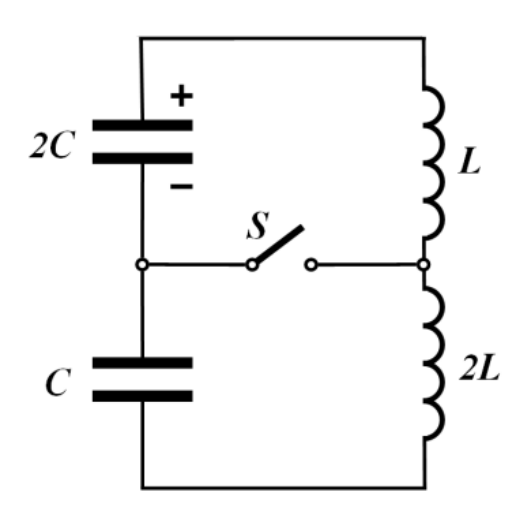
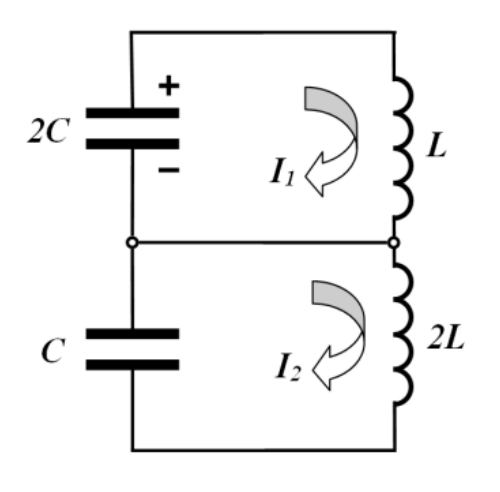
Part C Initially, a switch is unshorted in the circuit shown in the figure on the right, a capacitor of capacitance carries the electric charge , a capacitor of capacitance is uncharged, and there are no electric currents in both coils of inductance and , respectively. The capacitor starts to discharge and at the moment when the current in the coils reaches its maximum value, the switch is instantly shorted. Find the maximum current through the switch thereafter. [3 т.]
Отговори
- Part A
- Part B
- Part C
Решение
Part A
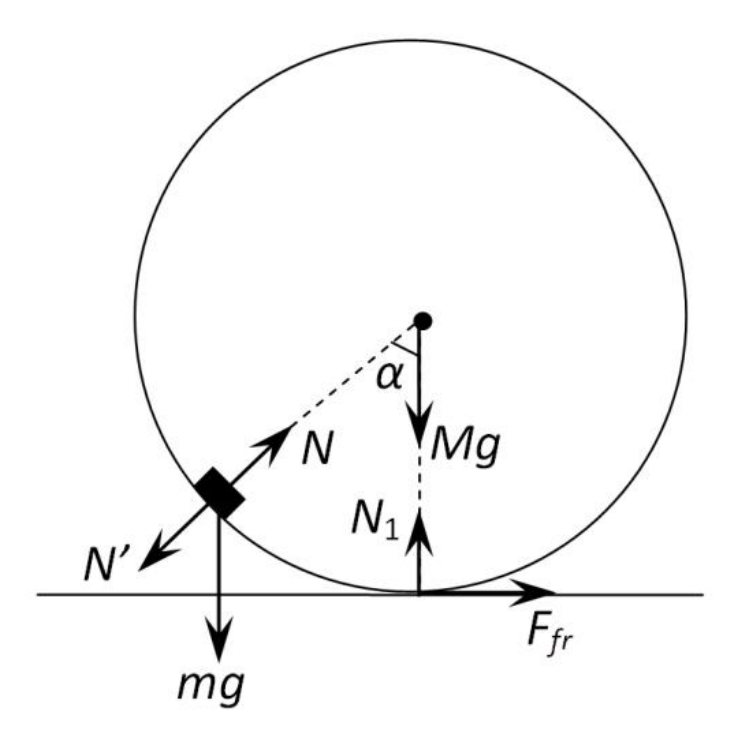
Consider the forces acting on the puck and the cylinder and depicted in the figure on the right. The puck is subject to the gravity force and the reaction force from the cylinder . The cylinder is subject to the gravity force , the reaction force from the plane , the friction force and the pressure force from the puck . The idea is to write the horizontal projections of the equations of motion. It is written for the puck as follows
where is the horizontal projection of the puck acceleration.
For the cylinder the equation of motion with the acceleration is found as
Since the cylinder moves along the plane without sliding its angular acceleration is obtained as
Then the equation of rotational motion around the center of mass of the cylinder takes the form
where the inertia moment of the hollow cylinder is given by
Solving (A.2)-(A.5) yields
From equations (A.1) and (A.6) it is easily concluded that
Since the initial velocities of the puck and of the cylinder are both equal to zero, then, it follows from (A.7) after integrating that
It is obvious that the conservation law for the system is written as
where the angular velocity of the cylinder is found to be
since it does not slide over the plane.
Solving (A.8)-(A.10) results in velocities at the lowest point of the puck trajectory written as
In the reference frame sliding progressively along with the cylinder axis, the puck moves in a circle of radius and, at the lowest point of its trajectory, have the velocity
and the acceleration
At the lowest point of the puck trajectory the acceleration of the cylinder axis is equal to zero, therefore, the puck acceleration in the laboratory reference frame is also given by (A.15).
then the interaction force between the puck and the cylinder is finally found as
Part B
- According to the first law of thermodynamics, the amount of heat transmitted to the gas in the bubble is found as
where the molar heat capacity at arbitrary process is as follows
Here stands for the molar heat capacity of the gas at constant volume, designates its pressure, is the total amount of moles of gas in the bubble, and denote the volume and temperature of the gas, respectively.
Evaluate the derivative standing on the right hand side of (B.2). According to the Laplace formula, the gas pressure inside the bubble is defined by
thus, the equation of any equilibrium process with the gas in the bubble is a polytrope of the form
The equation of state of an ideal gas has the form
and hence equation (B.4) can be rewritten as
Differentiating (B.6) the derivative with respect to temperature sought is found as
Taking into account that the molar heat capacity of a diatomic gas at constant volume is
and using (B.5) it is finally obtained that
- Since the heat capacity of the gas is much smaller than the heat capacity of the soap film, and there is heat exchange between them, the gas can be considered as isothermal since the soap film plays the role of thermostat. Consider the fragment of soap film, limited by the angle as shown in the figure. It's area is found as
and the corresponding mass is obtained as
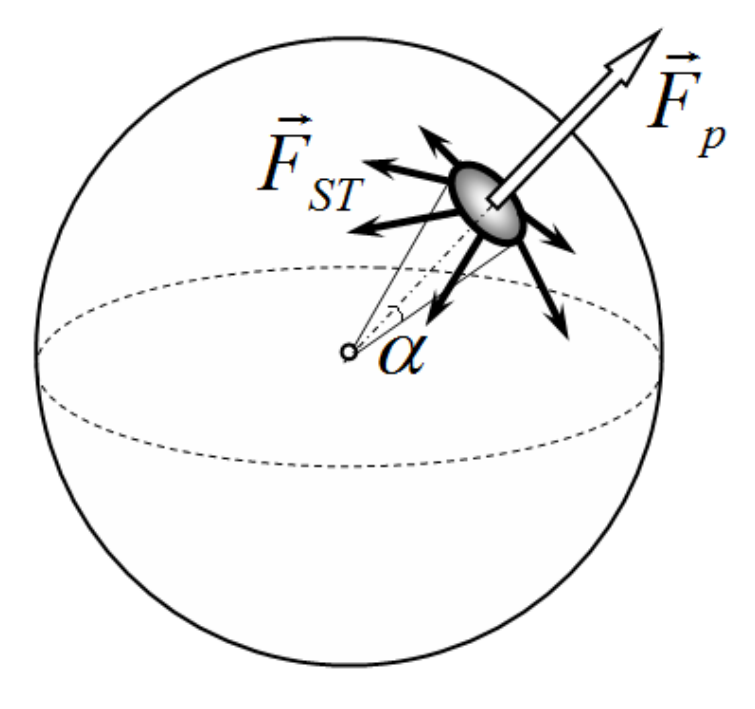
Let be an increase in the radius of the bubble, then the Newton second law for the fragment of the soap film mentioned above takes the form
where denotes the projection of the resultant surface tension force acting in the radial direction, stands for the gas pressure beneath the surface of the soap film and
is easily found as
Since the gaseous process can be considered isothermal, it is written that
Assuming that the volume increase is quite small, (B.14) yields
Thus, from (B.10) - (B.16) and (B.3) the equation of small oscillations of the soap film is derived as
with the frequency
Part C
The problem can be solved in different ways. Herein several possible solutions are considered.
Method 1. Direct approach
At the moment when the current in the coils is a maximum, the total voltage across the coils is equal to zero, so the capacitor voltages must be equal in magnitude and opposite in polarity. Let be a voltage on the capacitors at the time moment just mentioned and be that maximum current. According to the law of charge conservation
thus,
Then, from the energy conservation law
the maximum current is found as
After the key is shortened there will be independent oscillations in both circuits with the frequency
and their amplitudes are obtained from the corresponding energy conservation laws written as
Hence, the corresponding amplitudes are found as
Choose the positive directions of the currents in the circuits as shown in the figure on the right. Then, the current flowing through the key is written as follows
The currents depend on time as
The constants can be determined from the initial values of the currents and their amplitudes by putting down the following set of equations
Solving (C1.13)-(C1.16) it is found that
The sign in is chosen negative, since at the time moment of the key shortening the current in the coil decreases.
Thus, the dependence of the currents on time takes the following form
In accordance with (C.10), the current in the key is dependent on time according to
Hence, the amplitude of the current in the key is obtained as
Method 2. Vector diagram
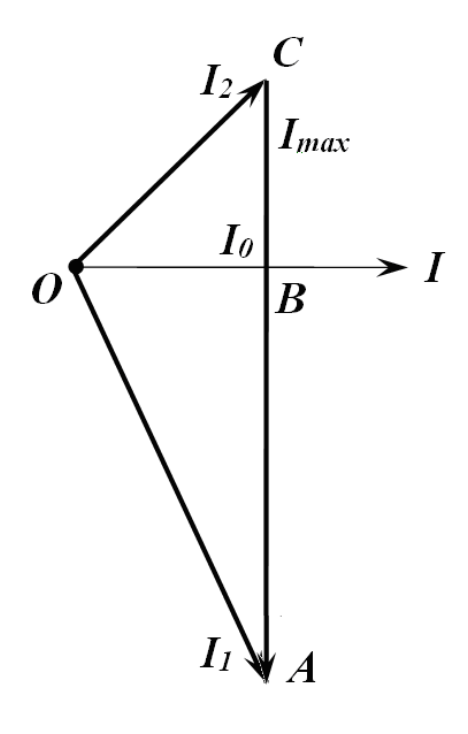
Instead of determining the coefficients the vector diagram shown in the figure on the right can be used. The segment represents the current sought and its projection on the current axis is zero at the time of the key shortening. The current in the coil of inductance grows at the same time moment because the capacitor continues to discharge, thus, this current is depicted in the figure by the segment . The current in the coil of inductance decreases at the time of the key shortening since it continues to charge the capacitor , that is why this current is depicted in the figure by the segment .
It is known for above that . Hence, it is found from the Pythagorean theorem that
Thus, the current sought is found as
Method 3. Heuristic approach
It is clear that the current through the key performs harmonic oscillations with the frequency
and it is equal to zero at the time of the key shortening, i.e.
Since the current is equal to zero at the time of the key shortening, then the current amplitude is equal to the current derivative at this time moment divided by the oscillation frequency. Let us find that current derivative. Let the capacitor of capacitance have the charge . Then the charge on the capacitor of capacitance is found from the charge conservation law as
After shortening the key the rate of current change in the coil of inductance is obtained as
whereas in the coil of inductance it is equal to
Since the voltage polarity on the capacitors are opposite, then the current derivative with respect to time finally takes the form
Note that this derivative is independent of the time of the key shortening!
Hence, the maximum current is found as
and it is independent of the time of the key shortening!