IPhO 2014, Теория — Задача 2. Van der Waals equation of state
Theoretical competition. Tuesday, 15 July 2014 · 15 юли 2014 г. · 11 т.
Условие
Problem 2. Van der Waals equation of state (11 points)
In a well-known model of an ideal gas, whose equation of state obeys the Clapeyron-Mendeleev law, the following important physical effects are neglected. First, molecules of a real gas have a finite size and, secondly, they interact with one another. In all parts of this problem one mole of water is considered.
Part A. Non-ideal gas equation of state (2 points)
Taking into account the finite size of the molecules, the gaseous equation of state takes the form
where stands for the gas pressure, its volume per mole and temperature, respectively, denotes the universal gas constant, and is a specific constant extracting some volume.
A1 Estimate and express it in terms of the diameter of the molecules . [0,3 т.]
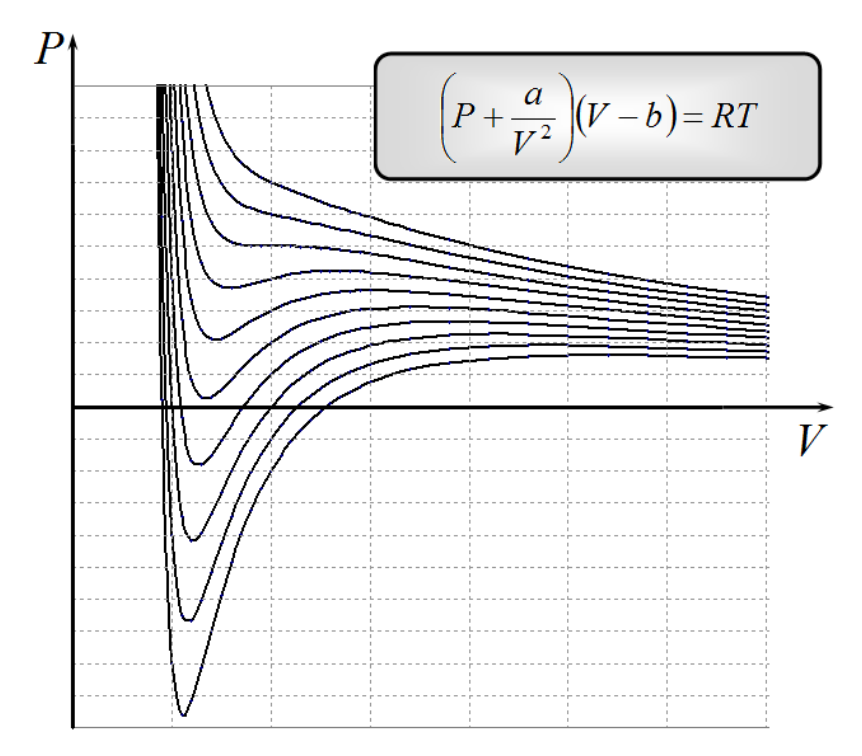
With account of intermolecular attraction forces, van der Waals proposed the following equation of state that neatly describes both the gaseous and liquid states of matter
where is another specific constant.
At temperatures below a certain critical value the isotherm of equation (2) is well represented by a non-monotonic curve 1 shown in Figure 1 which is then called van der Waals isotherm. In the same figure curve 2 shows the isotherm of an ideal gas at the same temperature. A real isotherm differs from the van der Waals isotherm by a straight segment drawn at some constant pressure . This straight segment is located between the volumes and , and corresponds to the equilibrium of the liquid phase (indicated by ) and the gaseous phase (referred to by ). From the second law of thermodynamics J. Maxwell showed that the pressure must be chosen such that the areas I and II shown in Figure 1 must be equal.
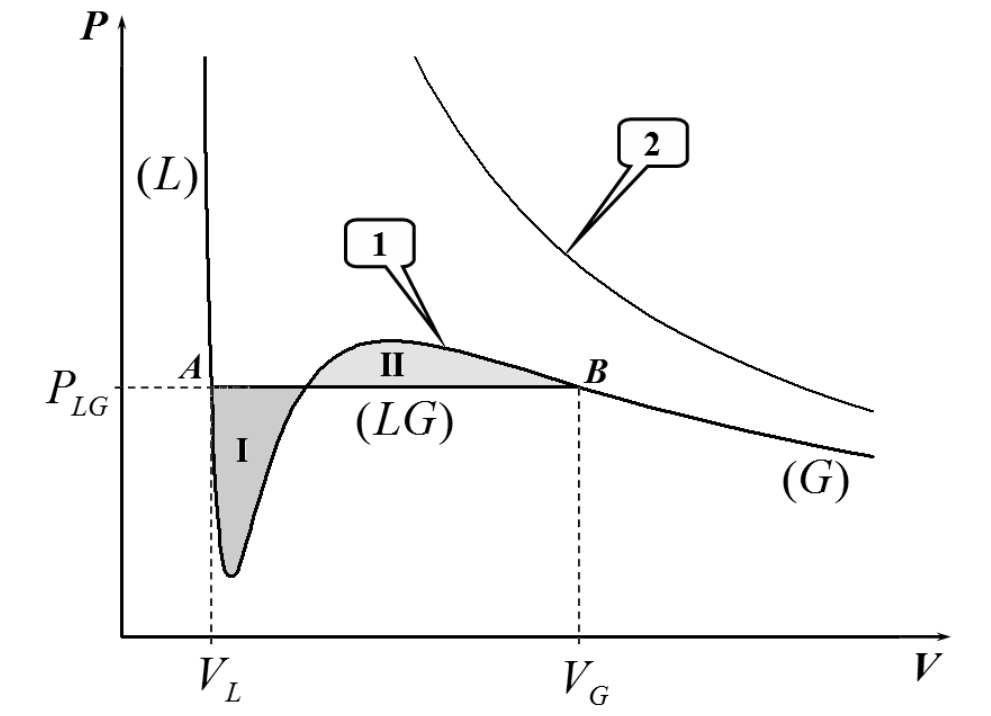
With increasing temperature the straight segment on the isotherm shrinks to a single point when the temperature and the pressure reaches some values and , respectively. The parameters and are called critical and can be measured experimentally with high degree of accuracy.
A2 Express the van der Waals constants and in terms of and . [1,3 т.]
A3 For water and . Calculate and for water. [0,2 т.]
A4 Estimate the diameter of water molecules . [0,2 т.]
Part B. Properties of gas and liquid (6 points)
This part of the problem deals with the properties of water in the gaseous and liquid states at temperature . The saturated vapor pressure at this temperature is known to be , and the molar mass of water is .
Gaseous state
It is reasonable to assume that the inequality is valid for the description of water properties in a gaseous state.
B1 Derive the formula for the volume and express it in terms of , and . [0,8 т.]
Almost the same volume can be approximately evaluated using the ideal gas law.
B2 Evaluate in percentage the relative decrease in the gas volume due to intermolecular forces, . [0,3 т.]
If the system volume is reduced below , the gas starts to condense. However, thoroughly purified gas can remain in a mechanically metastable state (called supercooled vapor) until its volume reaches a certain value .
The condition of mechanical stability of supercooled gas at constant temperature is written as: .
B3 Find and evaluate how many times the volume of water vapor can be reduced and still remains in a metastable state. In other words, what is ? [0,7 т.]
Liquid state
For the van der Waals’ description of water in a liquid state it is reasonable to assume that the following inequality holds .
B4 Express the volume of liquid water in terms of , and . [1 т.]
Assuming that , find the following characteristics of water. Do not be surprised if some of the data evaluated do not coincide with the well-known tabulated values!
B5 Express the liquid water density in some of the terms of and evaluate it. [0,5 т.]
B6 Express the volume thermal expansion coefficient in terms of , and evaluate it. [0,6 т.]
B7 Express the specific heat of water vaporization in terms of and evaluate it. [1,1 т.]
B8 Considering the monomolecular layer of water, estimate the surface tension of water. [1,2 т.]
Part C. Liquid-gas system (3 points)
From Maxwell’s rule (equalities of areas, by applying trivial integration) and the van der Waals’ equation of state together with the approximations made in Part B, it can be shown that the saturated vapor pressure depends on temperature as follows
where and are some constants, that can be expressed in terms of and as
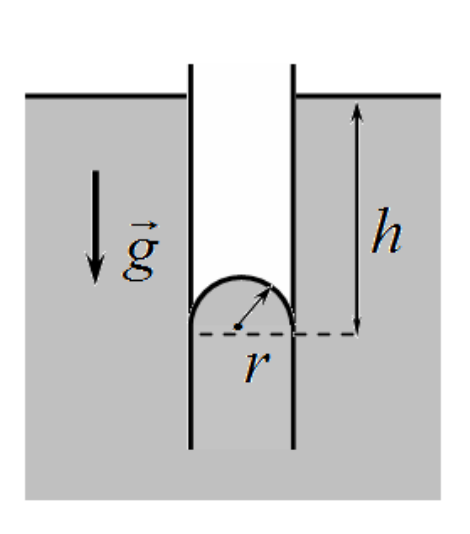
W. Thomson showed that the pressure of saturated vapor depends on the curvature of the liquid surface. Consider a liquid that does not wet the material of a capillary (contact angle 180°). When the capillary is immersed into the liquid, the liquid in the capillary drops to a certain level because of the surface tension (see Figure 3).
C1 Find a small change in pressure of the saturated vapor over the curved surface of liquid and express it in terms of the vapor density , the liquid density , the surface tension and the radius of surface curvature . [1,3 т.]
Metastable states, considered in part B3, are widely used in real experimental setups, such as the cloud chamber designed for registration of elementary particles. They also occur in natural phenomena such as the formation of morning dew. Supercooled vapor is subject to condensation by forming liquid droplets. Very small droplets evaporate quickly but large enough ones can still grow.
C2 Suppose that at the evening temperature of the water vapor in the air was saturated, but in the morning the ambient temperature has fallen by a small amount of . Assuming that the vapor pressure has remained unchanged, estimate the minimum radius of droplets that can grow. Use the tabulated value of water surface tension . [1,7 т.]
Отговори
A1
A2
A3
A4 m
The official solution also rounds the result to ≈ 4·10⁻¹⁰ m.
B1
B2 0.58 %
B3 86
B4
B5
B6
B7
B8
C1
C2
Решение
Problem 2. Van der Waals equation of state
Solution
Part A. Non-ideal gas equation of state
A1. If is substituted into the equation of state, then the gas pressure turns infinite. It is obvious that this is the moment when all the molecules are tightly packed. Therefore, the parameter is approximately equal to the volume of all molecules, i.e.
A2. In the most general case the van der Waals equation of state can be rewritten as
Since at the critical values of the gas parameters the straight line disappears, then, the solution of (A2.1) must have one real triple root, i.e. it can be rewritten as follows
Comparing the coefficients of expression (A2.1) and (A2.2), the following set of equations is obtained
Solution to the set (A2.3) is the following formulas for the van der Waals coefficients
Alternative solution
The critical parameters are achieved in the presence of an inflection point in the isotherm, at which the first and second derivatives are both zero. Therefore, they are defined by the following conditions
and
Thus, the following set of equations is obtained
which has the same solution (A2.4) and (A2.5).
A3. Numerical calculations for water produce the following result
A4. From equations (A1.4) and (A3.2) it is found that
Part B. Properties of gas and liquid
B1. Using the inequality , the van der Waals equation of state can be written as
which has the following solutions
Smaller root in (B1.2) gives the volume in an unstable state on the rising branch of the van der Waals isotherm. The volume of gas is given by the larger root, since at an expression for the volume of an ideal gas should be obtained, i.e.
For given values of the parameters the value . It can therefore be assumed that , then (B1.3) takes the form
B2. For an ideal gas
hence,
B3. Mechanical stability of a thermodynamic system is in power provided that
The minimum volume, in which the matter can still exist in the gaseous state, corresponds to a point in which
Using the van der Waals equation of state (B3.2) is written as
From (B3.2) and (B3.3), and with the help of , it is found that
Thus,
B4. Using the inequality , the van der Waals equation of state is written as
whose solution is
In this case, the smaller root should be taken, since at the liquid volume must be obtained according to (B4.1), i.e.
B5. Since (B4.3) gives the volume of the one mole of water its mass density is easily found as
B6. In accordance with (B4.3) the volume thermal expansion coefficient is derived as
B7. The heat, required to convert the liquid to gas, is used to overcome the intermolecular forces that create negative pressure , therefore,
and using , (B7.1) yields
B8. Consider some water of volume . To make a monolayer of thickness out of it, the following work must be done
Fabrication of the monomolecular layer may be interpreted as the evaporation of an equivalent volume of water which requires the following amount of heat
where the mass is given by
Using (A4.1a), (B5.1) and (B7.2), one finally gets
Part C. Liquid-gas systems
C1. At equilibrium, the pressure in the liquid and gas should be equal at all depths. The pressure in the fluid at the depth is related to the pressure of saturated vapor above the flat surface by
The surface tension creates additional pressure defined by the Laplace formula as
The same pressure in the fluid at the depth depends on the vapor pressure over the curved liquid surface and its radius of curvature as
Furthermore, the vapor pressure at different heights are related by
Solving (C1.1)-(C1.4), it is found that
Hence, the pressure difference sought is obtained as
Note that the vapor pressure over the convex surface of the liquid is larger than the pressure above the flat surface.
C2. Let be vapor pressure at a temperature , and be vapor pressure at a temperature . In accordance with equation (3) from problem statement, when the ambient temperature falls by an amount of the saturated vapor pressure changes by an amount
In accordance with the Thomson formula obtained in part C1, the pressure of saturated vapor above the droplet increases by the amount of . While a droplet is small in size, the vapor above its surface remains unsaturated. When a droplet has grown up to a certain minimum size, the vapor above its surface turns saturated.
Since the pressure remains unchanged, the following condition must hold
Assuming the vapor is almost ideal gas, its density can be found as
From equations (C2.1)-(C2.3), (B5.1) and (C1.6) one finds
Thus, it is finally obtained that