IPhO 2014, Теория — Задача 3. Simplest model of gas discharge
Problem 3: Simplest model of gas discharge · 10 т.
Внимание: Бележка към темата
The question prints b in the prose defining mobility after v=βE; that distinction is retained. The official solution’s (B1.3) middle expression and B6 reference to (B5.1) are retained as printed. The extra B7 belongs only to the presentation, not the scored competition paper. The archive item “3 copy.pdf” is not a readable PDF; the complete 3.pdf and 3_sol.pdf were used.
Theoretical competition
Tuesday, 15 July 2014 — 45th IPhO, Kazakhstan–Astana.
Условие
An electric current flowing through a gas is called a gas discharge. There are many types of gas discharges including glow discharge in lighting lamps, arc discharge in welding and the well known spark discharge that occurs between the clouds and the earth in the form of lightning.
Part A. Non-self-sustained gas discharge (4,8 т.)
In this part of the problem the so-called non-self-sustained gas discharge is studied. To maintain it a permanent operation an external ionizer is needed, which creates pairs of singly ionized ions and free electrons per unit volume and per unit time uniformly in the volume.
When an external ionizer is switched on, the number of electrons and ions starts to grow. Unlimited increase in the number densities of electrons and ions in the gas is prevented by the recombination process in which a free electron recombines with an ion to form a neutral atom. The number of recombining events that occurs in the gas per unit volume and per unit time is given by
where is a constant called the recombination coefficient, and denote the electron and ion number densities, respectively.
Suppose that at time the external ionizer is switched on and the initial number densities of electrons and ions in the gas are both equal to zero. Then, the electron number density depends on time as follows:
where and are some constants, and stands for the hyperbolic tangent.
A1 Find and express them in terms of and . [1,8 т.]
Assume that there are two external ionizers available. When the first one is switched on, the electron number density in the gas reaches its equilibrium value of be . When the second external ionizer is switched on, the electron number density reaches its equilibrium value of .
A2 Find the electron number density at equilibrium when both external ionizers are switched on simultaneously. [0,6 т.]
Attention! In what follows it is assumed that the external ionizer is switched on for quite long period of time such that all processes have become stationary and do not depend on time. Completely neglect the electric field due the charge carriers.
Assume that the gas fills in the tube between the two parallel conductive plates of area separated by the distance from each other. The voltage is applied across the plates to create an electric field between them. Assume that the number densities of both kinds of charge carriers remain almost constant along the tube.
Assume that both the electrons (denoted by the subscript ) and the ions (denoted by the subscript ) acquire the same ordered speed due to the electric field strength found as
where is a constant called charge mobility.
A3 Express the electric current in the tube in terms of and which is the elementary charge. [1,7 т.]
A4 Find the resistivity of the gas at sufficiently small values of the voltage applied and express it in terms of and . [0,7 т.]
Part B. Self-sustained gas discharge (5,2 т.)
In this part of the problem the ignition of the self-sustained gas discharge is considered to show how the electric current in the tube becomes self-maintaining.
Attention! In the sequel assume that the external ionizer continues to operate with the same rate, neglect the electric field due to the charge carriers such that the electric field is uniform along the tube, and the recombination can be completely ignored.
For the self-sustained gas discharge there are two important processes not considered above. The first process is a secondary electron emission, and the second one is a formation of electron avalanche. The secondary electron emission occurs when ions hit on the negative electrode, called a cathode, and the electrons are knocked out of it to move towards the positive electrode, called an anode. The ratio of the number of the knocked electrons per unit time to the number of ions hitting the cathode per unit time is called the coefficient of the secondary electron emission, .
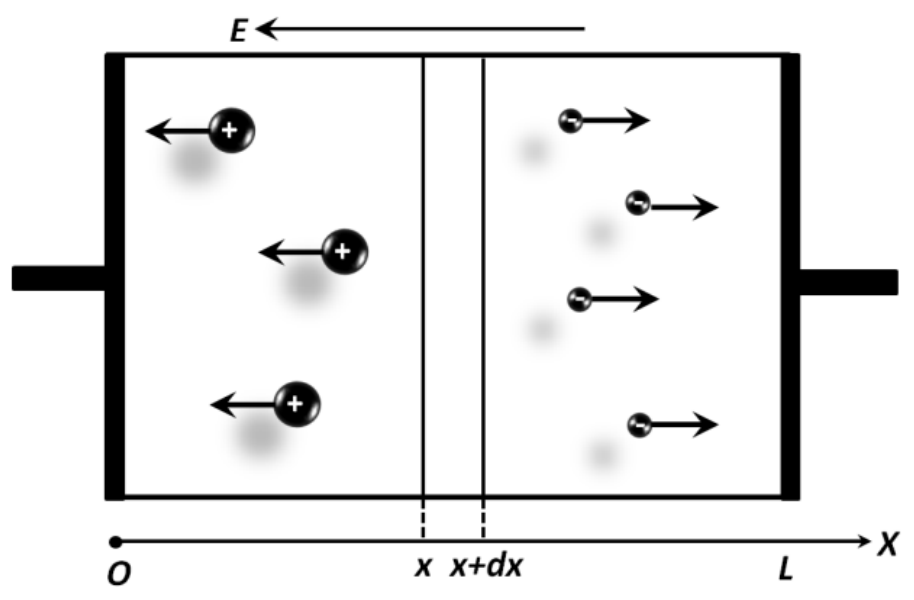
The formation of the electron avalanche is explained as follows. The electric field accelerates free electrons which acquire enough kinetic energy to ionize the atoms in the gas by hitting them. As a result the number of free electrons moving towards the anode significantly increases. This process is described by the Townsend coefficient , which characterizes an increase in the number of electrons due to moving electrons that have passed the distance , i.e.
The total current in any cross section of the gas tube consists of the ion and the electron currents which, in the steady state, depend on the coordinate , shown in the figure above. The electron current varies along the -axis according to the formula
where are some constants.
B1 Find and express them in terms of . [2 т.]
The ion current varies along the -axis according to the formula
where are some constants.
B2 Find and express them in terms of . [0,6 т.]
B3 Write down the condition for at . [0,3 т.]
B4 Write down the condition for and at . [0,6 т.]
B5 Find the total current and express it in terms of . Assume that it remains finite. [1,2 т.]
Let the Townsend coefficient be constant. When the length of the tube turns out greater than some critical value, i.e. , the external ionizer can be turned off and the discharge becomes self-sustained.
B6 Find and express it in terms of . [0,5 т.]
Supplementary presentation: B7
The archived presentation adds the following extension on slide 11; it is absent from the two-page competition paper and carries no stated score. The presentation gives
B7. Find and evaluate the minimum voltage applied across the plates, at which the self-sustained gas discharge can still appear in neon.
The slide does not give numerical values of or .
Решение
Part A. Non-self-sustained gas discharge
A1 Let us derive an equation describing the change of the electron number density with time. It is determined by the two processes; the generation of ion pairs by external ionizer and the recombination of electrons with ions. At ionization process electrons and ions are generated in pairs, and at recombination process they disappear in pairs as well. Thus, their concentrations are always equal at any given time, i.e.
Then the equation describing the number density evolution of electrons and ions in time can be written as
It is easy to show that at the function , therefore, by virtue of the initial condition , one finds
Substituting in (A1.2) and separating it in the independent functions (hyperbolic, or and ), one gets
A2 According to equation (A1.4) the number density of electrons at steady-state is expressed in terms of the external ionizer activity as
Thus, the following analogue of the Pythagorean theorem is obtained as
A3 In the steady state, the balance equations of electrons and ions in the tube volume take the form
It follows from equations (A3.1) and (A3.2) that the ion and electron currents are equal, i.e.
At the same time the total current in each tube section is the sum of the electron and ion currents
By definition of the current density the following relations hold
Substituting (A3.5) and (A3.6) into (A3.1) and (A3.2), the following quadratic equation for the current is derived
The electric field strength in the gas is equal to
and solution to the quadratic equation (A3.7) takes the form
It is obvious that only positive root does make sense, i.e.
A4 At low voltages (A3.10) simplifies and gives the following expression
which is actually the Ohm law. Using the well-known relation
together with
one gets
Part B. Self-sustained gas discharge
B1 Consider a gas layer located between and . The rate of change in the electron number inside the layer due to the electric current is given for a small time interval by
This change is due to the effect of the external ionization and the electron avalanche formation. The external ionizer creates the following number of electrons in the volume
whereas the electron avalanche produces the number of electrons found as
The balance equation for the number of electrons is written as
which results in the following differential equation for the electron current
On substituting , one derives
B2 Given the fact that the ions flow in the direction opposite to the electron motion, the balance equation for the number of ions is written as
where
Hence, the following differential equation for the ion current is obtained
On substituting the previously found electron current together with the ion current, , yields
B3 Since the ions starts to move from the anode located at , the following condition holds
B4 By definition of secondary electron emission coefficient the following condition should be imposed
B5 Total current in each tube section is the sum of the electron and ion currents:
After substituting the boundary conditions (B3.1) and (B4.1):
and
Solving (B5.2) and (B5.3) one can obtain:
So the total current:
B6 When the discharge gap length is increased, the denominator in formula (B5.1) decreases. At that moment, when it turns zero, the electric current in the gas becomes self-sustaining and external ionizer can be turned off. Thus,
Supplementary presentation: B7
Slide 11 gives the following steps for its additional B7 question:
With , the condition gives
The final boxed expression is printed as
Source note: The slide reverses the ratio of and in this final expression relative to its preceding formula for . The numerical constants needed to reproduce 122 V are not supplied on the slide. Here in the exponential minimum is Euler’s number; the exam uses for elementary charge. Slides 10–11 also display a total-current formula different from (B5.5). The complete competition solution above retains the exam’s formula.
Archived presentation
The accompanying 11-slide presentation dedicates this problem to Prof. F. Baimbetov. It illustrates the same derivations and adds an unscored B7 extension, included below. The full presentation remains available as an original supplementary source.
Оригинал в Архива: 3.pdf · официални решения: 3_sol.pdf · допълнителни данни: 3_pres.pdf