46th International Physics Olympiad 2015 Mumbai - India — Q T-1: Particles from the Sun · 10 т.
Условие
Photons from the surface of the Sun and neutrinos from its core can tell us about solar temperatures and also confirm that the Sun shines because of nuclear reactions.
Throughout this problem, take the mass of the Sun to be M⊙=2.00×1030kg, its radius, R⊙=7.00×10⁸m, its luminosity (radiation energy emitted per unit time), L⊙=3.85×1026W, and the Earth-Sun distance, d⊙=1.50×10¹¹m.
A1 Assume that the Sun radiates like a perfect blackbody. Use this fact to calculate the temperature, Ts, of the solar surface. [0,3 т.]
The spectrum of solar radiation can be approximated well by the Wien distribution law. Accordingly, the solar energy incident on any surface on the Earth per unit time per unit frequency interval, u(ν), is given by
u(ν)=Ad⊙2R⊙2c22πhν3exp(−hν/kBTs),
where ν is the frequency and A is the area of the surface normal to the direction of the incident radiation.
Now, consider a solar cell which consists of a thin disc of semiconducting material of area, A, placed perpendicular to the direction of the Sun’s rays.
A2 Using the Wien approximation, express the total radiated solar power, Pin, incident on the surface of the solar cell, in terms of A, R⊙, d⊙, Ts and the fundamental constants c, h, kB. [0,3 т.]
A3 Express the number of photons, nγ(ν), per unit time per unit frequency interval incident on the surface of the solar cell in terms of A, R⊙, d⊙, Ts, ν and the fundamental constants c, h, kB. [0,2 т.]
The semiconducting material of the solar cell has a “band gap” of energy, Eg. We assume the following model. Every photon of energy E≥Eg excites an electron across the band gap. This electron contributes an energy, Eg, as the useful output energy, and any extra energy is dissipated as heat (not converted to useful energy).
A4 Define xg=hνg/kBTs where Eg=hνg. Express the useful output power of the cell, Pout, in terms of xg, A, R⊙, d⊙, Ts and the fundamental constants c, h, kB. [1 т.]
A5 Express the efficiency, η, of this solar cell in terms of xg. [0,2 т.]
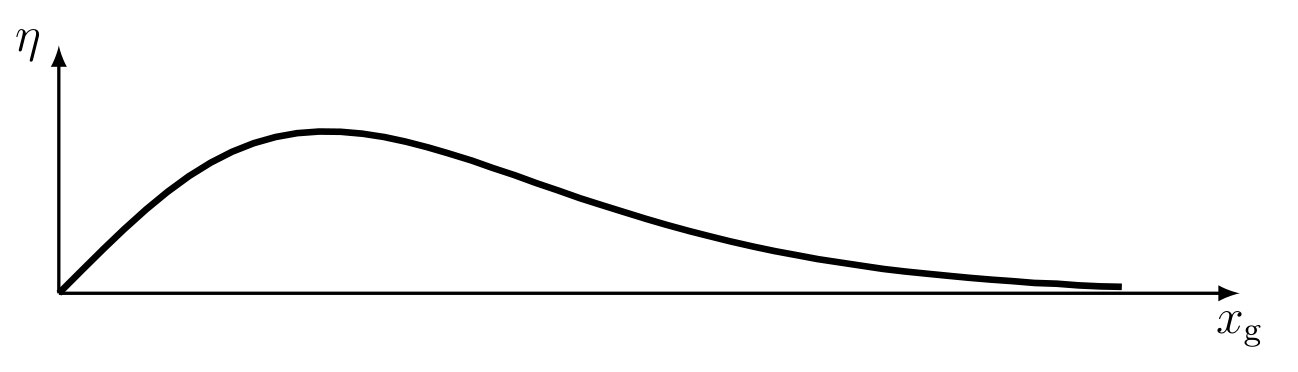
A6 Make a qualitative sketch of η versus xg. The values at xg=0 and xg→∞ should be clearly shown. What is the slope of η(xg) at xg=0 and xg→∞? [1 т.]
A7 Let x0 be the value of xg for which η is maximum. Obtain the cubic equation that gives x0. Estimate the value of x0 within an accuracy of ±0.25. Hence calculate η(x0). [1 т.]
A8 The band gap of pure silicon is Eg=1.11eV. Calculate the efficiency, ηSi, of a silicon solar cell using this value. [0,2 т.]
In the late nineteenth century, Kelvin and Helmholtz (KH) proposed a hypothesis to explain how the Sun shines. They postulated that starting as a very large cloud of matter of mass, M⊙, and negligible density, the Sun has been shrinking continuously. The shining of the Sun would then be due to the release of gravitational potential energy through this slow contraction.
A9 Let us assume that the density of matter is uniform inside the Sun. Find the total gravitational potential energy, Ω, of the Sun at present, in terms of G, M⊙ and R⊙. [0,3 т.]
A10 Estimate the maximum possible time, τKH (in years), for which the Sun could have been shining, according to the KH hypothesis. Assume that the luminosity of the Sun has been constant throughout this period. [0,5 т.]
The τKH calculated above does not match the age of the solar system estimated from studies of meteorites. This shows that the energy source of the Sun cannot be purely gravitational.
B Neutrinos from the Sun :
In 1938, Hans Bethe proposed that nuclear fusion of hydrogen into helium in the core of the Sun is the source of its energy. The net nuclear reaction is:
41H⟶4He+2e++2νe
The “electron neutrinos”, νe, produced in this reaction may be taken to be massless. They escape the Sun and their detection on the Earth confirms the occurrence of nuclear reactions inside the Sun. Energy carried away by the neutrinos can be neglected in this problem.
B1 Calculate the flux density, Φν, of the number of neutrinos arriving at the Earth, in units of m−2s−1. The energy released in the above reaction is ΔE=4.0×10⁻¹²J . Assume that the energy radiated by the Sun is entirely due to this reaction. [0,6 т.]
Travelling from the core of the Sun to the Earth, some of the electron neutrinos, νe, are converted to other types of neutrinos, νx. The efficiency of the detector for detecting νx is 1/6 of its efficiency for detecting νe. If there is no neutrino conversion, we expect to detect an average of N1 neutrinos in a year. However, due to the conversion, an average of N2 neutrinos (νe and νx combined) are actually detected per year.
B2 In terms of N1 and N2, calculate what fraction, f, of νe is converted to νx. [0,4 т.]
In order to detect neutrinos, large detectors filled with water are constructed. Although the interactions of neutrinos with matter are very rare, occasionally they knock out electrons from water molecules in the detector. These energetic electrons move through water at high speeds, emitting electromagnetic radiation in the process. As long as the speed of such an electron is greater than the speed of light in water (refractive index, n), this radiation, called Cherenkov radiation, is emitted in the shape of a cone.
B3 Assume that an electron knocked out by a neutrino loses energy at a constant rate of α per unit time, while it travels through water. If this electron emits Cherenkov radiation for a time, Δt, determine the energy imparted to this electron (Eimparted) by the neutrino, in terms of α, Δt, n, me and c. (Assume the electron to be at rest before its interaction with the neutrino.) [2 т.]
The fusion of H into He inside the Sun takes place in several steps. Nucleus of 7Be (rest mass, mBe) is produced in one of these intermediate steps. Subsequently, it can absorb an electron, producing a 7Li nucleus (rest mass, mLi<mBe) and emitting a νe. The corresponding nuclear reaction is:
7Be+e−⟶7Li+νe
When a Be nucleus (mBe=11.65×10⁻²⁷kg) is at rest and absorbs an electron also at rest, the emitted neutrino has energy Eν=1.44×10⁻¹³J. However, the Be nuclei are in random thermal motion due to the temperature Tc at the core of the Sun, and act as moving neutrino sources. As a result, the energy of emitted neutrinos fluctuates with a root mean square (rms) value ΔErms.
B4 If ΔErms=5.54×10⁻¹⁷J, calculate the rms speed of the Be nuclei, VBe, and hence estimate Tc. (Hint: ΔErms depends on the rms value of the component of velocity along the line of sight). [2 т.]
¹ Amol Dighe (TIFR), Anwesh Mazumdar (HBCSE-TIFR) and Vijay A. Singh (ex-National Coordinator, Science Olympiads) were the principal authors of this problem. The contributions of the Academic Committee, Academic Development Group and the International Board are gratefully acknowledged.
The useful power output is the useful energy quantum per photon, Eg≡hνg, multiplied by the number of photons with energy, E≥Eg.
Pout=hνg∫νg∞nγ(ν)dν
=hνgAd⊙2R⊙2c22π∫νg∞ν2exp(−hν/kBTs)dν
=kBTsxgAd⊙2R⊙2c22π(hkBTs)3∫xg∞x2e−xdx
=c2h32πkB4Ts4Ad⊙2R⊙2xg(xg2+2xg+2)e−xg
(A5) [0.2]
Solution:
Efficiency η=PinPout=6xg(xg2+2xg+2)e−xg
(A6) [1.0]
Solution:
η=61(xg3+2xg2+2xg)e−xg
Put limiting values, η(0)=0η(∞)=0.
Since the polynomial has all positive coefficients, it increases monotonically; the exponential function decreases monotonically. Therefore, η has only one maximum.
dxgdη=61(−xg3+xg2+2xg+2)e−xg
dxgdηxg=0=31dxgdηxg→∞=0
(A7) [1.0]
Solution:
The maximum will be for dxgdη=61(−xg3+xg2+2xg+2)e−xg=0
⇒p(xg)≡xg3−xg2−2xg−2=0
A Numerical Solution by the Bisection Method:
Now,
p(0)=−2
p(1)=−4
p(2)=−2
p(3)=10⇒2<x0<3
p(2.5)=2.375⇒2<x0<2.5
p(2.25)=−0.171⇒2.25<x0<2.5
The approximate value of xg where η is maximum is x0=2.27.
Alternative methods leading to the same result are acceptable.
η(2.27)=0.457
(A8) [0.2]
Solution:
xg=1.38×10−23×57631.11×1.60×10−19=2.23
ηSi=6xg(xg2+2xg+2)e−xg=0.457
(A9) [0.3]
Solution:
The total gravitational potential energy of the Sun: Ω=−∫0M⊙rGmdm
For constant density, ρ=4πR⊙33M⊙m=34πr3ρdm=4πr2ρdr
When the electron stops emitting Cherenkov radiation, its speed has reduced to vstop=c/n. Its total energy at this time is
Estop=1−vstop2/c2mec2=n2−1nmec2
The energy of the electron when it was knocked out is
Estart=αΔt+n2−1nmec2
Before interacting, the energy of the electron was equal to mec2.
Thus, the energy imparted by the neutrino is
Eimparted=Estart−mec2=αΔt+(n2−1n−1)mec2
(B4) [2.0]
Solution:
Moving 7Be nuclei give rise to Doppler effect for neutrinos. Since the fractional change in energy (ΔErms/Eν∼10−4) is small, the Doppler shift may be considered in the non-relativistic limit (a relativistic treatment gives almost same answer). Taking the line of sight along the z-direction,
EνΔErms=cvz,rms
=3.85×10−4
=31cVBe
⇒VBe=3×3.85×10−4×3.00×108ms−1=2.01×10⁵ms−1.
The average temperature is obtained by equating the average kinetic energy to the thermal energy.