46th International Physics Olympiad 2015 Mumbai - India — Q T-2 — The Extremum Principle · 10 т.
Условие
A The Extremum Principle in Mechanics
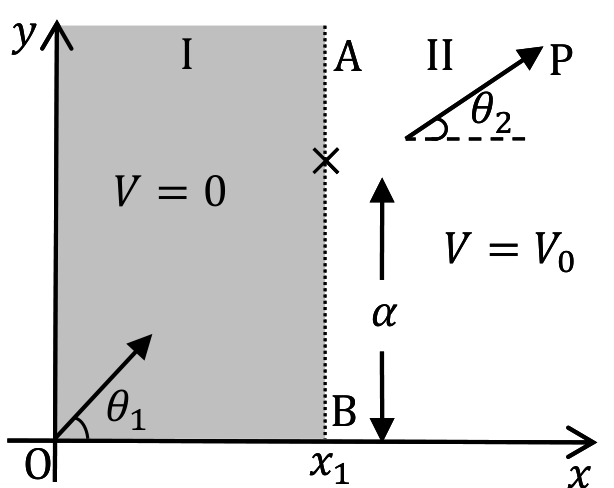
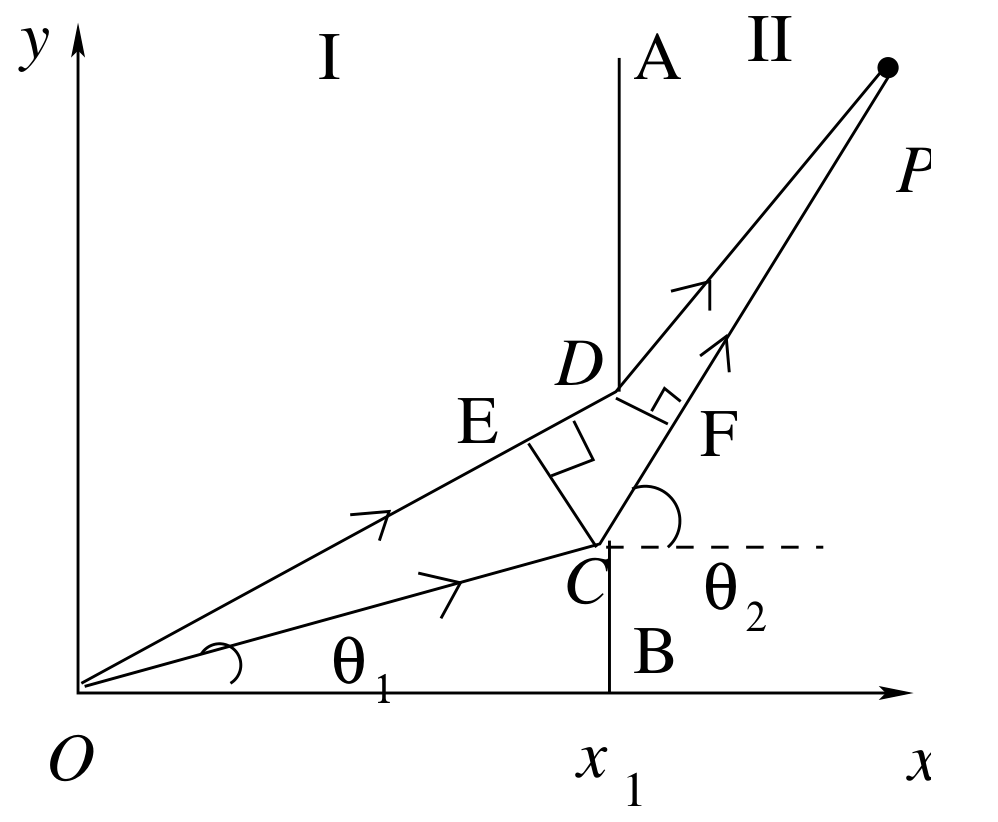
Consider a horizontal frictionless x−y plane shown in Fig. 1. It is divided into two regions, I and II, by a line AB satisfying the equation x=x1. The potential energy of a point particle of mass m in region I is V=0 while it is V=V0 in region II. The particle is sent from the origin O with speed v1 along a line making an angle θ1 with the x-axis. It reaches point P in region II traveling with speed v2 along a line that makes an angle θ2 with the x-axis. Ignore gravity and relativistic effects in this entire task T-2 (all parts).
¹ Manoj Harbola (IIT-Kanpur) and Vijay A. Singh (ex-National Coordinator, Science Olympiads) were the principal authors of this problem. The contributions of the Academic Committee, Academic Development Group and the International Board are gratefully acknowledged.
A1 Obtain an expression for v2 in terms of m, v1 and V0. [0,2 т.]
A2 Express v2 in terms of v1,θ1 and θ2. [0,3 т.]
Figure 1
We define a quantity called action A=m∫v(s)ds, where ds is the infinitesimal length along the trajectory of a particle of mass m moving with speed v(s). The integral is taken over the path. As an example, for a particle moving with constant speed v on a circular path of radius R, the action A for one revolution will be 2πmRv. For a particle with constant energy E, it can be shown that of all the possible trajectories between two fixed points, the actual trajectory is the one on which A defined above is an extremum (minimum or maximum). Historically this is known as the Principle of Least Action (PLA).
A3 PLA implies that the trajectory of a particle moving between two fixed points in a region of constant potential will be a straight line. Let the two fixed points O and P in Fig. 1 have coordinates (0,0) and (x0,y0) respectively and the boundary point where the particle transits from region I to region II have coordinates (x1,α). Note that x1 is fixed and the action depends on the coordinate α only. State the expression for the action A(α). Use PLA to obtain the relationship between v1/v2 and these coordinates. [1 т.]
B The Extremum Principle in Optics
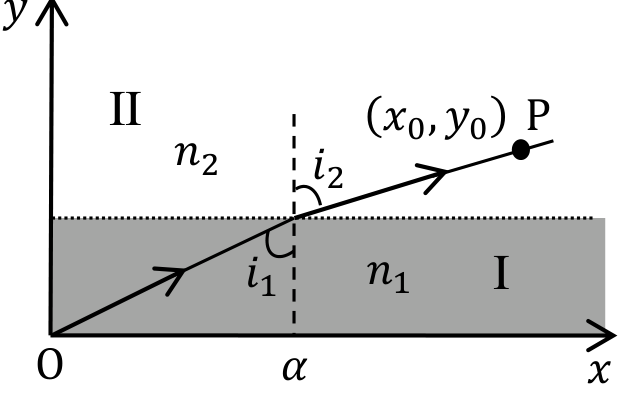
Figure 2
A light ray travels from medium I to medium II with refractive indices n1 and n2 respectively. The two media are separated by a line parallel to the x-axis. The light ray makes an angle i1 with the y-axis in medium I and i2 in medium II (see Fig. 2). To obtain the trajectory of the ray, we make use of another extremum (minimum or maximum) principle known as Fermat’s principle of least time.
B1 The principle states that between two fixed points, a light ray moves along a path such that time taken between the two points is an extremum. Derive the relation between sini1 and sini2 on the basis of Fermat’s principle. [0,5 т.]
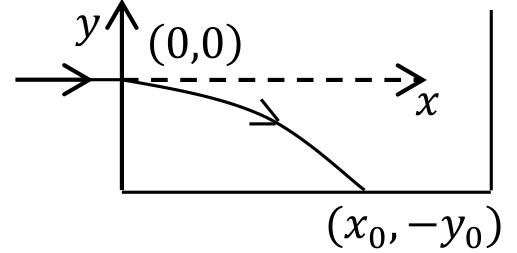
Figure 3: Tank of Sugar Solution
Shown in Fig. 3 is a schematic sketch of the path of a laser beam incident horizontally on a solution of sugar in which the concentration of sugar decreases with height. As a consequence, the refractive index of the solution also decreases with height.
B2 Assume that the refractive index n(y) depends only on y. Use the equation obtained in B1 to obtain the expression for the slope dy/dx of the beam’s path in terms of refractive index n0 at y=0 and n(y). [1,5 т.]
B3 The laser beam is directed horizontally from the origin (0,0) into the sugar solution at a height y0 from the bottom of the tank as shown in figure 3. Take n(y)=n0−ky where n0 and k are positive constants. Obtain an expression for x in terms of y and related quantities for the actual trajectory of the laser beam.
You may use: ∫secθdθ=ln(secθ+tanθ)+constant, where secθ=1/cosθ or
∫x2−1dx=ln(x+x2−1)+constant
[1,2 т.]
B4 Obtain the value of x0, the point where the beam meets the bottom of the tank. Take y0=10.0 cm, n0=1.50, k=0.050cm−1 (1 cm = 10−2 m). [0,8 т.]
C The Extremum Principle and the Wave Nature of Matter
We now explore the connection between the PLA and the wave nature of a moving particle. For this we assume that a particle moving from O to P can take all possible trajectories and we will seek a trajectory that depends on the constructive interference of de Broglie waves.
C1 As the particle moves along its trajectory by an infinitesimal distance Δs, relate the change Δφ in the phase of its de Broglie wave to the change ΔA in the action and the Planck constant. [0,6 т.]
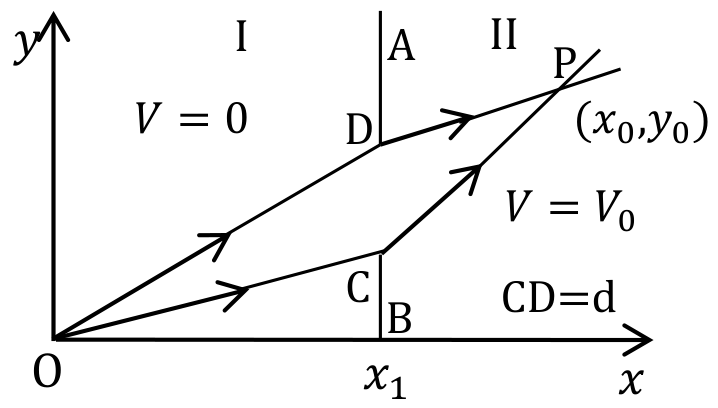
C2 Recall the problem from part A where the particle traverses from O to P (see Fig. 4). Let an opaque partition be placed at the boundary AB between the two regions. There is a small opening CD of width d in AB such that d≪(x0−x1) and d≪x1.
Figure 4
Consider two extreme paths OCP and ODP such that OCP lies on the classical trajectory discussed in part A. Obtain the phase difference ΔφCD between the two paths to first order. [1,2 т.]
D Matter Wave Interference
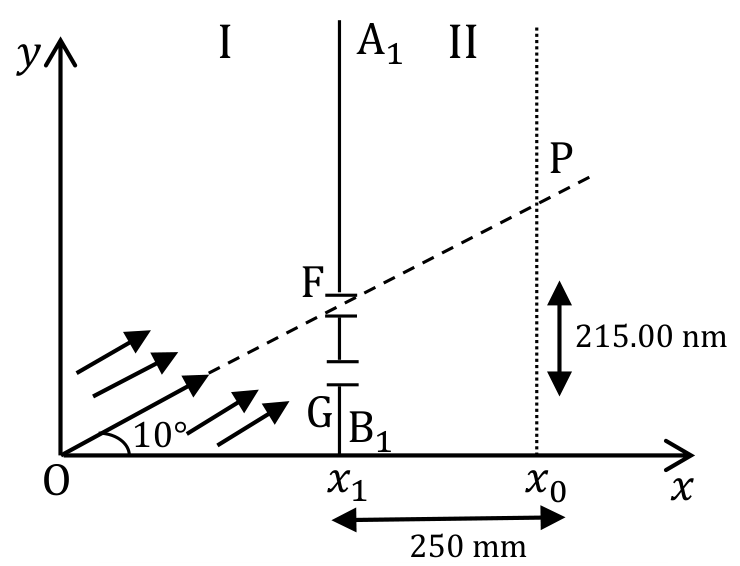
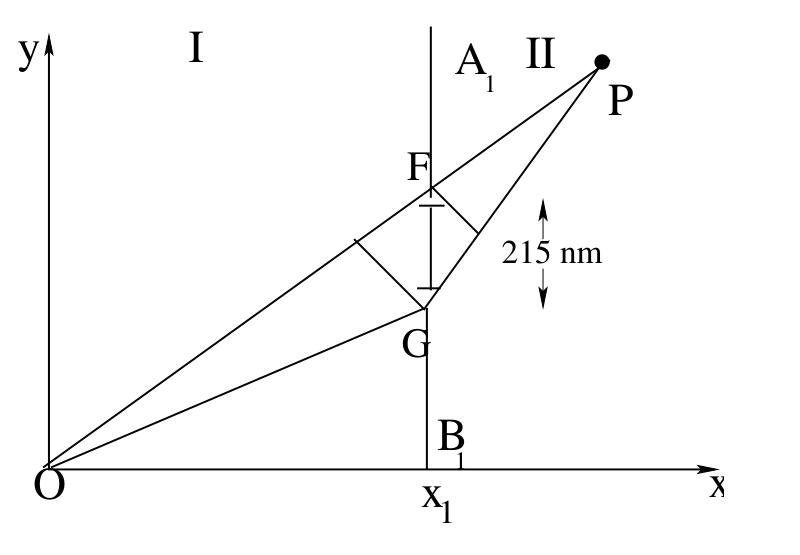
Consider an electron gun at O which directs a collimated beam of electrons to a narrow slit at F in the opaque partition A1B1 at x=x1 such that OFP is a straight line. P is a point on the screen at x=x0 (see Fig. 5). The speed in I is v1=2.0000×10⁷ms−1 and θ=10.0000∘. The potential in II is such that speed v2=1.9900×10⁷ms−1. The distance x0−x1 is 250.00mm(1mm=10−3m). Ignore electron-electron interaction.
Figure 5
D1 If the electrons at O have been accelerated from rest, calculate the accelerating potential U1. [0,3 т.]
D2 Another identical slit G is made in the partition A1B1 at a distance of 215.00nm(1nm=10−9m) below slit F (Fig. 5). If the phase difference between de Broglie waves arriving at P through the slits F and G is 2πβ, calculate β. [0,8 т.]
D3 What is the smallest distance Δy from P at which null (zero) electron detection maybe expected on the screen? [Note: you may find the approximation sin(θ+Δθ)≈sinθ+Δθcosθ useful] [1,2 т.]
D4 The beam has a square cross section of 500nm×500nm and the setup is 2 m long. What should be the minimum flux density Imin (number of electrons per unit normal area per unit time) if, on an average, there is at least one electron in the setup at a given time? [0,4 т.]
ΔφCD = 0 (from A2 or B1): constructive interference near the classical path.
D1 1139 V
D2 5.13
D3 -16.2 µm
The negative sign means that the closest minimum is below P (|Δy| = 0.0162 mm).
D44×1019 m⁻² s⁻¹
Решение
(A1) Solution:
From the principle of Conservation of Mechanical Energy
21mv12=21mv22+V0
v2=(v12−m2V0)1/2
(A2) Solution:
At the boundary there is an impulsive force (∝dV/dx) in the −x direction. Hence only the velocity component in the x−direction v1x suffers change . The component in the y−direction remains unchanged. Therefore
v1y=v2y
v1sinθ1=v2sinθ2
(A3) Solution:
By definition A(α) from O to P is
A(α)=mv1x12+α2+mv2(x0−x1)2+(y0−α)2
Differentiating w.r.t. α and setting the derivative of A(α) to zero
Note this is the same as A2, namely v1sinθ1=v2sinθ2.
(B1) Solution:
The speed of light in medium I is c/n1 and in medium II is c/n2, where c is the speed of light in vacuum. Let the two media be separated by the fixed line y=y1. Then time T(α) for light to travel from origin (0,0) and (x0,y0) is
T(α)=n1(y12+α2)/c+n2((x0−α)2+(y0−y1)2)/c
Differentiating w.r.t. α and setting the derivative of T(α) to zero