Joseph Amal Nathan (BARC) and Vijay A. Singh (ex-National Coordinator, Science Olympiads) were the principal authors of this problem. The contributions of the Academic Committee, Academic Development Group and the International Board are gratefully acknowledged.
Условие
Consider the two dimensional elastic collision between a neutron of mass 1 u and a moderator atom of mass A u. Before collision all the moderator atoms are considered at rest in the laboratory frame (LF). Let vb and va be the velocities of the neutron before and after collision respectively in the LF. Let vm be the velocity of the center of mass (CM) frame relative to LF and θ be the neutron scattering angle in the CM frame. All the particles involved in collisions are moving at nonrelativistic speeds.
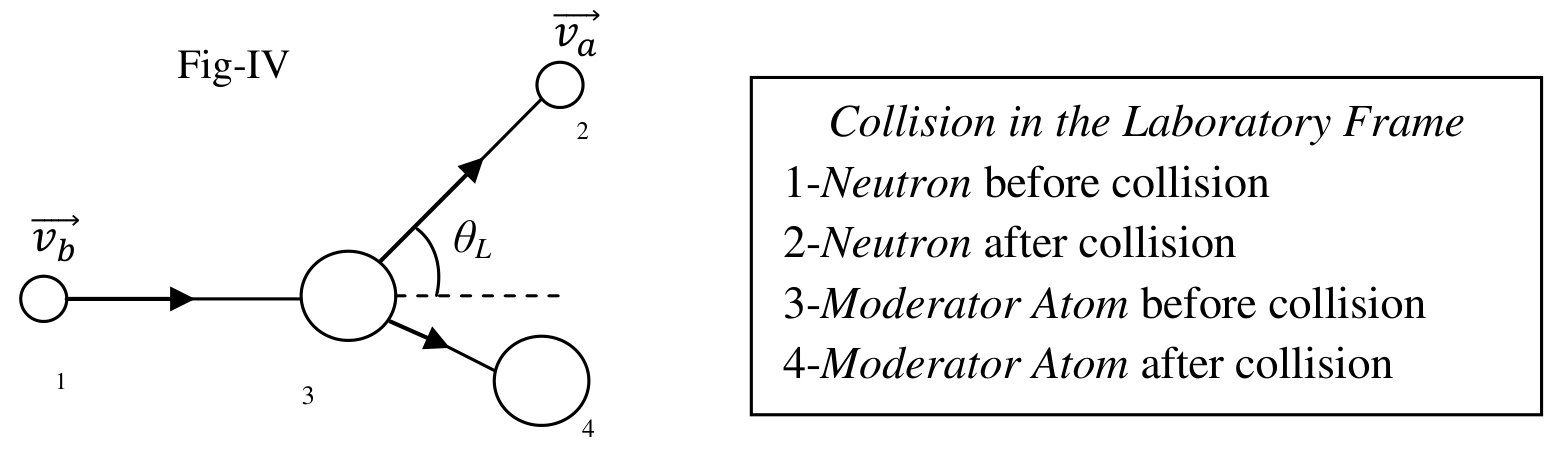
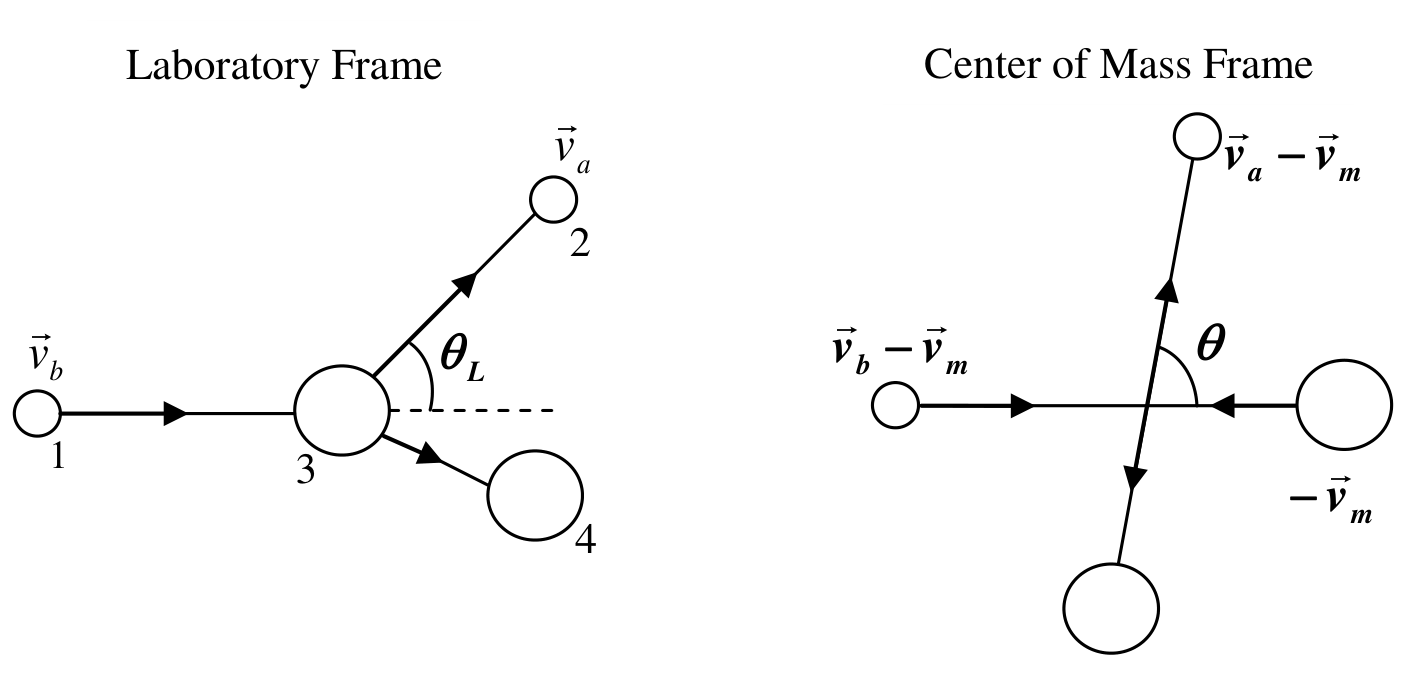
B1 The collision in LF is shown schematically, where θL is the scattering angle (Fig-IV). Sketch the collision schematically in CM frame. Label the particle velocities for 1, 2 and 3 in terms of vb, va and vm. Indicate the scattering angle θ. [1 т.]
Fig-IV
B2 Obtain v and V, the speeds of the neutron and moderator atom in the CM frame after collision, in terms of A and vb. [1 т.]
B3 Derive an expression for G(α,θ)=Ea/Eb , where Eb and Ea are the kinetic energies of the neutron, in the LF, before and after the collision respectively and α≡[(A−1)/(A+1)]2. [1 т.]
B4 Assume that the above expression holds for D2O molecule. Calculate the maximum possible fractional energy loss fl≡EbEb−Ea of the neutron for the D2O (20 u) moderator. [0,5 т.]
Отговори
B2v=A+1Avb,V=A+1vb
B3G(α,θ)=(A+1)2A2+2Acosθ+1=21[(1+α)+(1−α)cosθ]
B4 0.181
Acceptable range printed in the official solution: 0.170 to 0.190.
Решение
B1
Laboratory Frame / Center of Mass Frame
Solution:
B2
Solution:Detailed solution: Before the collision in the CM frame (vb−vm) and vm will be magnitude of the velocities of the neutron and moderator atom respectively. From momentum conservation in the CM frame, vb−vm=Avm gives vm=A+1vb.
After the collision, let v and V be magnitude of the velocities of neutron and moderator atom respectively in the CM frame. From conservation laws,
Solving gives v=A+1Avb and V=A+1vb. (OR) From definition of center of mass frame vm=A+1vb. Before the collision in the CM frame vb−vm=A+1Avb and vm will be magnitude of the velocities of the neutron and moderator atom respectively. In elastic collision the particles are scattered in the opposite direction in the CM frame and so the speeds remain same v=A+1Avb and V=A+1vb(→[0.2+0.1]).
Note: Alternative solutions are worked out in the end and will get appropriate weightage.
Detailed solution: Since va=v+vm, va2=v2+vm2+2vvmcosθ(→[0.3]). Substituting the values of v and vm, va2=(A+1)2A2vb2+(A+1)2vb2+(A+1)22Avb2cosθ(→[0.2]), so
Note: Alternative solutions are worked out in the end and will get appropriate weightage.
B4
Solution:fl=0.181
Detailed solution: The maximum energy loss will be when the collision is head on ie., Ea will be minimum for the scattering angle θ=π.
So Ea=Emin=αEb.
For D2O, α=0.819 and maximum fractional loss (EbEb−Emin)=1−α=0.181. [Acceptable Range (0.170 to 0.190)]
Alternative Solutions to sub-parts B2 and B3: Let σ be the scattering angle of the Moderator atom in the LF, taken clockwise with respect to the initial direction of the neutron before collision. Let U be the speed of the Moderator atom, in the LF, after collision. From momentum and kinetic conservation in LF we have
vb=vacosθL+AUcosσ,(1)
0=vasinθL−AUsinσ,(2)
21vb2=21AU2+21va2.(3)
Squaring and adding eq(1) and (2) to eliminate σ and from eq(3) we get
A2U2=va2+vb2−2vavbcosθL,
A2U2=Avb2−Ava2,(4)
which gives
2vavbcosθL=(A+1)va2−(A−1)vb2.(5)
(ii) Let v be the speed of the neutron after collision in the COMF. From definition of center of mass frame vm=A+1vb.
vasinθL and vacosθL are the perpendicular and parallel components of va, in the LF, resolved along the initial direction of the neutron before collision. Transforming these to the COMF gives vasinθL and vacosθL−vm as the perpendicular and parallel components of v. Substituting for vm and for 2vavbcosθL from eq(5) in v=va2sin2θL+va2cos2θL+vm2−2vavmcosθL and simplifying gives v=A+1Avb. Squaring the components of v to eliminate θL gives va2=v2+vm2+2vvmcosθ. Substituting for v and vm and simplifying gives,
(iii) From definition of center of mass frame vm=A+1vb. After the collision, let v and V be magnitude of the velocities of neutron and moderator atom respectively in the COMF. From conservation laws in the COMF,
v=AVand21(vb−vm)2+21Avm2=21v2+21AV2.
Solving gives v=A+1Avb and V=A+1vb. We also have vcosθ=vacosθL−vm, substituting for vm and for vacosθL from eq(5) and simplifying gives
(iv) From definition of center of mass frame vm=A+1vb. After the collision, let v and V be magnitude of the velocities of neutron and moderator atom respectively in the CM frame. From conservation laws in the CM frame,
v=AVand21(vb−vm)2+21Avm2=21v2+21AV2.
Solving gives v=A+1Avb and V=A+1vb. Usinσ and Ucosσ are the perpendicular and parallel components of U, in the LF, resolved along the initial direction of the neutron before collision. Transforming these to the COMF gives Usinσ and −Ucosσ+vm as the perpendicular and parallel components of V. So we get U2=V2sin2θ+V2cos2θ+vm2−2Vvmcosθ. Since V=vm we get U2=2vm2(1−cosθ). Substituting for U from eq(4) and simplifying gives