IPhO 2016, Теория — Задача 1. Two Problems in Mechanics
IPhO 2016 — Theory Q1 — Two Problems in Mechanics (10 points) · 10 т.
Условие
Please read the general instructions in the separate envelope before you start this problem.
Part A. The Hidden Disk (3.5 points)
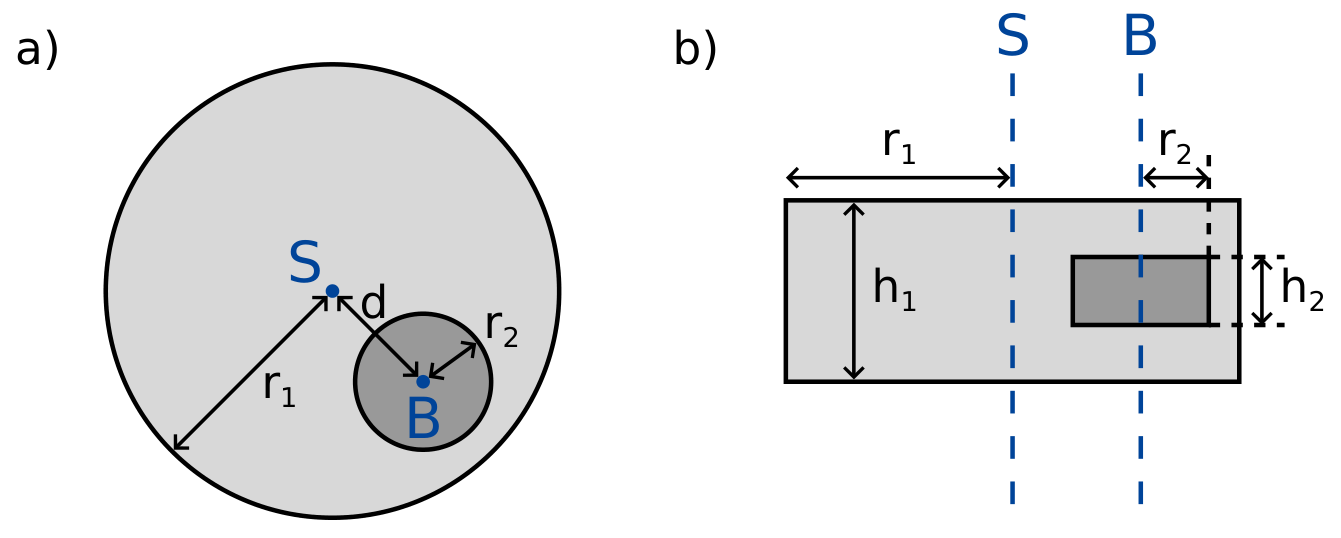
We consider a solid wooden cylinder of radius and thickness . Somewhere inside the wooden cylinder, the wood has been replaced by a metal disk of radius and thickness . The metal disk is placed in such a way that its symmetry axis is parallel to the symmetry axis of the wooden cylinder, and is placed at the same distance from the top and bottom face of the wooden cylinder. We denote the distance between and by . The density of wood is , the density of the metal is . The total mass of the wooden cylinder and the metal disk inside is .
In this task, we place the wooden cylinder on the ground so that it can freely roll to the left and right. See Fig. 1 for a side view and a view from the top of the setup.
The goal of this task is to determine the size and the position of the metal disk.
In what follows, when asked to express the result in terms of known quantities, you may always assume that the following are known:
The goal is to determine and , through indirect measurements.
We denote as the distance between the centre of mass of the whole system and the symmetry axis of the wooden cylinder. In order to determine this distance, we design the following experiment: We place the wooden cylinder on a horizontal base in such a way that it is in a stable equilibrium. Let us now slowly incline the base by an angle (see Fig. 2). As a result of the static friction, the wooden cylinder can roll freely without sliding. It will roll down the incline a little bit, but then come to rest in a stable equilibrium after rotating by an angle which we measure.
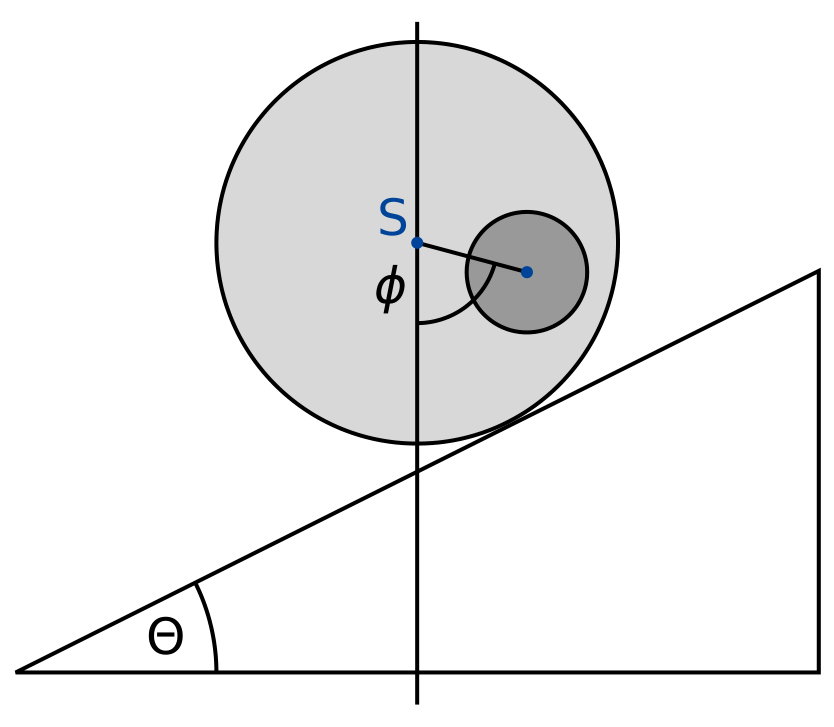
A.1 Find an expression for as a function of the quantities (1), the angle and the tilting angle of the base. [0,8 т.]
From now on, we can assume that the value of is known.
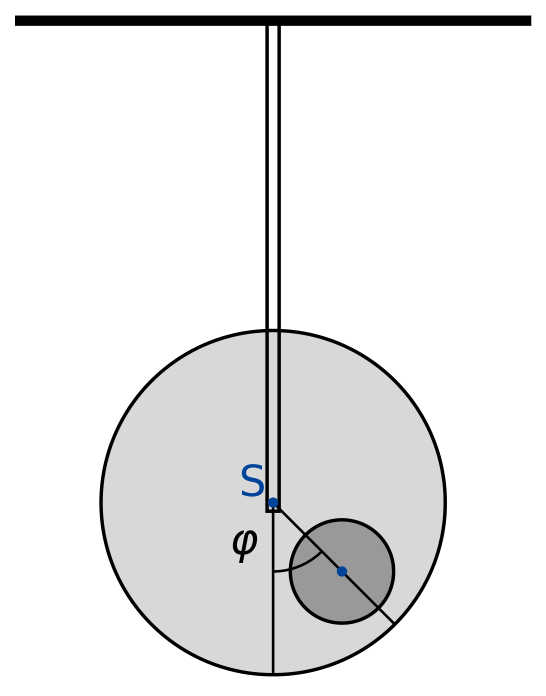
Next we want to measure the moment of inertia of the system with respect to the symmetry axis . To this end, we suspend the wooden cylinder at its symmetry axis from a rigid rod. We then turn it away from its equilibrium position by a small angle , and let it go. See figure 3 for the setup. We find that describes a periodic motion with period .
A.2 Find the equation of motion for . Express the moment of inertia of the system around its symmetry axis in terms of , and the known quantities (1). You may assume that we are only disturbing the equilibrium position by a small amount so that is always very small. [0,5 т.]
From the measurements in questions A.1 and A.2, we now want to determine the geometry and the position of the metal disk inside the wooden cylinder.
A.3 Find an expression for the distance as a function of and the quantities (1). You may also include and as variables in your expression, as they will be calculated in subtask A.5. [0,4 т.]
A.4 Find an expression for the moment of inertia in terms of and the known quantities (1). You may also include and as variables in your expression, as they will be calculated in subtask A.5. [0,7 т.]
A.5 Using all the above results, write down an expression for and in terms of , and the known quantities (1). You may express as a function of . [1,1 т.]
Part B. Rotating Space Station (6.5 points)
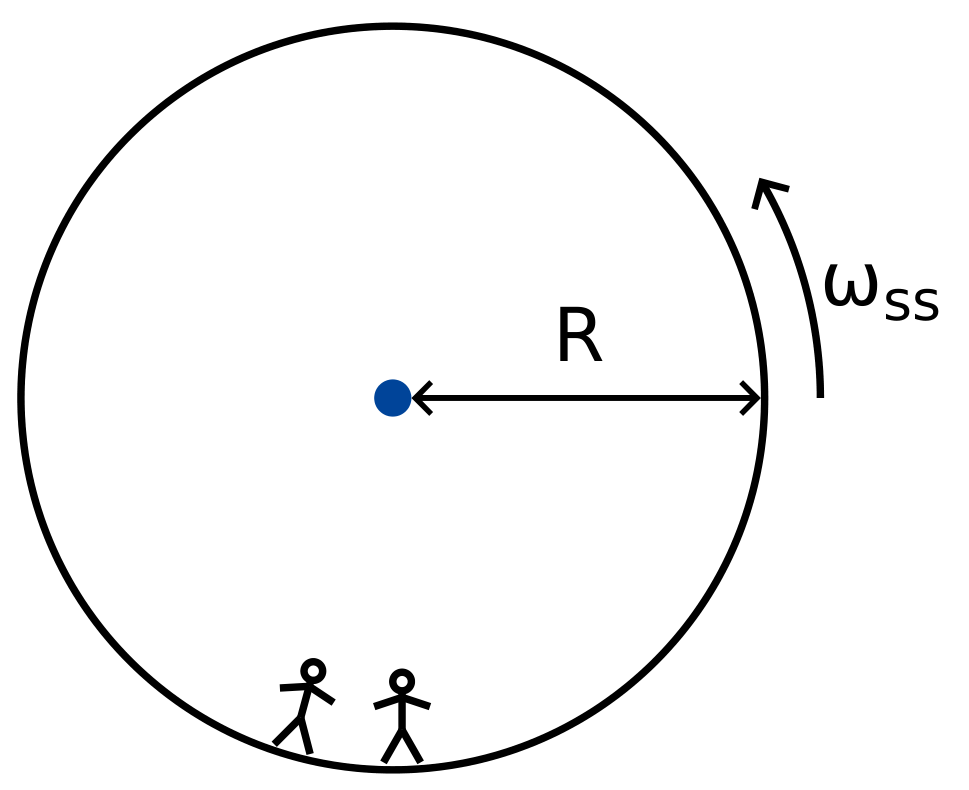
Alice is an astronaut living on a space station. The space station is a gigantic wheel of radius rotating around its axis, thereby providing artificial gravity for the astronauts. The astronauts live on the inner side of the rim of the wheel. The gravitational attraction of the space station and the curvature of the floor can be ignored.
B.1 At what angular frequency does the space station rotate so that the astronauts experience the same gravity as on the Earth's surface? [0,5 т.]
Alice and her astronaut friend Bob have an argument. Bob does not believe that they are in fact living in a space station and claims that they are on Earth. Alice wants to prove to Bob that they are living on a rotating space station by using physics. To this end, she attaches a mass to a spring with spring constant and lets it oscillate. The mass oscillates only in the vertical direction, and cannot move in the horizontal direction.
B.2 Assuming that on Earth gravity is constant with acceleration , what would be the angular oscillation frequency that a person on Earth would measure? [0,2 т.]
B.3 What angular oscillation frequency does Alice measure on the space station? [0,6 т.]
Alice is convinced that her experiment proves that they are on a rotating space station. Bob remains sceptical. He claims that when taking into account the change in gravity above the surface of the Earth, one finds a similar effect. In the following tasks we investigate whether Bob is right.
B.4 Derive an expression of the gravity for small heights above the surface of the Earth and compute the oscillation frequency of the oscillating mass (linear approximation is enough). Denote the radius of the Earth by . Neglect the rotation of Earth. [0,8 т.]
Indeed, for this space station, Alice does find that the spring pendulum oscillates with the frequency that Bob predicted.
B.5 For what radius of the space station does the oscillation frequency match the oscillation frequency on the Earth? Express your answer in terms of . [0,3 т.]
Exasperated with Bob's stubbornness, Alice comes up with an experiment to prove her point. To this end she climbs on a tower of height over the floor of the space station and drops a mass. This experiment can be understood in the rotating reference frame as well as in an inertial reference frame.
In a uniformly rotating reference frame, the astronauts perceive a fictitious force called the Coriolis force. The force acting on an object of mass moving at velocity in a rotating frame with constant angular frequency is given by
In terms of the scalar quantities you may use
where is the angle between the velocity and the axis of rotation. The force is perpendicular to both the velocity and the axis of rotation. The sign of the force can be determined from the right-hand rule, but in what follows you may choose it freely.
B.6 Calculate the horizontal velocity and the horizontal displacement (relative to the base of the tower, in the direction perpendicular to the tower) of the mass at the moment it hits the floor. You may assume that the height of the tower is small, so that the acceleration as measured by the astronauts is constant during the fall. Also, you may assume that . [1,1 т.]
To get a good result, Alice decides to conduct this experiment from a much taller tower than before. To her surprise, the mass hits the floor at the base of the tower, so that .
B.7 Find a lower bound for the height of the tower for which it can happen that . [1,3 т.]
Alice is willing to make one last attempt at convincing Bob. She wants to use her spring oscillator to show the effect of the Coriolis force. To this end she changes the original setup: She attaches her spring to a ring which can slide freely on a horizontal rod in the direction without any friction. The spring itself oscillates in the direction. The rod is parallel to the floor and perpendicular to the axis of rotation of the space station. The plane is thus perpendicular to the axis of rotation, with the direction pointing straight towards the center of rotation of the station.
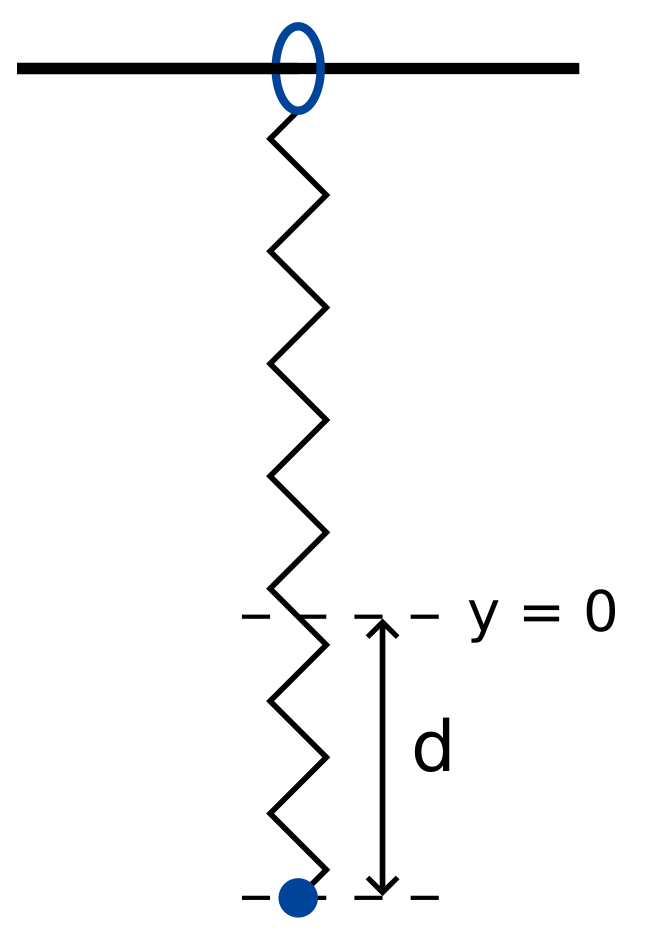
B.8 Alice pulls the mass a distance downwards from the equilibrium point , , and then lets it go (see figure 5).
- Give an algebraic expression of and . You may assume that is small, and neglect the Coriolis force for motion along the -axis.
- Sketch the trajectory , marking all important features such as amplitude. [1,7 т.]
Alice and Bob continue to argue.
Отговори
A.1
A.2
A.3
A.4
A.5
B.1
B.2
B.3
B.4
B.5
B.6
B.7
H/R = 1 − cos ϕ ≈ 0.871 with ϕ = tan ϕ, ϕ = 7.725 rad; the estimate x = 1/√(25π²/4+1) gives ≈ 0.874.
B.8
Решение
Problem 1 : Solution/marking scheme – Two Problems in Mechanics (10 points)
Part A. The Hidden Disk (3.5 points)
Solution A1: [0.8]
Geometric solution: use that torque with respect to point of contact is 0 center of gravity has to be vertically above point of contact.
Here may be called another name. Solve this:
Alternative: Torque and forces with respect to another point: [0.8]
Correct equation for torque 0.3
Correct equation for force 0.3
Correct solution 0.2
Solution A2: [0.5]
Write some equation of the form 0.1
Writing an equation of the form is also correct.
Two solutions:
- Kinetic energy: and potential energy: . Total energy is conserved, and differentiation w.r.t. time gives the equation of motion.
- Angular equation of motion from torque, .
Correct equation (either energy conservation or torque equation of motion) 0.3
Final answer
(Derivation:
so that
)
Solution A3: [0.4]
Some version of the center of mass equation, e.g.
correct solution:
Solution A4: [0.7]
correct answer for moment of inertia of homogeneous disk
Mass wrong -0.1
Factor wrong in formula for moment of inertia of a disk -0.1
Correct answer for moment of inertia of ‘excess’ disk:
Using Steiner’s theorem:
correct solution:
In terms of rather than gives 0.1pts rather than 0.2pts for the final answer: 0.1
Solution A5: [1.1]
It is not clear how exactly students will attempt to solve this system of equations. It is likely that they will use the following equation:
solve for :
replace by :
solve correctly for :
write down an equation for along the lines of and solve it correctly:
Part B. Rotating Space Station (6.5 points)
Solution B1: [0.5]
An equation for the centrifugal force along the lines of
Balancing the forces, correct equation
Correct solution
Solution B2: [0.2]
Realize that result is independent of 0.1
Correct result:
Solution B3: [0.6]
some version of the correct equation for force
getting the sign right
Find correct differential equation
Derive correct result
Using instead of is also correct.
Solution B4: [0.8]
linear approximation of gravity:
Realize that :
Opposite sign is also correct, as long as it is opposite in both terms.
Realize what this means for force, i.e. that the constant term can be eliminated by shifting the equilibrium point:
Find correct differential equation
correct result
No points are deducted if student answers with because ”oscillation frequency” might also be interpreted as inverse period.
Solution B5: [0.3]
Write down equation
Solve
If rather than is used, give only 0.1pt.
Solution B6: [1.1]
There are several possible solutions.
Solution one – Using Coriolis force
Velocity
Equation for Coriolis force with correct velocity:
Integrate this, or realize that it is like uniform acceleration for the velocity:
plug in correct value for
overall correct result
The displacement :
Integrate :
Instead of integrating, students may simply ‘average’ by taking of the final velocity. This gives a factor of instead of . Deduct a total of 0.1 pts for this. -0.1
Plug in value for
Solution two – Using inertial frame This solution is similar to the way to solve B7, but needs more complicated approximations than Solution one.
Here denotes the angle swept by the mass and the angle the astronauts (and tower) has rotated when the mass lands on the floor, see
Initially the velocity of the mass in an inertial frame is . 0.1
When the mass lands, the -direction has been rotated by so the new horizontal velocity component is then
(Student may also write instead of , since .)
Transforming to the rotating reference frame, one needs to subtract . 0.1
Finally in the reference frame of the astronauts
The sign of the velocity depend on the choice of reference direction, so a positive sign is also correct.
With the notation from the calculation of
where is the fall time of the mass, which is given by
(see solution to B7)
Writing this means
which is a valid end answer to the problem. It is possible, but not necessary, to approximate this for small :
which after insertion into the equation for and approximation of small yields the same result as in Solution one:
If this end answer misses the factor , deduct 0.1 points. -0.1
Solution three – Inertial frame with geometry trick
This is an alternative solution to obtain
The mass travels the distance , and during the fall the space station rotates by , see Figure 2. According to the intersecting chord theorem,
The rotated angle is where
is the fall time. Thus
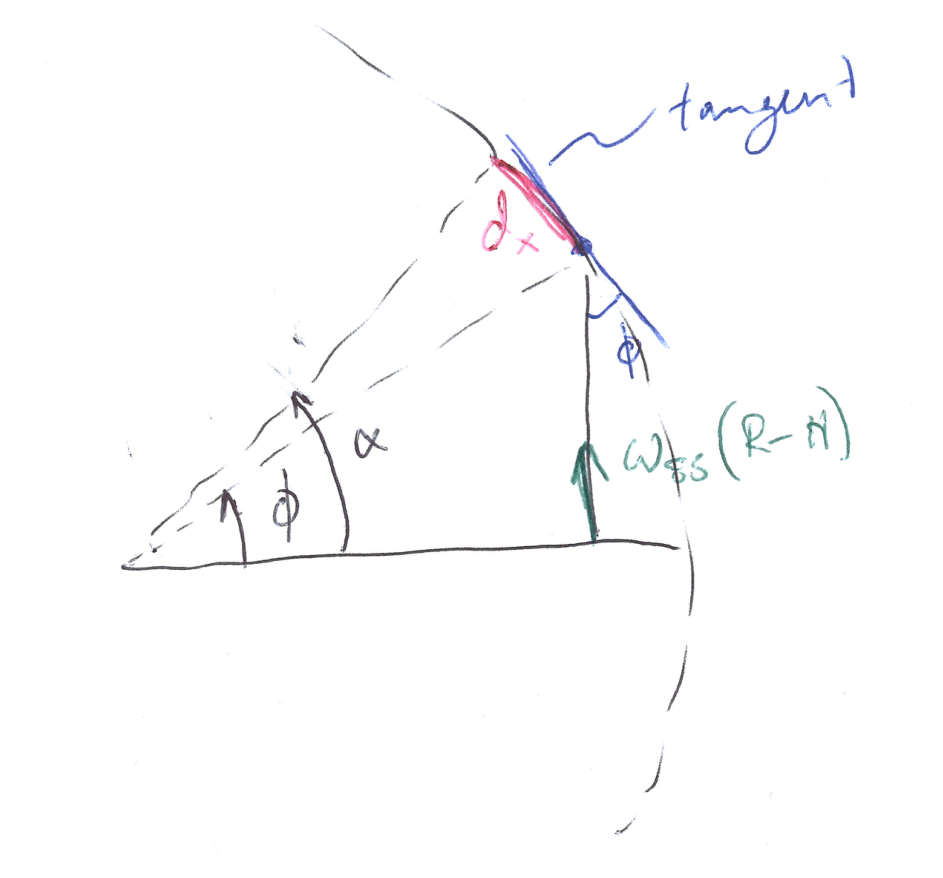
Figure 1: Notation for solution two
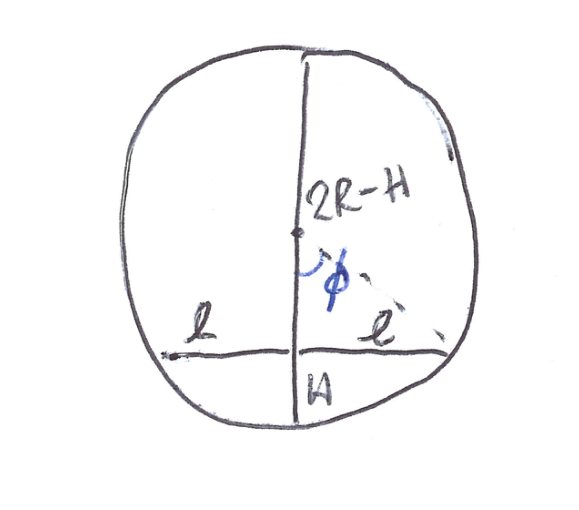
Figure 2: Notation for solution three.
Denote and . Since
one gets
Final answer 0.1
Solution B7: [1.3]
The key is to use a non-rotating frame of reference. If the mass is released close enough to the center, its linear velocity will be small enough for the space station to rotate more than before it hits the ground.
The velocity is given by
distance that the mass flies before hitting the space station
use non-rotating frame of reference to obtain time until impact
Now there are several possible ways to relate and the rotated angle of the space station:
Solution one
This time must match . Obtain the equation
Realizing that there is an infinite number of solutions. 0.2
This equation has one trivial solution , next solution is slightly less than which corresponds to the case (and is thus not correct). The one that gives a lower bound for is the third solution
The equation can be solved graphically or numerically to obtain a close value () which means
Give points if the method is correct, depending on the value of found, according to these intervals: 0.4
: 0.4 pts
: 0.3 pts
or : 0.2 pts
or method is incorrect: 0 pts
Solution two
relation between and rotated angle
obtain equation of the form
Figure 3 gives a plot of . The goal is to find an approximate solution for the second intersection. The first intersection is discarded – it is introduced because of and corresponds to a situation with .
Realizing that there is an infinite number of solutions. 0.2
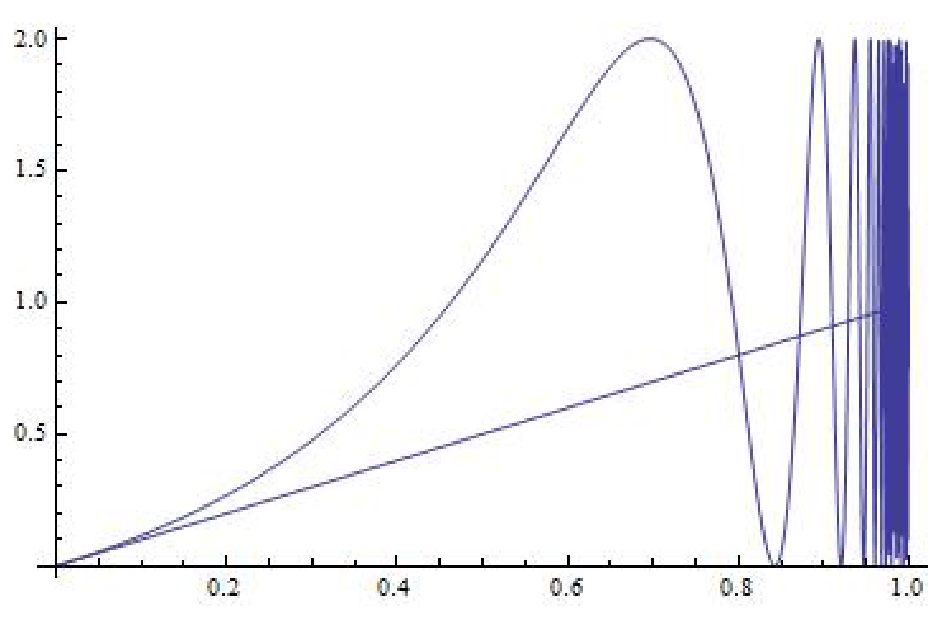
Figure 3: Plot of and
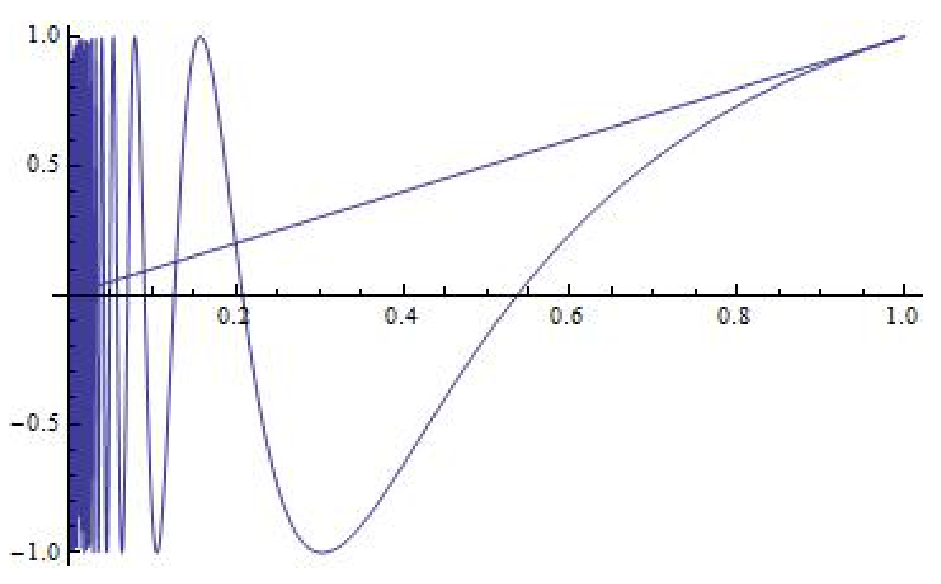
Figure 4: Plot of and
introduce new variable , so that the equation becomes
is then smaller than up to the first solution. In particular it is negative in some region (see figure 4). Finding the third zero thus gives a lower bound for the solution:
give lower bound
Note: the actual result is .
Use the same points for the numerical answer as was mentioned in solution one. 0.4
If the student plots rather than , find solution to : is equivalent to the solution above. Give same number of points.
It is also possible to use .
Solution B8: [1.7]
Note: we did not specify the overall sign of the Coriolis force. Give same amount of points if using opposite convention, but it has to be consistent! Otherwise: subtract 0.1pt for each instance of inconsistency. -0.1
Students are allowed to express everything in terms of , they don’t need to write explicitly. Deduct 0.1pt however if they use instead of .. -0.1
Realize that is standard harmonic oscillation:
Give correct constants from initial conditions
Correct expression for :
Coriolis force in -direction
Realize that this implies that is also a harmonic oscillation… 0.1
…but with a constant movement term superimposed: 0.1
getting the correct amplitude:
Correct answer with correct initial conditions:
Sketch:
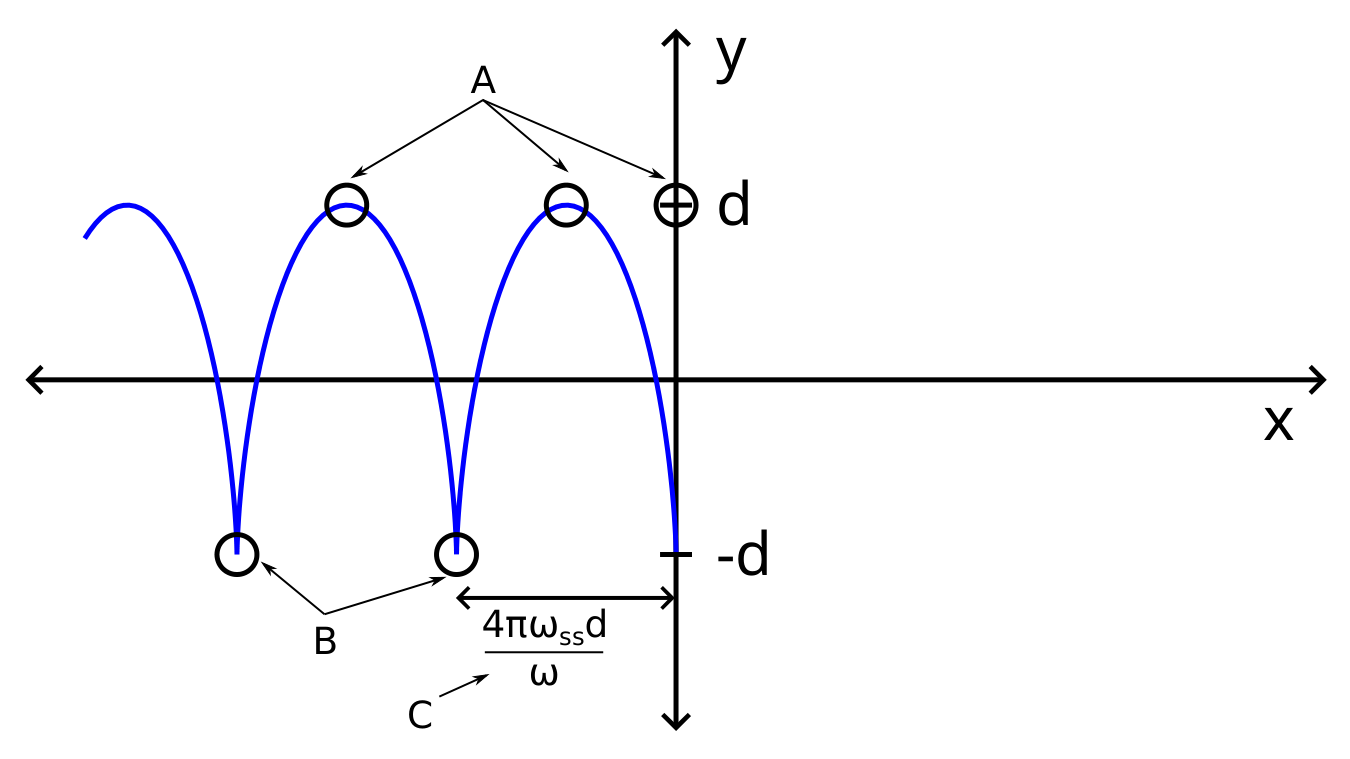
Correct qualitative sketch:
periodic motion 0.1
overall constant movement 0.1
B): cusps 0.1
And additionally correct quantitative sketch:
A)+B): peaks and cusps are at 0.1
C): cusps are at distance from each other 0.2