IPhO 2016, Теория — Задача 3. Large Hadron Collider
IPhO 2016 — Theory Q3 — Large Hadron Collider (10 points) · 10 т.
Условие
Please read the general instructions in the separate envelope before you start this problem.
In this task, the physics of the particle accelerator LHC (Large Hadron Collider) at CERN is discussed. CERN is the world's largest particle physics laboratory. Its main goal is to get insight into the fundamental laws of nature. Two beams of particles are accelerated to high energies, guided around the accelerator ring by a strong magnetic field and then made to collide with each other. The protons are not spread uniformly around the circumference of the accelerator, but they are clustered in so-called bunches. The resulting particles generated by collisions are observed with large detectors. Some parameters of the LHC can be found in table 1.
| LHC ring | |
|---|---|
| Circumference of ring | |
| Number of bunches per proton beam | |
| Number of protons per bunch | |
| Proton beams | |
| Energy of protons | |
| Centre of mass energy |
Table 1: Typical numerical values of relevant LHC parameters.
Particle physicists use convenient units for the energy, momentum and mass: The energy is measured in electron volts []. By definition, is the amount of energy gained by a particle with elementary charge, e, moved through a potential difference of one volt ().
The momentum is measured in units of and the mass in units of , where is the speed of light in vacuum. Since is a very small quantity of energy, particle physicists often use (), () or ().
Part A deals with the acceleration of protons or electrons. Part B is concerned with the identification of particles produced in the collisions at CERN.
Part A. LHC accelerator (6 т.)
Acceleration:
Assume that the protons have been accelerated by a voltage such that their velocity is very close to the speed of light and neglect any energy loss due to radiation or collisions with other particles.
A.1 Find the exact expression for the final velocity of the protons as a function of the accelerating voltage , and physical constants. [0,7 т.]
A design for a future experiment at CERN plans to use the protons from the LHC and to collide them with electrons which have an energy of .
A.2 For particles with high energy and low mass the relative deviation of the final velocity from the speed of light is very small. Find a first order approximation for and calculate for electrons with an energy of using the accelerating voltage and physical constants. [0,8 т.]
We now return to the protons in the LHC. Assume that the beam pipe has a circular shape.
A.3 Derive an expression for the uniform magnetic flux density necessary to keep the proton beam on a circular track. The expression should only contain the energy of the protons , the circumference , fundamental constants and numbers. You may use suitable approximations if their effect is smaller than precision given by the least number of significant digits.
Calculate the magnetic flux density for a proton energy of , neglecting interactions between the protons. [1 т.]
Radiated Power:
An accelerated charged particle radiates energy in the form of electromagnetic waves. The radiated power of a charged particle that circulates with a constant angular velocity depends only on its acceleration , its charge , the speed of light and the permittivity of free space .
A.4 Use dimensional analysis to find an expression for the radiated power . [1 т.]
The real formula for the radiated power contains a factor ; moreover, a full relativistic derivation gives an additional multiplicative factor , with .
A.5 Calculate , the total radiated power of the LHC, for a proton energy of (Note table 1). You may use suitable approximations. [1 т.]
Linear Acceleration:
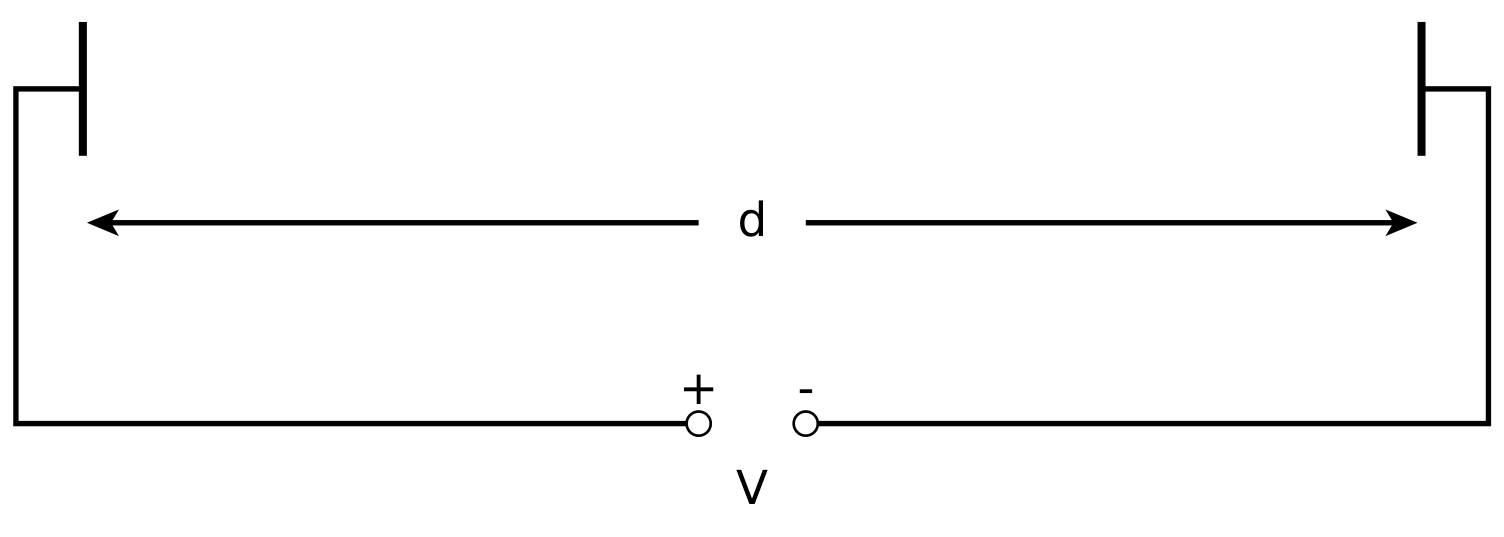
At CERN, protons at rest are accelerated by a linear accelerator of length through a potential difference of . Assume that the electrical field is homogeneous. A linear accelerator consists of two plates as sketched in Figure 1.
A.6 Determine the time that the protons take to pass through this field. [1,5 т.]
Part B. Particle Identification (4 т.)
Time of flight:
It is important to identify the high energy particles that are generated in the collision in order to interpret the interaction process. A simple method is to measure the time () that a particle with known momentum needs to pass a length in a so-called Time-of-Flight (ToF) detector. Typical particles which are identified in the detector, together with their masses, are listed in table 2.
| Particle | Mass |
|---|---|
| Deuteron | |
| Proton | |
| charged Kaon | |
| charged Pion | |
| Electron |
Table 2: Particles and their masses.
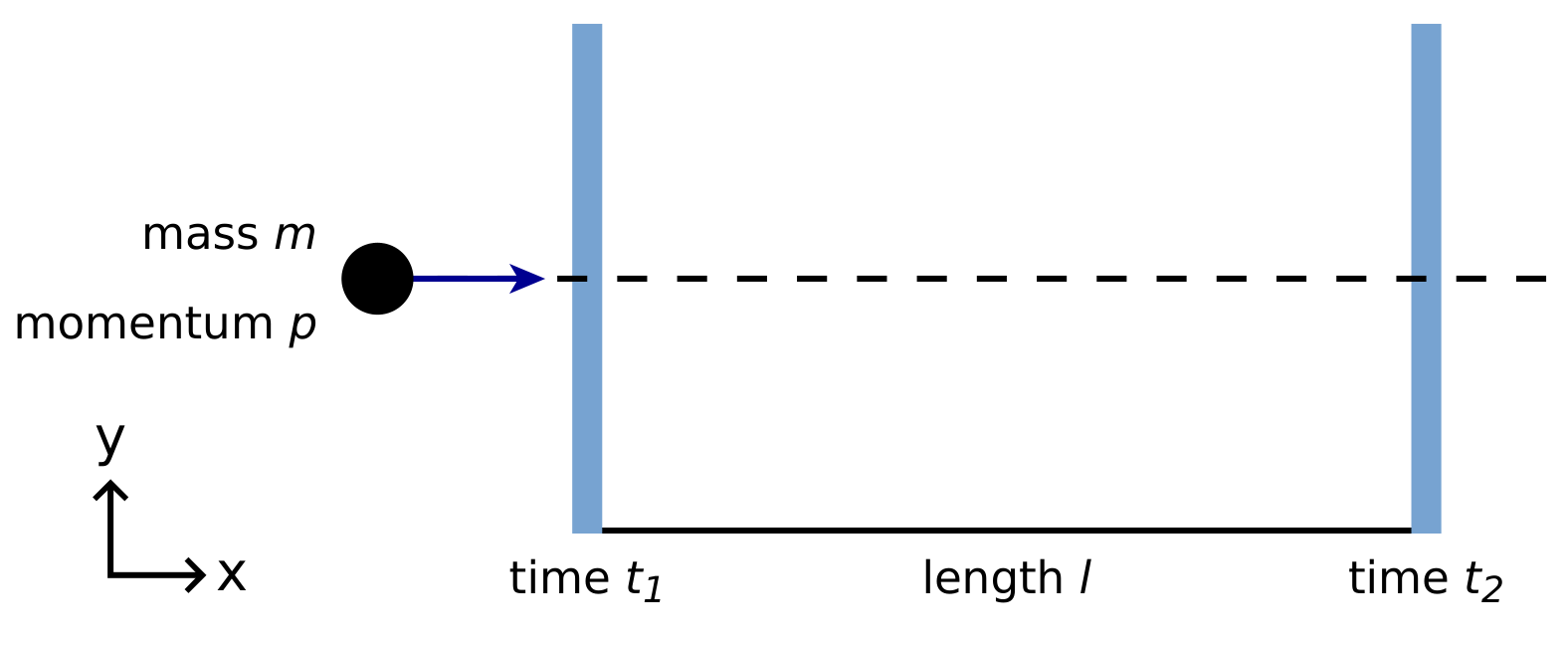
B.1 Express the particle mass in terms of of the momentum , the flight length and the flight time , assuming that particles have elementary charge and travel with velocity close to on straight tracks in the ToF detector and that they travel perpendicular to the two detection planes (see figure 2). [0,8 т.]
B.2 Calculate the minimal length of a ToF detector that allows to safely distinguish a charged kaon from a charged pion, given both their momenta are measured to be . For a good separation it is required that the difference in the time-of-flight is larger than three times the time resolution of the detector. The typical resolution of a ToF detector is . [0,7 т.]
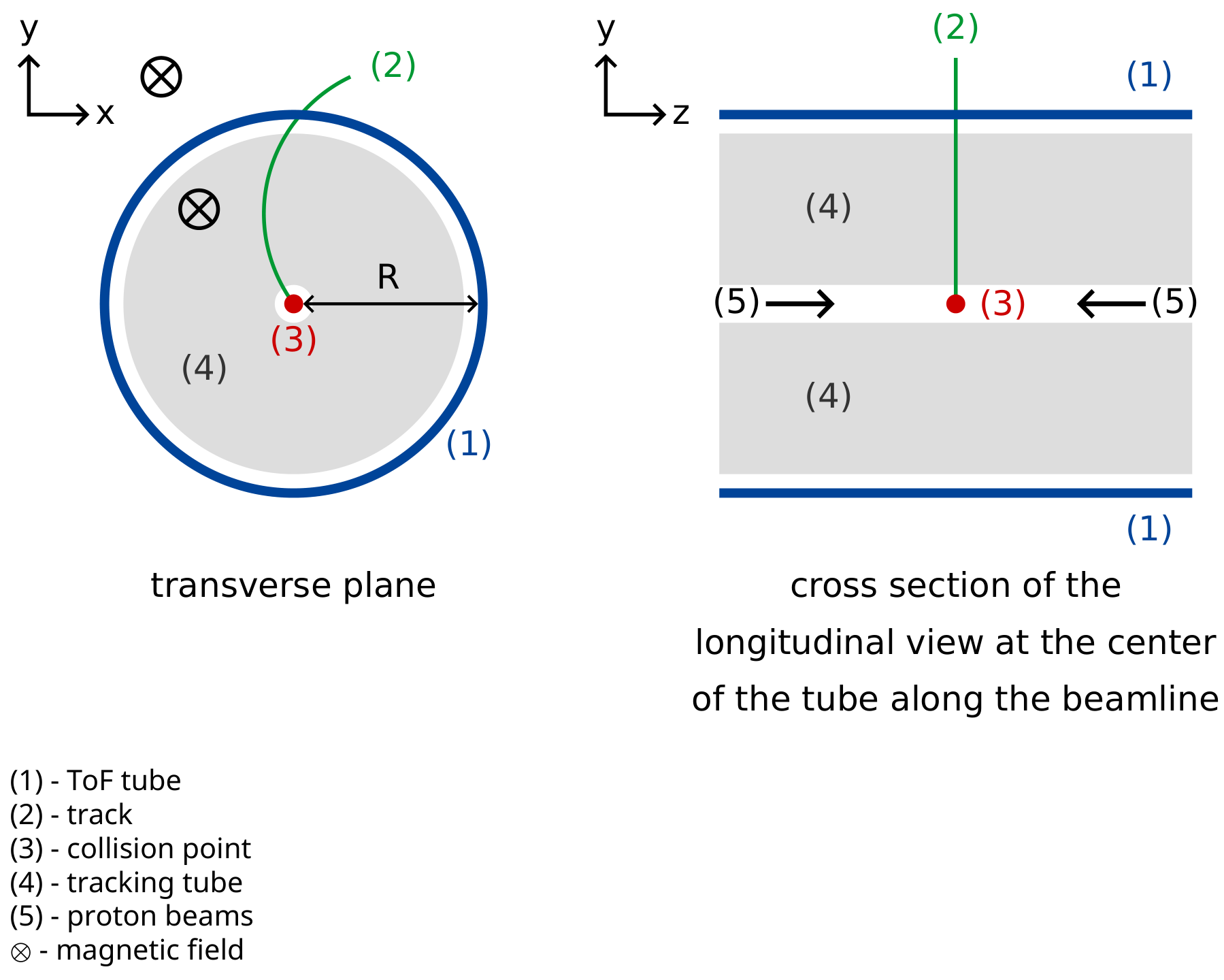
In the following, particles produced in a typical LHC detector are identified in a two stage detector consisting of a tracking detector and a ToF detector. Figure 3 shows the setup in the plane transverse and longitudinal to the proton beams. Both detectors are tubes surrounding the interaction region with the beam passing in the middle of the tubes. The tracking detector measures the trajectory of a charged particle which passes through a magnetic field whose direction is parallel to the proton beams. The radius of the trajectory allows one to determine the transverse momentum of the particle. Since the collision time is known the ToF detector only needs one tube to measure the flight time (time between the collision and the detection in the ToF tube). This ToF tube is situated just outside the tracking chamber. For this task you may assume that all particles created by the collision travel perpendicular to the proton beams, which means that the created particles have no momentum along the direction of the proton beams.
B.3 Express the particle mass in terms of the magnetic flux density , the radius of the ToF tube, fundamental constants and the measured quantities: radius of the track and time-of-flight . [1,7 т.]
We detected four particles and want to identify them. The magnetic flux density in the tracking detector was . The radius of the ToF tube was . Here are the measurements ():
| Particle | Radius of the trajectory | Time of flight |
|---|---|---|
| A | ||
| B | ||
| C | ||
| D |
B.4 Identify the four particles by calculating their mass. [0,8 т.]
Отговори
Part A. LHC accelerator, A.1
Part A. LHC accelerator, A.2
Δ ≃ ½(me c²/(me c² + V e))²
Part A. LHC accelerator, A.3 5.5 T
B = 2πE/(e c L)
Part A. LHC accelerator, A.4
Part A. LHC accelerator, A.5 5.13 kW
Part A. LHC accelerator, A.6 218 ns
Part B. Particle Identification, B.1
Part B. Particle Identification, B.2 1.28 m
Part B. Particle Identification, B.3
Part B. Particle Identification, B.4 Particles A and C are protons, B is a Pion and D a Kaon
Решение
Problem 3 : Solution/marking scheme – Large Hadron Collider (10 points)
Part A. LHC Accelerator (6 points)
A1 (0.7 pt) Find the exact expression for the final velocity of the protons as a function of the accelerating voltage , and fundamental constants.
Solution A1: [0.7]
Conservation of energy:
Penalties
No or incorrect total energy -0.3
Missing rest mass -0.2
Solve for velocity:
without proton rest mass: [0.5]
Solve for velocity:
Classical solution: [0.2]
A2 (0.8 pt) For particles with high energy and low rest mass the relative deviation of the final velocity from the speed of light is very small. Find a suitable approximation for and calculate for electrons with an energy of 60.0 GeV.
Solution A2: [0.8]
velocity (from previous question):
relative difference:
relative difference
classical solution gives no points 0.0
A3 (1.0 pt) Derive an expression for the uniform magnetic flux density necessary to keep the proton beam on a circular track. The expression should only contain the energy of the protons , the circumference , fundamental constants and numbers. You may use suitable approximations if their effect is smaller than the precision given by the least number of significant digits. Calculate the magnetic flux density for a proton energy of TeV.
Solution A3: [1.0]
Balance of forces:
In case of a mistake, partial points can be given for intermediate steps (up to max 0.2). Examples:
Example: Lorentz force 0.1
Example: 0.1
Energy:
Therefore:
With
follows:
Solution:
Penalty for or significant digits -0.1
Calculation without approximations is also correct but does not give more points
Penalty for each algebraic mistake -0.1
Classical calculation gives completely wrong result and maximum 0.3 pt [0.3]
Penalty for or significant digits -0.1
A4 (1.0 pt) An accelerated charged particle radiates energy in the form of electromagnetic waves. The radiated power of a charged particle that circulates with a constant angular velocity depends only on its acceleration a, its charge , the speed of light and the permittivity of free space . Use a dimensional analysis to find an expression for the radiated power .
Solution A4: [1.0]
Ansatz:
Dimensions: , , ,
All dimensions correct 0.3
Three dimensions correct 0.2
Two dimensions correct 0.1
if dimensions: N and Coulomb
From this follows:
Two equations correct 0.1
And therefore:
if dimensions: N and As
From this follows:
Two equations correct 0.1
And therefore:
if dimensions: kg and As
From this follows:
Two equations correct 0.1
And therefore:
Radiated Power:
Other solutions with other units are possible and are accepted
No solution but realise that unit of charge must vanish 0.2
A5 (1.0 pt) Calculate the total radiated power of the LHC for a proton energy of TeV (Note table 1). You may use appropriate approximations.
Solution A5: [1.0]
Radiated Power:
Energy:
Acceleration:
Therefore:
(not required )
Total radiated power:
penalty for missing factor 2 (for the two beams): -0.1 -0.1
penalty for wrong numbers 2808 and/or (numbers come from table 1): -0.1 -0.1
A6 (1.5 pt) Determine the time that the protons need to pass through this field.
Solution A6: [1.5]
2nd Newton's law
Conservation of energy:
Since
Alternative solution [1.5]
2nd Newton's law
velocity from A1 or from conservation of energy
and hence for
Alternative solution: integrate time [1.5]
Energy increases linearly with distance x
Alternative: differential equation [1.5]
classical solution: [0.4]
And hence for the time
Part B. Particle identification (4 points)
B1 (0.8 pt) Express the particle rest mass in terms of the momentum , the flight length and the flight time assuming that the particles with elementary charge travel with velocity close to on straight tracks in the ToF detector and that it travels perpendicular to the two detection planes (see Figure 2).
Solution B1: [0.8]
with velocity
relativistic momentum
gets
mass
Alternative [0.8]
with flight distance: , flight time t gets:
relativistic momentum
therefore the velocity:
insert into the expression for :
mass:
non-relativistic solution: [0.0]
flight time: velocity:
this solution gives no points 0.0
B2 (0.7 pt) Calculate the minimal length of a ToF detector that allows to safely distinguish a charged kaon from a charged pion given both their momenta are measured to be 1.00 GeV/c. For a good separation it is required that the difference in the time-of-flight is larger than three times the time resolution of the detector. The typical resolution of a ToF detector is 150 ps (1 ps = s).
Solution B2: [0.7]
Flight time difference between kaon and pion
Flight time difference between kaon and pion
Penalty for or significant digits -0.1
Non-relativistic solution: [0.3]
Flight time difference between kaon and pion
length:
Penalty for or significant digits -0.1
B3 (1.7 pt) Express the particle mass as a function of the magnetic flux density , the radius of the ToF tube, fundamental constants and the measured quantities: radius of the track and time-of-flight .
Solution B3: [1.7]
Particle is travelling perpendicular to the beam line hence the track length is given by the length of the arc
Lorentz force transverse momentum, since there is no longitudinal momentum, the momentum is the same as the transverse momentum
Use formula from B1 to calculate the mass
track length: length of arc
penalty for just taking a straight track () -0.4
partial points for intermediate steps, maximum 0.4
Lorentz force
partial points for intermediate steps, maximum 0.3
longitudinal momentum=0 0.1
momentum
partial points for intermediate steps, maximum 0.5
Non-relativistic: track length: length of arc [0.9]
penalty for just taking a straight track () -0.4
partial points for intermediate steps, maximum 0.4
partial points for intermediate steps, maximum 0.3
B4 (0.8 pt) Identify the four particles by calculating their mass.
| Particle | Radius r [m] | Time of flight [ns] |
|---|---|---|
| A | 5.10 | 20 |
| B | 2.94 | 14 |
| C | 6.06 | 18 |
| D | 2.32 | 25 |
Solution B4: [0.8]
| Particle | arc | p | p | pt/l | pt/l | pt/l | Mass | Mass |
|---|---|---|---|---|---|---|---|---|
| A | 3.786 | 764.47 | 4.0855 | 4.038 | 1210.6 | 2.158 | 938.65 | 1.673 |
| B | 4.002 | 440.69 | 2.3552 | 1.542 | 462.2 | 0.824 | 139.32 | 0.248 |
| C | 3.760 | 908.37 | 4.8546 | 4.349 | 1303.7 | 2.324 | 935.10 | 1.667 |
| D | 4.283 | 347.76 | 1.8585 | 2.030 | 608.6 | 1.085 | 499.44 | 0.890 |
Particles A and C are protons, B is a Pion and D a Kaon
correct mass and identification: per particle 0.2
penalty for correct mass but no or wrong identification for 1 or 2 particles -0.1
penalty for correct mass but no or wrong identification for 3 or 4 particles -0.2
wrong mass, correct momentum:per particle 0.1
wrong momentum, correct arc for 3 or 4 particles 0.2
wrong momentum, correct arc for 1 or 2 particles 0.1
non relativistic solution Particle identification is not possible [0.4]
| Particle | arc | |||||
|---|---|---|---|---|---|---|
| A | 3.786 | 764.47 | 4.0855 | 4.038 | 1210.6 | 2.158 |
| B | 4.010 | 440.69 | 2.3552 | 1.542 | 462.2 | 0.824 |
| C | 3.760 | 908.37 | 4.8546 | 4.349 | 1303.7 | 2.324 |
| D | 4.283 | 347.76 | 1.8585 | 2.030 | 608.6 | 1.085 |
correct mass or correct momentum: per particle 0.1
wrong momentum, correct arc for 3 or 4 particles 0.2
wrong momentum, correct arc for 1 or 2 particles 0.1