IPhO 2017, Теория — Задача 1. Dark Matter
T1 · Dark Matter · 10 т.
General instructions: Theoretical Examination (30 points)
The theoretical examination lasts for 5 hours and is worth a total of 30 points.
Before the exam
You must not open the envelopes containing the problems before the sound signal indicating the beginning of the examination.
The beginning and end of the examination will be indicated by a sound signal. There will be announcements every hour indicating the elapsed time, as well as fifteen minutes before the end of the examination (before the final sound signal).
During the exam
- Dedicated answer sheets are provided for writing your answers. Enter the final answers into the appropriate boxes in the corresponding answer sheet. For every problem, there are extra blank work sheets for carrying out detailed work. Always use the work sheets that belong to the problem you are currently working on (check the problem number in the header). If you have written something on any sheet which you do not want to be graded, cross it out. Only use the front side of every page.
- In your answers, try to be as concise as possible: use equations, logical operators and sketches to illustrate your thoughts whenever possible. Avoid the use of long sentences.
- Please give an appropriate number of significant digits when stating numbers.
- You may often be able to solve later parts of a problem without having solved the previous ones.
- A list of physical constants is given on separate page.
You are not allowed to leave your working place without permission. If you need any assistance (need to refill your drinking water bottle, broken calculator, need to visit a restroom, etc.), please draw the attention of a team guide by lifting up one of the three flags into the air ("Refill my water bottle, please", "I need to go to toilet, please", or "I need help, please" in all other cases).
At the end of the exam
- At the end of the examination you must stop writing immediately.
- For every problem, sort the corresponding sheets in the following order: problem sheets, answer sheets, work sheets and scratch paper.
- Put all the sheets belonging to one problem into the same envelope. Also put the general instructions into the remaining separate envelope. Make sure your student code is written on each envelope. Also hand in empty sheets. You are not allowed to take any sheets of paper out of the examination area.
- Leave the calculator provided by the organizers on the table.
Editorial source note: these are the shared instructions for all three theory problems. This edition contains only T1 (10 points). The separate physical-constants sheet is not present in the supplied standalone catalogue pack.
Условие
The first formal inference for the existence of dark matter was provided by Fritz Zwicky based on his observation on the dynamics of the Coma galaxy cluster, a cluster of galaxies that consist of about a thousand of galaxies. Zwicky used the Virial theorem to estimate the mass of the galaxy cluster. In a simple sun-planet system, where the planet revolves around the sun in a circular orbit, the Virial theorem states that the kinetic energy of the planet is exactly related to its gravitational potential energy. While in a general case for a system of many particles bounded by some interaction, the Virial theorem, relates the time average total kinetic energy with its time average total potential energy.
In 1933, based on his observation on the velocity of the galaxies near the edge of the Coma galaxy cluster, Zwicky estimated that the cluster has more mass than what was visually observed (i.e. the galaxies). The gravitational attraction from the observable matter (the galaxies) was too small to account for the velocities of the galaxies. Thus there must be some hidden masses that account for such a large velocity. That hidden mass is the dark matter mass. In what follows, assume that the mass of each galaxy is the sum of its visible mass and the mass of the dark matter which moves together with that galaxy, and dark matter interacts with visible matter only gravitationally.
A. Cluster of Galaxies
Consider a cluster of galaxies consist of a large number of galaxies and dark matter that are distributed homogeneously in a sphere of radius with the total mass (galaxies and dark matters) of the cluster . Assume that the average total mass (visible and dark matter) of a galaxy is .
A.1 Assuming a continuous distribution of matter in the cluster, find the total gravitational potential energy of the cluster, in terms of and . [1 т.]
A.2 Due to cosmological expansion, any distance object will be moving away from an observer on Earth with a speed that depends on the distance from the observer to the object. A certain Lyman (a hydrogen emission spectral line) frequency from a type IA supernova on the -th galaxy in the galaxy cluster is observed to be , with , while the same corresponding Lyman frequency on Earth is .
Determine the average speed of the whole galaxy cluster moving away from the Earth in terms of (with ), and . Note that a galaxy speed is very small compared to the speed of light . [0,5 т.]
A.3 By assuming that the galaxies velocities with respect to the center of the cluster are isotropic (the same in all direction), determine the root-mean square speed of the galaxies with respect to the center of the cluster in terms of , (with ), and . From this result determine the mean kinetic energy of a galaxy with respect to the center of the cluster in terms of and . [1,5 т.]
A.4 To find the total mass of the cluster, one can use Virial theorem. The theorem stated that for a system of particles bounded by their conservative force,
where is the time average total kinetic energy, is the time average total potential energy, and is a constant. This theorem can be derived by assuming that for a system of particles bounded by its own interaction, the magnitudes of the position and momentum of each particle are finite, and thus the following quantity
is finite.
Using the fact that the time average over a long period of time of vanishes, , determine in the Virial theorem above for the case of gravitational interaction. (Hint: Try to do the problem with the summation in for a small finite number of galaxies). [1,7 т.]
A.5 From the previous results determine the total dark matter mass of the cluster in terms of , , and , where is the average total visible mass of a galaxy. Note that the root-mean square speed of the dark matter is the same as that of the galaxies. [0,5 т.]
B. Dark Matter in a Galaxy
Dark matter also exists inside and around a galaxy. Consider a spherical galaxy with a visible edge radius (an approximate outermost distance where a large number of stars still visible, but note that a very small number of stars may still be distributed in the region beyond ). Assume that the stars in the galaxy are point particles with an average mass . The stars in the galaxy, distributed homogeneously with a number density , are assumed to move in circular orbits.
B.1 If the galaxy consists only of stars, find the speed of a star as a function of its distance to the center of the galaxy and sketch for and . [0,8 т.]
B.2 The existence of dark matter can be inferred from the galaxy rotation curve, which is a plot of obtained from observations. The figure below shows a common pattern of the galaxy rotation curve. You may assume simplifyingly that is a linear function for and a constant for .
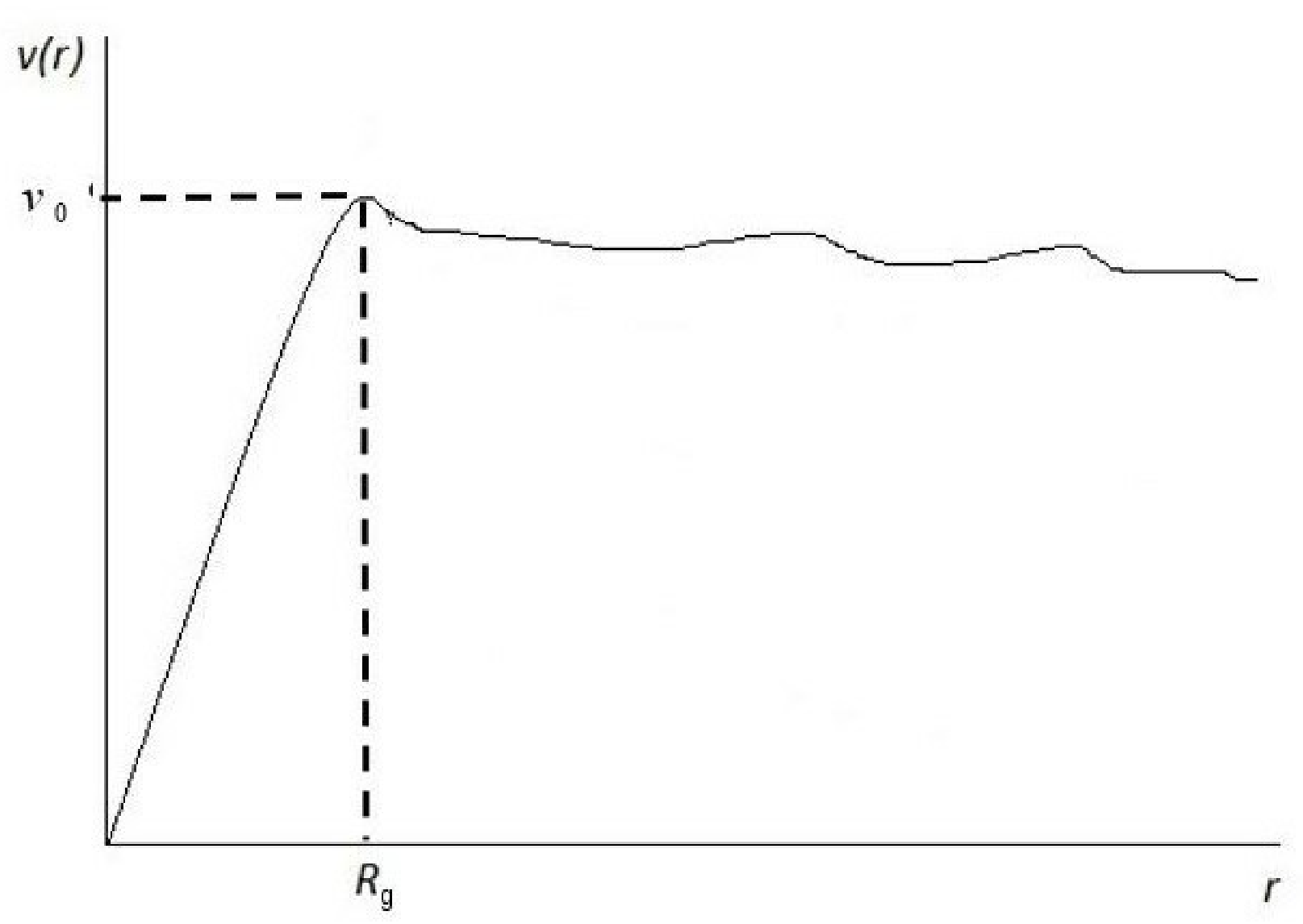
Find the total mass of that part of the galaxy which lies within the sphere of radius in terms of and . [0,5 т.]
B.3 The discrepancy between the figure in B.2 and the plot obtained in B.1 indicates the existence of dark matter.
Determine the dark matter mass density as a function of , , , , and for and . [1,5 т.]
C. Interstellar Gas and Dark Matter
Now consider a young galaxy whose mass is dominated by interstellar gas and dark matters (neglect the mass of the stars). The interstellar gas is assumed to consist of identical particles of mass . The number density and temperature of the gas depend on the distance from the center of the galaxy . Although many physical processes happen in the gas, we can assume the gas is in a hydrostatic equilibrium due to its pressure and the galaxy gravitational attraction.
C.1 Find the pressure gradient of the gas , in terms of , and . Here, is the total mass of gas and dark matters within a sphere of radius from the galaxy center. [0,5 т.]
C.2 Assuming the interstellar gas as an ideal gas, find in terms of , and their derivatives with respect to . [0,5 т.]
C.3 Next for simplicity assume that the gas is in isothermal distribution at temperature and the interstellar gas number density is given by
where and are some constants.
Find the dark matter mass density as a function of inside the galaxy. [1 т.]
Решение
Official solutions and marking scheme. All printed grading subdivisions and alternative derivations are retained below.
A. Cluster of Galaxies
A.1 Potential energy for a system of a spherical object with mass and a test particle with mass at a distance is given by
0.2 pts. Thus for a sphere of radius
0.6 pts. Then using the total mass of the system we have
0.2 pts. Total 1.0 pts. [1 т.]
A.2 Using the Doppler Effect,
where and . Thus the -th galaxy moving away (radial) speed is
Alternative without approximation:
0.2 pts. All the galaxies in the galaxy cluster will be moving away together due to the cosmological expansion. Thus the average moving away speed of the galaxies in the cluster is
Alternative without approximation:
0.3 pts. Total 0.5 pts.
Editorial source note: “without approximation” is the key's wording for its classical Doppler expression; it is not a relativistic Doppler formula. [0,5 т.]
A.3 The galaxy moving away speed , in part A.2, is only one component of the three component of the galaxy velocity. Thus the average square speed of each galaxy with respect to the center of the cluster is
Due to isotropic assumption
0.5 pts. And thus the root mean square of the galaxy speed with respect to the cluster center is
Alternative without approximation:
0.7 pts. The mean kinetic energy of the galaxies with respect to the center of the cluster is
0.3 pts. Total 1.5 pts.
Editorial source note: the key swaps to in one line and prints in the intermediate reciprocal-frequency expression, whereas its final expression has . The source's summation grouping in the component formula is also retained. [1,5 т.]
A.4 The time average of vanishes
Now
0.6 pts. Where is the total kinetic energy of the system. Since the gravitational force on -th particle comes from its interaction with other particles then
Alternative proof:
Collecting terms and noting that we have
0.9 pts. Thus we have
And by taking its time average we obtain and thus . Therefore .
0.2 pts. Total 1.7 pts.
Editorial source note: the alternative expansion prints in place of a position vector and ends with ; these apparent typographical errors are retained. [1,7 т.]
A.5 Using Virial theorem, and since the dark matter has the same root mean square speed as the galaxy, then we have
0.3 pts. From which we have
0.1 pts. And the dark matter mass is then
0.1 pts. Total 0.5 pts. [0,5 т.]
B. Dark Matter in a Galaxy
B.1 Answer B.1: The gravitational attraction for a particle at a distance from the center of the sphere comes only from particles inside a spherical volume of radius . For particle inside the sphere with mass , assuming the particle is orbiting the center of mass in a circular orbit, we have
0.3 pts. With is the total mass inside a sphere of radius
Thus we have
0.2 pts. While for particle outside the sphere, we have
0.2 pts. The sketch is given below
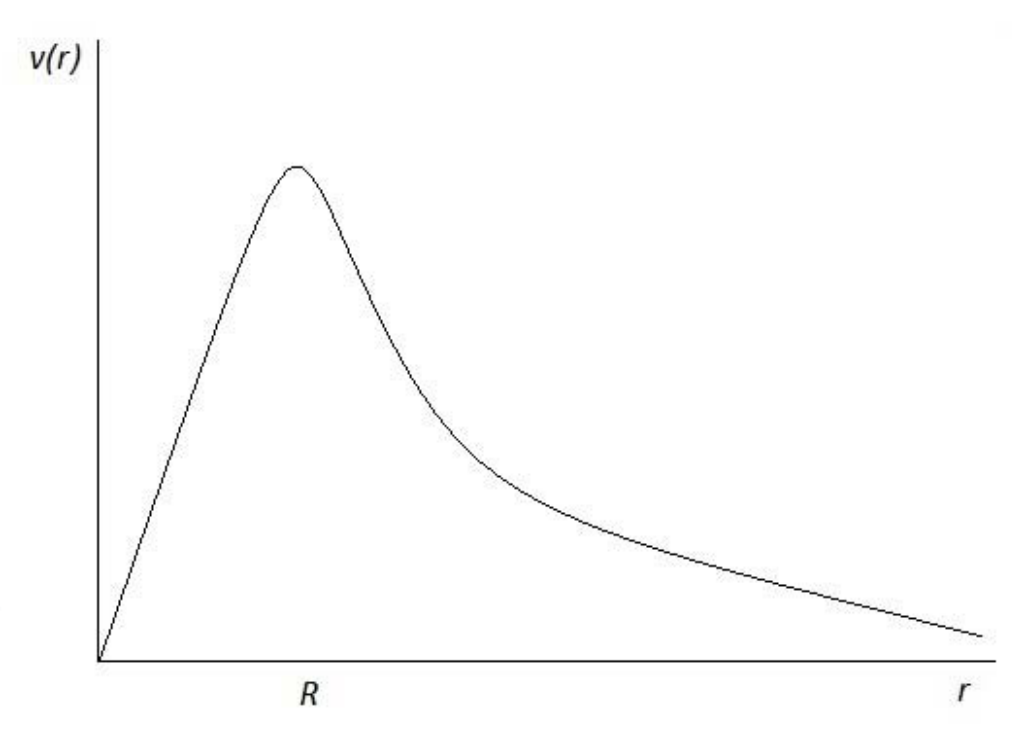
0.1 pts. Total 0.8 pts.
Editorial source note: the first force equation prints rather than , and the exterior formula and sketch use rather than . [0,8 т.]
B.2 The total mass can be inferred from
Thus
0.5 pts. Total 0.5 pts. [0,5 т.]
B.3 Base on the previous answer in B.1, if the mass of the galaxy comes only from the visible stars, then the galaxy rotation curve should fall proportional to on the outside at a distance . But in the figure of problem b) the curve remain constant after , we can infer from
To make constant, then should be proportional to for , i.e. for , with is a constant.
0.3 pts. While for , to obtain a linear plot proportional to , then should be proportional to , i.e. .
0.3 pts. Thus for we have
Thus total mass density .
0.2 pts.
Thus the dark matter mass density
0.2 pts. While for we have
0.2 pts. Now to find the constant .
Thus and .
We can also find from the following
Thus the dark matter mass density (which is also the total mass density since for .
0.3 pts. Total 1.5 pts.
Editorial source note: the source changes to and to in intermediate lines, and uses both for dark matter and total density. Its unprimed inside the first integral and unmatched prose parenthesis are retained. [1,5 т.]
C. Interstellar Gas and Dark Matter
C.1 Consider a very small volume of a disk with area and thickness , see Fig.1
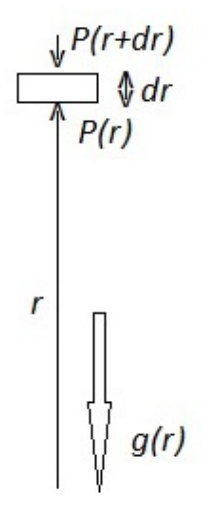
In hydrostatic equilibrium we have
0.3 pts.
0.2 pts. Total 0.5 pts. [0,5 т.]
C.2 Using the ideal gas law where where is the number density, we have
Thus we have
0.5 pts. Total 0.5 pts. [0,5 т.]
C.3 If we have isothermal distribution, we have and
0.2 pts. From information about interstellar gas number density, we have
Thus we have
0.2 pts. Mass density of the interstellar gas is
Thus
0.3 pts.
0.3 pts. Total 1.0 pts. [1 т.]
AT1 answer sheet
The official five-page form has six Student Code boxes, blank answer spaces and a blank Marks column. Its A heading reads “Cluster of Galaxie”; B reads “Dark Matter in Galaxy”. The downloadable original preserves the writing space, including the continuation of B.1 on otherwise blank page 3.
| Question | Printed answer fields | Points |
|---|---|---|
| A.1 | 1.0 | |
| A.2 | 0.5 | |
| A.3 | ; | 1.5 |
| A.4 | 1.7 | |
| A.5 | 0.5 | |
| B.1 | For : ; for : ; sketch for both ranges | 0.8 |
| B.2 | 0.5 | |
| B.3 | For : ; for : | 1.5 |
| C.1 | 0.5 | |
| C.2 | 0.5 | |
| C.3 | 1.0 |
The form prints instead of the question's , and its B.1 boundary inequalities differ from the question.
Page 5: DO NOT WRITE BELOW
| SECTION | SCORE |
|---|---|
| A | |
| B | |
| C | |
| TOTAL |
Оригинал в Архива: 1.pdf · официални решения: 1_sol.pdf · допълнителни данни: 1_anssheet.pdf · допълнителни данни: th_instructions.pdf