IPhO 2017, Теория — Задача 2. Earthquake, Volcano and Tsunami
T2 · Earthquake, Volcano and Tsunami · 10 т.
General instructions: Theoretical Examination (30 points)
The theoretical examination lasts for 5 hours and is worth a total of 30 points.
Before the exam
You must not open the envelopes containing the problems before the sound signal indicating the beginning of the examination.
The beginning and end of the examination will be indicated by a sound signal. There will be announcements every hour indicating the elapsed time, as well as fifteen minutes before the end of the examination (before the final sound signal).
During the exam
- Dedicated answer sheets are provided for writing your answers. Enter the final answers into the appropriate boxes in the corresponding answer sheet. For every problem, there are extra blank work sheets for carrying out detailed work. Always use the work sheets that belong to the problem you are currently working on (check the problem number in the header). If you have written something on any sheet which you do not want to be graded, cross it out. Only use the front side of every page.
- In your answers, try to be as concise as possible: use equations, logical operators and sketches to illustrate your thoughts whenever possible. Avoid the use of long sentences.
- Please give an appropriate number of significant digits when stating numbers.
- You may often be able to solve later parts of a problem without having solved the previous ones.
- A list of physical constants is given on separate page.
You are not allowed to leave your working place without permission. If you need any assistance (need to refill your drinking water bottle, broken calculator, need to visit a restroom, etc.), please draw the attention of a team guide by lifting up one of the three flags into the air ("Refill my water bottle, please", "I need to go to the toilet, please", or "I need help, please" in all other cases).
At the end of the exam
- At the end of the examination you must stop writing immediately.
- For every problem, sort the corresponding sheets in the following order: problem sheets, answer sheets, work sheets and scratch paper.
- Put all the sheets belonging to one problem into the same envelope. Also put the general instructions into the remaining separate envelope. Make sure your student code is written on each envelope. Also hand in empty sheets. You are not allowed to take any sheets of paper out of the examination area.
- Leave the calculator provided by the organizers on the table.
Editorial source note: these are the shared instructions for all three theory problems. This edition contains only T2 (10 points). The separate physical-constants sheet is not present in the supplied standalone catalogue pack.
Условие
Indonesia is the supermarket of natural hazards. Almost all of the natural hazards have occurred in Indonesia, such as volcano eruptions, earthquakes and tsunami.
A. Merapi Volcano Eruption (1,3 т.)
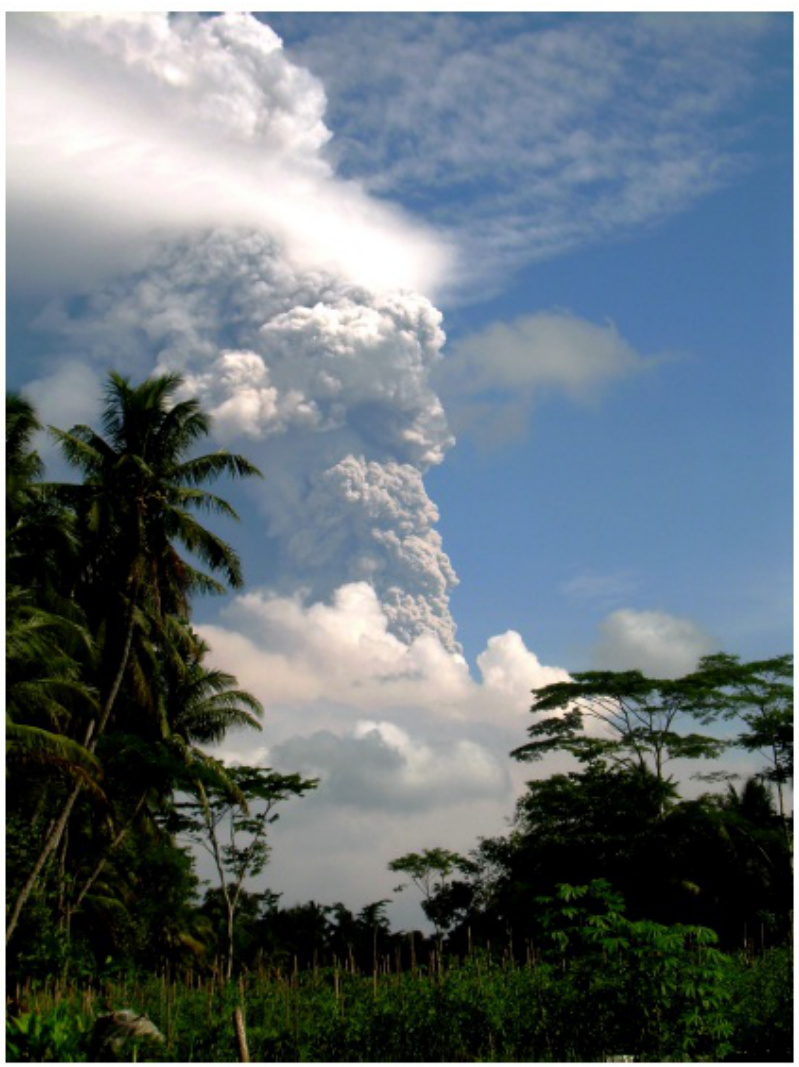
Merapi volcano in Yogyakarta is one of the most active volcano in Java. Pyroclastic flows are well-known eruption characteristics of the volcano. The pyroclastic flow is a hot mixture of gas and rock which travels away from a volcano. In October 26th, 2010, Merapi showed his explosive character by producing an ash plume that reached 12 km altitude (Fig. 1) and pyroclastic currents displacing more than 20,000 people around the volcano.
Let us look at the causes of the largest eruption of Merapi in 2010. It is known by geophysicists that the influence of the external water into the magma plays an important role to the explosive behavior of volcanic eruptions (hydro magmatic eruptions). Let's assume that we dealt with a volcano as a system that consists of mixture of magmatic particles and water. The volcano vents structures and atmosphere are being boundary of the system. The explosive eruption is considered to be happening in two stages, (1) an instantaneous magma-water interaction, and (2) a system expansion. In the first stage, a mass of magma () at an absolute temperature () mixes with a mass of external water () at an absolute temperature (). The thermal equilibrium is reached almost instantaneously. This interaction can be perceived as a nearly-constant volume process. Latent heat of evaporation of water and latent heat of melting of magma can be neglected.
A.1 Find the equilibrium temperature at the first stage in terms of the masses and heat capacity per unit mass of water and magma . [0,5 т.]
A.2 Determine its equilibrium pressure at the first stage by assuming that the mixture can be modeled as ideal gas. Assume that the volume per unit mole of the mixture is . [0,3 т.]
A.3 The system expansion (the second stage) can occur through several possibilities, one of which is thermal detonation. Although such process is quite complicated, we can empirically measure the relative velocity of the erupted mixture. The velocity of gas during the eruption depend on the pressure , the total mass and the volume of the mixture in the conduit of a volcano.
Express the velocity of gas during the eruption in terms of , , and up to a proportional constant .
The observed pressure is around the order of 100 MPa. This makes the eruption (relative) velocity can be as large as ballistic velocity. [0,5 т.]
B. The Yogyakarta Earthquake (5,7 т.)
The 2006 Yogyakarta earthquake of magnitude , which destroyed many buildings in the Bantul and Yogyakarta area, occured at 05:54:00.00 local time or 22:54:00.00 UTC. The earthquake was caused by a sudden displacement of the Opak fault segment (see Fig. 2). The hypocenter was located 15 km below the surface.
The seismic wave that propagates on the earth crust can be recorded using seismometer. The diagram from seismometer is called seismogram (Fig. 2 and 3, Lower graph). The seismograms represent the vertical ground velocity as a function of time recorded by the seismic station at Gamping Station Yogyakarta (YOGI) (Fig. 2) and Denpasar, Bali (DNP) (Fig. 3). In general, seismic wave consists of three wave types: the longitudinal or primary (-wave), the transversal or secondary (-wave), and the surface wave. The -wave and -wave travel in the subsurface while the surface wave travels along the Earth surface. Seismic waves traveling through subsurfaces to the stations can be divided into those that propagate in a straight line, those that are reflected by a layer's boundary, and those that are refracted into the next layer. The longitudinal wave or the primary wave has the highest velocity, while the surface wave has the lowest velocity, around 60% of the -wave.
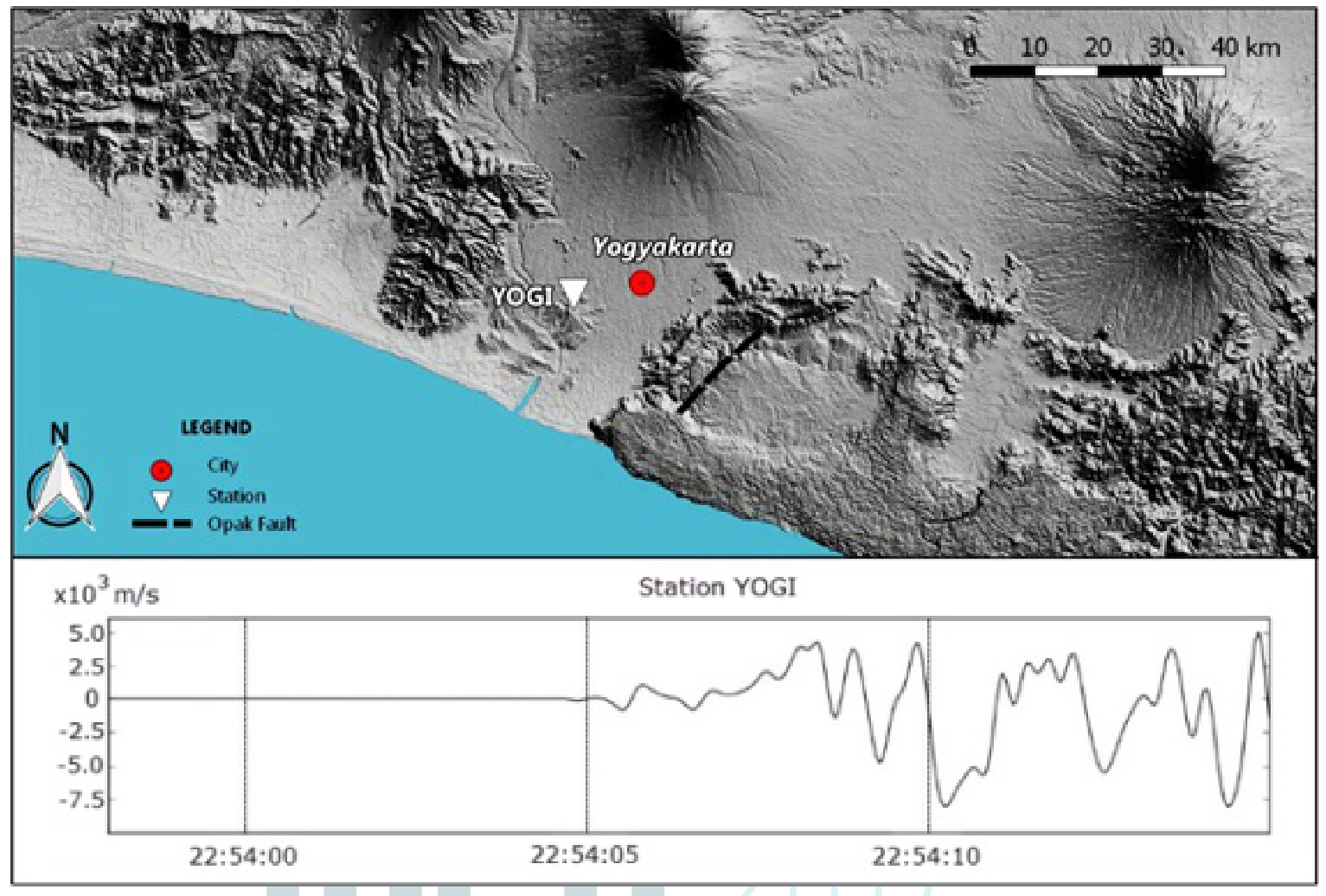
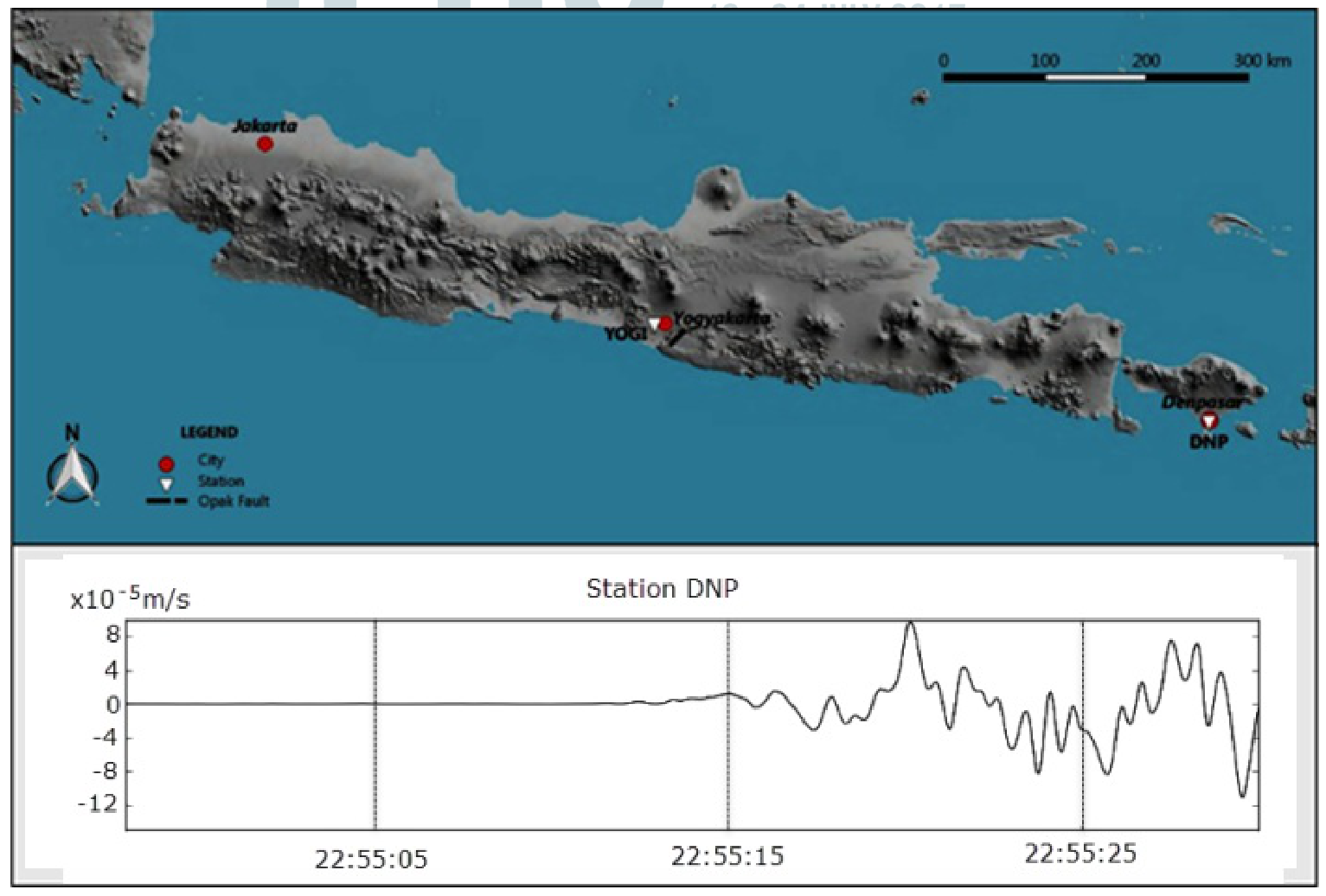
The distance between the epicenter (the projection of hypocenter on the Earth surface) and the YOGI and DNP stations respectively are 22.5 km and 500 km. The depth of the Earth crust layer in Java, Indonesia, is 30 km. Beneath the Earth's crust is the Earth's mantle layer. Just like other wave phenomena, seismic wave also satisfies the Snell's law. The seismic wave can also be reflected by the mantle layer. In this problem we assume that the earth curvature is neglected.
B.1 Fig. 2 shows the seismogram at the YOGI station. Use the data to find the velocity of the -wave in the Earth crust. [0,5 т.]
B.2 Find the travel time of the direct Wave and reflected wave due to the Yogyakarta earthquake that arrived at the DNP station in Denpasar. [0,6 т.]
B.3 By assuming that the Earth is composed of only two layers: the crust and the mantle, the primary wave propagates in the crust and in the mantle with different constant velocities. The velocity in the mantle is faster than in the crust. Note that -wave refracted into the mantle at the right angle () is being partly refracted back into the crust along its entire path of propagation along the crust-mantle boundary.
Find the velocity of the -wave in the mantle. [1,2 т.]
B.4 For a more realistic Earth structure, the crust can be divided into a number of thin layers so that the velocity of the seismic wave is a function of the depth according to where is a constant and the hypocenter is approximated on the surface. In this model, the wave ray is curving.
Let us define the ray parameter , where is the angle between the ray and the normal. Suppose a seismic wave arrives to the station with ray parameter ; express the distance to the hypocenter in terms of , , and . Assume that the hypocenter is very close to the ground surface. [1,4 т.]
B.5 Find the travel time from hypocenter to any station, in form of integral over . [1 т.]
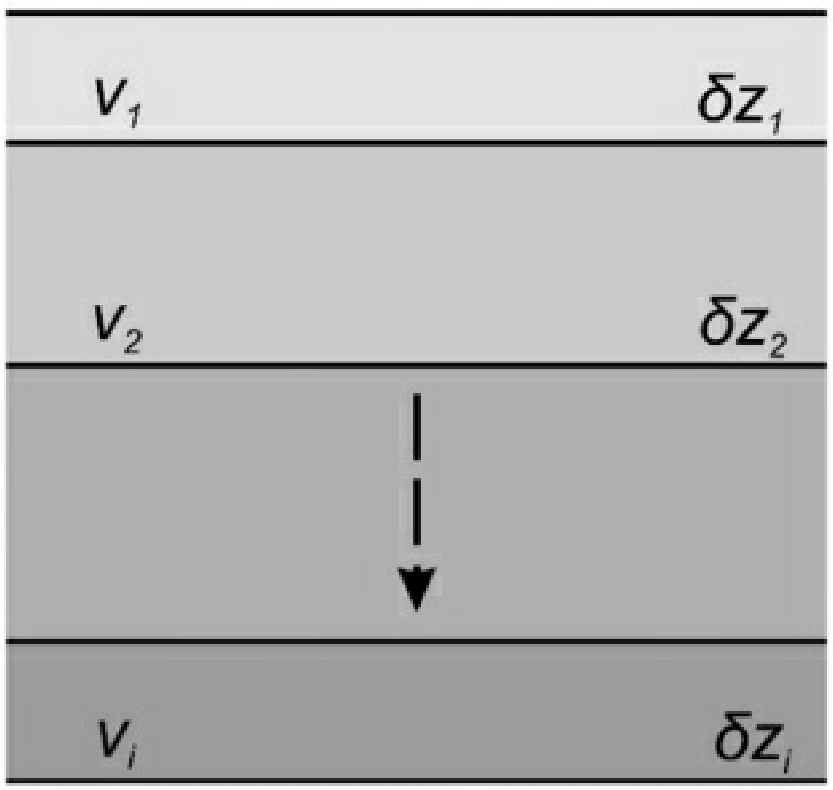
B.6 The earth consists of a stack of homogeneous layers with the velocity of each layer is and the thickness of .
From the result of the previous problem, approximate the travel time () from the hypocenter to DNP station by assuming that the crust consists of only three discretized layers, (), characterized by km/sec, km/sec, km/sec, sec/km, km, km, km.
[1 т.]
C. Java Tsunami (3 т.)
The 2006 Pangandaran earthquake and tsunami occurred on July 17 at 15:19:27 local time off the coast of west and central Java. During the earthquake where the epicenter fault is on the ocean floor, the fault may be displaced producing a remarkably large water wave called tsunami. In other words, a tsunami is a shallow-water wave which is initiated by a tiny amplitude, but with an extremely large wavelength. Consider a sudden fault causing a lifting of some ocean floor as shown in Fig. 5. Assume that the energy of the earthquake is transformed to the potential energy of this raised ocean water. For simple model we approximate that the raised water has a geometry of a box with its area of (where ) and height of .
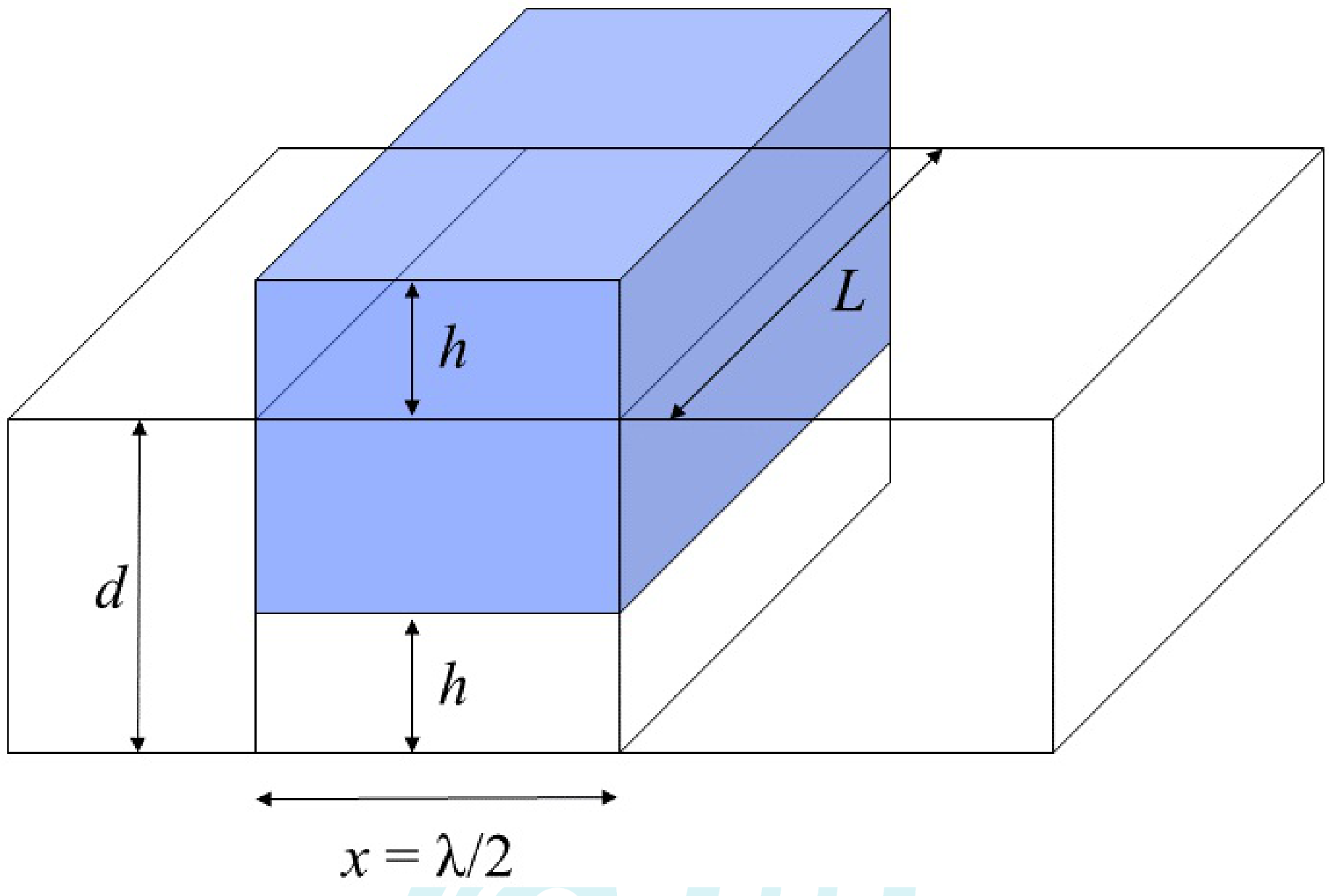
C.1 Find the potential energy stored in the raised ocean water due to the earthquake with respect to ocean surface. Assume that the density of sea water is . [0,5 т.]
C.2 Find the speed of tsunami wave up to dimensionless factor. [1,2 т.]
C.3 Using energy argument, determine the amplitude of the tsunami wave as a function of the depth, assuming that the depth varies slowly and also knowing that at a depth of the amplitude is . [1,3 т.]
Решение
Official solutions and marking scheme. Total score for Problem T2: Section A 1.3 points; Section B 5.7 points; Section C 3.0 points. Total: 10 points.
A. Merapi Volcano Eruption (1,3 т.)
A.1 Using Black's Principle the equilibrium temperature can be obtained
Thus,
0.5 pts. [0,5 т.]
A.2 For ideal gas,
thus
0.3 pts. [0,3 т.]
A.3 The relative velocity can be expressed as
where is a dimensionless constant.
Using dimensional analysis, one can obtain that
Therefore
0.5 pts. Total score: 1.3 pts. [0,5 т.]
B. The Yogyakarta Earthquake (5,7 т.)
B.1 From the given seismogram, fig. 2
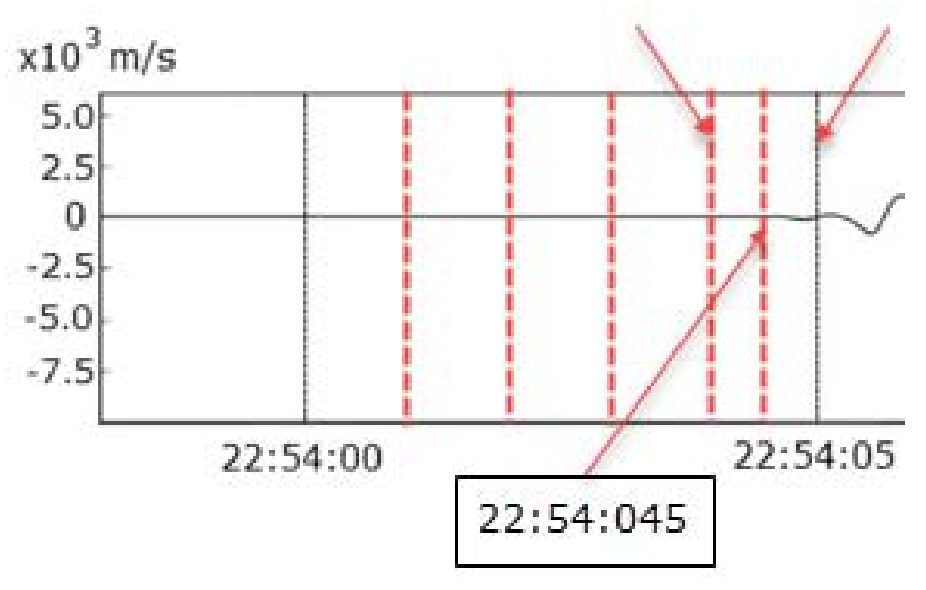
One can see that the -wave arrived at 22:54:045 or (4.5–5.5) seconds after the earthquake occurred at the hypocenter. 0.3 pts.
Since the horizontal distance from the epicenter to the seismic station in Gamping is 22.5 km, and the depth of the hypocenter is 15 km, the distance from the hypocenter to the station is
0.1 pts.
Therefore, the P-wave velocity is
0.1 pts. [0,5 т.]
B.2 Direct wave:
0.2 pts.
As in the case of an optical wave, the Snell's law is also applicable to the seismic wave.
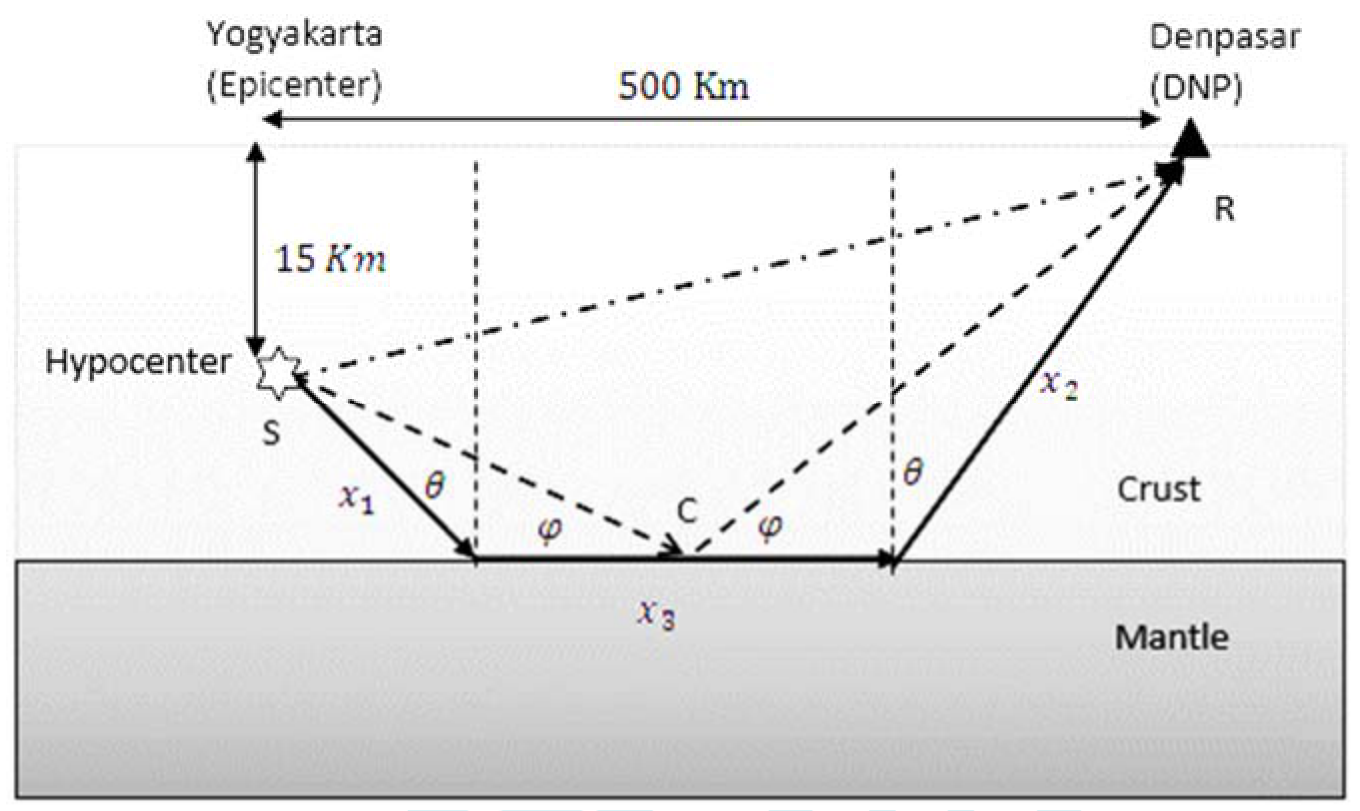
Reflected wave:
0.4 pts.
Editorial source note: the printed intermediate numerator and stated numerical result are retained; that numerator is inconsistent with . [0,6 т.]
B.3 Velocity of P-wave on the mantle. The fastest wave crossing the mantle is that propagating along the upperpart of the mantle. From the figure on refracted wave, we obtain that
0.4 pts.
The total travel time:
Arranging the equation, we get
whose solution is
0.5 pts.
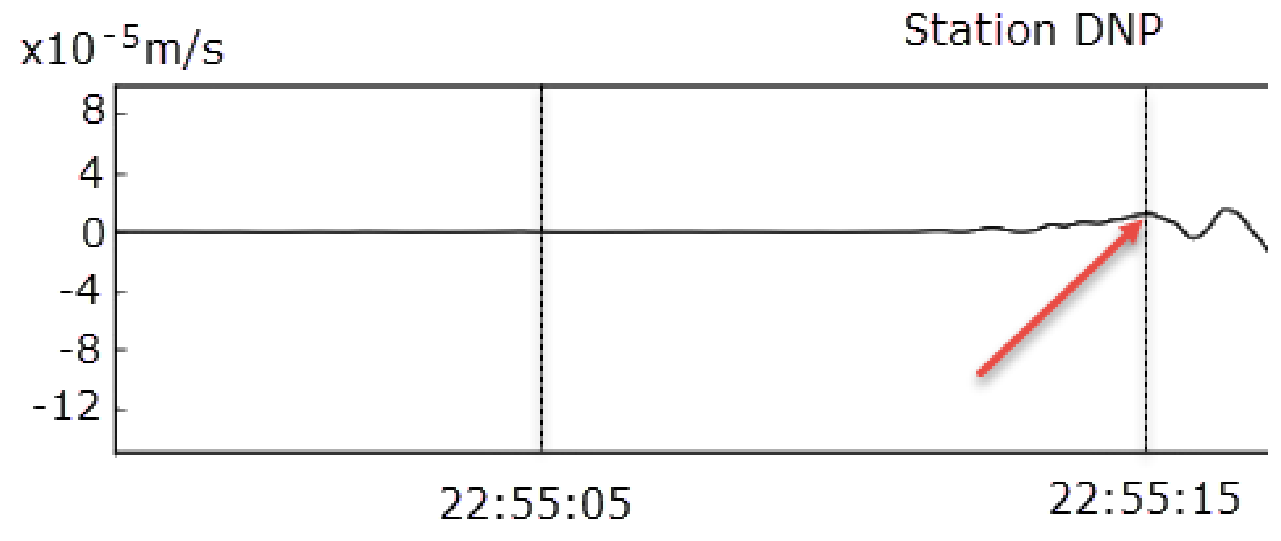
From the seismogram, we know that the fastest wave arrived at Denpasar station at 22:55:15, which is s from the origin time of the earthquake in Yogyakarta. Thus km/s. 0.3 pts.
Editorial source note: the quadratic above prints without a square. The subsequent formula is reproduced as supplied, without silently repairing the key. [1,2 т.]
B.4 By using Snell's law and defining and we obtain
0.2 pts.
where and is the initial angle of the seismic wave direction.
0.5 pts.
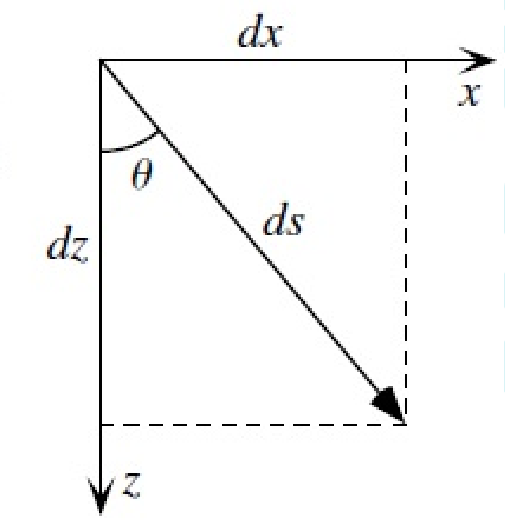
The distance is equal to twice the distance from epicenter to the turning point. The turning point is the point when . Thus
0.7 pts.
Editorial source note: the final expression is printed with this sign order and an unevaluated , rather than an evaluated endpoint expression. It is retained as printed. [1,4 т.]
B.5 For the travel time, ; .
Thus
and therefore
1.0 pts. [1 т.]
B.6 The total travel time from the source to the Denpasar can be calculated using previous relation
Which is valid for a continuous . For a simplified stacked of homogeneous layers (Figure F), the integral equation became a summation
0.6 pts.
0.4 pts.
Note that the actual travel time from the epicenter to Denpasar is 75 seconds. By varying the parameters of velocity and depth up to suitable value of observed travel time, physicist can know Earth structure.
Total score: 5.7 pts.
Editorial source note: the reference “Figure F” is printed in the key; the corresponding layer diagram in the question is Fig. 4. [1 т.]
C. Java Tsunami (3 т.)
C.1 The center of mass of the raised ocean water with respect to the ocean surface is . Thus
where is the ocean water density. 0.5 pts. [0,5 т.]
C.2 Considering a shallow ocean wave in Fig. 5, the whole water (from the surface until the ocean floor) can be considered to be moving due to the wave motion. The potential energy is equal to the kinetic energy.
Where and is the horizontal speed of the water component.
The water component that was in the upper part should be equal to the one that moves horizontally for a half of period of time, , i.e. .
Thus we have
0.7 pts.
Accordingly,
Thus
0.5 pts. [1,2 т.]
C.3 Using the argument that the wave energy density is proportional to its amplitude with is amplitude and is a proportional constant
Because the energy flux is conserve, then
for an area where the wave flow though.
Then,
(Therefore the tsunami wave will increase its amplitude and become narrower as it approaches the beach).
1.3 pts. Total score: 3.0 pts. [1,3 т.]
AT2 answer sheet
The official four-page answer sheet has student-code boxes and the following response fields. The original downloadable sheet preserves writing space and the examiner's marks column.
| Question | Answer field | Points |
|---|---|---|
| A.1 | 0.5 | |
| A.2 | 0.3 | |
| A.3 | 0.5 | |
| B.1 | 0.5 | |
| B.2 | ; | 0.6 |
| B.3 | 1.2 | |
| B.4 | 1.4 | |
| B.5 | 1.0 | |
| B.6 | 1.0 | |
| C.1 | 0.5 | |
| C.2 | 1.2 | |
| C.3 | 1.3 |
Page 4 states DO NOT WRITE BELOW and provides a SECTION/SCORE table with rows Section A, Section B, Section C and TOTAL.
Оригинал в Архива: 2.pdf · официални решения: 2_sol.pdf · допълнителни данни: 2_anssheet.pdf · допълнителни данни: th_instructions.pdf