IPhO 2017, Теория — Задача 3. Cosmic Inflation
T3 · Cosmic Inflation · 10 т.
General instructions: Theoretical Examination (30 points)
The theoretical examination lasts for 5 hours and is worth a total of 30 points.
Before the exam
You must not open the envelopes containing the problems before the sound signal indicating the beginning of the examination.
The beginning and end of the examination will be indicated by a sound signal. There will be announcements every hour indicating the elapsed time, as well as fifteen minutes before the end of the examination (before the final sound signal).
During the exam
- Dedicated answer sheets are provided for writing your answers. Enter the final answers into the appropriate boxes in the corresponding answer sheet. For every problem, there are extra blank work sheets for carrying out detailed work. Always use the work sheets that belong to the problem you are currently working on (check the problem number in the header). If you have written something on any sheet which you do not want to be graded, cross it out. Only use the front side of every page.
- In your answers, try to be as concise as possible: use equations, logical operators and sketches to illustrate your thoughts whenever possible. Avoid the use of long sentences.
- Please give an appropriate number of significant digits when stating numbers.
- You may often be able to solve later parts of a problem without having solved the previous ones.
- A list of physical constants is given on separate page.
You are not allowed to leave your working place without permission. If you need any assistance (need to refill your drinking water bottle, broken calculator, need to visit a restroom, etc.), please draw the attention of a team guide by lifting up one of the three flags into the air ("Refill my water bottle, please", "I need to go to the toilet, please", or "I need help, please" in all other cases).
At the end of the exam
- At the end of the examination you must stop writing immediately.
- For every problem, sort the corresponding sheets in the following order: problem sheets, answer sheets, work sheets and scratch paper.
- Put all the sheets belonging to one problem into the same envelope. Also put the general instructions into the remaining separate envelope. Make sure your student code is written on each envelope. Also hand in empty sheets. You are not allowed to take any sheets of paper out of the examination area.
- Leave the calculator provided by the organizers on the table.
Editorial source note: these are the shared instructions for all three theory problems. This edition contains only T3 (10 points). The separate physical-constants sheet is not present in the supplied standalone catalogue pack.
Условие
Due to the relative movement of galaxies observed from the earth, the wavelength of visible spectrum of a particular galaxy differs from its original wavelength, which is known as the electromagnetic Doppler effect. One expects, for a collection of galaxies, to a random distributions of wavelength shifts: some positive (red shift) and some negative (blue shift). However, observations show that all, expect for a nearby group of galaxies, are red shifted. This must be true even if the observation take place on different point in the universe. As a conclusion, our universe must be expanding. On the other hand local irregularity of the universe can be neglected on scales of more than 100 Mpc, in which 1 pc = 3.26 light-years. Averaged over large scales, the clumpy distribution of galaxies becomes more and more isotropic (independent of direction) and homogeneous (independent of position). Therefore we can assume the universe as a matter having a uniform mass density and is expanding.
A. Expansion of Universe
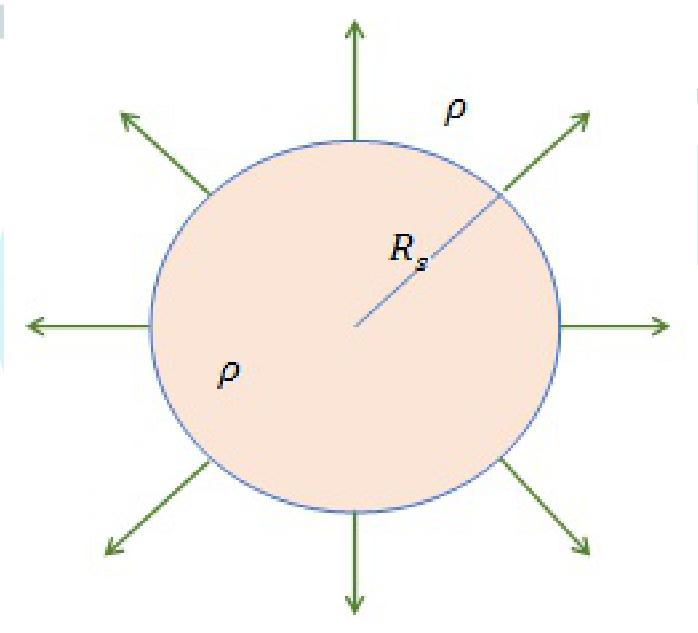
For a simple model of our universe, let us consider an expanding uniform-density sphere embedded in a medium of a much larger sphere with the same density. Let say at some time, the radius of the smaller sphere is . To express the expansion of the sphere, the time dependency of the radius can be expressed by scale factor , that is .
Using Newton's law of gravity to evaluate velocity of a mass element on the sphere boundary according the model of our universe, one can obtain a set of Friedmann equations:
where a dimensionless constant, and is velocity of light.
A.1 Determine the constant in the equation (1) [1,3 т.]
A.2 The discussion so far is non-relativistic. But in fact, it can be extended to a relativistic system by reinterpreting as total energy density (excluding the gravitational potential energy). In this relativistic system derives the 2nd Friedmann equation:
using the 1st law thermodynamics of an adiabatic system, where denotes the pressure on the sphere.
Determine the constants in the equation (2) [0,9 т.]
A.3 To solve Eqs. (1) and (2), one should assume a relation , such as , where is a constant. There is also a factor being called Hubble parameter. The present values of parameters are usually symbolized by subscript 0 such as , , , and so on. For simplicity, we take .
Universe is believed to start from a big explosion called Big-Bang that produces radiation of relativistic particles. During its expansion, the universe is cooling down and the particles in it become non-relativistic. However, the recent observations clarify that the present universe is dominated by cosmological constant energy density. For the case of photon, as the universe is expanding, the photon's wavelength expands proportionally to the scale factor.
For each of the following three cases determine the resulting value of : (i) a universe filled only with radiation (i.e. photon energy), (ii) a universe filled only with non-relativistic matter and (iii) a universe with constant energy density. [1,2 т.]
A.4 In the case of , find for each case of (i) to (iii) being mentioned in A.3. Use the initial condition for case (i) and (ii), and use the condition for case (iii). [1,2 т.]
A.5 Constant in Eq. (1) refers to classification of spatial geometry of the universe. Its value can be for positive-curvature universe (closed), for flat universe (infinite), and for negative-curvature universe (open, infinite). Let define a density ratio , where is critical energy density. Note that is obtained from problem A.1.
Express in Eq.(1) in terms of , , , and .
Editorial source note: the definition above prints ; the key instead uses . The question also changes the radius symbol from to . Both are retained. [0,1 т.]
A.6 Find a range for that corresponds to each value of , and . [0,3 т.]
B. Motivation To Introduce Inflation Phase and Its General Conditions
The observation of cosmic microwave background radiation (CMB) suggests that our present universe is approximately flat. The problem is that if this is true then the present universe should start from exactly flat early universe, otherwise any deviation from the flatness will eventually grow over time and spoil the present flatness.
B.1 Find as a function of time for the universe when it is dominated by radiation or non-relativistic matter (see problem A.3). [0,5 т.]
B.2 To solve the problem, at some early time in its history, the universe should undergo a constant energy density domination period which leads to an exponential expansion so called inflation period.
For this constant energy density domination period, find as a function of time. Assume that . [0,3 т.]
B.3 Show that condition for inflation implies several following conditions: negative pressure, accelerated expansion (), and decreasing Hubble radius (). [0,9 т.]
B.4 Show that the condition of decreasing Hubble radius can be expressed in terms of parameter as .
Inflation occurs as long as and then ends when . We can define e-folding number , such that and at the end of inflation. [0,2 т.]
C. Inflation Generated by Homogenously Distributed Matter
As an example of simple physical system that can generate period of inflation is a universe dominated by homogenously distributed matter. This kind of matter is called inflaton and can be characterized by a function .
The dynamical equation of the matter can be expressed as
where is a potential function and . The Hubble parameter satisfies
with is a constant called the reduced Planck mass. Inflation phase occurs during domination of potential energy over kinetic energy for sufficient time such that term in equation (3) can be neglected. This condition is called slow-roll approximation.
The quantities and , where , are called 'slow-roll' parameters.
C.1 Estimate parameter , parameter , in terms of potential and its first and second derivative ( and ). [1,7 т.]
D. Inflation with A Simple Potential
Predictions of any inflation model should be compared to observational constraints from CMB as follow and , where and are evaluated at for inflation model being generated by a dominant matter. Assume that potential of matter takes a simple form where is any integer and is a constant.
D.1 Calculate at the end of inflation. [0,5 т.]
D.2 Express and in terms of e-folding number N and integer . Estimate the value of that is closest to observational values and . Take in your calculation. [0,9 т.]
Решение
Official solutions and marking scheme. All printed grading subdivisions are retained below.
A. Expansion of Universe
A.1 For any test mass on the boundary of the sphere,
where is mass portion inside the sphere. 0.2 marks.
Multiplying equation (A.1.1) with and integrating it gives
where is a integration constant. 0.6 marks.
Taking , and . 0.2 marks.
0.2 marks.
Therefore, we have . 0.1 marks. Total 1.3. [1,3 т.]
A.2 The 2nd Friedmann equation can be obtained from the 1st law of thermodynamics:
0.1 marks.
For adiabatic processes and its time derivative is . 0.1 marks.
For the sphere . 0.1 marks.
Its total energy is . 0.2 marks.
Therefore . 0.1 marks.
It yields
0.2 marks.
Therefore, we have . 0.1 marks. Total 0.9.
Editorial source note: the intermediate expression for omits a factor multiplying ; this printed omission is retained. [0,9 т.]
A.3 Interpreting as total energy density, and substituting in to the 2nd Friedmann equation yields:
0.1 marks.
0.2 marks.
(i) In case of radiation, photon as example, the energy is given by then its energy density so that . 0.3 marks.
(ii) In case of nonrelativistic matter, its energy density nearly since dominant energy comes from its rest energy , so that . 0.3 marks.
(iii) For a constant energy density, let say , so that . 0.3 marks. Total 1.2.
Editorial source note: this key uses and for energy densities here, although the question introduced as mass density. [1,2 т.]
A.4 (i) In case of , for radiation we have . So by comparing the parameters values with their present value, ,
0.2 marks.
Because , , then
where after taking . 0.2 marks.
(ii) for non-relativistic matter domination, using , and similar way we will get
where . 0.4 marks.
(iii) for constant energy density,
Where is integration constant and . Taking condition ,
0.4 marks. Total 1.2.
Editorial source note: the intermediate expression in (ii) prints , despite the preceding conservation law. Both are retained. [1,2 т.]
A.5 Condition for critical energy condition:
Friedmann equation can be written as
0.1 marks. Total 0.1. [0,1 т.]
A.6 Because , then corresponds to , corresponds to and corresponds to .
0.3 marks. Total 0.3. [0,3 т.]
B. Motivation To Introduce Inflation Phase and Its General Conditions
B.1 Equation (A.5.1) shows that
0.1 marks.
In a universe dominated by non-relativistic matter or radiation, scale factor can be written as a function of time as where ( for radiation and for non-relativistic matter). 0.2 marks.
0.2 marks. Total 0.5. [0,5 т.]
B.2 For a period dominated by constant energy provides the solution so that . 0.1 marks.
0.2 marks. Total 0.3.
Editorial source note: the key prints the base in , rather than , and no factor in this last expression. Retained as supplied. [0,3 т.]
B.3 Inflation period can be generated by constant energy period, therefore it is a phase where so that (negative pressure). 0.2 marks.
Differentiating Friedmann equation leads to
0.4 marks.
So that because during inflation , it is equivalent with condition (accelerated expansion). 0.1 marks.
As a result, or (shrinking Hubble radius). 0.2 marks. Total 0.9. [0,9 т.]
B.4 Inflation condition can be written as , with as such
0.2 marks. Total 0.2. [0,2 т.]
C. Inflation Generated by Homogenously Distributed Matter
C.1 Differentiating equations (4) and employing equation 4 we can get
0.3 marks.
Therefore . 0.1 marks.
The inflation can occur when the potential energy dominates the particle's energy () such that . 0.2 marks.
Slow-roll approximation: . 0.1 marks.
Implies
0.3 marks.
we also have
Therefore
0.4 marks.
0.3 marks. Total 1.7.
Editorial source note: the prose refers twice to equation (4), although the displayed substitution also uses equation (3). The printed capitalization in (C.1.2) is retained. [1,7 т.]
D. Inflation with A Simple Potential
D.1 Inflation ends at . Using yields
0.5 marks. Total 0.5. [0,5 т.]
D.2 From equations (C.1.1), (C.1.2) and (C.1.3) we can obtain
where is a integration constant. As at then .
0.2 marks.
0.2 marks.
0.2 marks.
So that
0.1 marks.
0.1 marks.
To obtain the observational constraint we need which is inconsistent with the condition . There is no a closest integer that can obtains . As example, for leads a contradiction and for leads a contradiction .
0.1 marks. Total 0.9.
Editorial source note: the question defines with at the end but asks for . The supplied key follows this printed convention and concludes that no closest integer works, including the quoted negative numerical examples. These inconsistent sign/numerical statements are retained rather than replaced with a corrected model calculation. [0,9 т.]
AT3 answer sheet
The official four-page sheet has Student Code boxes and a blank Marks column. The following response fields preserve its content; the downloadable original retains the writing spaces.
| Question | Printed answer fields | Points |
|---|---|---|
| A.1 | 1.3 | |
| A.2 | 0.9 | |
| A.3 | (i) ; (ii) ; (iii) | 1.2 |
| A.4 | (i) ; (ii) ; (iii) | 1.2 |
| A.5 | Blank response box | 0.1 |
| A.6 | Blank response box | 0.3 |
| B.1 | 0.5 | |
| B.2 | 0.3 | |
| B.3 | Blank response box | 0.9 |
| B.4 | Blank response box | 0.2 |
| C.1 | ; ; | 1.7 |
| D.1 | 0.5 | |
| D.2 | ; | 0.9 |
The answer sheet titles C “Inflation Generated by Homogenously Distributed Particles” and D “Particles Inflation with a Simple Potential”, differing slightly from the question headings. D.2 continues onto page 4; there are no extra tasks on that page.
Оригинал в Архива: 3.pdf · официални решения: 3_sol.pdf · допълнителни данни: 3_anssheet.pdf · допълнителни данни: th_instructions.pdf