IPhO 2018 Lisbon, Portugal — Theory Q1 — LIGO-GW150914 (10 points) · 10 т.
Условие
In 2015, the gravitational-wave observatory LIGO detected, for the first time, the passing of gravitational waves (GW) through Earth. This event, named GW150914, was triggered by waves produced by two black holes that were orbiting on quasi-circular orbits. This problem will make you estimate some physical parameters of the system, from the properties of the detected signal.
Part A: Newtonian (conservative) orbits (3.0 points)
A.1 Consider a system of two stars with masses M1,M2, at locations r1,r2, respectively, with respect to the center-of-mass of the system, that is,
M1r1+M2r2=0.(1)
The stars are isolated from the rest of the Universe and moving at non-relativistic velocities. Using Newton's laws, the acceleration vector of mass M1 can be expressed as
dt2d2r1=−αr1nr1,(2)
where r1=∣r1∣,r2=∣r2∣. Find n∈N and α=α(G,M1,M2), where G is Newton's constant [G≃6.67×10⁻¹¹Nm2kg−2]. [1 т.]
A.2 The total energy of the 2-mass system, in circular orbits, can be expressed as:
E=A(μ,Ω,L)−GLMμ,(3)
where
μ≡M1+M2M1M2,M≡M1+M2,(4)
are the reduced mass and total mass of the system, Ω is the angular velocity of each mass and L is the total separation L=r1+r2. Obtain the explicit form of the term A(μ,Ω,L). [1 т.]
A.3 Equation 3 can be simplified to E=βGLMμ. Determine the number β. [1 т.]
Part B: Introducing relativistic dissipation (7.0 points)
The correct theory of gravity, General Relativity, was formulated by Einstein in 1915, and predicts that gravity travels with the speed of light. The messengers carrying information about the interaction are called GWs. GWs are emitted whenever masses are accelerated, making the system of masses lose energy.
Consider a system of two point-like particles, isolated from the rest of the Universe. Einstein proved that for small enough velocities the emitted GWs: 1) have a frequency which is twice as large as the orbital frequency; 2) can be characterized by a luminosity, i.e. emitted power P, which is dominated by Einstein's quadrupole formula,
P=5c5Gi=1∑3j=1∑3(dt3d3Qij)(dt3d3Qij).(5)
Here, c is the velocity of light c≃3×10⁸ m/s. For a system of 2 pointlike particles orbiting on the x−y plane, Qij is the following table (i,j label the row/column number)
Determine k in terms of Ω and the numerical values of the constants ai, bi, cij. [1 т.]
B.2 Compute the power P emitted in gravitational waves for that system, and obtain:
P=ξc5Gμ2L4Ω6.(9)
What is the number ξ? [If you could not obtain ξ, use ξ=6.4 in the following.] [1 т.]
B.3 In the absence of GW emission the two masses will orbit on a fixed circular orbit indefinitely. However, the emission of GWs causes the system to lose energy and to slowly evolve towards smaller circular orbits. Obtain that the rate of change dtdΩ of the orbital angular velocity takes the form
(dtdΩ)3=(3ξ)3c15Ω11(GMc)5,(10)
where Mc is called the chirp mass. Obtain Mc as a function of M and μ. This mass determines the increase in frequency during the orbital decay. [The name "chirp" is inspired by the high pitch sound (increasing frequency) produced by small birds.] [1 т.]
B.4 Using the information provided above, relate the orbital angular velocity Ω with the GW frequency fGW. Knowing that, for any smooth function F(t) and a=1,
dtdF(t)=χF(t)a⇒F(t)1−a=χ(1−a)(t−t0),(11)
where χ is a constant and t0 is an integration constant, show that (10) implies that the GW frequency is
fGW−8/3=8π8/3ξ(c3GMc)(2/3)+p(t0−t)2−p(12)
and determine the constant p. [2 т.]
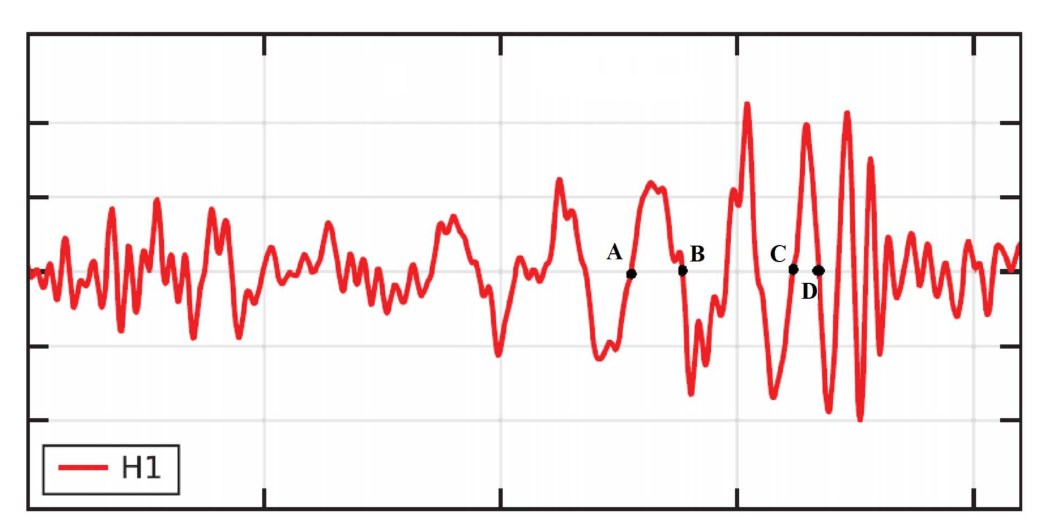
On September 14, 2015 GW150914 was registered by the LIGO detectors, consisting of two L-shaped arms, each 4 km long. These arms changed by a relative length according to Fig. 1. The arms of the detector respond linearly to a passing gravitational wave, and the response pattern mimics the wave. This wave was created by two black holes on quasi-circular orbits; the loss of energy through gravitational radiation caused the orbit to shrink and the black holes to eventually collide. The collision point corresponds, roughly, to the peak of the signal after point D, in Fig. 1.
Figure 1. Strain, i.e. relative variation of the size of each arm, at the LIGO detector H1. The horizontal axis is time, and the points A, B, C, D correspond to t=0.000,0.009,0.034,0.040 seconds, respectively.
B.5 From the figure, estimate fGW(t) at
tAB=2tB+tAandtCD=2tD+tC.(13)
Assuming that (12) is valid all the way until the collision (which strictly speaking is not true) and that the two objects have equal mass, estimate the chirp mass, Mc, and total mass of the system, in terms of solar masses M⊙≃2×1030 kg. [1 т.]
B.6 Estimate the minimal orbital separation between the two objects at tCD. Hence estimate a maximum size for each object, Rmax. Obtain R⊙/Rmax to compare this size with the radius of our Sun, R⊙≃7×10⁵ km. Estimate also their orbital linear velocity at the same instant, vcol, comparing it with the speed of light, vcol/c.
Conclude that these are extremely fast moving, extremely compact objects indeed! [1 т.]
A.2 The total energy of the system is the sum of the two kinetic energies plus the gravitational potential energy. For circular motions, the linear velocity of each of the masses reads
∣v1∣=r1Ω,∣v2∣=r2Ω,(4)
Thus, the total energy is
E=21(M1r12+M2r22)Ω2−LGM1M2,(5)
Now,
(M1r1−M2r2)2=0⇒M1r12+M2r22=μL2.(6)
Thus,
E=21μL2Ω2−GLMμ.(7)
A.2 (1.0pt)
A(μ,Ω,L)=21μL2Ω2.
A.3 Energy (3) of the question sheet can be interpreted as describing a system of a mass μ in a circular orbit with angular velocity Ω, radius L, around a mass M (at rest). Equating the gravitational acceleration to the centripetal acceleration:
GL2M=Ω2L.(8)
This is indeed Kepler’s third law (for circular orbits). Then, from (7),
E=−21GLMμ.(9)
A.3 (1.0pt)
β=−21.
Part B - Introducing relativistic dissipation (7.0 points)
B.1 Some simple trigonometry for the x,y motion of the masses (in an appropriate Cartesian system) yields:
B.4 Angular and cycle frequencies are related as Ω=2πf. From the information provided above: GWs have a frequency which is twice as large as the orbital frequency, we have
2πΩ=2fGW.(19)
Formula (10) of the question sheet has the form
dtdΩ=χΩ11/3,χ≡596c5(GMc)5/3.(20)
Thus, from (11) of the question sheet
Ω(t)−8/3=38χ(t0−t),(21)
or, using (20) and the definition of χ gives
fGW−8/3(t)=5(8π)8/3(c3GMc)5/3(t0−t).(22)
B.4 (2.0pt)
p=1.
B.5 From the figure, we consider the two Δt’s as half periods. Thus, the (cycle) GW frequency is fGW=1/(2Δt). Then, the four given points allow us to compute the frequency at the mean time of the two intervals as
tAB
tCD
t (s)
0.0045
0.037
fGW (Hz)
(2×0.009)−1
(2×0.006)−1
Now, using (22) we have two pairs of (fGW,t) values for two unknowns (t0,Mc). Expressing (22) for both tAB and tCD and dividing the two equations we obtain:
Replacing by the numerical values, A≃2.95 and t0≃0.054 s. Now we can use (22) for either of the two values tAB or tCD and determine Mc. One obtains for the chirp mass
Mc≃6×1031kg≃30×M⊙.(24)
Thus, the total mass M is
M=43/5Mc≃69×M⊙.(25)
This result is actually remarkably close to the best estimates using the full theory of General Relativity! [Even though the actual objects do not have precisely equal masses and the theory we have just used is not valid very close to the collision.]
B.5 (1.0pt)
Mc≃30×M⊙,M≃69×M⊙.
B.6 From (8), Kepler’s law states that L=(GM/Ω2)1/3. The second pair of points highlighted in the plot correspond to the cycle prior to merger. Thus, we use (19) to obtain the orbital angular velocity at tCD:
ΩtCD∼2.6×10²rad/s.(26)
Then, using the total mass (25) we find
L∼5×10²km.(27)
Thus, these objects have a maximum radius of Rmax∼250 km. Hence they have over 30 times more mass and,
RmaxR⊙∼3×10³(28)
they are 3000 times smaller than the Sun and!
Their linear velocity is
vcol=2LΩ≃7×10⁴km/s.(29)
They are moving at over 20% of the velocity of light!