IPhO 2018, Теория — Задача 2. Where is the neutrino?
IPhO 2018 Lisbon, Portugal — Theory Q2 — Where is the neutrino? (10 points) · 10 т.
Условие
When two protons collide with a very high energy at the Large Hadron Collider (LHC), several particles may be produced as a result of that collision, such as electrons, muons, neutrinos, quarks, and their respective anti-particles. Most of these particles can be detected by the particle detector surrounding the collision point. For example, quarks undergo a process called hadronisation in which they become a shower of subatomic particles, called "jet''. In addition, the high magnetic field present in the detectors allows even very energetic charged particles to curve enough for their momentum to be determined. The ATLAS detector uses a superconducting solenoid system that produces a constant and uniform 2.00 Tesla magnetic field in the inner part of the detector, surrounding the collision point. Charged particles with momenta below a certain value will be curved so strongly that they will loop repeatedly in the field and most likely not be measured. Due to its nature, the neutrino is not detected at all, as it escapes through the detector without interacting.
Data: Electron rest mass, kg; Elementary charge, C;
Speed of light, m s; Vacuum permittivity, F m
Part A. ATLAS Detector physics (4.0 points)
A.1 Derive an expression for the cyclotron radius, , of the circular trajectory of an electron acted upon by a magnetic force perpendicular to its velocity, and express that radius as a function of its kinetic energy, ; charge modulus, ; mass, ; and magnetic field, . Assume that the electron is a non-relativistic classical particle. [0,5 т.]
Electrons produced inside the ATLAS detector must be treated relativistically. However, the formula for the cyclotron radius also holds for relativistic motion when the relativistic momentum is considered.
A.2 Calculate the minimum value of the momentum of an electron that allows it to escape the inner part of the detector in the radial direction. The inner part of the detector has a cylindrical shape with a radius of 1.1 meters, and the electron is produced in the collision point exactly in the center of the cylinder. Express your answer in MeV/. [0,5 т.]
When accelerated perpendicularly to the velocity, relativistic particles of charge and rest mass emit electromagnetic radiation, called synchrotron radiation. The emitted power is given by
where is the acceleration and .
A.3 A particle is called ultrarelativistic when its speed is very close to the speed of light. For an ultrarelativistic particle the emitted power can be expressed as:
where is a real number, are integers, is the energy of the charged particle and is the magnetic field. Find , and . [1 т.]
A.4 In the ultrarelativistic limit, the energy of the electron as a function of time is:
where is the initial energy of the electron. Find as a function of , , , and . [1 т.]
A.5 Consider an electron produced at the collision point along the radial direction with an energy of 100 GeV. Estimate the amount of energy that is lost due to synchrotron radiation until the electron escapes the inner part of the detector? Express your answer in MeV. [0,5 т.]
A.6 Find an expression for the cyclotron frequency of the electron as a function of time in the ultrarelativistic limit. [0,5 т.]
Part B. Finding the neutrino (6.0 points)
The collision between the two protons shown in Figure 1 leads to the production of a top quark () and an anti-top quark (), the heaviest elementary particles ever detected. The top quark decays into a boson and a bottom quark (), while the anti-top quark decays into a boson and an anti-bottom quark (). In the case depicted in Figure 1, the boson decays into a anti-muon () and a neutrino (), and the boson decays into a quark and an anti-quark. The task of this problem is to reconstruct the full momentum of the neutrino using the momenta of some detected particles. For simplicity, all particles and jets in this problem will be considered massless, except for the top quark and W bosons.
The momenta of the top quark decay products can be determined from the experiment (see Table), except for the neutrino momentum component along the (-axis). The total linear momentum of the final state particles caught by the detector is only zero on the transverse plane ( plane), and not along the collision line (-axis). As such, one can find the transverse momentum of the neutrino from the missing momentum in the transverse plane.
On June 4, 2015, the ATLAS experiment at the LHC recorded a proton-proton collision at 00:21:24 GMT+1 like the one represented in Figure 1.
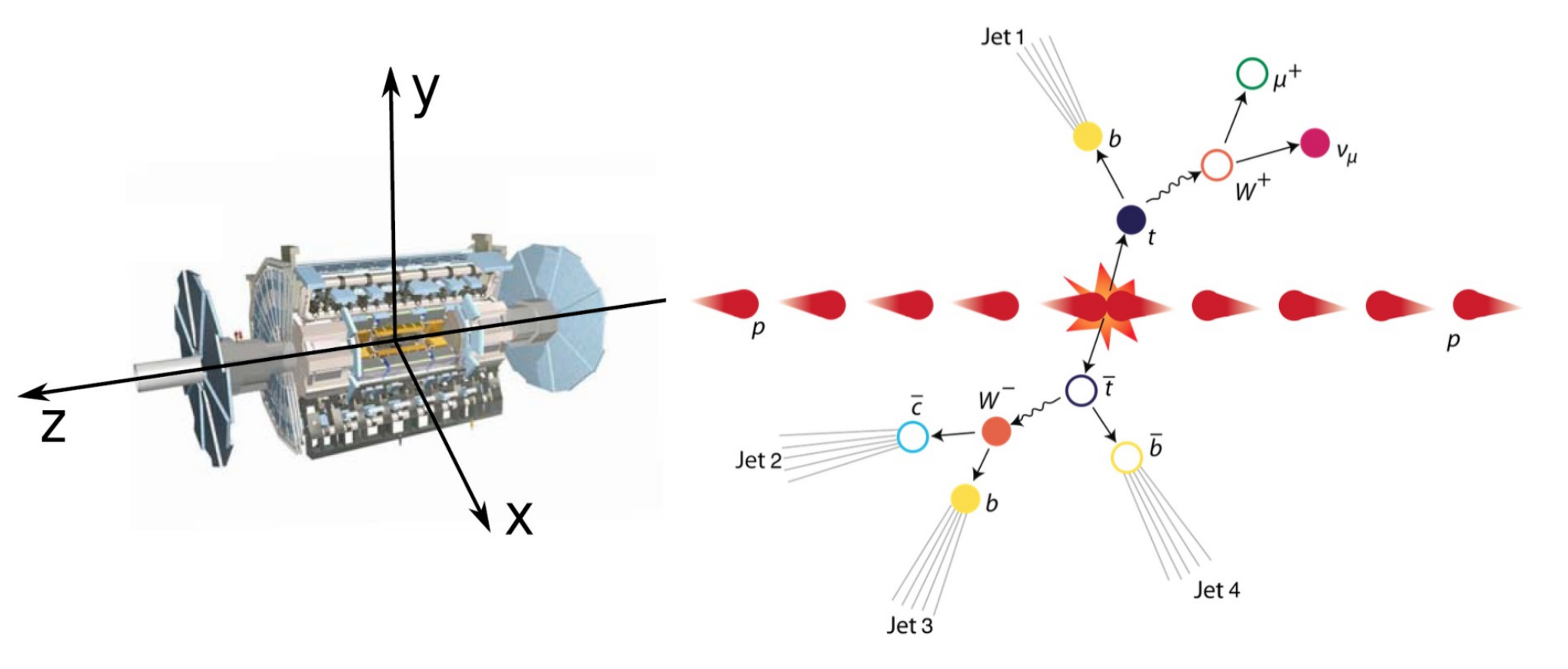
The linear momenta of the three final-state particles coming from the top quark decay, including the neutrino, is presented below for each component.
| Particle | (GeV/) | (GeV/) | (GeV/) |
|---|---|---|---|
| anti-muon () | |||
| jet 1 () | |||
| neutrino () | --- |
B.1 Find an equation which relates the square of the boson mass, , with the neutrino and anti-muon momentum components presented in the table above. Express your answer in terms of the neutrino and anti-muon transverse momentum,
and their -axis momentum components, and . [1,5 т.]
B.2 Assuming a boson mass of GeV/ calculate the two possible solutions for the neutrino momentum along the -axis, . Express your answer in GeV/c. [1,5 т.]
B.3 Calculate the top quark mass for each one of the two previous solutions. Express your answer in GeV/.
[If you did not obtain the two solutions in B.2, use
[1 т.]
The normalised number of collision events for the measurement of the top quark mass (as determined from the experiment), has two components: the so-called "signal" (corresponding to the decay of top quarks) and "background" (corresponding to events from other processes that do not include top quarks). Experimental data include both processes, see Fig. 2.
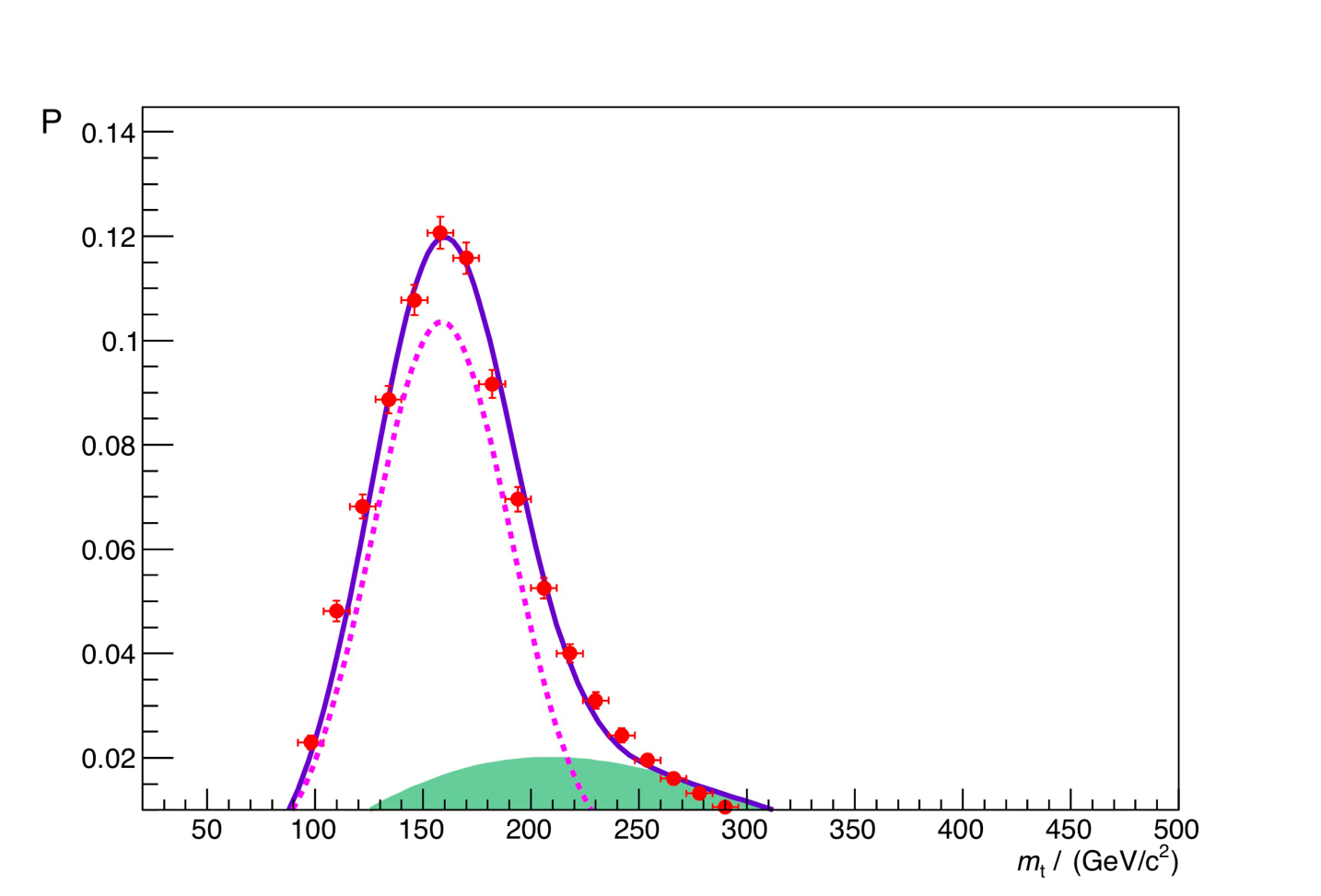
B.4 According to the top quark mass distribution, which one of the two previous solutions is more likely to be the right one? Estimate the probability for the most likely solution. [1 т.]
B.5 Calculate the distance traveled by the top quark before decaying, using the most likely solution. Assume the top quark has a mean lifetime at rest of s. [1 т.]
Отговори
A.1
A.2 330 MeV/c
A.3
A.4
A.5 -56 MeV
The official answer is printed as the change of energy, ΔE = −56 MeV; the energy lost is 56 MeV.
A.6
B.1
B.2
B.3
B.4 The most likely candidate is the mt = 169.3 GeV/c² solution (probability roughly 0.1, versus below 0.01 for mt = 311.2 GeV/c²).
B.5 m
Решение
Part A. ATLAS Detector physics (4.0 points)
A.1
The magnetic force is the centripetal force:
First express the velocity in terms of the kinetic energy,
and then insert it in the expression above for the radius to get
A.1 (0.5pt)
A.2
The radius of the circular motion of a charged particle in the presence of a uniform magnetic field is given by,
This formula is valid in the relativistic scenario if the mass correction, is included:
Note that the radius of the circular motion is half the radius of the inner part of the detector. One obtains [1 MeV/ m kg s]
A.2 (0.5pt)
A.3
The acceleration for the particle is , in the ultrarelativistic limit. Then,
Since we can obtain and, finally,
Therefore,
A.3 (1.0pt)
A.4
The power emitted by the particle is given by,
The energy of the particle as a function of time can be calculated from
where . This leads to,
with
A.4 (1.0pt)
A.5
If the initial energy of the electron is 100 GeV, the radius of curvature is extremely large ( m). Therefore, in approximation, one can consider the electron is moving in the inner part of the ATLAS detector along a straight line. The time of flight of the electron is , where m is the radius of the inner part of the detector. The total energy lost due to synchrotron radiation is,
and
A.5 (0.5pt)
A.6
In the ultrarelativistic limit, and . The cyclotron frequency is,
A.6 (0.5pt)
Part B. Finding the neutrino (6.0 points)
B.1
Since the boson decays into an anti-muon and a neutrino, one can use principles of conservation of energy and linear momentum to calculate the unknown of the neutrino. Moreover, the anti-muon and the neutrino can be considered massless, which implies that the magnitude of their momenta (times ) and their energies are the same. Therefore, the conservation of linear momentum can be expressed as
and the conservation of energy as,
In addition, one can also relate the energy and the momentum of the boson through its mass,
which leads to a quadratic equation on ,
B.1 (1.5pt)
B.2
The numerical substitution directly in the answer of B.1, using
leads to
This is a quadratic equation, equivalent to
whose solutions are:
B.2 (1.5pt)
The general solution of the equation above in B.1 leads to
Numerical substitution leads to the above mentioned values for .
B.3
The final state particles of the top quark decay are the anti-muon, the neutrino and jet 1. Since the neutrino is now fully reconstructed the energy and linear momentum of the top quark can be calculated as,
The top quark mass is,
The substitution of values leads to two possible masses:
B.3 (1.0pt)
B.4
According to the frequency distribution for signal (dashed line), the probability of the GeV/ solution is roughly 0.1 while the probability of the GeV/c solution is below 0.01. Therefore,
B.4 (1.0pt) The most likely candidate is the GeV/c solution.
B.5
The top quark energy for the most likely candidate is GeV .
B.5 (1.0pt)