IPhO 2019, Теория — Задача 1. Zero-length springs and slinky coils
Theory Q1 — Zero-length springs and slinky coils (IPhO Israel 2019, English (Official)) · 10 т.
Условие
A zero effective length spring (ZLS) is a spring for which the force is proportional to the spring's length, for where is the minimal length of the spring as well as its unstretched length. Figure 1 shows the relation between the force and the spring length for a ZLS, where the slope of the line is the spring constant .
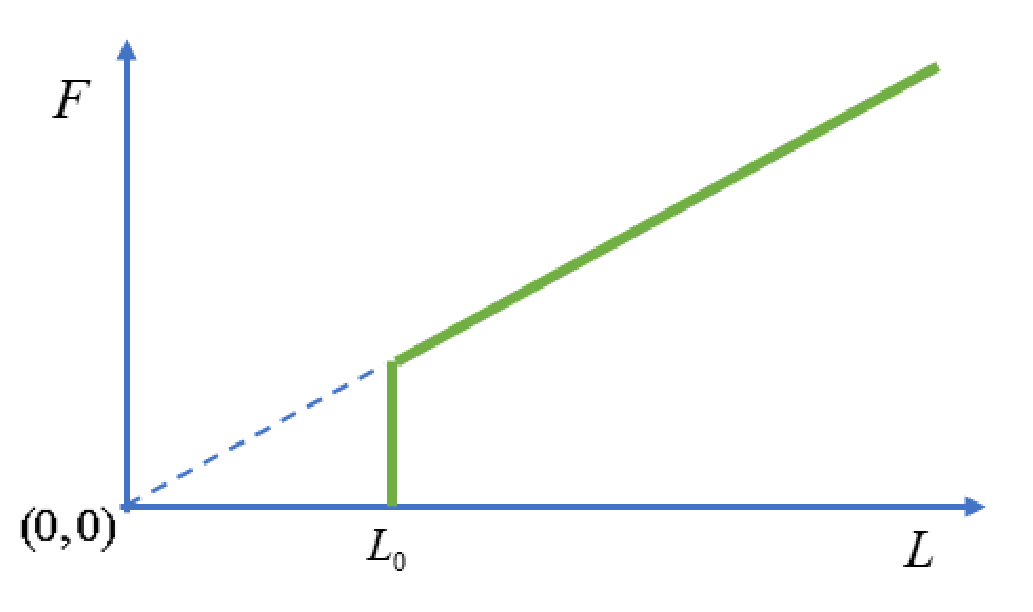
A ZLS is useful in seismography and allows very accurate measurement of changes in the gravitational acceleration . Here, we shall consider a homogenous ZLS, whose weight exceeds . We define a corresponding dimensionless ratio, to characterize the relative softness of the spring. The toy known as “slinky” may be (but not necessarily) such a ZLS.
Part A: Statics (3.0 points)
A.1 Consider a segment of length of the unstretched ZLS spring which is then stretched by a force , under weightless conditions. What is the length of this segment as a function of and the parameters of the spring? [0,5 т.]
A.2 For a segment of length , calculate the work required to stretch it from its original length to a length . [0,5 т.]
Throughout this question, we will denote a point on the spring by its distance from the bottom of the spring when it is unstretched. In particular, for every point on the spring, remains unchanged as the spring stretches.
A.3 Suppose that we hang the spring by its top end, so that it stretches under its own weight. What is the total length of the suspended spring in equilibrium? Express your answers in terms of and . [2 т.]
Part B: Dynamics (5.5 points)
Experiments show that when the spring is hung at rest and then released, it gradually contracts from the top, while the lower part remains stationary (see Figure 2). As time advances, the contracting part moves as a solid chunk and accumulates additional turns of the spring, while the stationary part becomes shorter. Every point on the spring begins to move only when the moving part reaches it. The bottom end of the spring starts moving only when the spring is fully collapsed and reaches its unstretched length . After that, the contracted spring continues falling straight downwards, without tumbling, as a rigid body under the influence of gravity.
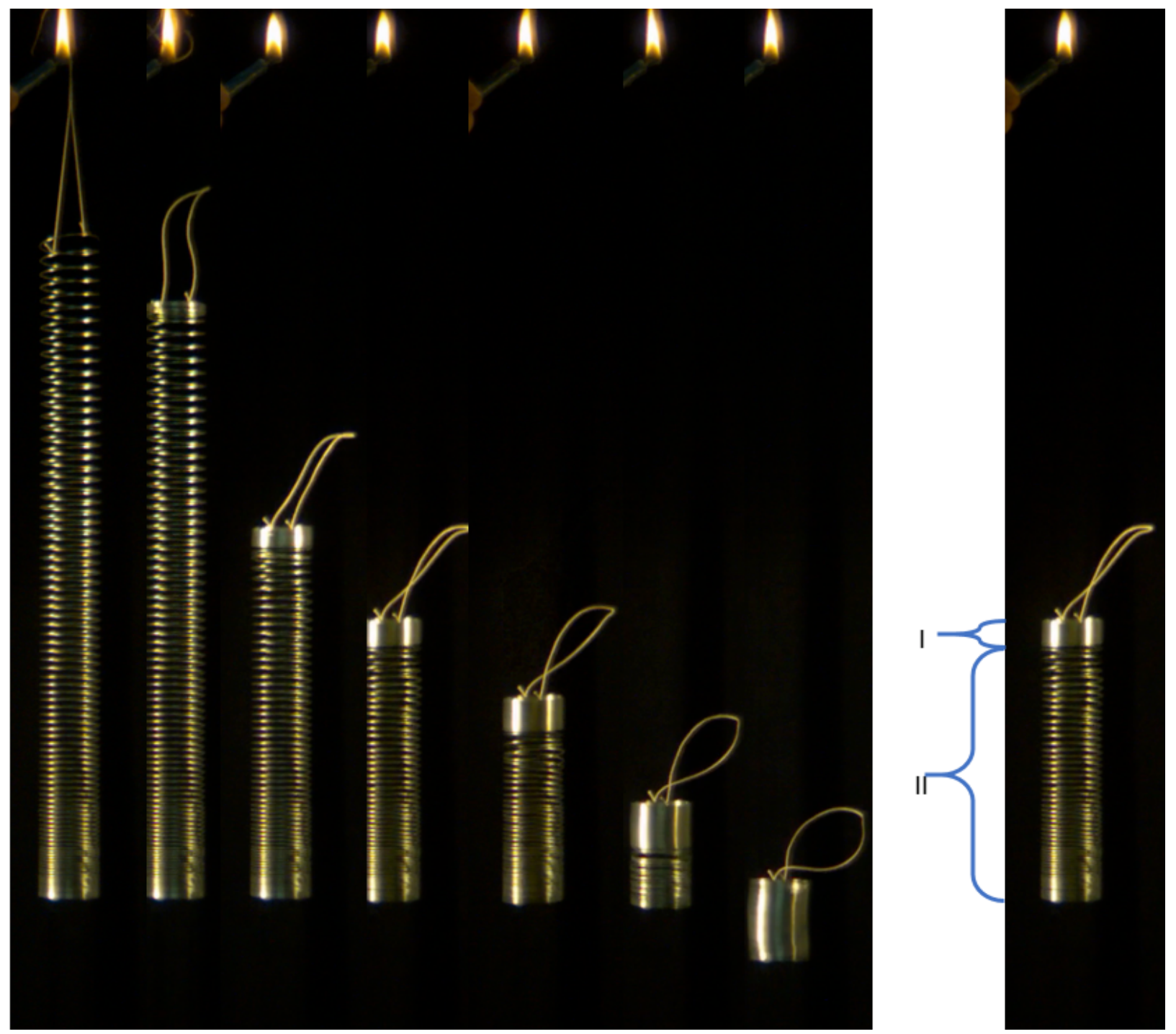
In the remaining parts of the question, you are asked to base your solution on this described model. You may neglect air resistance, but you are not allowed to neglect .
B.1 Calculate the time it takes from the moment the spring is released, until it fully collapses back to its minimal length . Express your answer in terms of , and .
Compute the numerical value of for a spring with , and , while taking to be . [2,5 т.]
B.2 In this task is used to denote the coordinate of the boundary between parts I (in figure 2, the moving part) and II (the stationary part). At a certain moment, while a stationary part still exists its mass is , and the moving part moves with uniform instantaneous velocity . Show that at this moment (while there exists a stationary part) the velocity of the moving part is . Express the constants and in terms of , and . [2,5 т.]
B.3 Based on B.2, find the minimum speed of the moving part of the spring in the course of its motion, after its release and before it hits the ground. Express your answer in terms of , , and . [0,5 т.]
Part C: Energetics (1.5 points)
C.1 Calculate the amount of mechanical energy that was lost by generating heat, from the moment the spring is released until just before the spring hits the ground. Express your answer in terms of , , and . [1,5 т.]
Отговори
A.1
A.2
A.3
B.1 ≈ s
With alpha = 0.0285.
B.2
B.3
C.1
Решение
Zero-length springs and slinky coils – Solution
Part A: Statics
A.1 The force causes the spring to change its length from to . Since equal parts of the spring are extended to equal lengths, we get: .
Since , we get . From this result we see that any piece of length the spring behaves as a ZLS with spring constant .
A.2 Let us compute the work of the force. From Task A.1: .
Hence, .
A.3. At every point along the statically hanging spring the weight of the mass below is balanced by the tension from above. This implies that at the bottom of the spring there is a section of length whose turns are still touching each other, as their weight is insufficient to exceed the threshold force to pull them apart. The length can be derived from the equation: , hence .
For , a segment of the unstretched spring between and feels a weight of from beneath, which causes its length to stretch from to .
Integration of the last expression over the stretched region, up to the point , gives its height when the spring is stretched
Part B: Dynamics
B.1. From Task A.3 we have . We now calculate the position of the center of mass of the suspended spring. The contribution of the unstretched section of height at the bottom, having a mass of , is . The position of the center of mass is obtained by summing the contributions of its elements:
Where we have used . Substituting yields
When the spring is contracted to its free length , its center of mass is located at . From the falling of the center of mass at acceleration we get:
Hence, .
For , , , and , we have , and .
B.2. The moving top section of the spring is pulled down by its own weight, and also by the tension in the spring below, which is equal to the weight of the stationary section of the spring. Thus, the moving top section experiences a constant force throughout its whole fall. Another way to see that, is that a total force of is exerted on the spring, but only the moving part experiences it. Let’s calculate the position of the center of mass at equilibrium of the upper part, i.e., all points with for some . From part A, the position of a small portion with coordinate is: and the center of mass of this part is:
The position of the upper part of CM when it contracts to a length is . The change in the CM during the contraction process is: .
The acceleration of the CM of the upper part is .
From the work energy theorem we get the equation , hence
Therefore, and .
Note that for , we have and for , we get , hence, the moment we release the spring its velocity is finite (not zero, the meaning is that it accumulate this velocity in time that is much shorter than the contracting time ) and it decreases to of the initial value when .
B.3. Note that even though the center of mass of the spring accelerates downwards constantly, the moving top section actually decelerates, while the position of the center of mass moves down the spring. The speed of the top section , calculated in Task B2, decreases and approaches the value immediately before it attaches to the bottom section of height , which was unstretched and at rest. Once the moving top section attaches to the resting bottom section, its momentum is shared between both sections, so the speed further decreases just before the whole spring starts accelerating downwards as a single mass. Thus, the minimum speed is that of the whole spring immediately after its full collapse. From momentum conservation, we have
Part C: Energetics
C.1. From the moment the spring is released, the acceleration of its center of mass is governed by the external force and therefore the gravitational potential energy of the spring is fully converted into the kinetic energy of the center of mass of the spring, which just before hitting the ground is equal to the kinetic energy of the spring.
All that is left is the elastic energy stored in the spring, which is converted into heat, sound, etc. To calculate it, we consider the elastic energy stored in a segment of the stretched spring, which when unstretched lies between and , using the result of Task A.2, , by choosing and , and using (which was obtained in Task A.3), we get:
. Integrating from to we find