IPhO 2019, Теория — Задача 2.2. The interaction of microwave radiation with water molecules
The Physics of a Microwave Oven · 3,4 т.
The Physics of a Microwave Oven
This question discusses the generation of microwave radiation in a microwave oven, and its use to heat up food. The microwave radiation is generated in a device called “magnetron”. Part A concerns the operation of the magnetron, while part B deals with the absorption of microwave radiation in food.
Условие
This part deals with the usage of microwave radiation (radiated by the magnetron antenna into the food chamber) for cooking, that is, heating up a lossy dielectric material such as water, either pure or salty (which is our model for, say, soup).
An electric dipole is a configuration of two equal and opposite electric charges and a small distance apart. The electric dipole vector points from the negative to the positive charge, and its magnitude is .
A time-dependent electric field is applied on a single dipole of moment with constant magnitude . The angle between the dipole and the electric field is .
B.1 Write expressions for both the magnitude of the torque applied by the electric field on the dipole and the power delivered by the field to the dipole, in terms of , , and their derivatives. [0,5 т.]
Water molecules are polar, hence can be treated as electric dipoles. Due to the strong hydrogen bonds between water molecules in liquid water, one cannot treat them as independent dipoles. Rather, one should refer to the polarization vector , which is the dipole moment density (average dipole moment per unit volume of an ensemble of water molecules). The polarization is parallel to the local applied alternating electric field (of the microwave radiation), , and oscillates in time with an amplitude that is proportional to the amplitude of the local alternating electric field, but with a phase lag .
The local alternating electric field at a given location inside the water is , where , giving rise to polarization , where the dimensionless constant is a property of water.
B.2 Find an expression for the time-averaged power per unit volume absorbed by the water.
The time-average for a time dependent periodic variable over its period is defined as:
[0,5 т.]
Let us now consider the propagation of the radiation through the water. The relative dielectric constant of water (at the electromagnetic field frequency) is , and the corresponding index of refraction of water is . The momentary energy density of the electric field is given by . The time-averaged energy density of the electric and magnetic fields are equal.
B.3 Let us denote the time-averaged radiation energy flux density by (average radiation power flow per unit area). Here is the depth of penetration into the water, and the radiation propagates in the direction. Find an expression for the dependence of the flux density on . The flux density at the water surface, , may appear in your result. [1,1 т.]
The phase lag is the result of the interaction between the water molecules. It depends on the dimensionless dielectric loss coefficient and the relative dielectric constant (both of which depend on the radiation angular frequency and the temperature) via the relation . When is small enough, the electric field at penetration depth into the water is given by:
where and is the speed of light in vacuum.
B.4 Employ the approximation and find an expression for the coefficient defined in Task B.2 in terms of the other parameters. [0,6 т.]
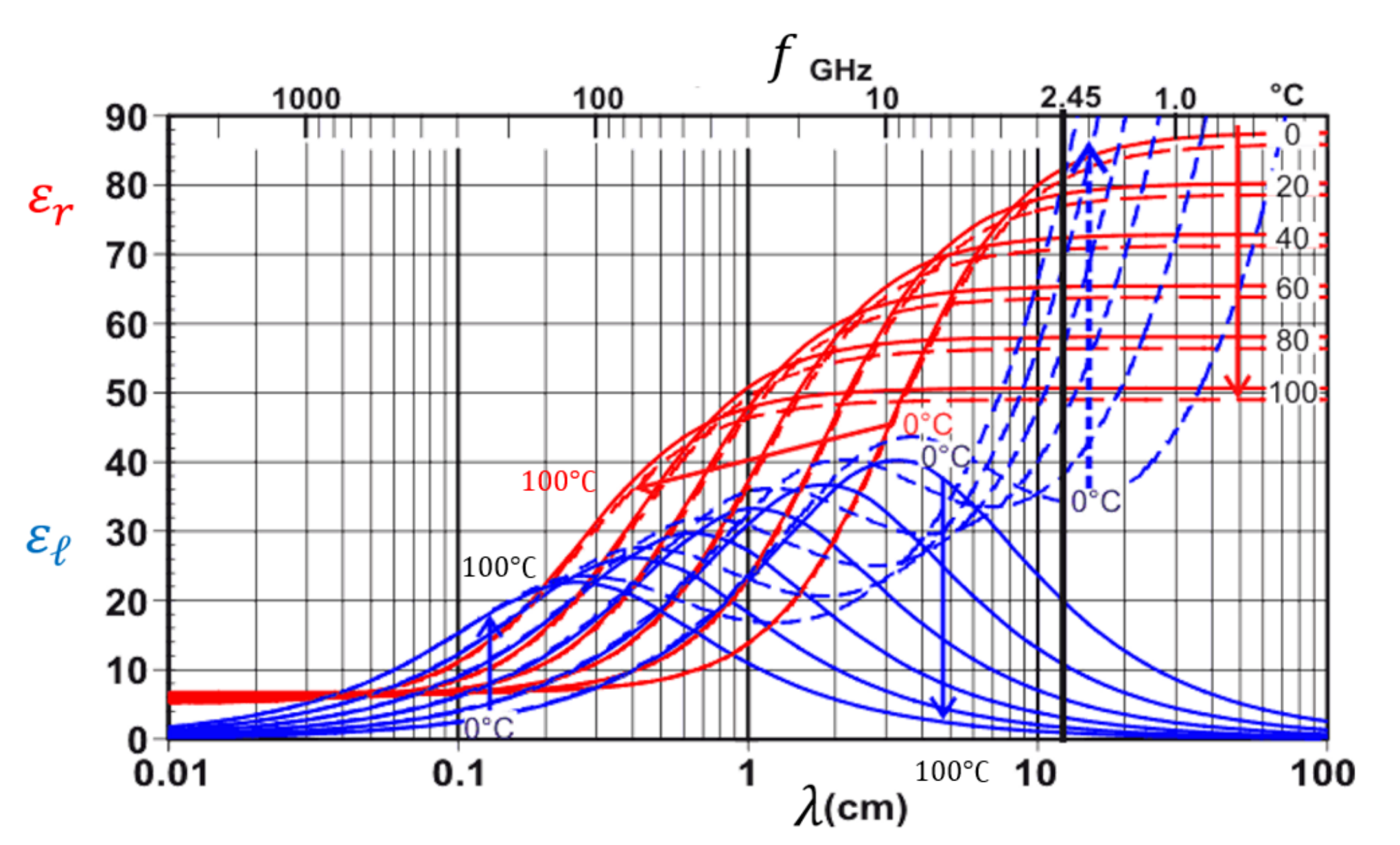
Figure 5 depicts (blue) and (red) for both pure water (solid lines) and a dilute solution of salt in water (dashed lines) as functions of wavelength or frequency, at several different temperatures. The angular frequency is indicated by a bold vertical line. Below we will consider microwave radiation at this frequency only.
B.5 Use Figure 5 to address the following questions:
- For water at , find the penetration depth at which the power per unit volume is reduced to half of its value at .
- Indicate in the Answer Sheet whether the penetration depth of the microwave radiation into water increases, decreases or remains the same with temperature.
- Indicate in the Answer Sheet whether the penetration depth of the microwave radiation into soup (dilute salt solution) increases, decreases or remains the same with temperature. [0,7 т.]
Отговори
B.1
B.2
B.3
B.4
B.5 12 mm
- mm (with , ); 2. for water increases with temperature; 3. for soup decreases with temperature.
Решение
Part B: The interaction of microwave radiation with water molecules
B.1. The torque at time is given by , hence the instantaneous power delivered to the dipole by the electric field is
B.2. Since the average dipole density (hence the average of each molecular dipole) is parallel to the field, the absorbed power density is (angular brackets, , denote average over time)
B.3. The energy density of the electromagnetic field at penetration depth , which is twice the electric energy density, is . Therefore, the time-averaged flux density at depth is:
where is the speed of light in vacuum. decreases with due to the absorbed power calculated in the previous task we find
hence .
B.4. Similarly to the previous task, the energy flux corresponding to the given field is
Equating the argument of the exponent in the last expression with the result of the previous task, and using the given approximation leads to .
B.5.
- Using previous results, the radiation power per unit area is reduced to half of its value at . From the given graph, at the given frequency and , hence mm.
We have just found that the penetration depth is proportional to . From the given graph we thus find that:
Heating up pure water (continuous lines) decreases much more significantly than the corresponding decrease of at the given frequency. Thus, the penetration depth of pure water increases with temperature, allowing deeper penetration of the microwave radiation and heating up the water inner regions.
On the contrary, for a soup (dilute salt solution, dashed lines) at the given frequency increases with temperature while decreases. Thus, the absorption rate increases with temperature, the penetration depth decreases, and less microwave radiation reaches its inner regions.
| material | increases with temp. | decreases with temp. | remains the same |
|---|---|---|---|
| water | X | ||
| soup | X |