IPhO 2021, Теория — Задача 1. Planetary Physics
IPhO Lithuania 2021 — Theory Q1: Planetary Physics (10 points) · 10 т.
Условие
This problem consists of two independent problems related to the interior of planets. The effects of the surface curvature of the planets can be neglected. You might need to use the formula
Part A. Mid-ocean ridge (5.0 points)
Consider a large vessel of water that is situated in a uniform gravitational field with free-fall acceleration . Two vertical rectangular plates parallel to each other are fitted into the vessel so that the vertical edges of the plates are in a tight gap-less contact with the vertical walls of the vessel. Length of each plate is immersed in water (Fig. 1). The width of the plates along the -axis is , water density is .
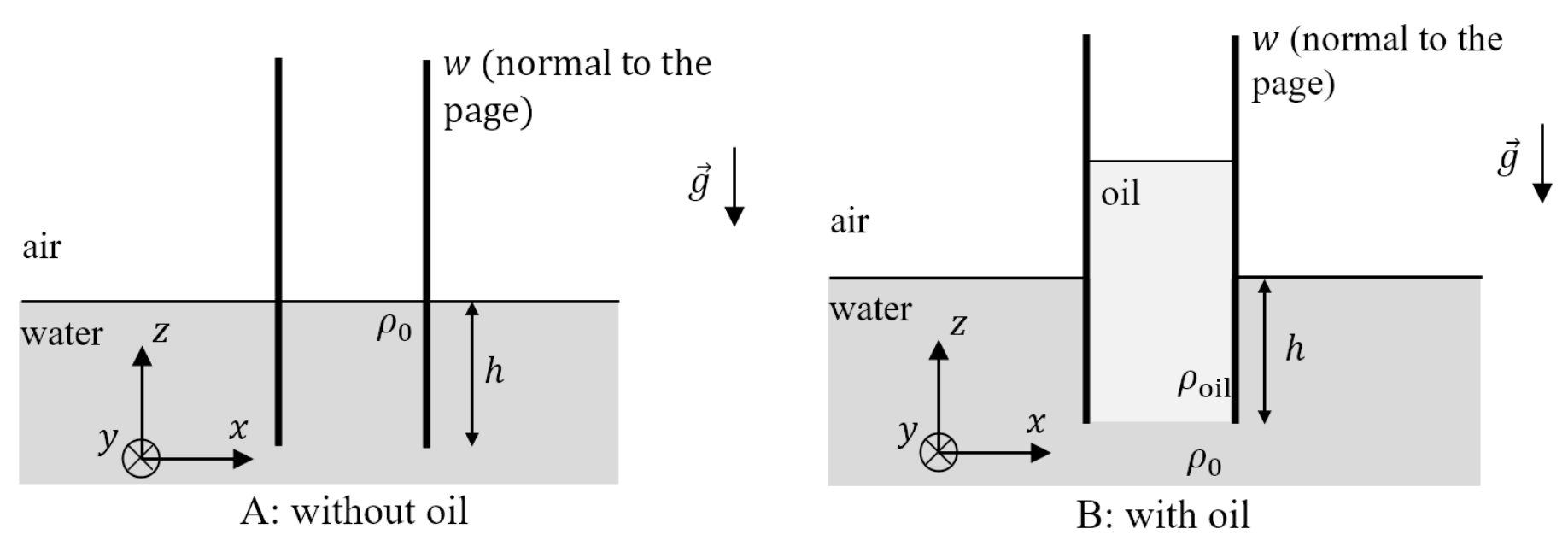
Oil of density () is poured into the space between the plates until the lower level of the oil has reached the lower edges of the plates. Assume that plates and vessel edges are high enough for oil not to overflow them. Surface tension and mixing of fluids can be neglected.
A.1 What is the -component of the net force acting on the right plate (magnitude and direction)? [0,8 т.]
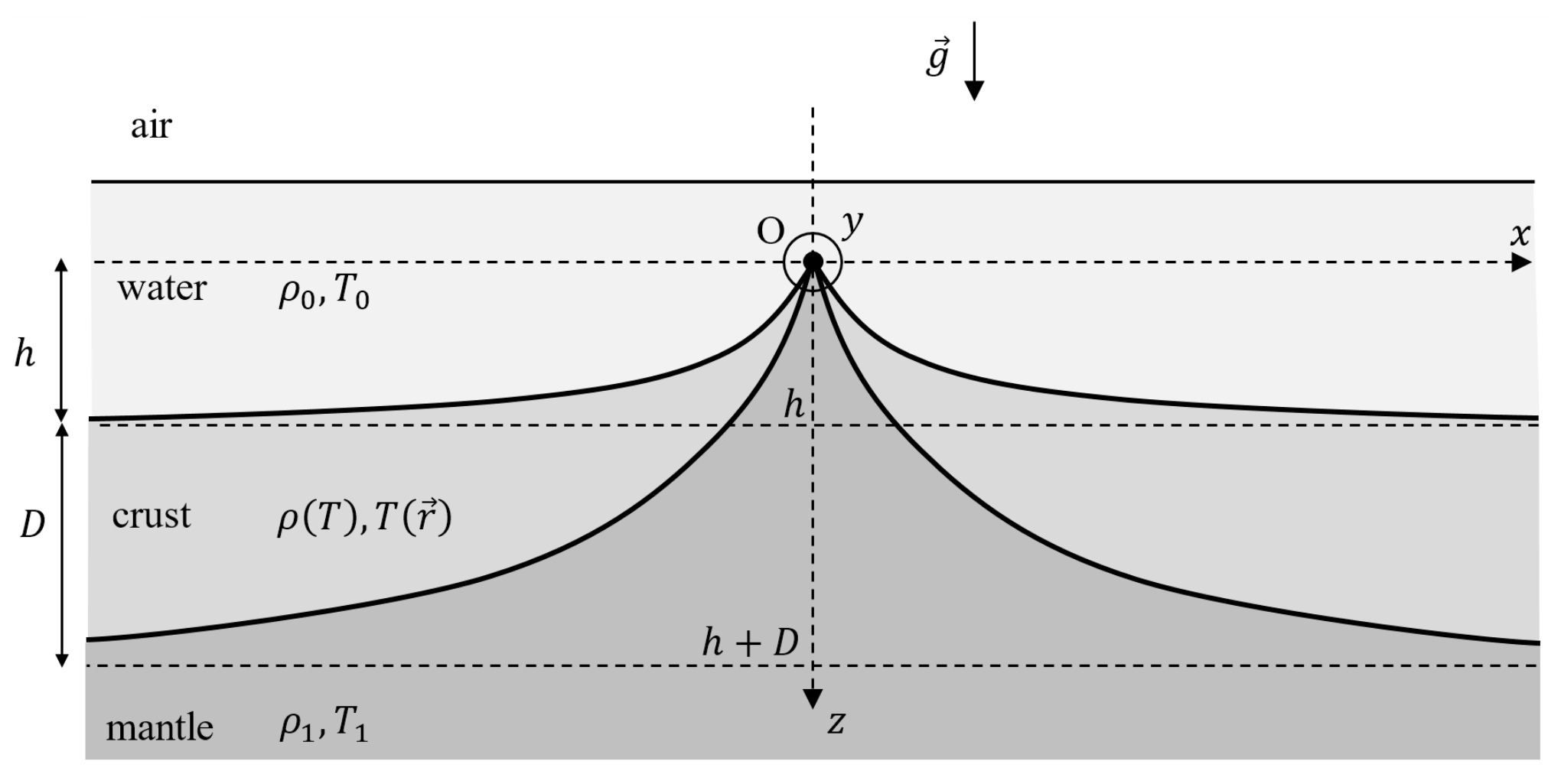
Fig. 2 shows a cross-section of a mid-ocean ridge. It consists of overlaying layers of mantle, crust and ocean water. The mantle is composed of rocks that we assume can flow in geological timescales and therefore, in this problem will be treated as a fluid. The thickness of the crust is much smaller than the characteristic length scale in the -direction, hence, the crust behaves as a freely bendable plate. To high accuracy, such a ridge can be modeled as a two-dimensional system, without any variation of variables along the -axis, which is perpendicular to the plane of Fig. 2. Assume that the ridge length along the -axis is much larger than any other length introduced in this problem.
At the centre of the ridge the thickness of the crust is assumed to be zero. As the horizontal distance from the centre increases, the crust gets thicker and approaches a constant thickness as . Correspondingly, the ocean floor subsides by a vertical height below the top of the ridge O, which we define as the origin of our coordinate system (see Fig. 2). Water density and temperature can be assumed to be constant in space and time. The same can be assumed for mantle density and its temperature . The temperature of the crust is also constant in time but can depend on position.
It is known that, to high accuracy, the crustal material expands linearly with temperature . Since water and mantle temperatures are assumed to be constant, it is convenient to use a rescaled version of the thermal expansion coefficient. Then , where is the length of a piece of crustal material, is its length at temperature , and is the rescaled thermal expansion coefficient, which can be assumed to be constant.
A.2 Assuming that the crust is isotropic, find how its density depends on its temperature . Assuming that , write your answer in the approximate form
where terms of order and higher are neglected. Then, identify constant . [0,6 т.]
It is known that . Also, thermal conductivity of the crust can be assumed to be constant. As a consequence, very far away from the ridge axis the temperature of the crust depends linearly with depth.
A.3 By assuming that mantle and water each behave like an incompressible fluid at hydrostatic equilibrium, express the far-distance crust thickness in terms of , , , and . Any motion of the material can be neglected. [1,1 т.]
A.4 Find, to the leading order in , the net horizontal force acting on the right half () of the crust in terms of , , , , and . [1,6 т.]
Suppose that crust is thermally isolated from the rest of the Earth. As a result of heat conduction, the temperatures of the upper and lower surfaces of the crust are going to get closer to each other until the crust reaches thermal equilibrium. Specific heat of the crust is and can be assumed to be constant.
A.5 By using dimensional analysis or order-of-magnitude analysis, estimate the characteristic time in which the difference between the upper and lower surface temperatures of the crust far away from the ridge axis is going to approach zero. You can assume that does not depend on the two initial surface temperatures of the crust. [0,9 т.]
Part B. Seismic waves in a stratified medium (5.0 points)
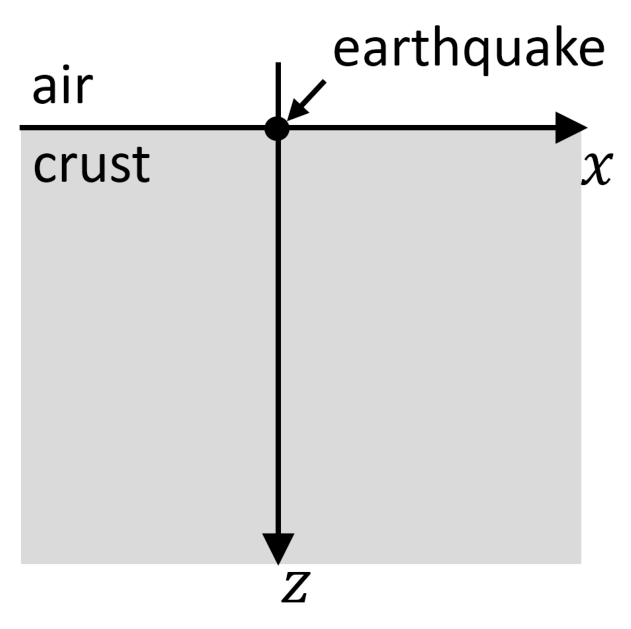
Suppose that a short earthquake happens at the surface of some planet. The seismic waves can be assumed to originate from a line source situated at , where is the horizontal coordinate and is the depth below the surface (Fig. 3). The seismic wave source can be assumed to be much longer than any other length considered in this question.
As a result of the earthquake, a uniform flux of the so-called longitudinal P waves is emitted along all the directions in the - plane that have positive component along the -axis. Since the wave theory in a solid is generally complicated, in this problem we neglect all the other waves emitted by the earthquake. The crust of the planet is stratified so that the P-wave speed depends on depth according to , where is the speed at the surface and is a known positive constant.
B.1 Consider a single ray emitted by the earthquake that makes an initial angle with the -axis and travels in the - plane. What is the horizontal coordinate at which this ray can be detected at the surface of the planet? It is known that the ray path is an arc of a circle. Write your answer in the form , where and are constants to be found. [1,5 т.]
If you were unable to find and , in the following questions you can use the result as given. Suppose that total energy per unit length of the source released as P waves into the crust during the earthquake is . Assume that waves are completely absorbed when they reach the surface of the planet from below.
B.2 Find how the energy density per unit area absorbed by the surface depends on the distance along the surface . Sketch the plot of . [1,5 т.]
From now on, assume that the waves are instead fully reflected when reaching the surface. Imagine a device positioned at that has the same geometry as the previously considered earthquake source. The device is capable of emitting P waves in a freely chosen angular distribution. We make the device emit a signal with a narrow range of emission angles. In particular, the initial angle the signal makes with the vertical belongs to the interval , where , and .
B.3 At what distance along the surface from the source is the furthest point that the signal does not reach? Write your answer in terms of , and other constants given above. [2 т.]
Отговори
Final results are given per part (A.1–B.3).
A.1
The force acts on the right plate to the right.
A.2
A.3
A.4
A.5
B.1
B.2
B.3
Решение
Part A. Mid-ocean ridge (5.0 points)
A.1 (0.8 points)
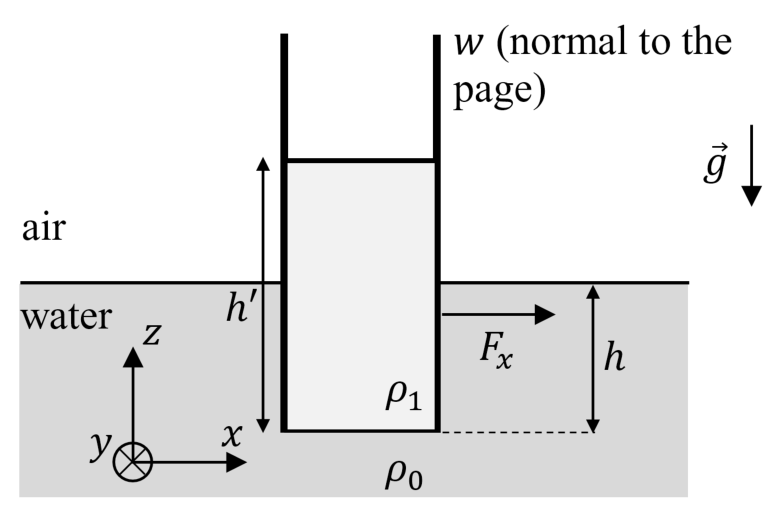
Let be the height of the column of oil (see Fig. 1). Then pressure at depth below the water surface must be , from where . Horizontal force on the plate , where the force due to new fluid is and the force due to water is .
Combining all the equation above, we get
This force acts on the right plate to the right.
A.2 (0.6 points)
Consider a rectangular mass element of the crust. Since relation holds for all three dimensions of the solid, its volume satisfies
where is the volume at . If the mass of the element is , density is then
Since , this can be approximated as
so that .
A.3 (1.1 points)
Since mantle behaves like a fluid in hydrostatic equilibrium, pressure at must be the same for all . Therefore,
Similarly, we must have
Hence, the change in pressure between and must be the same at both and . At the ridge axis
while far away
Since the temperature of the crust at depends linearly on height, after applying the relevant temperature boundary conditions,
From all the equations above and by using the density formula given in the problem text,
from where we straightforwardly obtain
A.4 (1.6 points)
The net horizontal force on the half of the ridge is the difference between the pressure forces acting at and :
From considerations of the previous question, pressure at is
while very far away
The equations above can be combined into
After a straightforward integration and using ,
Since , and , the term with is of the leading order, hence, after substituting the result of A.3, the required answer is
A.5 (0.9 points)
Method 1: dimensional analysis. The timescale is expected to depend only on density of the crust , its specific heat , thermal conductivity and thickness . Hence, we can write
where is a dimensionless constant. We will obtain the powers – via dimensional analysis.
Define the symbols for different dimensions: for length, for mass, for time and for temperature. Then , , , and have dimensions , , , and , respectively. The resulting set of linear equations to balance the powers of length, mass, time and temperature, respectively, is
This gives , , . Hence,
Method 2: scale analysis. Consider a piece of crust of area . Heat flux that has to be transmitted through the crust is of order , where . On the other hand, the law of thermal conductivity gives that .
From the two equations, , from where we get that is independent of and
Part B. Seismic waves in a stratified medium (5.0 points)
B.1 (1.5 points)
Seismic waves in this problem can be treated by using ray theory. Namely, their propagation is described by the Snell’s law of refraction
where the refractive index is
and denotes the seismic wave speed in a material with refractive index . From the two equations above we have
Method 1. Since this describes an arc of a circle, we have that at , (Fig. 2), giving
from where the circle radius . From simple geometry we get
leading to
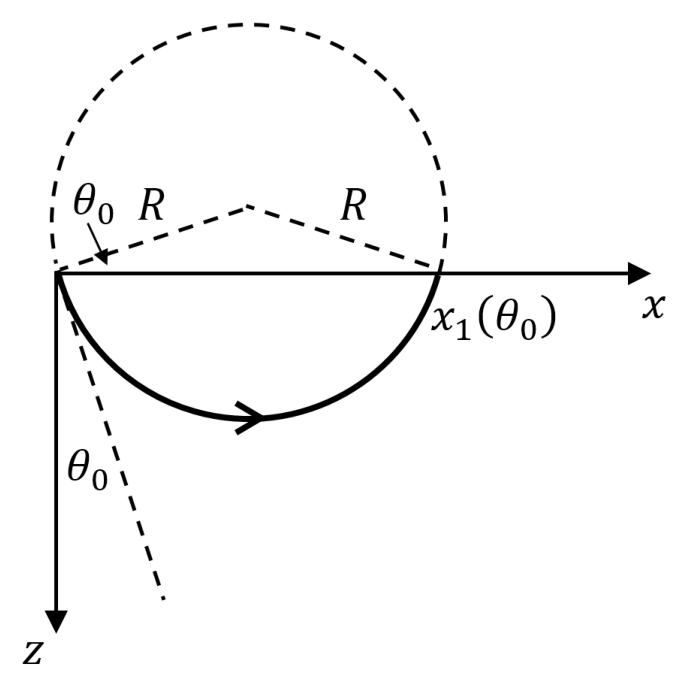
i.e. and .
Method 2. Implicitly differentiating gives
An infinitesimal ray path length is related to the change in the vertical coordinate via
giving
This is an equation of an arc of a circle of radius
Alternatively, instead of considering an infinitesimal ray path length , one can obtain the answer by writing
The first derivative can be eliminated via Snell’s law, leading to
which can be integrated to get
where we used Snell’s law again to get that the ray has at the point where it reaches the surface.
B.2 (1.5 points)
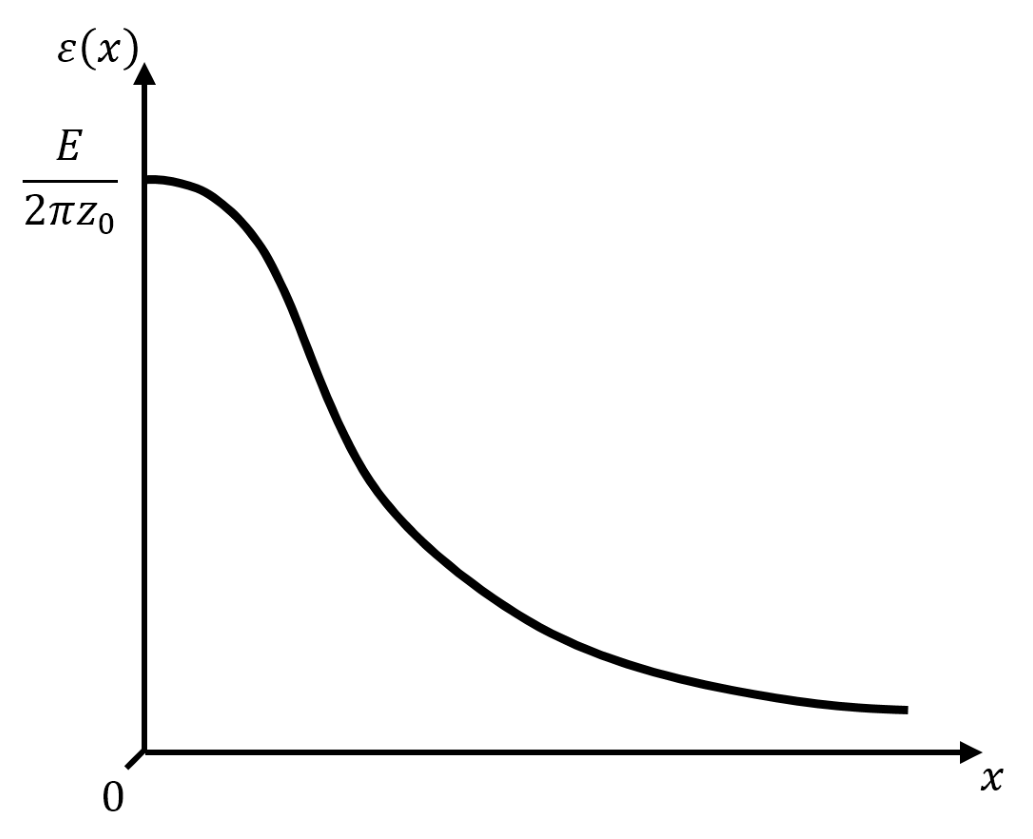
In two dimensions, is the energy carried by rays that are emitted within interval . On the other hand, the energy carried by rays that arrive at is . Therefore,
Using the result of question B.1,
Hence,
This function is plotted in Fig. 3.
B.3 (2.0 points)
Define and . To the leading order in , . With each reflection of the signal, the horizontal distance between the points where the edges of the signal reflect increases by . When moving along the positive -axis, these zones get wider until they overlap. If this happens after reflections, then
where the approximate sign tends to equality as .
The position where the zones start to overlap is at . Therefore,
Since , we can approximate
Combining the last two equations and substituting the expression gives
Оригинал в Архива: Th1.pdf · официални решения: Th1-Solution.pdf