IPhO 2021, Теория — Задача 2. Electrostatic lens
IPhO Lithuania 2021 — Theory Q2: Electrostatic lens (10 points) · 10 т.
Условие
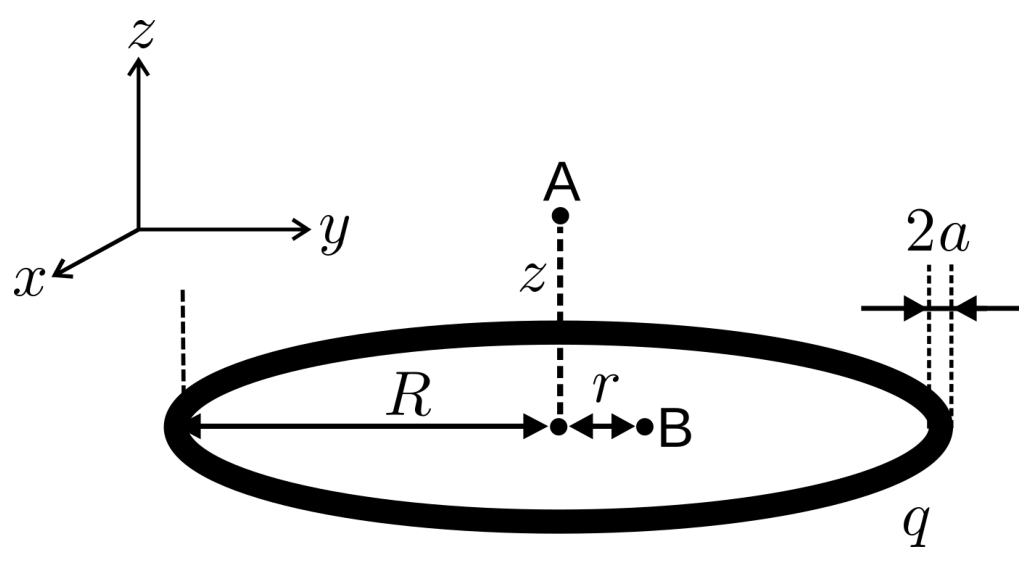
Consider a uniformly charged metallic ring of radius and total charge . The ring is a hollow toroid of thickness . This thickness can be neglected in parts A, B, C, and E. The plane coincides with the plane of the ring, while the -axis is perpendicular to it, as shown in Figure 1. In parts A and B you might need to use the formula (Taylor expansion)
Part A. Electrostatic potential on the axis of the ring (1 point)
A.1 Calculate the electrostatic potential along the axis of the ring at a distance from its center (point A in Figure 1). [0,3 т.]
A.2 Calculate the electrostatic potential to the lowest non-zero power of , assuming . [0,4 т.]
A.3 An electron (mass and charge ) is placed at point A (Figure 1, ). What is the force acting on the electron? Looking at the expression of the force, determine the sign of so that the resulting motion would correspond to oscillations. The moving electron does not influence the charge distribution on the ring. [0,2 т.]
A.4 What is the angular frequency of such harmonic oscillations? [0,1 т.]
Part B. Electrostatic potential in the plane of the ring (1.7 points)
In this part of the problem you will have to analyze the potential in the plane of the ring () for (point B in Figure 1). To the lowest non-zero power of the electrostatic potential is given by .
B.1 Find the expression for . You might need to use the Taylor expansion formula given above. [1,5 т.]
B.2 An electron is placed at point B (Figure 1, ). What is the force acting on the electron? Looking at the expression of the force, determine the sign of so that the resulting motion would correspond to harmonic oscillations. The moving electron does not influence the charge distribution on the ring. [0,2 т.]
Part C. The focal length of the idealized electrostatic lens: instantaneous charging (2.3 points)
One wants to build a device to focus electrons—an electrostatic lens. Let us consider the following construction. The ring is situated perpendicularly to the -axis, as shown in Figure 2. We have a source that produces on-demand packets of non-relativistic electrons. Kinetic energy of these electrons is ( is velocity) and they leave the source at precisely controlled moments. The system is programmed so that the ring is charge-neutral most of the time, but its charge becomes when electrons are closer than a distance () from the plane of the ring (shaded region in Figure 2, called “active region”). In part C assume that charging and de-charging processes are instantaneous and the electric field ”fills the space” instantaneously as well. One can neglect magnetic fields and assume that the velocity of electrons in the -direction is constant. Moving electrons do not perturb the charge distribution on the ring.
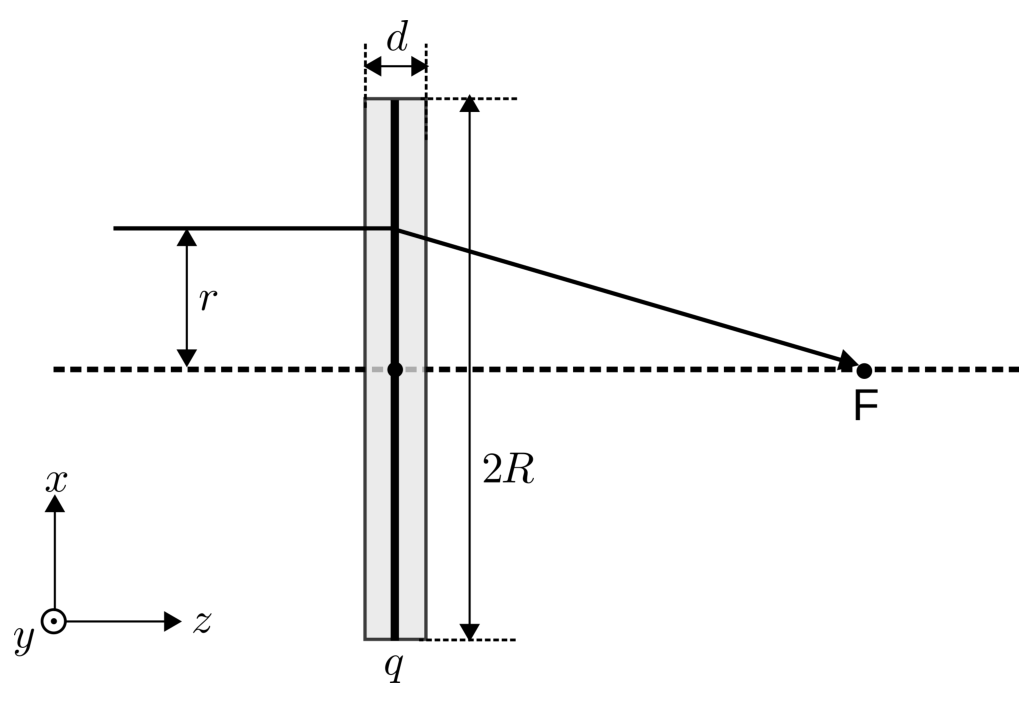
C.1 Determine the focal length of this lens. Assume that . Express your answer in terms of the constant from question B.1 and other known quantities. Assume that before reaching the ”active region” the electron packet is parallel to the -axis and . The sign of is such so that the lens is focusing. [1,3 т.]
In reality the electron source is placed on the -axis at a distance from the center of the ring. Consider that electrons are no longer parallel to the -axis before reaching the ”active region”, but are emitted from a point source at a range of different angles rad to the -axis. Electrons are focused in a point situated at a distance from the center of the ring.
C.2 Find . Express your answer in terms of the constant from question B.1 and other known quantities. [0,8 т.]
C.3 Is the equation of a thin optical lens
fulfilled for the electrostatic lens? Show it by explicitly calculating . [0,2 т.]
Part D. The ring as a capacitor (3 points)
The model considered above was idealized and we assumed that the ring charged instantaneously. In reality charging is non-instantaneous, as the ring is a capacitor with a finite capacitance . In this part we will analyze the properties of this capacitor. You might need the following integrals:
and
D.1 Calculate the capacitance of the ring. Consider that the ring has a finite width , but remember that . [2 т.]
When electrons reach the “active region”, the ring is connected to a source of voltage (Figure 3). When electrons pass the “active region”, the ring is connected to the ground. The resistance of contacts is and the resistance of the ring itself can be neglected.
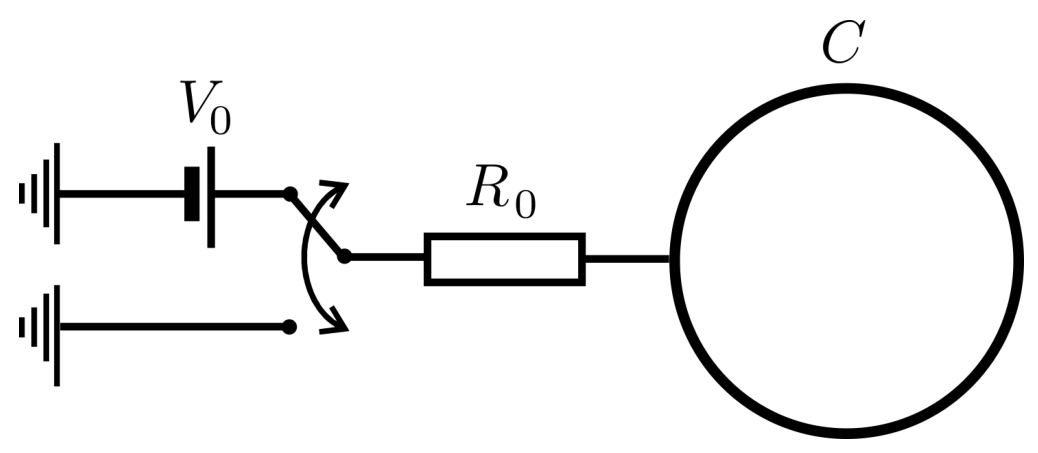
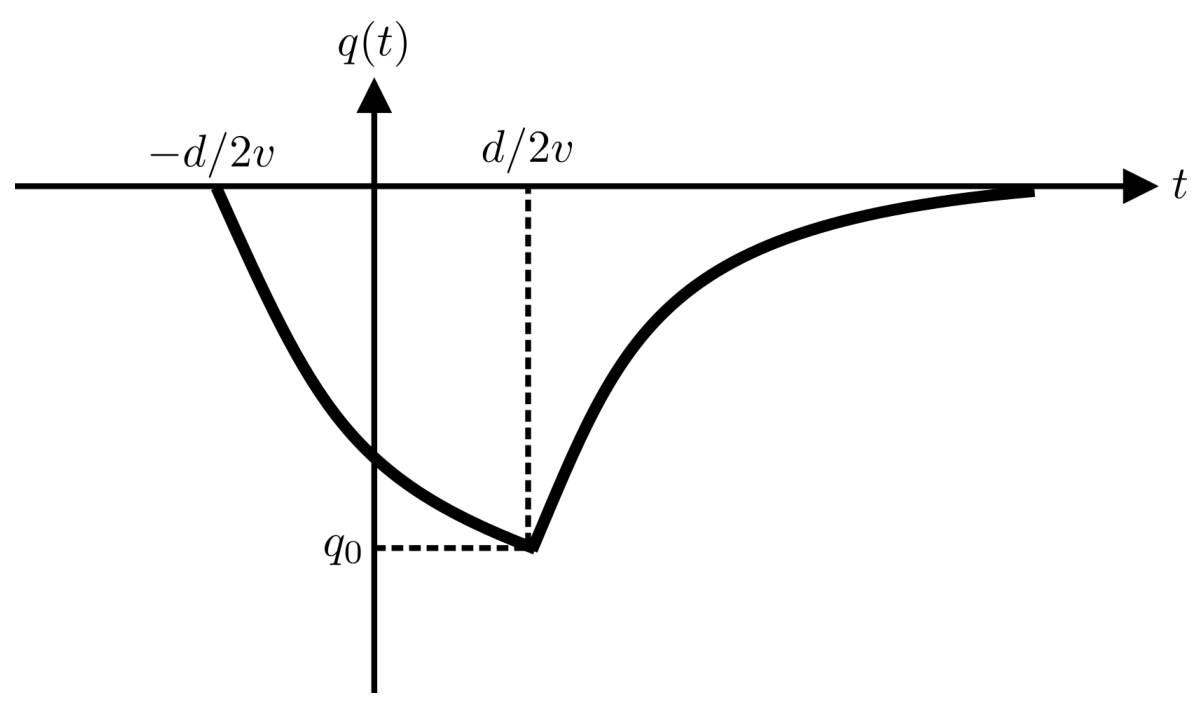
D.2 Determine the dependence of the charge on the ring as a function of time, , and make a schematic plot of this dependence. corresponds to a time moment when electrons are in the plane of the ring. What is the charge on the ring when the absolute value is maximal? The capacitance of the ring is (i.e., you do not have to use the actual expression found in D.1).
Remark: the drawn polarity in Figure 3 is for indicative purposes only. The sign should be chosen so that the lens is focusing. [1 т.]
Part E. Focal length of a more realistic lens: non-instantaneous charging (2 points)
In this part of the problem, we will consider the action of this more realistic lens. Here we will again neglect the width of the ring and will assume that electrons travel parallel to the -axis before reaching the ”active region”. However, the charging of the ring is no longer instantaneous.
E.1 Find the focal length of the lens. Assume that , but and are of the same order of magnitude. Express your answer in terms of the constant from part B and other known quantities. [1,7 т.]
E.2 You will see, that the result for is similar to that obtained in part C, whereby the value is substituted with . Find the expression for in terms of quantities given in formulation of the problem. [0,3 т.]
Отговори
A.1
A.2
A.3
A.4
B.1
B.2
C.1
C.2
C.3
Yes, the thin-lens equation holds.
D.1
D.2
E.1
E.2
Решение
Part A. Electrostatic potential on the axis of the ring (1 point)
A.1 (0.3 points)
The linear charge density of the ring is . All the points of the ring are situated a distance away from point A. Integrating over the whole ring we readily obtain:
A.2 (0.4 points)
Using an expansion in powers of we obtain:
A.3 (0.2 points)
The potential energy of the electron is . The force acting on the electron is
If this is a restoring force, it should be negative for positive . Thus, .
A.4 (0.1 points)
The equation of motion for an electron is
(here dots denote time derivatives). We therefore get
Part B. Electrostatic potential in the plane of the ring (1.7 points)
B.1 (1.5 points)
There are two different ways to solve this problem: (i) using direct integration; (ii) using Gauss’s law and the result of part A.
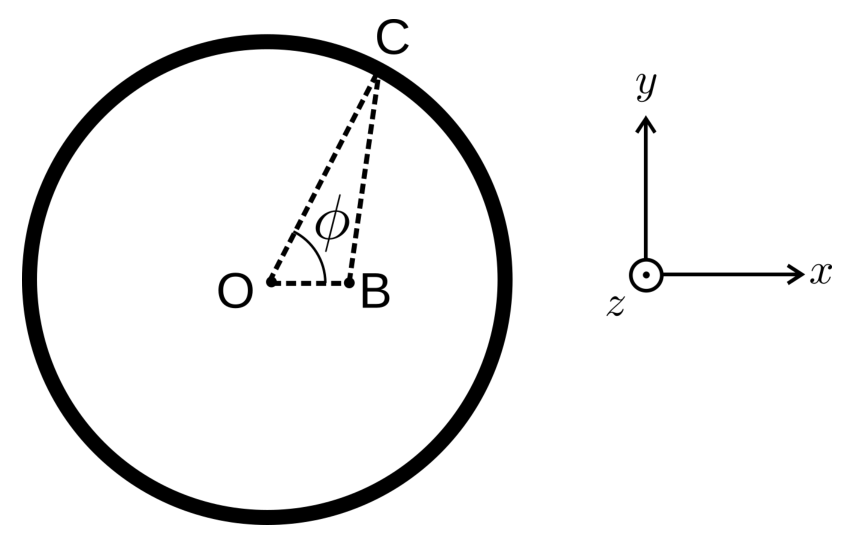
(i) Direct integration. We will follow the notations of Figure 1. Since the potential has cylindrical symmetry, let the point B, where we calculate the potential, be on the -axis. Let
Thus:
Electrostatic potential created by ring element at the point B:
Using the expansion given in the formulation of the problem for we have:
Ignoring the terms of the order and we get:
Integrating over all angles we finally obtain:
From here, comparing with the expression , we obtain
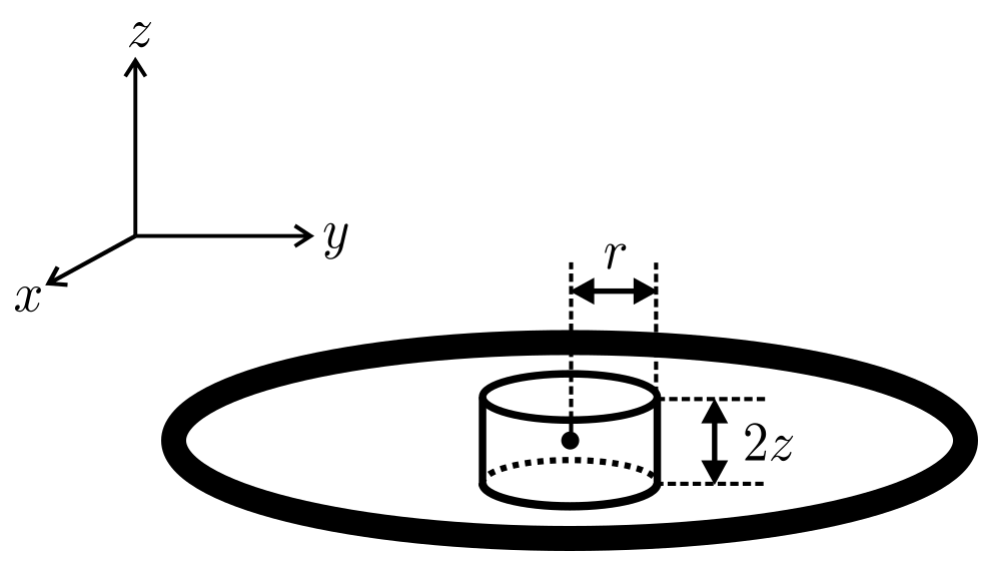
(ii) Gauss’s law.
Let us analyze a small cylinder of radius . The center of the cylinder coincides with the center of the ring. In part A we analyzed the potential along the -axis, while in this part we analyze the potential along the radius . For any and the potential has an expression:
The lowest order terms are quadratic in and . Due to reflection symmetry the potential does not contain terms of the type . This, for example, immediately gives us . Thus, for small and electric fields in the radial and axial directions are:
Applying Gauss’s law to the cylinder we obtain:
The second integral is:
The first integral is:
Gauss’s theorem thus gives:
This immediately yields
which agrees with the result obtained via direct integration.
B.2 (0.2 points)
The potential of the electron is . Force acting on the electron in the plane is
To have oscillations we need the force to be negative for . Thus, .
Part C. The focal length of the idealized electrostatic lens (2.3 points)
C.1 (1.3 points)
Let us consider an electron with the velocity at a distance from the “optical” axis (Figure 2 of the problem). The electron crosses the “active region” of the lens in time
The equation of motion in the direction:
During the time the electron crosses the active region of the lens, the electron acquires radial velocity:
The lens will be focusing if . The time it takes for an electron to reach the “optical” axis is:
During this time the electron travels in the -direction a distance
does not depend on the radial distance , therefore all electron will cross the “optical” axis (will be focused) in the same spot. Thus,
C.2 (0.8 points)
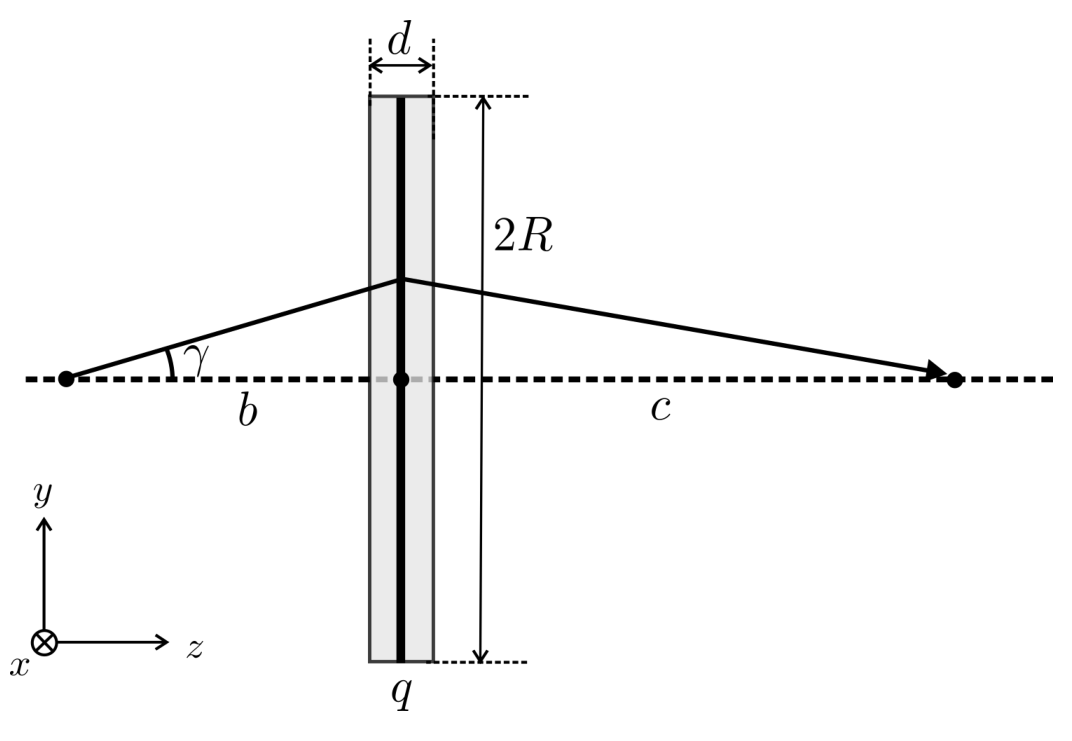
Let us consider an electron emitted an an angle to the optical axis (Figure 3). Its initial velocity in the radial direction is:
where is the radial distance of the electron when it reaches the plane of the ring. The velocity in the -direction is
For small angles the additional velocity in the -direction acquired in the “active region” is the same as in part C.1. Thus, the radial velocity after crossing the active region is
where the first term is positive and the second term is negative, since . If the electrons are focused, then (this can be verified after obtaining the final result). The electron will reach the optical axis in time
During this time it will travel a distance
C.3 (0.2 pt)
From the previous answer we obtain:
Comparing with the answer of C.1 we immediately obtain
i.e. the equation of a thin optical lens is valid for an electrostatic lens as well.
Part D. The ring as a capacitor (3 points)
D.1 (2.0 points)
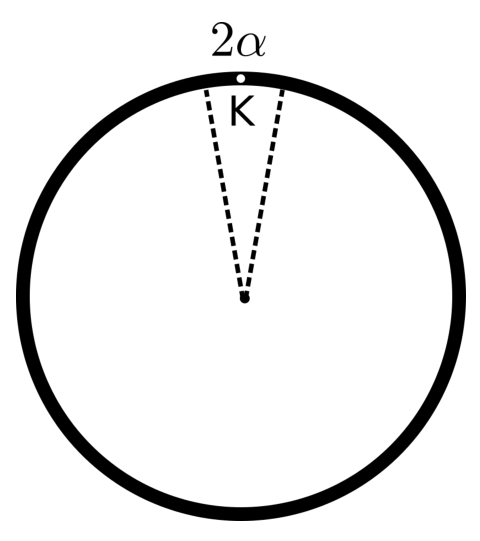
Let us sub-divide the entire ring into two parts: a part corresponding to the angle , and the rest of the ring, as shown in Figure 4. While the angle is small in comparison to 1, let us assume that the length of the first part, , is still large compared to (). Let us calculate the electrostatic potential at point K. It it a sum of two terms: the first one produced by the cut-out part with an angle (contribution ) and the second one originating from the rest of the ring (contribution ).
Contribution . Since , we can neglect the curvature of the cylinder that is cut out from the ring. The linear charge density on the ring is . The potential at the center of the cylinder is then given by an integral:
Using the integral provided in the description of the problem we get:
As ,
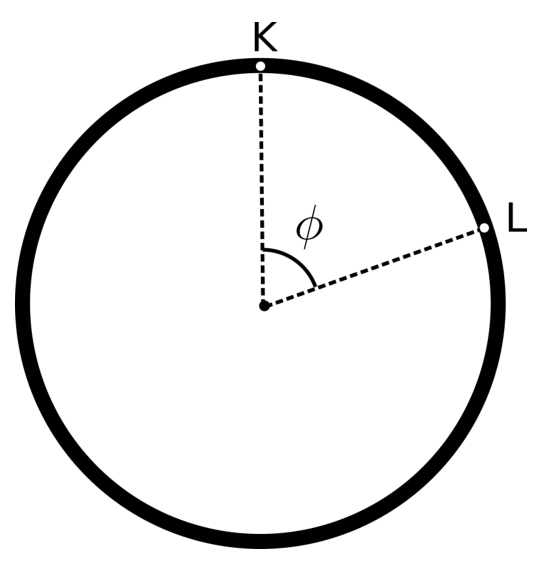
Contribution . In this case we can neglect the thickness . Using the cosine theorem we can derive the distance between points K and L of Figure 5:
The contribution can then be written as an integral:
Using the integral from the formulation of the problem, we calculate:
for . Therefore
The total potential and capacitance. The total potential is the sum of and :
drops out from the expression. From here we obtain the capacitance :
as .
D.2 (1.0 point)
Let be the charge on the ring at a time . Potential of the disk is thus . Voltage drop of the resistor is . Therefore for time :
Integrating this equation and keeping in mind that at , we get:
The charge attains the largest absolute value at . The value of the charge at this time is:
When , we get:
From here:
Therefore, we obtain:
For a lens to be focusing we require that charge is negative, therefore . The dependence of charge on time is shown in Figure 6.
Part E. Focal length of a more realistic lens (2 points)
E.1 (1.7 points)
Like in part C, the radial equation of motion of an electron is:
where in this case depends on time. Using the notation , we obtain:
As , then during charging–decharging the electron does not substantially change its radial position , and we can assume to be constant during the entire charging–decharging process. In this case the acquired vertical velocity is
We can use the derived equations for and find the integrals. The integral is (using the notation , , ):
The integral is
Adding the two integrals we obtain for the final integral:
Interestingly, it does not depend on . Therefore, the acquired vertical velocity of the electron is
Following the logic similar to part C, we derive the focal length
E.2 (0.3 points).
Comparing with from part C we immediately obtain .
Оригинал в Архива: Th2.pdf · официални решения: Th2-Solution.pdf