IPhO 2021, Теория — Задача 3. Particles and Waves
Theory Q3 — Particles and Waves (10 points) — IPhO Lithuania 2021, English (Official) · 10 т.
Условие
Wave–particle duality, which states that each particle can be described as a wave and vice versa, is one of the central concepts of quantum mechanics. In this problem, we will rely on this notion and just a few other basic assumptions to explore a selection of quantum phenomena covering the two distinct types of particles of the microworld—fermions and bosons.
A.1 Part A. Quantum particle in a box (1.4 points)
Consider a particle of mass moving in a one-dimensional potential well, where its potential energy is given by
While classical particle can move in such a potential having any kinetic energy, for quantum particle only some specific positive discrete energy levels are allowed. In any such allowed state, the particle can be described as a standing de Broglie wave with nodes at the walls.
Determine the minimal possible energy of the quantum particle in the well. Express your answer in terms of , , and the Planck’s constant . [0,4 т.]
A.2 The particle’s state with minimal possible energy is called the ground state, and all the rest allowed states are called excited states. Let us sort all the possible energy values in the increasing order and denote them as , starting from for the ground state.
Find the general expression for the energy (here ). [0,6 т.]
A.3 Particle can undergo instantaneous transition from one state to another only by emitting or absorbing a photon of the corresponding energy difference. Find the wavelength of the photon emitted during the transition of the particle from the first excited state () to the ground state (). [0,4 т.]
B.1 Part B. Optical properties of molecules (2.1 points)
In this part, we will study several optical properties of the cyanine Cy5 molecule—a widely used dye molecule, schematically shown in Fig. 1a. Its optical properties are determined mainly by the carbon backbone, composed of the alternating single and double bonds between carbon atoms, shown in Fig. 1b, while the influence of the rings at the molecule’s ends as well as radicals R is much smaller. Three of the four valence electrons of each C atom (and of N atoms) in the backbone form the chemical bonds, while the remaining valence electrons are “shared” and can move along the whole backbone. The net potential energy of each such electron is shown with oscillating thin line in Fig. 1c, with minima corresponding to the positions of the C and N atoms.
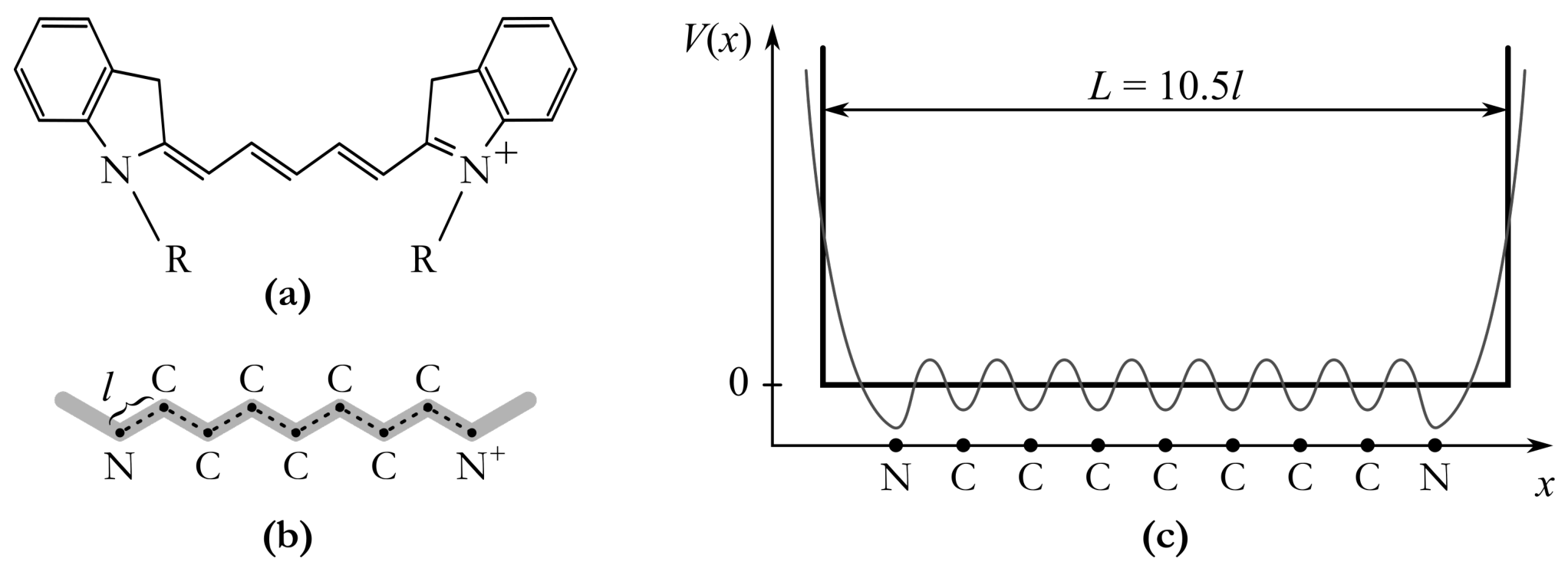
For simplicity, we will approximate this potential energy profile by a simple function given in Eq. 1 with the width (see thick line in Fig. 1c), here is the mean inter-atomic distance (see also Fig. 1b). As a result, we obtain the “electronic gas” composed of 10 electrons (7 from C atoms, 2 from the N atom, and 1 from the N ion), moving in a one-dimensional potential well discussed in part A. In our evaluation, we can neglect the mutual interaction of these electrons; however, we should account for the fact that electrons are fermions and thus obey the Pauli exclusion principle. We also neglect the influence of other electrons as well as motion of the nuclei.
Evaluate the largest wavelength of the photon that can be absorbed by the Cy5 molecule assuming that the electron system is initially in its ground state. Express your answer in terms of , physical constants and some numerical prefactor, and calculate the numerical value. [0,8 т.]
B.2 Another dye molecule Cy3 has similar structure, but its backbone is shorter by 2 carbon atoms. Is its absorption spectrum shifted to the bluer or to the redder spectral region compared to the Cy5 molecule? Evaluate numerically the magnitude of this spectral shift. You can assume that removing two carbon atoms doesn’t change the molecule shape and only makes the backbone length shorter by two interatomic distances. [0,4 т.]
B.3 Being in the excited state, molecule can undergo a spontaneous transition to the ground state while emitting photon. The mean rate of such events (i.e. the relative decrease of the molecules being in the excited state, , over time , ) is determined by the wavelength of the emitted photon, the transition electrical dipole moment (which is of the order of , here is elementary charge) as well as vacuum permittivity and Planck’s constant .
Using dimension analysis, determine the expression for the rate of spontaneous emission in terms of , , , and . The numerical prefactor for your expression is . [0,7 т.]
B.4 For Cy5 molecule, . Evaluate the mean fluorescence lifetime of the lowest excited state of Cy5 molecule, , which is reciprocal to the rate of its emissive transition to the ground state. [0,2 т.]
C.1 Part C. Bose-Einstein condensation (1.5 points)
This part is not directly related to Parts A and B. Here, we will study the collective behaviour of bosonic particles. Bosons do not respect the Pauli exclusion principle, and—at low temperatures or high densities—experience a dramatic phenomenon known as the Bose–Einstein condensation (BEC). This is a phase transition to an intriguing collective quantum state: a large number of identical particles ‘condense’ into a single quantum state and start behaving as a single wave. The transition is typically reached by cooling a fixed number of particles below the critical temperature. In principle, it can also be induced by keeping the temperature fixed and driving the particle density past its critical value.
We begin by exploring the relation between the temperature and the particle density at the transition. As it turns out, estimates of their critical values can be deduced from a simple observation: Bose-Einstein condensation takes place when the de Broglie wavelength corresponding to the mean square speed of the particles is equal to the characteristic distance between the particles in a gas.
Given a non-interacting gas of atoms in thermal equilibrium, write the expressions for their typical linear momentum and the typical de Broglie wavelength as a function of atom’s mass , temperature and physical constants. [0,4 т.]
C.2 Calculate the typical distance between the particles in a gas, , as a function of particle density . Hence deduce the critical temperature as a function of atom’s mass, their density and physical constants. [0,5 т.]
C.3 To realize BEC in the lab, the experimentalists have to cool gases to temperatures as low as = 100 nK.
What is the particle density of the Rb gas if the transition takes place at such a temperature? For the sake of comparison, calculate also the ‘ordinary’ particle density of an ideal gas at the standard temperature and pressure (STP), i.e. and . How many times is the ‘ordinary’ gas denser? You may assume that the mass of the atoms is equal to 87 atomic mass units (). [0,6 т.]
D.1 Part D. Three-beam optical lattices (5 points)
The first Bose-Einstein condensates were produced back in 1995, and since then the experimental work has branched out in diverse directions. In this part, you will investigate one particularly fruitful idea to load the condensate into spatially periodic potentials created by interfering a number of coherent laser beams. Due to the periodic nature of the resulting interference patterns, they are referred to as optical lattices. The potential energy of an atom moving in an optical lattice is proportional to the local intensity of the light, and in your calculations you may assume that
Here, is a positive constant, and the angle brackets indicate time-averaging which eliminates the rapidly oscillating terms. The electric field produced by the i-th laser is described by
with the amplitude , the wave vector , and the unit-length polarization vector .
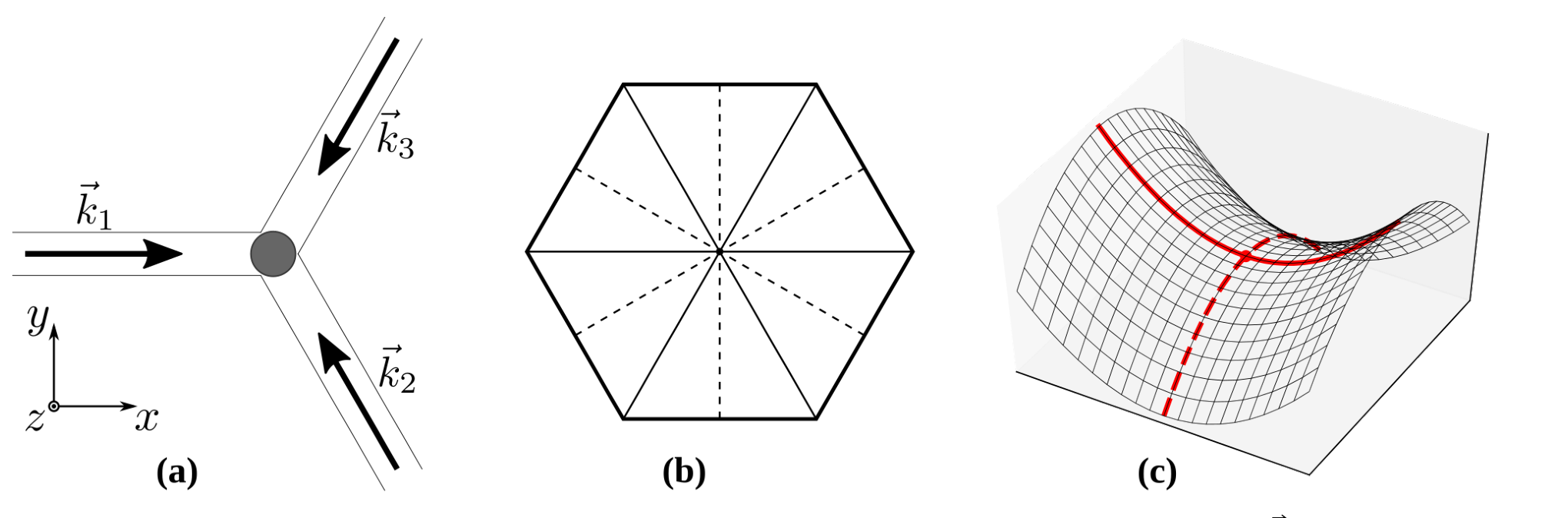
Your task is to study triangular optical lattices that are produced by interfering three coherent laser beams of equal intensity. A typical setup is shown in Fig. 2a. Here, all three beams are polarized in the direction, propagate in the plane and intersect at equal angles of 120°. Choose the direction of the axis parallel to the wave vector .
Using Eqs. 2 and 3 obtain the expression for the potential energy as a function of in the plane of the beams.
Hint: the result can be neatly expressed as a constant term plus a sum of three cosine functions of arguments . Please write your result in this form and identify the vectors . [1,4 т.]
D.2 The resulting potential energy has a sixfold rotational symmetry axis, i.e., the potential distribution is invariant with respect to a rotation by a multiple of 60° around the origin. Provide a simple argument to prove that this is indeed the case. [0,5 т.]
D.3 The above observation of symmetry simplifies the analysis of the two-dimensional potential distribution . As shown in Fig. 2b, a regular hexagon has symmetry lines that, respectively, connect opposite vertices (solid lines) and midpoints of opposite edges (dashed lines). Therefore, in our situation one does not need to produce and study two-dimensional potential plots as many insights can be deduced by focusing on the coordinate axes and that run along the symmetry lines.
Derive the behavior of the potential along the coordinate axes, i.e., determine the functions and . Identify the locations of the extrema of and as functions of a single argument. As these functions are periodic, please include in your lists only one representative from each family of periodically repeated minima and maxima. [1,2 т.]
D.4 We are interested in determining the locations of so-called lattice sites, i.e., the minima of the full two-dimensional potential . The obtained minima of single-argument functions and identify their suspected positions but still have to be checked to eliminate the saddle points. As shown in Fig. 2c, when studied along a single line, saddle points may disguise as minima but they are not.
Review your results in the previous question to determine actual minima of the optical lattice: Identify all equivalent minima nearest to (but not coinciding with) the origin. What is the distance between the nearest minima, in other words—the lattice constant of our optical lattice? Express the answer in terms of the laser wavelength . [0,8 т.]
D.5 Charge neutrality of ultracold atoms suggests that their interactions become relevant only when two or more atoms occupy the same site of an optical lattice. However, experimentalists are also able to explore setups that sustain long-range atomic interactions. A possible approach relies on creation of the so-called Rydberg atoms that are physically large and feature other exaggerated properties. Rydberg atoms are excited atoms with one electron promoted to a state with a very high principal quantum number . The size of a Rydberg atom can be estimated by calculating the radius of the classical circular orbit of that electron with the orbital angular momentum , here is the reduced Planck constant.
Calculate the value of that corresponds to the radius of the Rb Rydberg atom comparable to the wavelength of laser light = 380 nm. Give your answer in terms of and physical constants and find its numerical value. [1,1 т.]
Отговори
A.1
A.2
A.3
B.1
B.2 129 nm
Shifted to the blue: , .
B.3
B.4 3.3 ns
C.1
C.2
C.3
D.1
D.3
D.4
D.5
Решение
Part A. Quantum particle in a box (1.4 points)
A.1 (0.4 points)
The width of the potential well () should be equal to the half of the wavelength of the de Broglie standing wave , here is the Planck’s constant and is the momentum of the particle. Thus , and the minimal possible energy of the particle is
A.2 (0.6 points)
The potential well should fit an integer number of the de Broglie half-wavelengths: , . Therefore, particle’s momentum, corresponding to the de Broglie wavelength is
and the corresponding energy is
A.3 (0.4 points)
The energy of the emitted photon, (here is the speed of light and is the photon’s wavelength) should be equal to the energy difference , therefore
Part B. Optical properties of molecules (2.1 points)
B.1 (0.8 points)
Taking into account the Pauli exclusion principle, each energy level is occupied by two electrons with spins oriented in the opposite directions. As a results, 10 electrons fill the lowest 5 states, and the absorption of the photon of the longest wavelength corresponds to the transition of one electron from the occupied to the unoccupied energy state:
where and can be found from Eq. 1, where is replaced with the electron mass . Hence we obtain:
This result correspond precisely to the experimental value the peak position of the Cy5 absorption spectrum.
B.2 (0.4 points)
In the similar model for the Cy3 molecule, there are 8 electrons in the box of length , thus photon’s absorption corresponds to the transition. Taking into account the result of question B1, we obtain
i. e. the absorption spectrum of the Cy3 molecule is shifted by to the blue comparing to that of the Cy5 molecule. The experimental value is , so that our model catches general properties of these dye molecules rather well.
B.3 (0.7 points)
Let us assume
The SI units of the relevant quantities are:
By plugging these expressions into Eq. 2 we obtain a simple system of linear equations for the unknown powers , , , and :
By solving this system we get:
so that the rate of spontaneous emission is
B.4 (0.2 points)
By using the result of question B.2 and expressing transition dipole moment as , we obtain from Eq. 3:
Part C. Bose-Einstein condensation (1.5 points)
C.1 (0.4 points)
At temperature , the average kinetic energy of translational motion is . Equating this result to , we obtain typical momentum and the de Broglie wavelength
C.2 (0.5 points)
The volume per particle is a good estimate for . We obtain , with and equate to express .
C.3 (0.6 points)
Using the answer to the previous question, we express . Equation of state for the ideal gas gives . Numerical estimations yield and .
Part D. Three-beam optical lattices (5.0 points)
D.1 (1.4 points)
We sum the three electric fields ( components)
and square the result
Time averaging gives
we analyse the 9 terms and simplify to
Here
or in terms of the Levi-Civita symbol, . Incidentally, they are known as the reciprocal lattice vectors.
D.2 (0.5 points)
Argument: Observe that rotation by maps the three vectors into the relabelled triplet of ’s.
D.3 (1.2 points)
We find
and deduce
The potential has a simple cosine form, and the origin in an obvious minimum. Its replica appear at multiples of . In the midpoint between any two minima, e.g. at , the function has its maxima.
Concerning the behaviour along the axis, we have
Looking for the extrema, we find the equation
- (corresponding to ) is the ‘deep’ minimum – the lattice site;
- (corresponding to ) is the ‘shallow’ minimum (later shown to be a saddle point of );
- and (corresponding to and , respectively) are maxima.
D.4 (0.8 points)
We review the minima found in the previous question and eliminate the saddle point at . The actual minima of the 2D potential landscape are:
- – at the origin;
- – nearest to the origin in the positive direction along the axis. On the grounds of symmetry we argue that there are six equivalent nearest minima in the directions , , , and with respect to the axis.
Distance between nearest minima (the lattice constant) . Given that the laser wavelength is , we have , thus .
D.5 (1.1 points)
The atom’s core electrons (all but the one promoted to to a state with a high principal quantum number ) shield the electric field of the nucleus so that the effective potential for the outer electron resembles that of a hydrogen atom. The attractive force acting on that electron, , gives rise to its centripetal acceleration . Equating and using the expression for the angular momentum to eliminate the velocity, we find the quantum number corresponding to the orbit with the radius :
Оригинал в Архива: Th3.pdf · официални решения: Th3-Solution.pdf