IPhO 2022, theory — Задача 1. James Webb Space Telescope (12 points)
Автор: Olympiads XYZ · транскрипция на официалните материали
Проверена срещу оригинала на 13.9.2026 от същия модел, който я е транскрибирал (без независима проверка)
Theory — Q2, English (Official) · 12 т.
Внимание: Бележка към темата
Solution incomplete in this window: Part D.2 continues past solutions page 6 (pages 7–9 of 9).
Условие
This is a question on the physics of the James Webb Space Telescope. Light from a star strikes the primary mirror, with an area of , and reflects off of a secondary mirror. The focal length of the system is . The light is focused into the ISIM (Integrated Science Instrument Module), which contains the CCD (charged-coupled device) cameras.
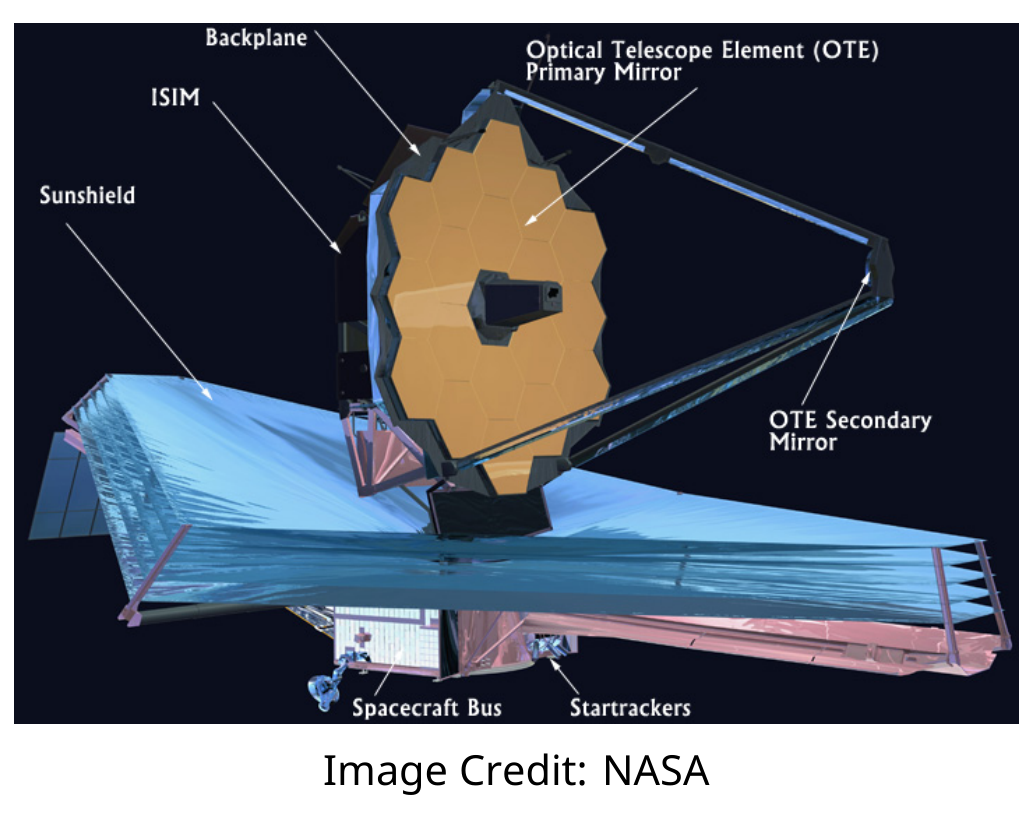
Part A. Imaging a Star (1.8 points) The nearest Red Giant is 89 light-years distant, has a temperature of , and a diameter of . [1,8 т.]
A.1 Calculate the diameter of a focused image of the star on the CCD camera imaging surface. [0,4 т.]
A.2 Estimate the diameter of a diffraction central maximum on the CCD camera imaging surface. Assume a wavelength of , which is the strongest intensity wavelength from the red giant star. [0,4 т.]
A.3 If the CCD is not cooled and can lose heat only by radiating from the top of the imaging surface, what would be the equilibrium temperature of the CCD at the location of the image of the red giant star? Assume the CCD surface is a blackbody. Provide a formula and a numerical estimate. [1 т.]
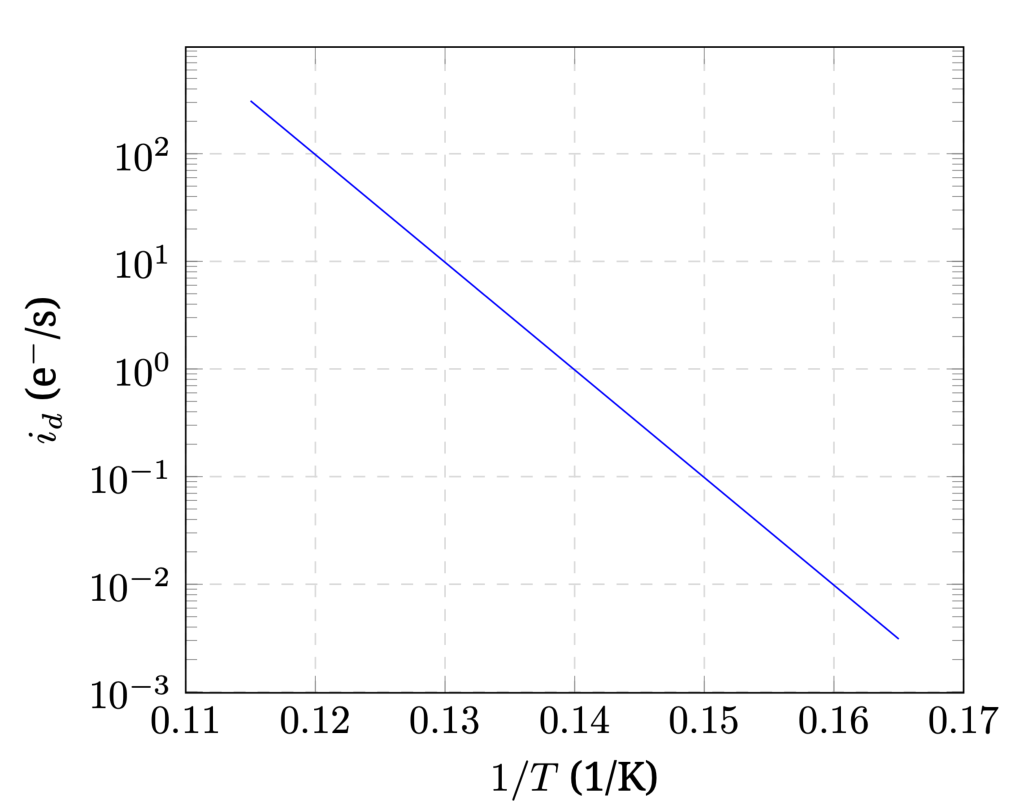
Part B. Counting Photons (1.8 points) The absorption of a photon by the CCD camera leads to the emission of an electron within the apparatus. This occurs only if the photon has sufficient energy to excite an electron across an energy gap . Assume that every photon with sufficient energy succeeds. There is also leakage of electrons across the gap caused by the temperature of the CCD camera; this is the dark current and is measured in the number of electrons per second. It is a function of temperature according to
where is a constant. [1,8 т.]
B.1 From the dark current graph, provide an order of magnitude estimate for the temperature of a distant source of thermal photons that would just be capable of exciting an electron on the pixel. [0,4 т.]
B.2 Write an expression for the total count uncertainty , if there is a readout noise , a dark current , an incoming photon rate , and an exposure time . [0,4 т.]
B.3 Assume an operating temperature of . Calculate the minimum photon rate so that the photon count is ten times the count uncertainty. [0,5 т.]
B.4 Assuming all photons are just capable of exciting an electron across the band gap, what is the intensity of the source of photons found in B.3 on the primary mirror? Express your answer in [0,5 т.]
Part C. Passive Cooling (4.4 points) An infrared CCD camera must be kept at a low temperature. The first tool is a shield to protect from the sun's radiation.
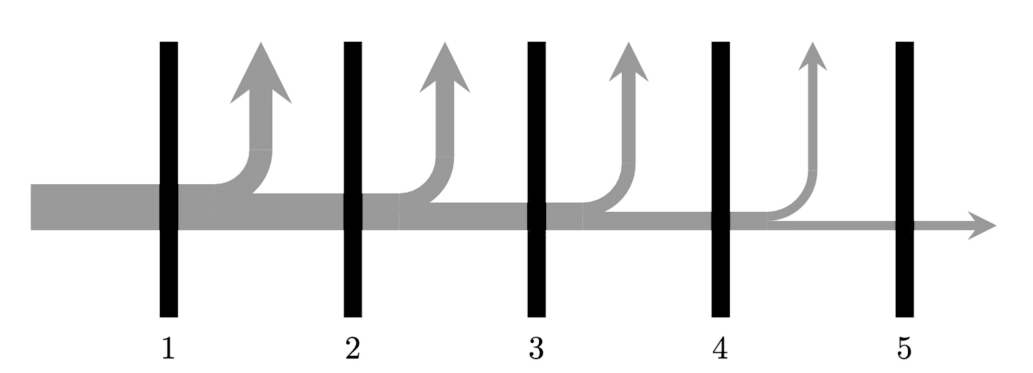
The sun-shield consists of five separated reflective layers in thin sheets (black); radiant energy (gray) from the sun is incident on the first sheet on left, and some energy escapes between every pair of sheets.
Assume the following simplifications:
- Sheets are square, each with area .
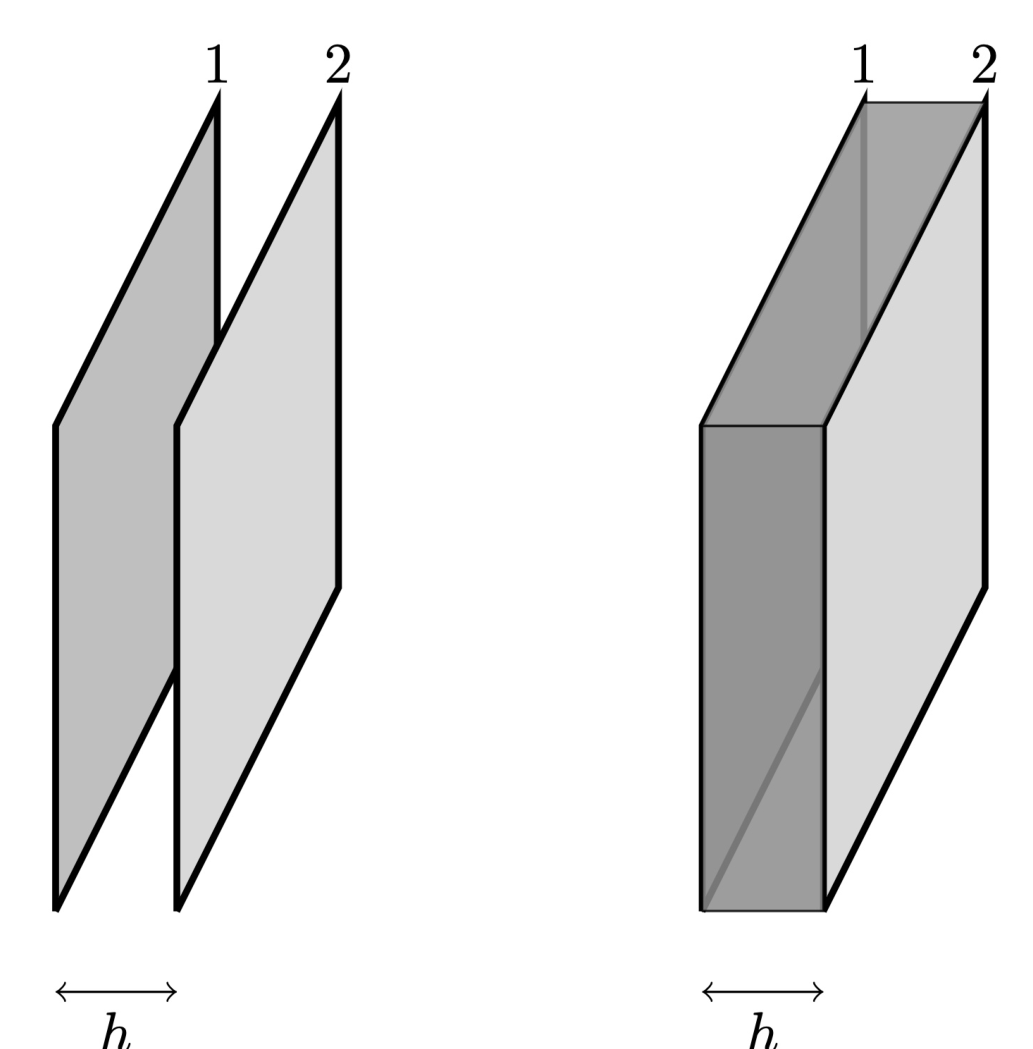
- Sheets are parallel and separated by along the perimeter.
- Sheets have constant emissivity . Assume that all reflections off of sheet surfaces are diffuse.
- Sheets are thin with temperature on the front and back surfaces equal and uniform.
- The fraction of radiant flux emitted by a sheet that is absorbed by the adjacent sheet is . This means that if sheet 1 in the figure above emits an amount of heat toward sheet 2 then sheet 2 will absorb an amount from sheet 1.
- The amount of radiant flux ejected out of the perimeter gap between two sheets is approximated as where is the net flux between the two sheets. The fraction . This is equivalent to saying that the heat loss to space between two sheets is proportional to the net heat exchange between the sheets. This is a rough approximation for this problem.
- Background temperature of space is negligible. [4,4 т.]
C.1 Derive expressions for the equilibrium temperatures of the first sheet and fifth sheet in terms of the incident solar radiation intensity , the constants and , and any necessary physical constants. To simplify your expression, you may define additional constants in terms of and , etc. [2,4 т.]
C.2 Derive numerical estimates for and from the information about the sheet geometry assuming an emissivity . You are encouraged to consider the rectangular box model of the sheets above, where the perimeter area effectively acts as a perfect absorber of radiant energy. [1,6 т.]
C.3 Numerically determine the temperatures of sheet 1 and sheet 5. The solar intensity is . [0,4 т.]
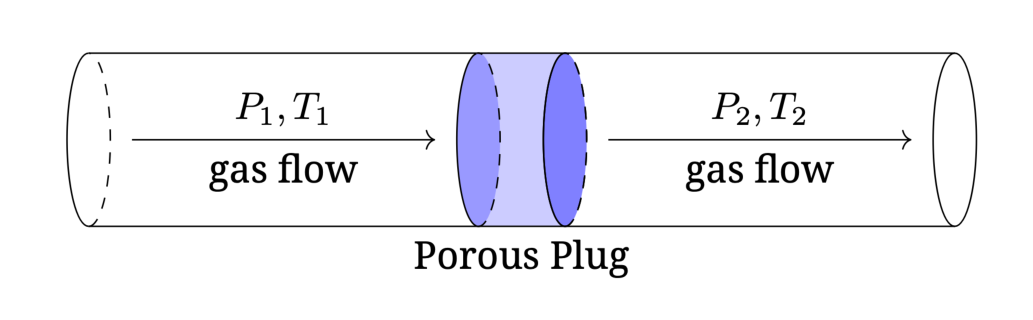
Part D. Cryo-cooler (4 points) The last stage of the cooling system directly cools the CCD camera. A closed cycle refrigeration system has a supply pipe line feeding helium gas at constant pressure moving through a sponge like porous plug into a pipe with constant pressure . The pipe carries the gas to cool the CCD. The helium gas then passes through a pump before returning to the supply line.
Helium gas supplied on the left at well defined pressure and temperature is forced through the plug to well defined pressure and temperature , where it is carried away on the right.
As the gas moves through the porous plug, viscous friction with the narrow walls of the channels in the sponge becomes an important effect; however, no heat is transferred to or from the gas during the process. The bulk speed of the gas in region 2 is only marginally greater than the bulk speed in region 1.
Helium is not an ideal gas, but does remain in a gaseous state throughout this process. [4 т.]
D.1 Consider a mole of gas that passes from left to right through the plug. Complete the table in your answer sheet by writing '>' or '<' to identify the quantity that must be greater, '=' to identify quantities that must be equal, or '?' if it is not possible to know which is greater or equal without more information. [1 т.]
D.2 Identify a conserved quantity constructed from (internal energy), (pressure), and (volume) as a mole of gas moves through the plug; show work on how you derived this conserved quantity. [0,6 т.]
D.3 Your answer sheets have graphs of internal energy per mass against volume per mass for helium with isotherms and lines of constant entropy.
Assuming that and , use the graph to find a numerical value for the conserved quantity that you found in Part D.2. Show the construction on the graph! [1,4 т.]
D.4 Find the maximum possible temperature for . Show the construction on the graph! [0,8 т.]
D.5 Assuming your value for the maximum found in D.4, find a numerical value for . [0,2 т.]
Решение
Покажи официалното решение
Оригинал в Архива: IPhO_2022_Q2.pdf · официални решения: T2_solution.pdf