IPhO 2023 — Задача 1. Neutron Stars (10 points)
Автор: Olympiads XYZ · транскрипция на официалните материали
Проверена срещу оригинала на 13.9.2026 от същия модел, който я е транскрибирал (без независима проверка)
Theory — IPhO 2023 Tokyo Japan — Q2 — English (Official) — Neutron Stars (10 points) · 10 т.
Внимание: Бележка към темата
Този прозорец съдържа само документа с решения; текстът на задачите е в отделния документ IPhO_2023_Q2.pdf.
Условие
We discuss the stability of large nuclei and estimate the mass of neutron stars theoretically and experimentally.
Part A. Mass and stability of nuclei (2.5 points)
The rest-energy of a nucleus consisting of protons and neutrons is smaller than the sum of rest-energies of protons and neutrons, hereafter called nucleons, by the binding energy , where is the speed of light in vacuum. Ignoring minor corrections, we can approximate the binding energy consisting of the volume term with , the surface term with , the Coulomb energy term with , and the symmetry energy term with in the following way.
where is the mass number and is the nucleon mass. In the calculation, use , , , and ( electron volts).
Part B. Neutron star as a gigantic nucleus (1.5 points)
For large nuclei with a large enough mass number with a threshold , these nuclei stay stable against nuclear fission because of the sufficiently large binding energy due to gravity.
Part C. Neutron star in a binary system (6.0 points)
Some neutron stars are pulsars regularly emitting electromagnetic waves, which we call "light" for simplicity here, at a constant period. Neutron stars often make binary systems with a White Dwarf. Let us consider the star configuration shown in Fig. 1, where a light pulse from a neutron star N to the Earth E passes near a White Dwarf W of the binary system. Measuring these pulses influenced by the star's gravity leads to an accurate estimation of the mass of W as explained below, resulting in the estimation of the mass of N.

A.1 Under the condition of , determine for maximizing the binding energy per nucleon, . [0,9 т.]
A.2 Under the condition of fixed , the atomic number of the most stable nucleus is determined by maximizing . For , calculate using Eq. (1). [0,9 т.]
A.3 A nucleus having large breaks up into lighter nuclei through fission in order to minimize the total rest-mass energy. For simplicity, we consider one of multiple ways to break a nucleus with into two equal nuclei, which occurs when the following energy relation holds,
When this relation is written as
obtain up to two significant digits. [0,7 т.]
B.1 We assume that and is realized for sufficiently large and Eq. (1) continues to hold with the addition of the gravitational binding energy. The binding energy due to gravity is
where and with are the mass and the radius of the nucleus, respectively. For , obtain in the MeV unit up to the first significant digit. Then, ignoring the surface term, estimate up to the first significant digit. In the calculation, use and where and . [1,5 т.]
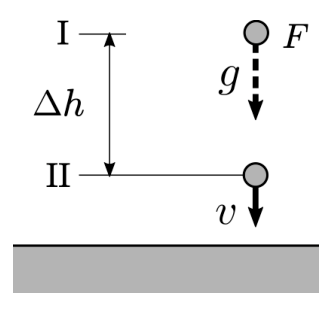
C.1 As shown in the figure below, under the constant gravitational acceleration we place two levels I and II with the height difference . Set the identical clocks at I, II, and , the free-falling system, denoted by clock-I, clock-II, and clock-F, respectively.
We assume that an observer sits with clock-F, and initially is placed at the same height as that of clock-I and its velocity is zero. Since the clocks are identical, they register equal time intervals, . Then, we let fall freely, and work in the frame of , which is considered to be inertial. In this frame, clock-II passes by clock-F with velocity , so that the time dilation of clock-II can be determined by the Lorentz-transformation. When time elapses on clock-F, time elapses on clock-II. Determine in terms of up to the first order in , where is a difference of the gravitational potential, i.e., the gravitational potential energy per unit mass. [1 т.]
C.2 Under the gravitational potential , time delays change the effective speed of light, , observed at the infinity, though the local speed of light is . When , can be given up to the first order in as
including the effect of space distortion, which was not featured in C.1. We note that the light path can be approximated as a straight line. As shown in Fig. 1 (a), we take the -axis along the light path from the neutron star N to the Earth E and place at the point where the White Dwarf W is the closest to the light path. Let be the -coordinate of N, be that of E, and be the distance between W and the light path. Estimate the changes of the arrival time of the light from N to E caused by the White Dwarf with mass and evaluate the answer in a simple form disregarding higher order terms of the following small quantities: , , and . If necessary, use the following formula.
[1,8 т.]
C.3 As shown below, in a binary star system N and W are assumed to be moving in circular orbits with zero eccentricity around the center of mass on the orbit plane. Let be the orbital inclination angle measured from the orbit plane to the line directed toward E from , and let be the length between N and W and be the mass of the White Dwarf. In the following, we assume .
We observe light pulses from N on E far away from N. The light path to E varies with time depending on the configuration of N and W. The delay in the time interval of arriving pulses on E has maximum value for and the minimum value for (see Fig. 1 (b) for the configuration). Calculate in a simple form disregarding higher order terms of small quantities as done in C.2. We note that the delays due to gravity from stellar objects other than W are assumed to cancel out in . [1,8 т.]
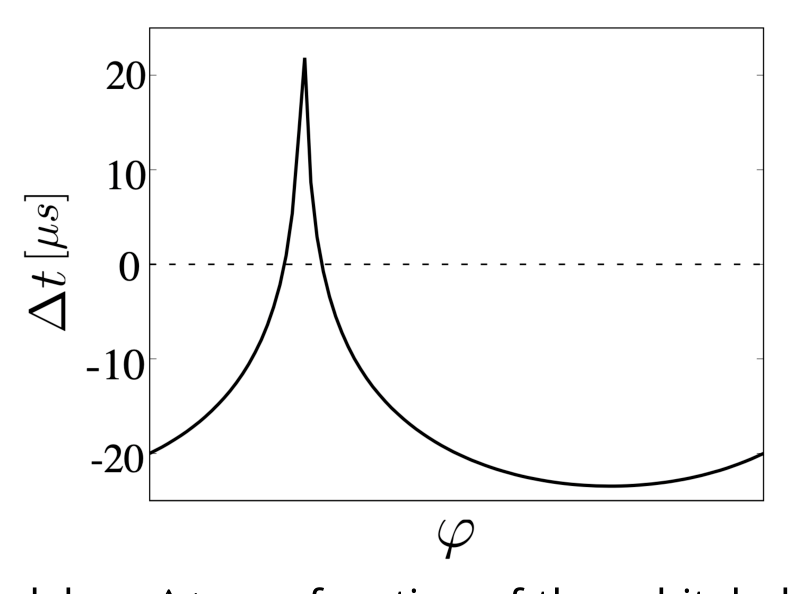
C.4 The below figure shows the observed time delays as a function of the orbital phase for the binary star system with and . Estimate in terms of the solar mass and show the results for up to the first significant digit. Here the approximate relation, , can be used. [0,8 т.]
C.5 In the binary system of neutron stars, two stars release energy and angular momentum by emitting gravitational waves and eventually collide to merge. For simplicity, let us consider only a circular motion with the radius and the angular velocity and then holds with the constant depending on neither nor if relativistic effects are ignored. Determine the value for . [0,4 т.]
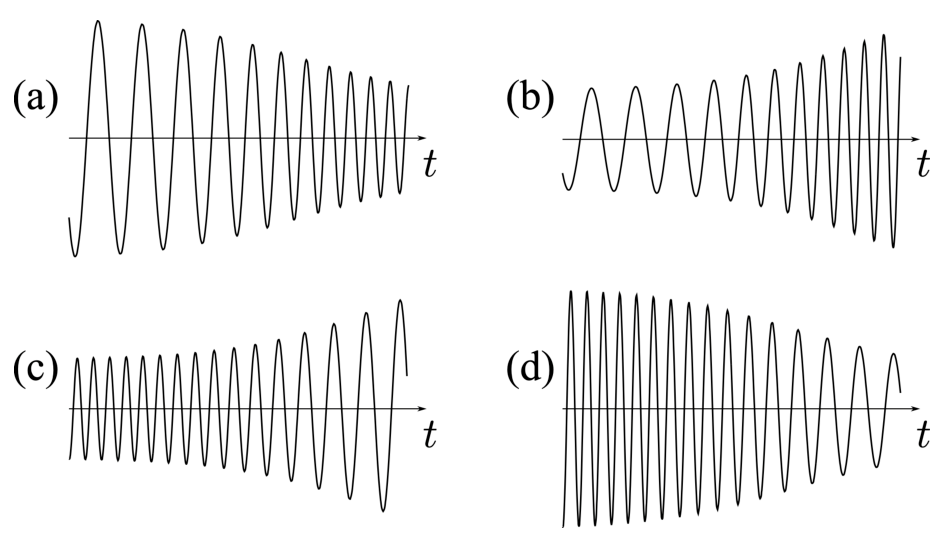
C.6 The amplitude of the emitted gravitational wave from the binary system in C.5 is proportional to . Figure below qualitatively shows four different temporal profiles of the observed gravitational waves before the two-star collision. Select the most appropriate profile from (a) to (d). [0,2 т.]
Решение
Покажи официалното решение
Оригинал в Архива: IPhO_2023_Q2.pdf · официални решения: IPhO_2023_S2.pdf