IPhO 2023 — Задача 1. Water and Objects (10 pt)
Автор: Olympiads XYZ · транскрипция на официалните материали
Проверена срещу оригинала на 13.9.2026 от същия модел, който я е транскрибирал (без независима проверка)
Theory — IPhO 2023 TOKYO JAPAN — Q3 — English (Official) · 10 т.
Условие
In this problem, we consider the phenomena caused by the interaction between water and objects, related to surface tension. Part A treats motion, while Parts B and C are regarding static situations.
If necessary, you can use the fact that if the function satisfies the differential equation ( is a positive constant), then its general solution is , where and are arbitrary constants.
Part A. Merger of water drops (2.0 points)
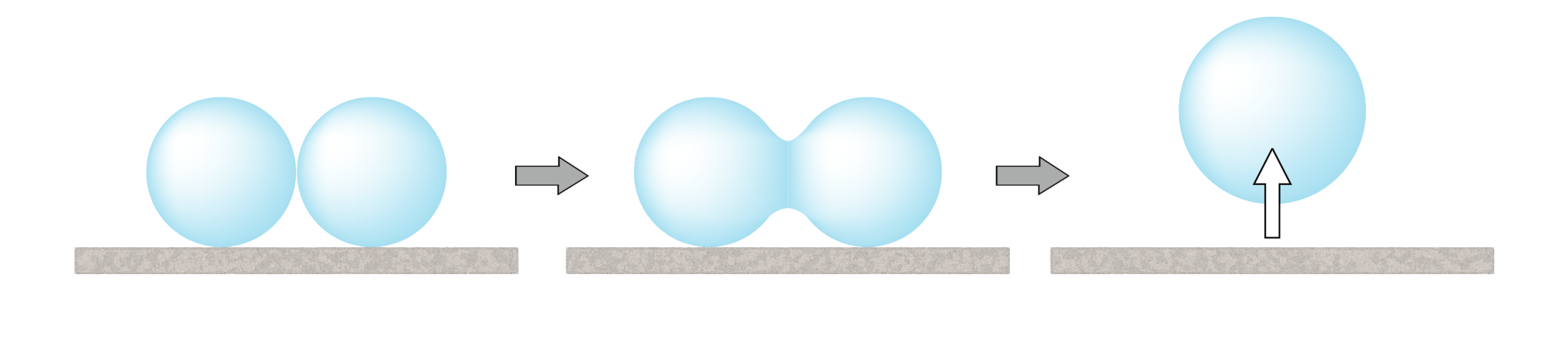
As shown in Fig.1, we consider two stationary, spherical water drops on the surface of a superhydrophobic material, i.e., very strong repulsive force exists between material and water.
Initially neighboring two identical spherical water drops are placed on the surface; then these two drops are merged after touching each other and form a larger spherical water drop, which suddenly jumps up.
Part B. A vertically placed board (4.5 points)
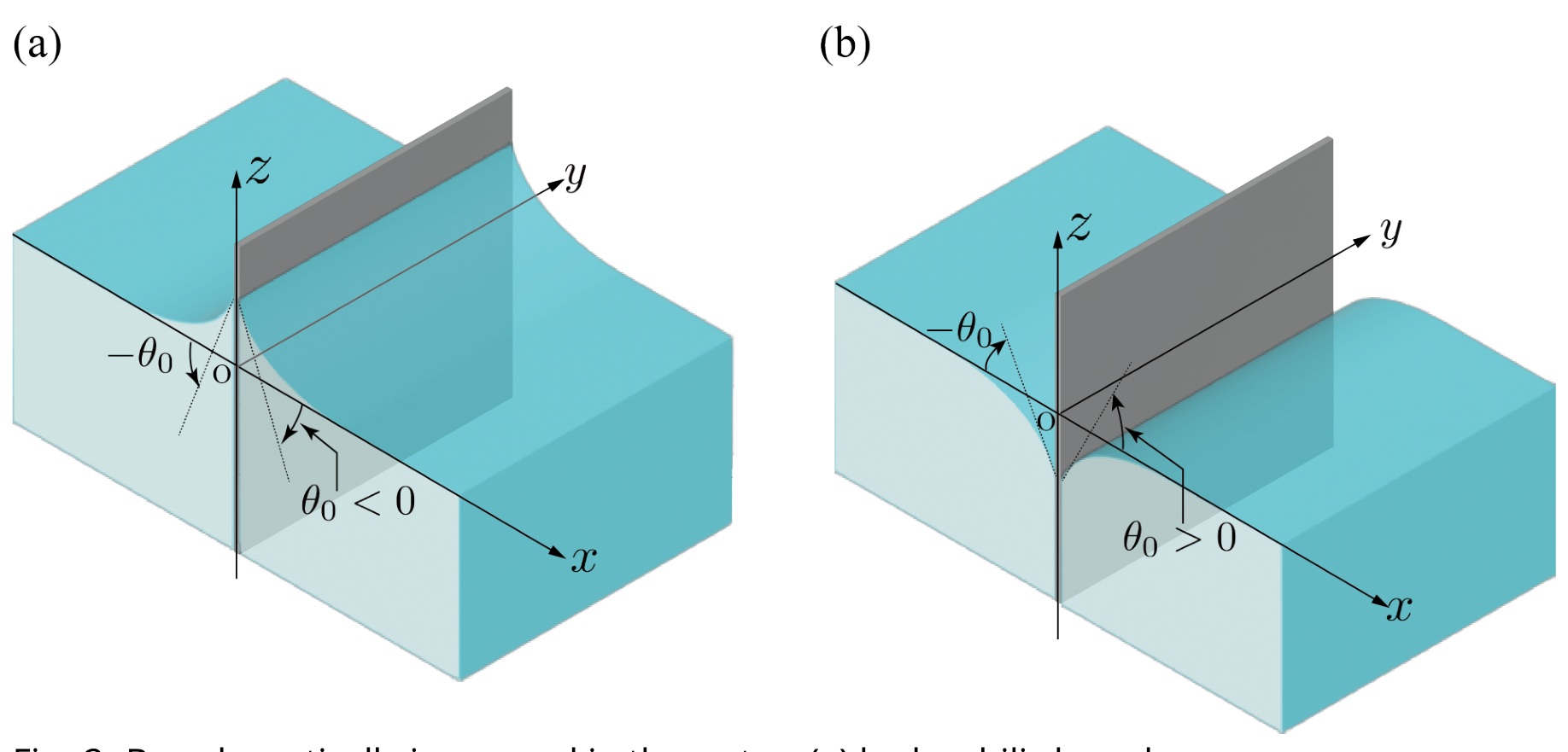
A flat board is immersed vertically in water. Figures 2(a) and 2(b) respectively show water surface forms for the hydrophilic (attractive) and hydrophobic board materials. We neglect the thickness of the board.
The board surface is on the plane, and the horizontal water surface far away from the board is on the plane with . The surface shape does not depend on the -coordinate. Let be the angle between the water surface and the horizontal plane at a point on the water surface in the plane. Here is measured with respect to the positive axis and the counterclockwise rotation is taken as positive. Let be at the point of contact between the board and the water surface . In the following, is fixed by the properties of the board material.
Water density is constant and water surface tension is uniform. The gravitational acceleration constant is given by . The atmospheric pressure, , is assumed to be always uniform. Let us determine the water surface form in the following steps. Note that the unit of surface tension is J/m as well as N/m.
Part C. Interaction between two rods (3.5 points)
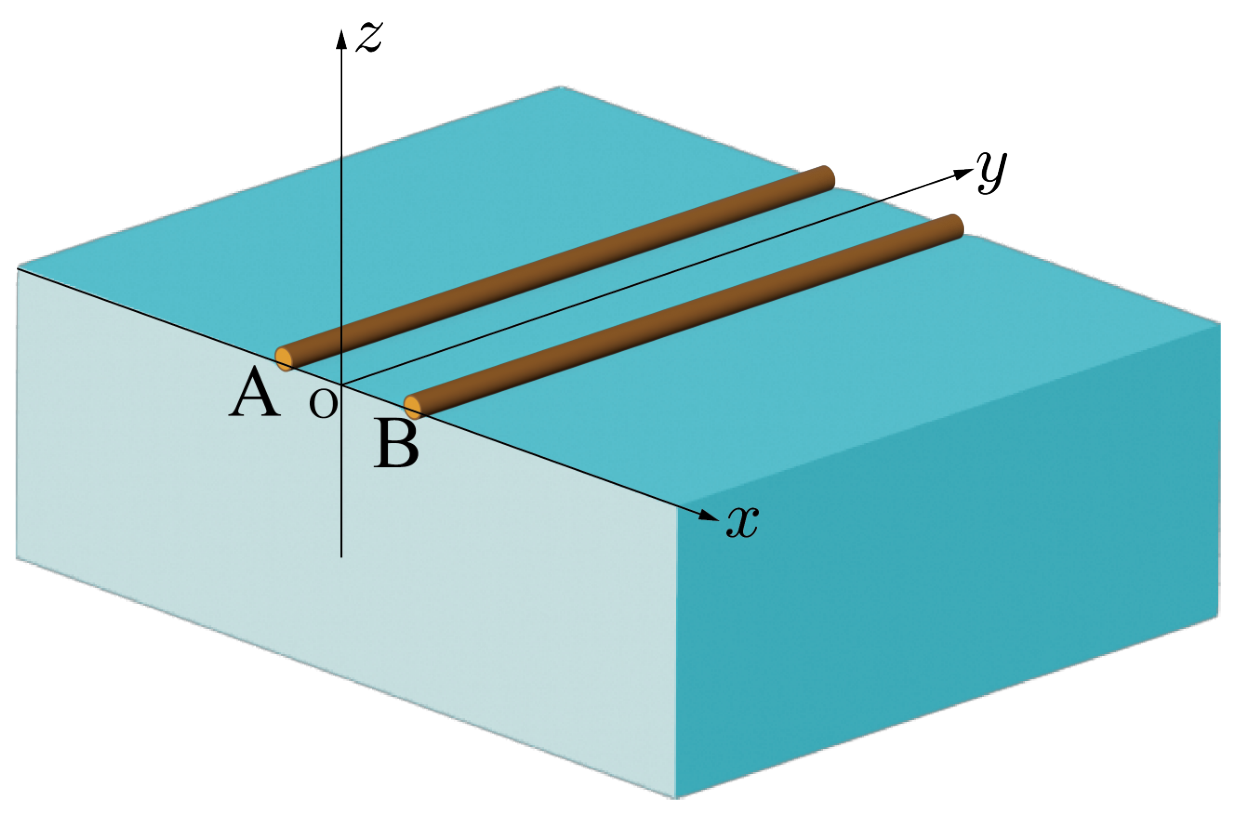
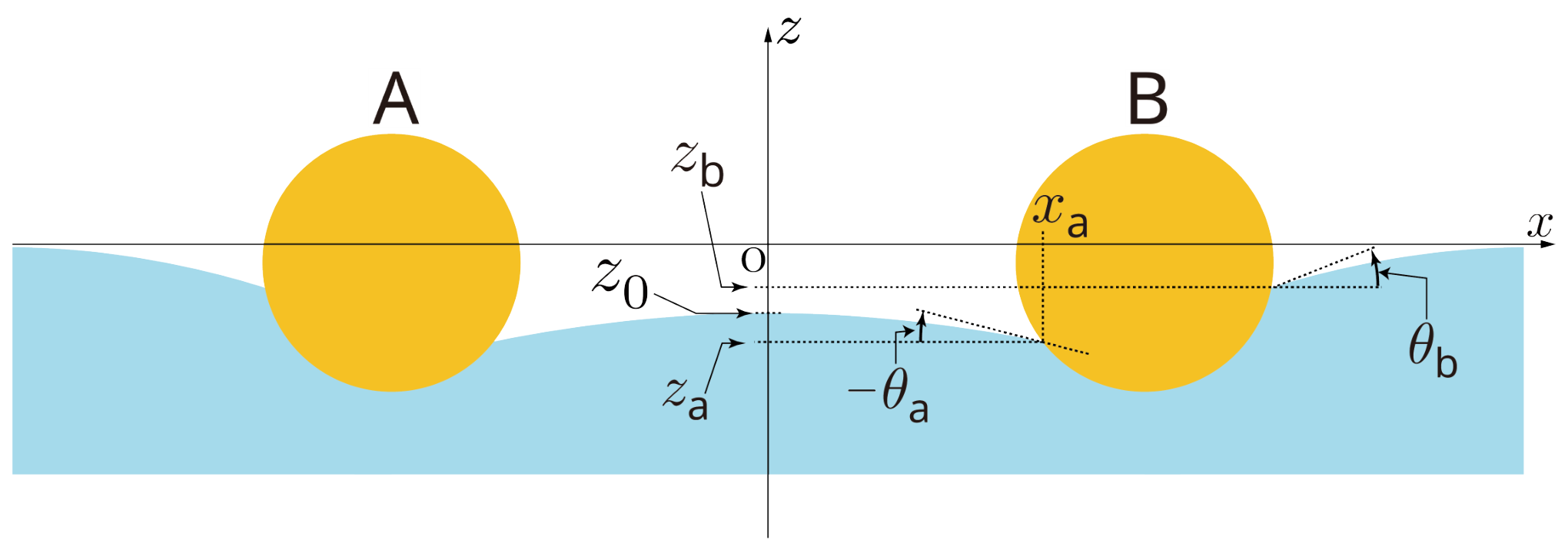
The identical rods A and B made of the same material floating in parallel on the water surface are placed at the same distance away from the -axis (Fig.4).
A.1 The radius of both water drops before the merger is 100 m. The density of water is kg/m. The surface tension is J/m. A portion of the difference of the surface energy before and after the merger, , is transformed into the kinetic energy of the jumped water drop. Then, determine the initial jump-up velocity, , of the merged water drop in two significant digits under the following assumptions:
- Before and after merger, the total volume of water is conserved. [2 т.]
B.1 We consider a hydrophilic board case, as shown in Fig.2(a). We note that the water pressure, , satisfies the conditions for and for . Then, express at in terms of , , , and . [0,6 т.]
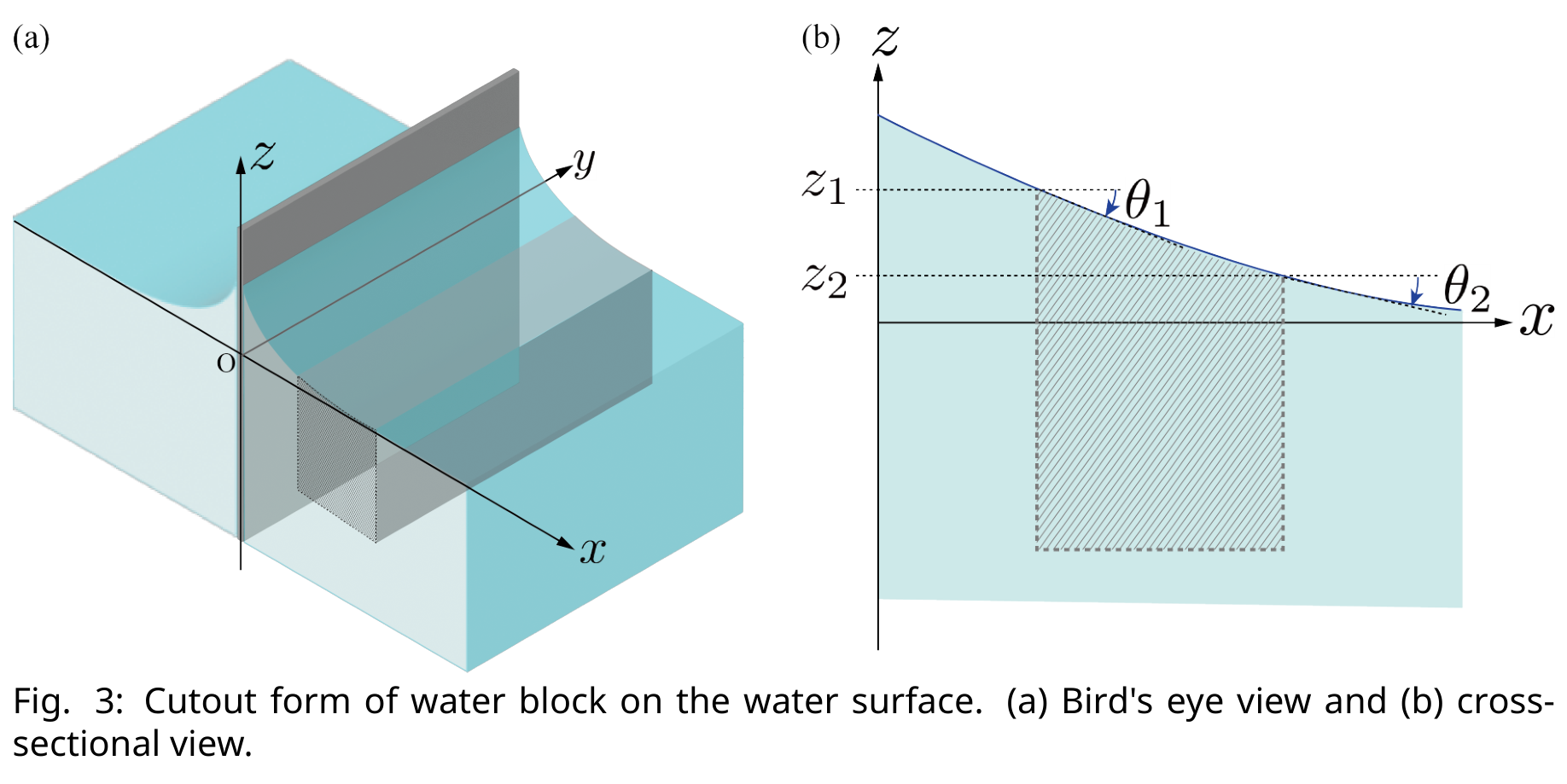
B.2 We consider a water block whose cutout is shown as shaded in Fig.3(a). Its plane cross-section is shown in a hatched area in Fig.3(b). Let and respectively be the left and right edge coordinates of the boundary (water surface) between the water block and the air. Obtain a horizontal component ( component) of the net force per unit length along the -axis, , which is exerted on the water block due to the pressure, in terms of , , , and . Note that results in no net horizontal force on the water block. [0,8 т.]
B.3 Surface tension acting on the water block is balanced with the force discussed in B.2. We respectively define and as the angles between the water surface and the horizontal plane at the left and right edges. Express in terms of , , and . [0,8 т.]
B.4 The following equation holds at an arbitrary point on the water surface, Determine the exponent and express the constant in terms of and . Note that this equation holds regardless of hydrophilic or hydrophobic board materials. [0,8 т.]
B.5 In Eq. (1) in B.4, we assume that variation of the water surface is slow, i.e., , so that we can expand with respect to up to the second order. Then, differentiating the resultant equation with respect to , we obtain the differential equation satisfied by . Solve this differential equation and determine for in terms of and . Note that the vertical directions of Figs. 2 and 3 are exaggerated for better view and they do not satisfy the condition, . [1,5 т.]
C.1 At the contact points of the rod B and the water surface, we define the -coordinates and , and the angles and , as shown in Fig.5. Determine the horizontal force component, , on the rod B per unit length along the -axis in terms of , , , , , , and . [1 т.]
C.2 We define the -coordinate of the water surface, , at the midpoint of two rods in the plane. Express the force obtained in C.1 without using , , , and . [1,5 т.]
C.3 Let be the -coordinate of the contact point between the water surface and the left side of the rod B. Using the differential equation obtained in B.5, express the water level coordinate of the midpoint of these two rods A and B in terms of and . You can use the constant introduced in B.4. [1 т.]
Решение
Покажи официалното решение
Оригинал в Архива: IPhO_2023_Q3.pdf · официални решения: IPhO_2023_S3.pdf