IPhO 2024, theory — Задача 1. The Greenhouse Effect
Автор: Olympiads XYZ · транскрипция на официалните материали
Проверена срещу оригинала на 13.9.2026 от същия модел, който я е транскрибирал (без независима проверка)
The Greenhouse Effect · 21 юли 2024 г. · 30 т.
Внимание: Бележка към темата
Part B-6 final results are on solutions page 7, not included in this window.
Условие
In 2021, Syukuro Manabe and Klaus Hasselmann were awarded half of the Nobel Prize in Physics for their work in modeling Earth's climate and accurately predicting the global warming caused by human industrial activities. In this problem, we will examine a simple model of global warming due to the greenhouse effect. The greenhouse gases alter the optical properties of the Earth's atmosphere in transmitting or absorbing Earth's infrared radiation, resulting in a rise in the average temperature of the planet.
All objects, at different temperatures, emit thermal radiation. The quantity indicates the thermal radiative power per unit area of an object at temperature between the wavelengths and . According to Planck's theory of blackbody radiation, we have
in which and . The wavelength corresponding to the maximum of comes from the relation (Wien's displacement law). Indeed, using equation (1), it can be shown that , where the dimensionless quantity is the non-trivial root of an equation of the form ; you are asked to find the function in one of the following tasks. Total radiative power per unit area of a blackbody in all wavelengths is given by the Stephan-Boltzmann law as where . Moreover, according to Kirchhoff's law of radiation, at thermal equilibrium a body absorbing a certain fraction of the incident radiation at a specific wavelength, will radiate the same fraction of the blackbody radiation at that same wavelength.
Throughout this problem assume that the Sun is a blackbody at its average surface temperature of . The Sun's radius is and the average distance between the Earth and the Sun is . We denote by , the spectral solar power radiated into a unit area of the Earth normal to the direction of radiation. The integral of this quantity over all wavelengths, i.e. , is called the solar constant.
In this problem assume that the Earth is in thermal equilibrium and has the same temperature at all points on its surface. In all parts of the problem, express the desired quantity in parametric form in terms of the data given in the problem and then find its numerical value accurate to three significant figures. The required units are indicated on the answer sheet.
A. Earth as a Blackbody
In this part, consider the Earth's surface as a blackbody and neglect the Earth's atmosphere.
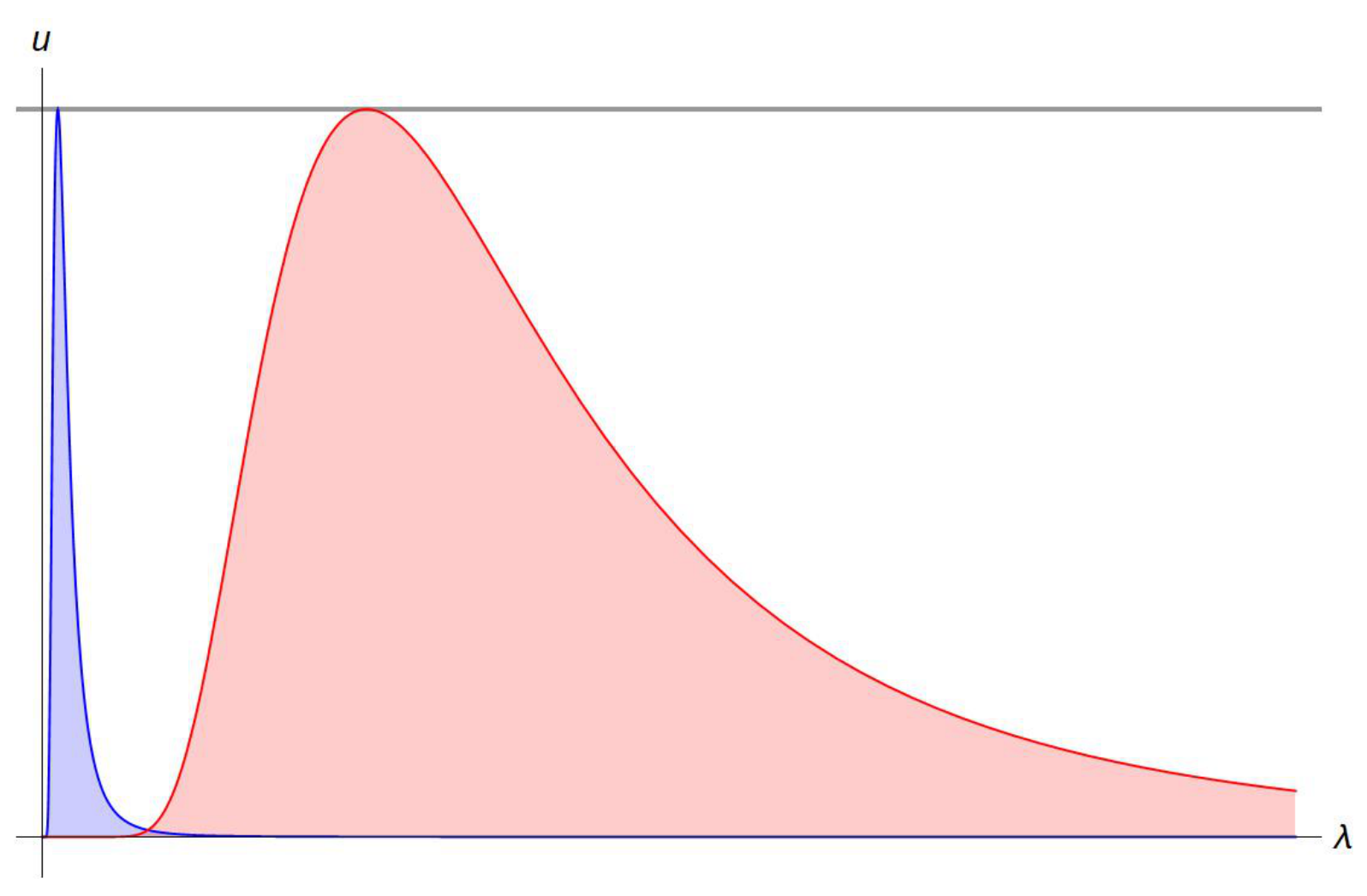
In figure 1 the functions and are plotted versus , where is a dimensionless coefficient to rescale such that the values of the two peaks coincide.
B. The Greenhouse Effect
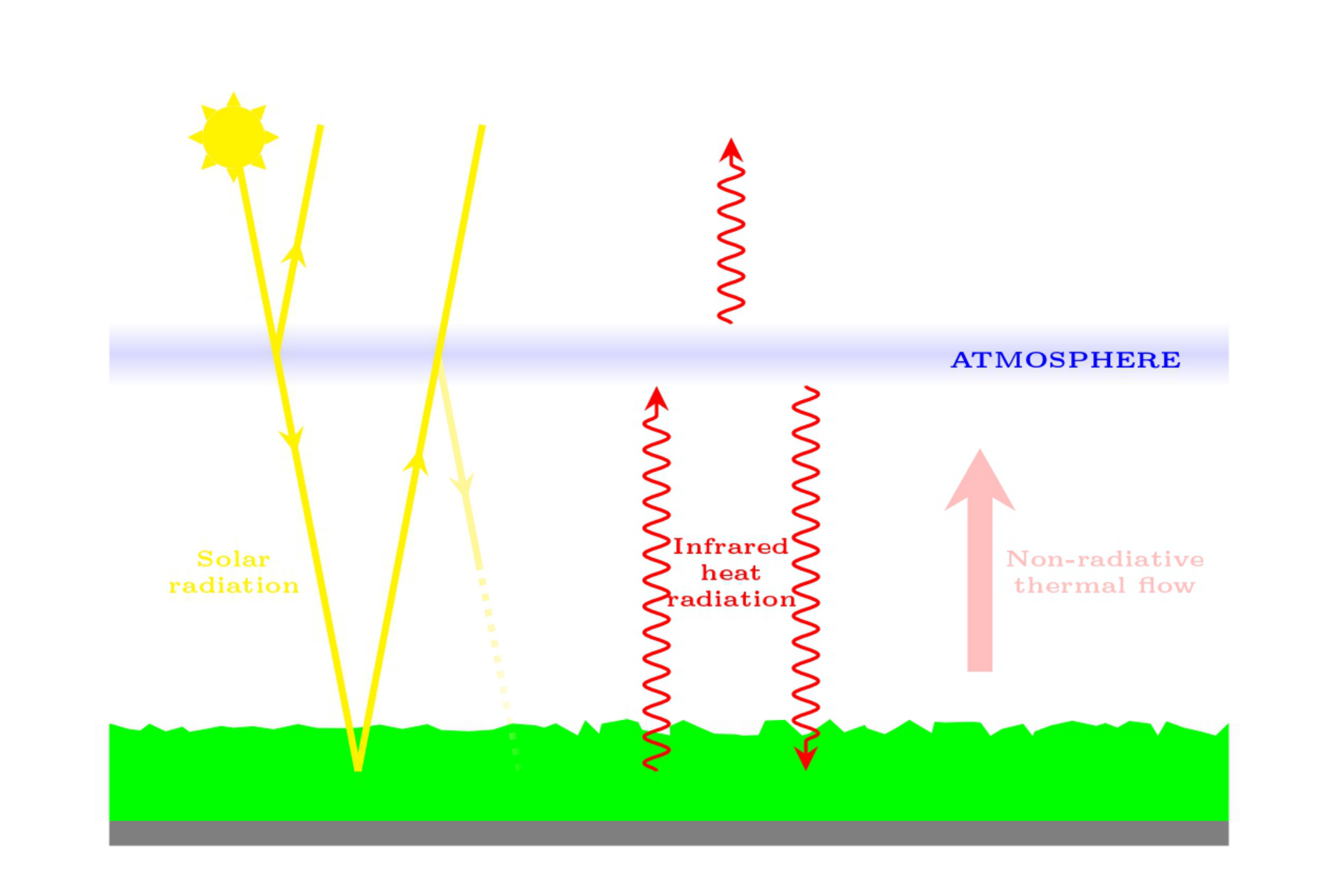
In this part, we introduce a simple model in which the Earth's atmosphere is modeled as a thin layer at a small distance above the Earth's surface so that the difference between the area of the atmosphere's layer and the area of the Earth's surface can be neglected (see figure 2). In what follows assume that the major part of the thermal radiation from the Earth and the Sun are emitted at wavelengths near the for each one. Also assume that the "atmosphere layer" reflects a fraction of the visible-ultraviolet radiation incident from above or below, and completely transmits the rest. Assume that the atmosphere does not reflect any part of the infrared radiation, however, it absorbs a fraction of the infrared radiation and transmits the rest. This behavior, known as the greenhouse effect, changes the average temperature of the Earth. The Earth's surface, on the other hand, reflects a fraction of the visible-ultraviolet radiation and absorbs the rest of this radiation and all the infrared radiation.
Now assume that . In this case, the combined system of "Earth + atmosphere" reflects a different fraction of the solar radiation, called "albedo" and denoted by .
Assume and . These values come from real data and may differ from the results which you have obtained in the previous tasks. Now suppose that a non-radiative (e. g. convective) thermal flow is maintained from the Earth to the atmosphere, where is a constant. The quantity, , is the transmitted power per unit area.
A-1 Find the solar constant, . [0,6 т.]
A-2 Find the Earth's temperature, . [0,6 т.]
A-3 Find the function . [0,4 т.]
A-4 Calculate the numerical value of , and from this value , find the value of . [0,4 т.]
A-5 Find for the Sun and the Earth. [0,2 т.]
A-6 Determine . [0,8 т.]
B-1 Assume that and , and calculate the Earth's temperature and the atmosphere's temperature . [1 т.]
B-2 Determine the albedo, , in terms of and . Then calculate its numerical value assuming (and ). [1,6 т.]
B-3 a) Express the Earth's temperature in terms of , , , and .
b) Using the given data and the calculated albedo, find the numerical value of which leads to the current average temperature of for the Earth. [1 т.]
B-4 Find and determine by how much the Earth's temperature increases if increases by one percent. [0,8 т.]
B-5 Calculate and in terms of , , , , and . [1,6 т.]
B-6 a) Differentiating the equations obtained in part B-5 with respect to , find the two algebraic equations satisfied by and .
b) Use these equations to find the numerical value of change in the Earth's temperature as a result of a one percent increase in the value of . [1 т.]
Решение
Покажи официалното решение
Оригинал в Архива: IPhO_2024_Q1.pdf · официални решения: IPhO_2024_S1.pdf