IPhO 2024, theory — Задача 1. Trapping Ions and Cooling Atoms
Автор: Olympiads XYZ · транскрипция на официалните материали
Проверена срещу оригинала на 13.9.2026 от същия модел, който я е транскрибирал (без независима проверка)
Trapping Ions and Cooling Atoms · 21 юли 2024 г. · 30 т.
Условие
In recent decades, trapping and cooling atoms and ions has been a fascinating topic for physicists, with several Nobel prizes awarded for work in this area. In the first part of this question, we will explore a technique for trapping ions, known as the "Paul trap". Wolfgang Paul and Hans Dehmelt received one half of the 1989 Nobel Prize in Physics for this work. Next, we investigate the Doppler cooling technique, one of the works cited in the press release for the 1997 Nobel Prize in Physics awarded to Steven Chu, Claude Cohen-Tannoudji, and William Daniel Phillips "for developments of methods to cool and trap atoms with laser light".
A. The Paul Trap
It is known that with electrostatic fields, it is not possible to create a stable equilibrium for a charged particle. Therefore, creating a stable equilibrium point for ions requires more sophisticated techniques. The Paul trap is one of these techniques.
Consider a ring of charge with a radius and a uniform positive linear charge density . A positive point charge with mass is placed at the center of the ring.
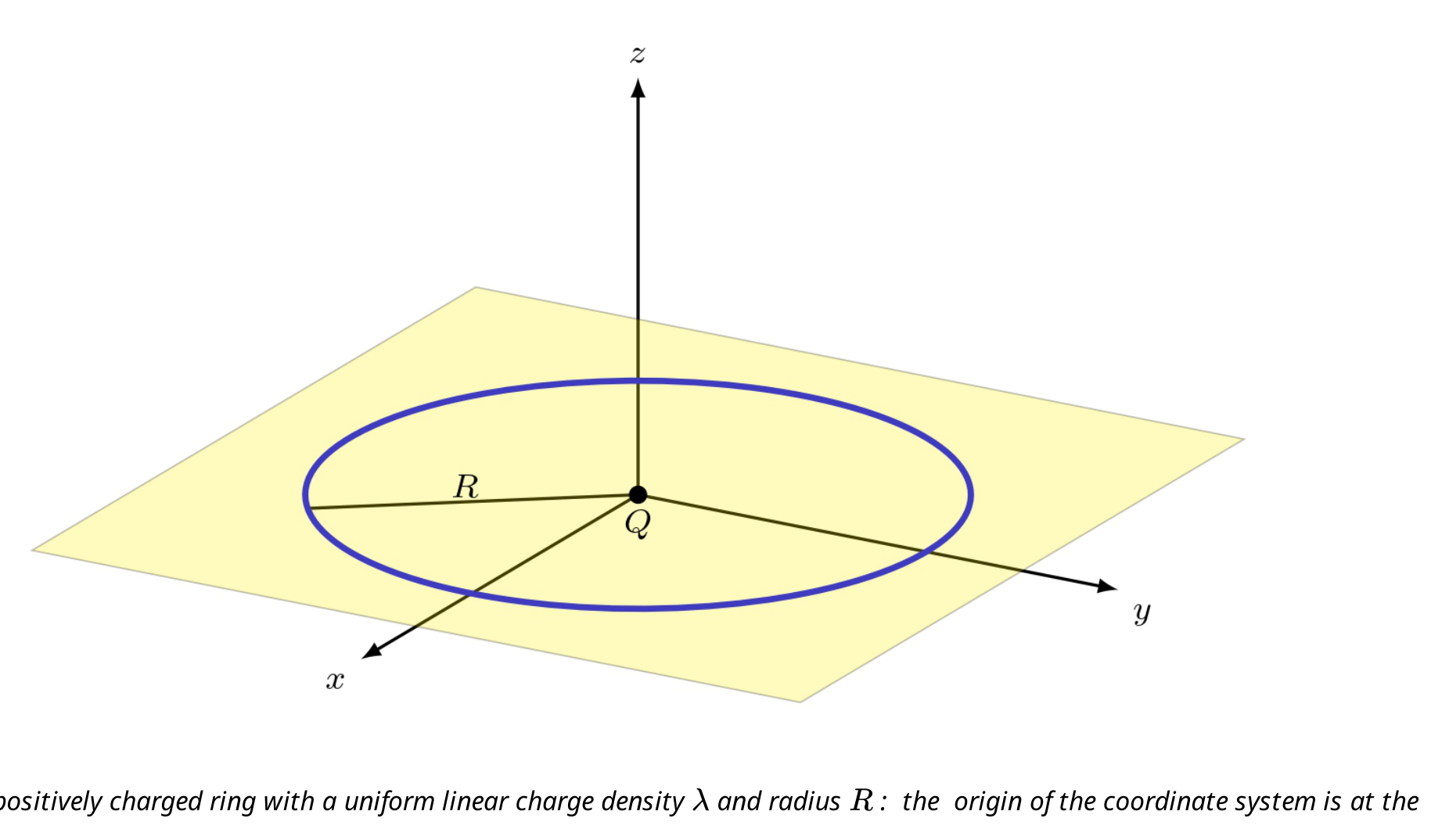
A-1 a) In cartesian coordinates , obtain the electric field due to the charged ring in the vicinity of the ring's center to the first order in , , and .
b) Find the angular frequency of small oscillations of the charged particle around the center of the ring in the directions for which a stable equilibrium exists. [1,5 т.]
A-2 In order to trap the charge fully, we would like to apply alternating fields to produce a dynamic equilibrium. Assume that the charge density is in which , , and are adjustable. We shall ignore radiative effects. Then the equation of motion for small displacements from the center of the ring, along the direction perpendicular to the plane of the ring will turn out to be:
Write and in terms of the known parameters. [0,4 т.]
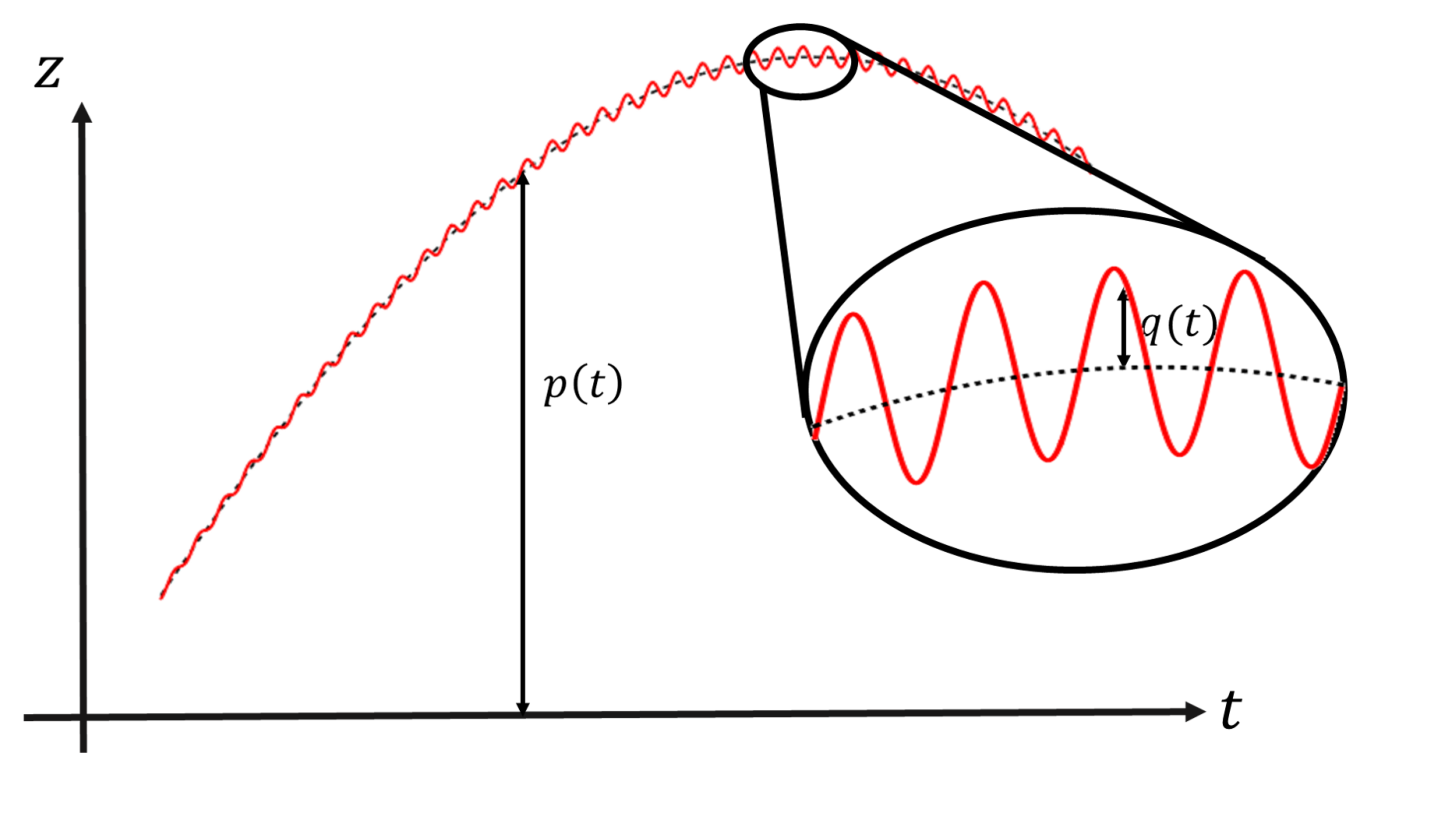
A-3 We would like to obtain an approximate solution to Equation (1) by making the following simplifying assumptions: , , and . With these assumptions, it can be shown that the solution of this equation can be split into two parts: , where is a slowly varying component and is a small-amplitude rapidly-varying component with a mean value of zero. In other words, may be assumed constant over a few oscillations of (see Figure 2).
a) Using the approximations stated above, find the equation of motion for in terms of , , and .
b) Find the solution of this equation by considering appropriate initial conditions corresponding to the required properties of this function. [1,8 т.]
A-4 a) Using the mean effect of the rapidly varying component and obtain an effective equation of motion for .
b) Investigate the stability of the equilibrium point and find the condition for a stable equilibrium. [1,5 т.]
A-5 Assume that and . We would like to use this device to trap a singly ionized atom 100 times heavier than a hydrogen atom.
Calculate . Assume and estimate the smallest frequency required to stabilize the motion of this ion. Use the data given at the end of the question. [0,4 т.]
B-1 B. Doppler Cooling
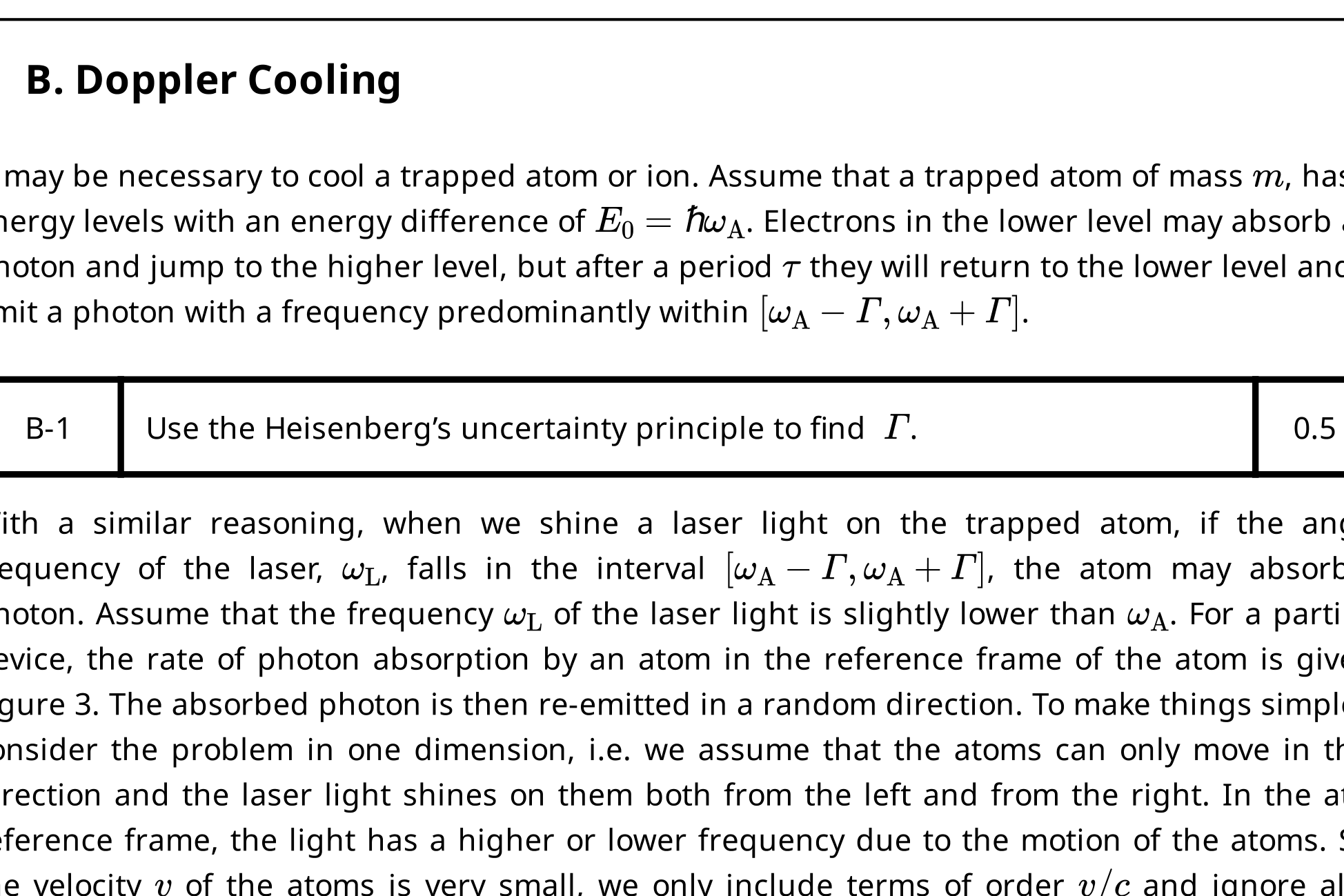
It may be necessary to cool a trapped atom or ion. Assume that a trapped atom of mass , has two energy levels with an energy difference of . Electrons in the lower level may absorb a photon and jump to the higher level, but after a period they will return to the lower level and emit a photon with a frequency predominantly within .
Use the Heisenberg's uncertainty principle to find . [0,5 т.]
B-2 With a similar reasoning, when we shine a laser light on the trapped atom, if the angular frequency of the laser, , falls in the interval , the atom may absorb the photon. Assume that the frequency of the laser light is slightly lower than . For a particular device, the rate of photon absorption by an atom in the reference frame of the atom is given in Figure 3. The absorbed photon is then re-emitted in a random direction. To make things simple, we consider the problem in one dimension, i.e. we assume that the atoms can only move in the -direction and the laser light shines on them both from the left and from the right. In the atom's reference frame, the light has a higher or lower frequency due to the motion of the atoms. Since the velocity of the atoms is very small, we only include terms of order and ignore all the higher-order terms. Moreover, we have so that the velocity of the atom nearly does not change after absorbing the photon. Also, the change in frequency due to the Doppler effect is so small compared to , that the function for in the diagram of Figure 3 may be approximated by the following linear function:
where is the number of absorbed photons per unit of time, is the value of for , and is the slope of the line tangent to the curve at . The frequency of the re-emitted photon is almost equal to the frequency of the incident photon, but it is emitted with equal probability in the positive or negative -direction. In fact, up to the order considered here the two frequencies are identical. Note that we are considering the whole process in the atom's reference frame.
a) Assume that the trapped atom is moving with a velocity, in the lab frame. In the frame of reference of the atom, calculate the collision rate of the photons, incident from each of the two directions, with the atoms (denoted by and ) and the rate of absorption of momentum in each direction (denoted by and ).
b) Determine the effective force on the atom as a function of , , , and , in the reference frame of the laboratory. Assume , [1,7 т.]
B-3 We would like to find the lowest temperature that can be achieved using this technique. Assume that the velocity of a particular atom has been reduced to zero exactly, and at this very moment it absorbs a photon (incident from any of the two directions), and re-emits the photon randomly in any of the two directions, with almost the same frequency. Assume that this process happens once every units of time.
Considering the momentum of the atom after such a process for the two possible outcomes, calculate the average power absorbed by the atom. [1 т.]
B-4 Consider the force calculated in Task B-2 and calculate the output power. Then, calculate the average value of at equilibrium. Using your knowledge of the kinetic theory of gases estimate the temperature of the atoms. [0,8 т.]
B-5 Estimate this temperature, for an atom 100 times heavier than a hydrogen atom. Assume that , , and .
mass of hydrogen atom: charge of an electron: permittivity of free space: Boltzmann constant: Planck constant: [0,4 т.]
Решение
Покажи официалното решение
Оригинал в Архива: IPhO_2024_Q2.pdf · официални решения: IPhO_2024_S2.pdf