IPhO 2024, theory — Задача 1. Black Widow Pulsar
Автор: Olympiads XYZ · транскрипция на официалните материали
Проверена срещу оригинала на 13.9.2026 от същия модел, който я е транскрибирал (без независима проверка)
Black Widow Pulsar · 30 т.
Внимание: Бележка към темата
Solution incomplete in this window; parts from B-7 onward are on solutions pages 7–8.
Условие
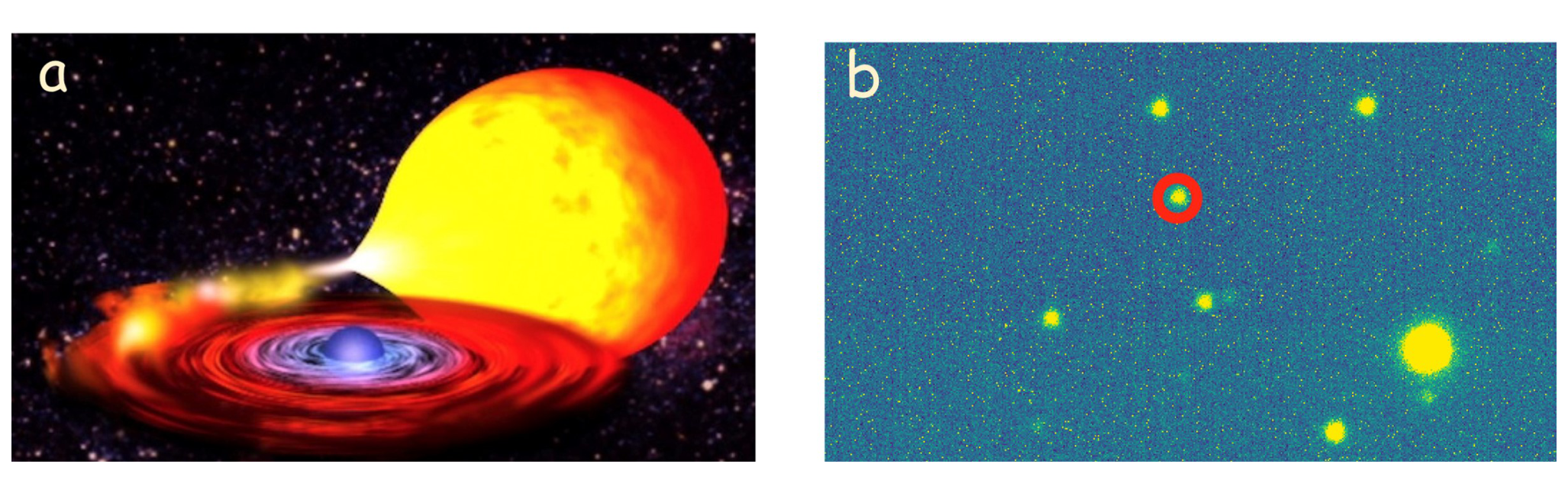
A significant number of the observed stars are binaries. One or both of the stars may be neutron stars rotating with a high angular velocity and emitting electromagnetic waves; such stars are called pulsars. Sometimes a companion star is an expansive mass of gas that gradually falls down onto the neutron star and causes its mass to increase (Figure 1-a). In this way, a neutron star gradually swallows up a portion of the mass of its companion star. For this reason, the neutron star has been compared to a black widow (or redback spider), a female spider which eats its mate after mating. The heating of the gas falling down onto the black widow generates radiation which can be observed. The heaviest neutron stars often are black widows and they serve as natural laboratories for testing fundamental physics. Figure 1-b shows the picture of the companion of the neutron star PSR J2215+5135, taken by the 3.4-meter optical telescope of the Iranian National Observatory. No neutron star can be seen in this image and the observed light is due to its companion.
A. A Binary System
Consider a simple model in which the black widow and its companion star, are represented by two point masses and moving on a circular orbit around their center of mass. To investigate the dynamics of this system, consider a rotating coordinate system in which the two bodies are stationary. Take the center of mass to be the origin of the coordinate system. Assume that the two point masses lie on the -axis on both sides of the origin at a distance from each other, and that lies on the negative -axis. At an arbitrary point in the plane of motion, the effective potential for a unit test mass is the sum of the gravitational potentials of the two point masses plus the centrifugal potential.
Suppose (just for task A-3) and assume that is surrounded by a rarefied gas of very low density. The mass of this gas is insignificant and we ignore its gravitational effects. If the size of this gas envelope becomes greater than a specific limit, the gas will overflow onto . Suppose the overflow occurs through on the -axis.
Take the rotational period of the stars around their center of mass to be . Assume that mass flows from to at a very small rate of . This rate is so small that in each period of rotation, the distance between the two stars can be assumed to be constant. However, after a long period of time, the distance between the two stars changes, while the motion remains circular.
The gas separated from forms a disk rotating around and heats up due to friction (Figure 1-a). As the gas loses energy, it spirals inward toward and finally falls onto it. In the steady state, the mass flows at the constant rate of , from to the disc and from the disc onto . At the same time, the heated disk emits thermal radiation as a blackbody. This disk forms very close to the neutron star so the gravitational pull of the star can be ignored for the analysis of the disk's motion. Also, ignore the heat capacity of the gas.
In the binary system PSR J2215+5135, the mass of the neutron star is and the mass of its companion star is , where is the mass of the Sun. The rotational period is , and the Stefan-Boltzmann constant is , and the gravitational constant is . Assume that the mass flow rate to the neutron star is .
Assume that after a sudden explosion, the star ejects a part of its mass out of the binary system at a very high speed, and its mass becomes . Take the magnitude of the velocity of relative to to be after the explosion.
B. Analysis of the Stability of a Star
In this part we study the stability of a single star. Consider a star containing a specific kind of matter with the equation of state where and are constants. Let and be the pressure and density at a distance from the center of the star, respectively. The pressure and density at the center of the star are and , respectively. In all tasks of the part B, take all outward vectors to be positive.
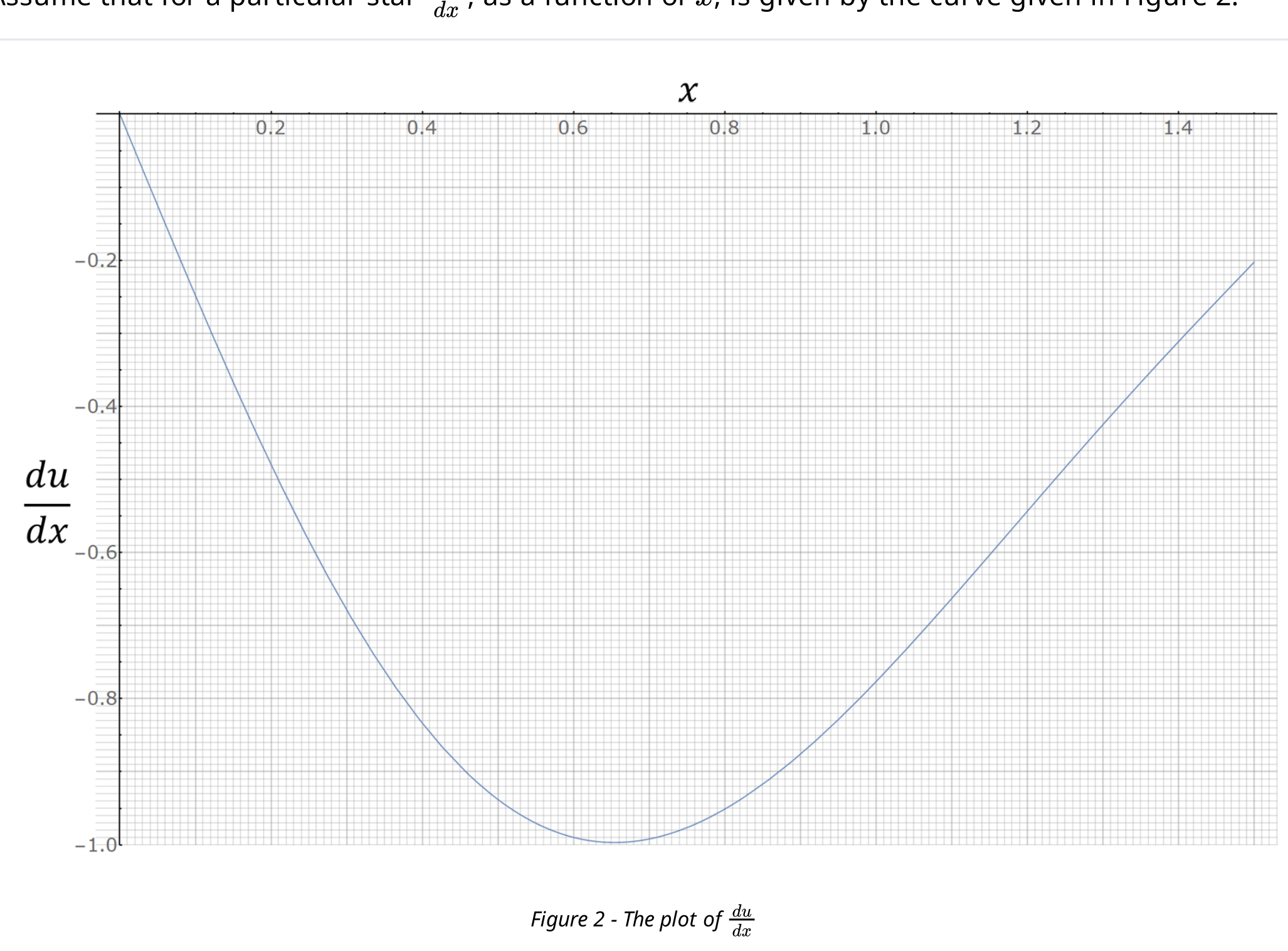
Assume that for a particular star , as a function of , is given by the curve given in Figure 2.
To analyze the stability of the system, we assume that the star deviates slightly from its equilibrium state: we assume that the spherical shell, which was in equilibrium at radius , now has a radius , similarly the parameters , , and have changed to , , and respectively. For convenience, we shall only consider small 's near the center of the star, for which we can assume that , where .
A-1 Write in terms of , , , and . [1 т.]
A-2 Assuming , plot the function qualitatively. [0,7 т.]
A-3 Find the numerical value of , up to two significant figures. You may use the calculator. [0,5 т.]
A-4 Calculate the rate of change of and in terms of , , , , and . [0,6 т.]
A-5 Determine the temperature of the disc at distance from the center of the star in terms of , , , and (Stefan-Boltzmann constant). [1 т.]
A-6 Calculate the temperature of the disc at the radius in kelvins. [0,5 т.]
A-7 Determine the maximum value of , in terms of , , , and , that allows the new binary system to stay bounded. Assuming that the explosion is isotropic, what is the minimum value of for the binary system to remain bounded? [0,7 т.]
B-1 Determine the gravitational acceleration near the center of the star in terms of and the constants and . [0,2 т.]
B-2 Derive a (differential) equation for determining at equilibrium, and write it in the following form: . Find the functions and . [0,6 т.]
B-3 Construct a quantity of the form with the dimension of length. [0,4 т.]
B-4 Rewrite the (differential) equation of task B-2 in the following form: where and . Find the functions and . [0,3 т.]
B-5 For one finds . Determine . [0,6 т.]
B-6 Use the behavior of the curve in Figure 2, in the vicinity of the point , to find up to 3 significant figures. Use the given ruler if necessary. [0,8 т.]
B-7 Find and in terms of and to the first order in . [0,9 т.]
B-8 Using Newton's equation of motion for the spherical layer with the equilibrium radius of find in terms of , , , , and (By we mean derivative of with respect to at constant .) [0,6 т.]
B-9 Obtain in terms of and the constants given in the problem. Find the minimum value of for a stable equilibrium, and find the oscillation's angular frequency of the star. [0,6 т.]
Решение
Покажи официалното решение
Оригинал в Архива: IPhO_2024_Q3.pdf · официални решения: IPhO_2024_S3.pdf