IPhO 2025, theory — Задача 1. Strongly correlated Fermi gases
Автор: Olympiads XYZ · транскрипция на официалните материали
Проверена срещу оригинала на 13.9.2026 от същия модел, който я е транскрибирал (без независима проверка)
Theory-Backup — Strongly correlated Fermi gases (10.0 points) — Q4, English (Official) · 10 т.
Условие
Despite twenty orders of magnitude of difference in density, it can be shown that laser cooled atoms and nuclear matter in neutron star share the same equation of state characterized by a single numerical parameter called Bertsch's parameter. In this problem we show how precise measurements on ultracold vapours allowed for an accurate determination of this parameter using tabletop experiments.
A. Thermodynamics of a non-interacting quantum gas
Consider a quantum particle of mass confined in a cubic box of size . We consider first that the motion of the particle is restricted along the axis and we assume that the wave function of the particle can be described in complex notations by a plane wave
Here is positive and we note the associated wavelength.
Since the particle cannot leave the box, we assume that .
We assume that the previous result is valid in all three , and directions.
We consider fermionic atoms that, like electrons, obey Pauli's Exclusion Principle, meaning that we can only put two atoms per quantum state. We assume that the states are filled one by one with increasing energy.
Consider a number of atoms. We call (the Fermi energy) the energy of the last occupied state. We also define the so-called Fermi momentum by .
We add a small number of atoms to the system.
We note the pressure of the gas.
We now consider the case of interacting atoms. The interactions are described by an attractive inter-atomic potential of typical range . In the so-called ultra-cold regime, the atomic wavelength is much larger than . As a consequence, the matter waves cannot resolve the details of the potential and one can show that the effect of the interactions can be encapsulated in the coupling constant
Furthermore, we conventionally take , which defines .
Using a dimensional argument, one can show that the energy of the interacting cloud can be written as
where and were introduced in questions A.4 and A.5, and depends only on .
The so-called unitary limit corresponds to a regime where . We assume that the function has a finite value in this limit and we define the so-called Bertsch parameter.
B. Thermodynamics of a trapped quantum gas
We now consider that the atoms are confined by a single-particle optical potential . We assume that the cloud can be locally considered as homogeneous and that the results of Part A are still applicable locally. We consider first the case of a non-interacting Fermi gas.
Consider first the case of a one-dimensional potential , with . We assume that the cloud is homogeeous in the direction and we note the area of the cloud in the plane. Let's consider the volume of the cloud comprised between and .
We assume that this expression holds for a general potential depending on the three coordinates . If the the cloud is sufficiently small we can furthermore approximate by a harmonic potential close to its minimum. We thus take
Using the previous question, one can prove that after a proper spatial rescaling, the system can be mapped onto a gas of fermions trapped in an isotropic harmonic potential of frequency .
It is possible to change the value of using an external magnetic field . In the case of fermionic Li, the unitary limit is reached for and the cloud behaves as a non-interacting gas at high field.
A.1 Express the kinetic energy of the particle as a function of , and . [0,5 т.]
A.2 Show that , where is a strictly positive integer. [0,6 т.]
A.3 Represent the quantum states in the phase space. Express with the volume occupied by each state. [0,7 т.]
A.4 Represent the states with energy lower than in -space. Deduce the expression of with . [1,4 т.]
A.5 Express the increase in energy in the system as a function of . Show that the energy is given by
for some number . [0,8 т.]
A.6 Express the energy variation for a change in volume . Deduce the expression of the pressure as a function of density . [0,8 т.]
A.7 Give the value of . [0,4 т.]
A.8 Show that, at the unitary limit, the properties of the interacting cloud are identical to those of a noninteracting system up to a rescaling of Planck's constant . Give the value of . [0,6 т.]
B.1 Write the total forces exerted on the atoms and show that the density is given by
where is the Fermi energy at the trap center. Give the expression of . [1,5 т.]
B.2 Find the equation defining the surface of the cloud. Give the expression of the radius of the cloud in the direction as a function of , and . [0,7 т.]
B.3 Calculate the total atom number as a spatial integral by decomposing the cloud into infinitesimal shells of radius and thickness , and show that
where you will give the value of the exponent . Hint: we give
[1,1 т.]
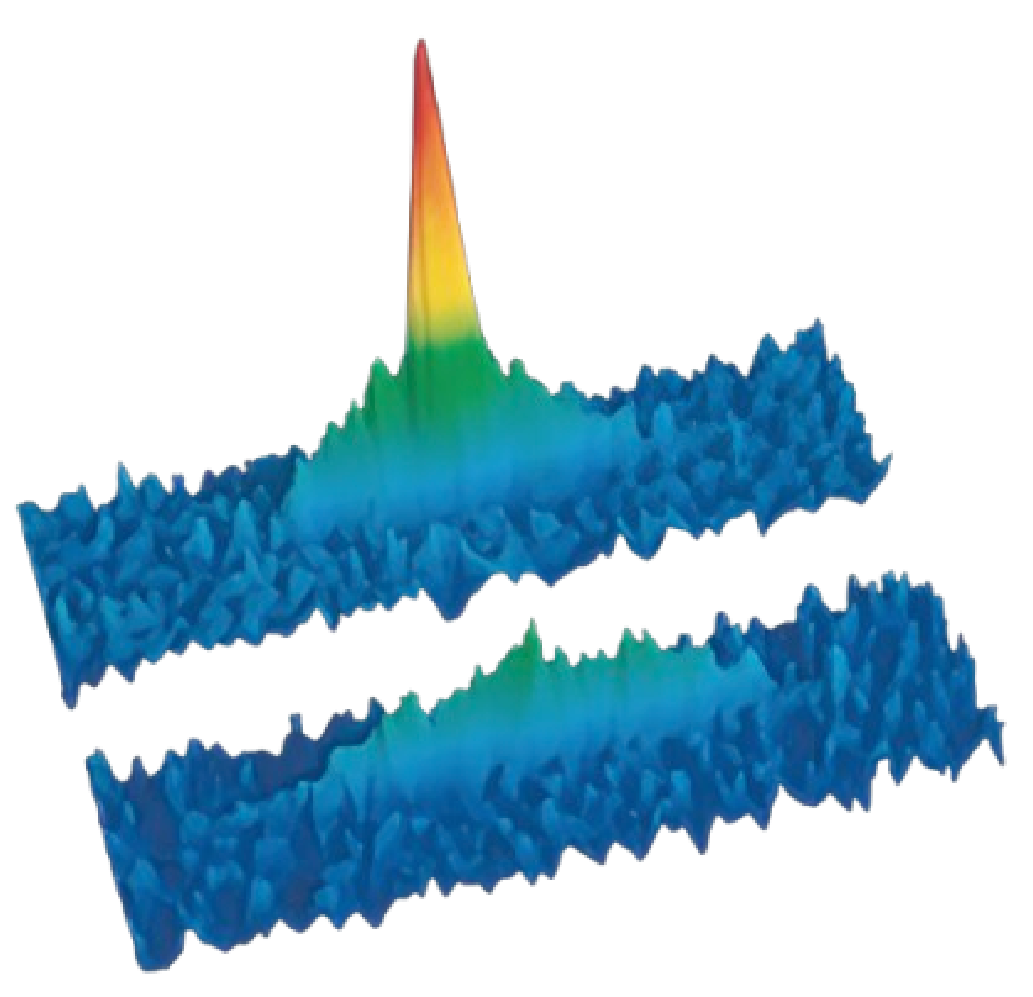
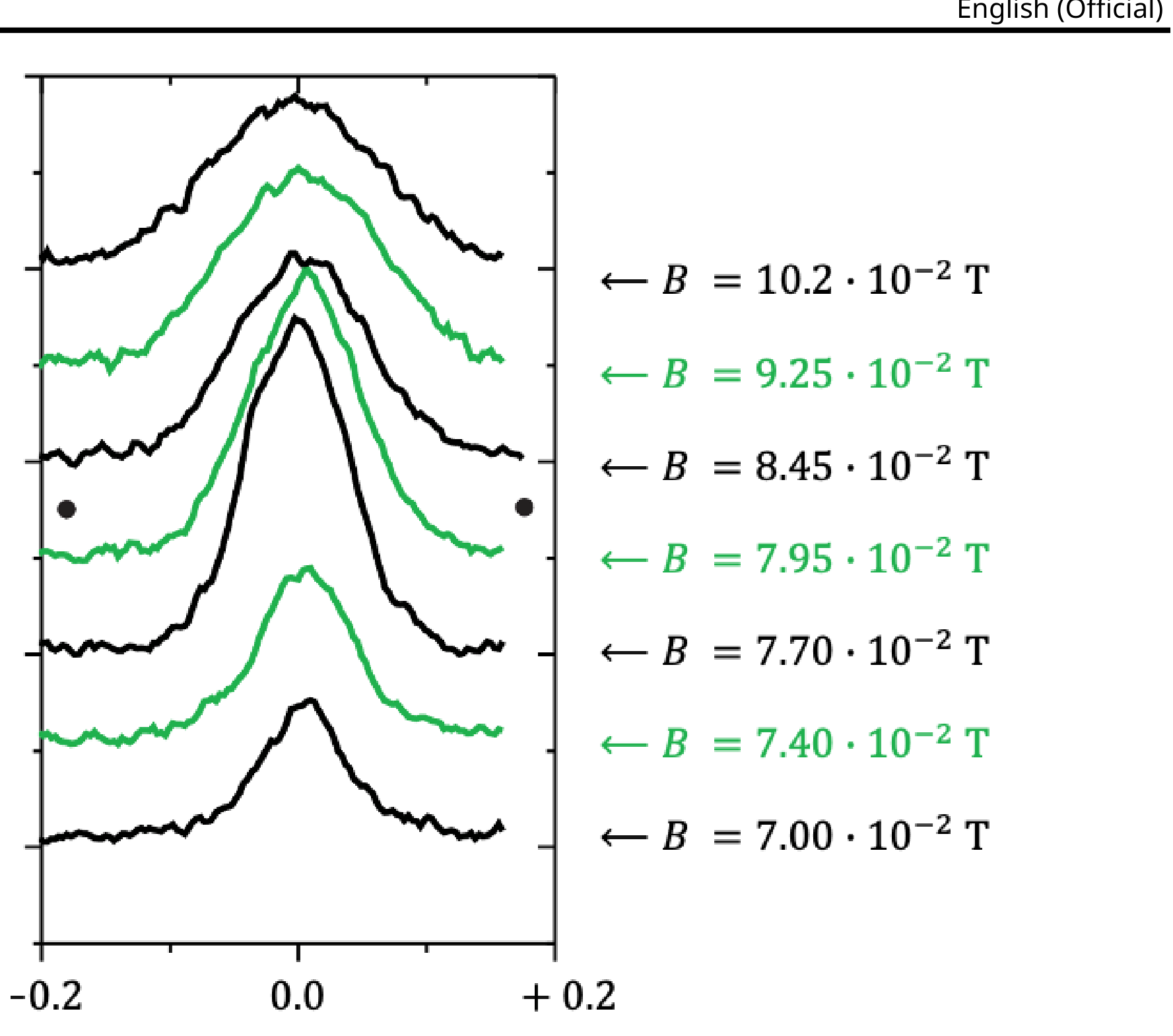
B.4 Express the ratio with and deduce from the data of Fig. 2 an estimate of . [0,9 т.]
Решение
Внимание: Непълно решение
The archive provides only the problems document (Theory-Backup); no official solutions file is attached.
Оригинал в Архива: IPhO_2025_Q6.pdf