IPhO 2026, Теория — Задача 3. Chasing the absolute zero
Theoretical Exam -- English (Official) · 10 т.
Условие
A refrigeration cycle must be carried out by a system with characteristics appropriate for the temperatures to be achieved. One hundred years ago, in 1926, the chemist William Giauque and, independently, the physicist Peter Debye proposed paramagnetic salts as ideal systems for lowering temperatures far below 1 K. Indeed, beginning in the following decade, temperatures as low as 0.0044 K were achieved (Wander de Haas and Gerrit Wiersma, 1935, Leiden Cryogenic Laboratories). In this question, the paramagnetic Carnot refrigeration cycle is studied.
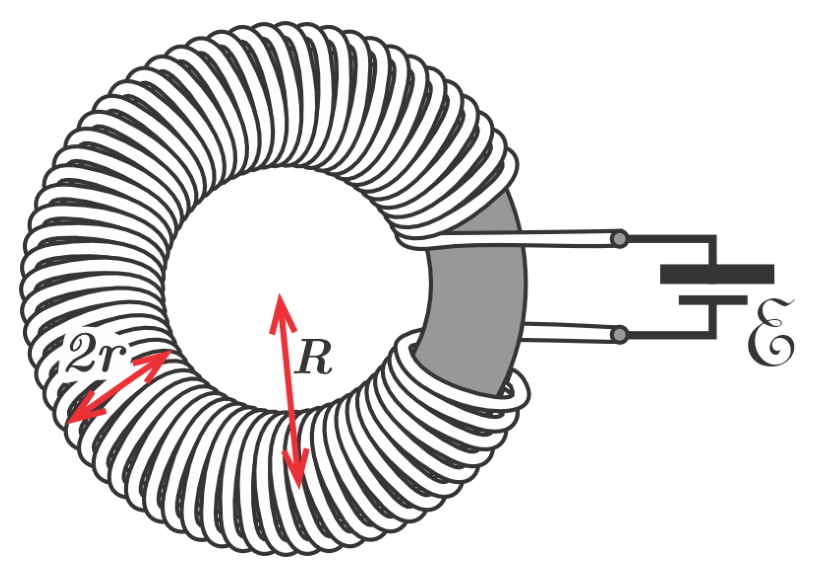
Consider a torus with mean radius and inner radius made of a homogeneous, isotropic paramagnetic material, around which an insulated conducting wire is wound, with its ends connected to an external voltage source (emf), as shown in figure 3a. The resistance of the wire is so low that energy losses due to the heating of the wire can be neglected. The winding is dense, with turns in total, and it is assumed that , so that the fields and and the magnetization have approximately constant magnitudes throughout the torus. Let and be the volume and the cross-section area of the torus. Hereinafter, the abbreviation Pm-T is used to refer to the paramagnetic torus.
In paramagnetic materials, is parallel to and the following relation holds:
Energy transfer sign convention: in this problem, Work () and Heat () are considered positive when they flow into the system, and negative when they flow out.
T3-A [1.0 pts]. Work in the Pm-T
Hint: in magnetic materials, , where is the net free current passing through the area bounded by the closed curve .
T3-A1 Let be the magnitude of in the torus. Write in terms of , , and the instantaneous electric current in the wire. [0,2 т.]
T3-A2 Let be the work that the external voltage source performs to change the magnitude of by . Write in terms of , , and . [0,6 т.]
T3-A3 The total work done by the voltage source, , can be divided in two parts: the work that would be performed to change the magnetic field if the toroid had a vacuum core, , and the work done on the paramagnetic material itself, . Write in terms of , , and . [0,2 т.]
T3-B [3.0 pts]. Heat and temperature in the Pm-T
The following table compares two thermodynamic systems: the ideal gas and the Pm-T. Use this information and your answer to question T3-A3 to solve the following questions. This information will also be used in part C. If you did not find an answer for in question T3-A3, you may use where is a number. The volume of the paramagnetic torus is constant, so that there is no work due to pressure. Below, is the temperature in all instances.
| IDEAL GAS | PARAMAGNETIC TORUS |
|---|---|
| State functions: and temperature | State functions: and temperature |
| Constants: and number of moles | Constants: and number of moles |
| Equation of state: | Equation of state: |
| Heat capacity at constant : | Heat capacity at constant : |
| Internal energy in any process satisfies | Internal energy in any process satisfies |
and are constants given by the material in the torus. You may use the equations provided in the table directly without proving them.
T3-B1 If the magnitude of changes from to at a constant temperature , an energy is transferred between the Pm-T and its environment. Write in terms of , , , , , , and . [1,5 т.]
T3-B2 If the magnitude of changes adiabatically from to , the temperature of the Pm-T changes from to . Write in terms of , , , , , , , and . [1,5 т.]
T3-C [6.0 pts]. Carnot refrigerator of the Pm-T
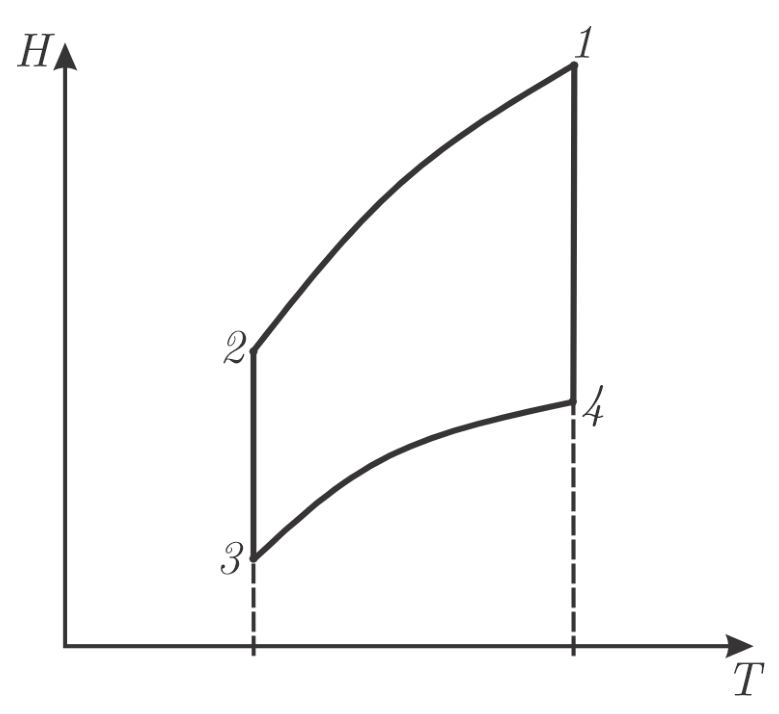
The vs. diagram of the Carnot refrigeration cycle performed by the Pm-T is shown in figure 3b. In this cycle, let:
: temperature of the hot reservoir
: temperature of the cold reservoir
: absolute value of the heat transferred to the hot reservoir
: absolute value of the heat absorbed from the cold reservoir
T3-C1 Mark and on the axis of the vs. diagram. Also label the processes in which the transfers of and occur, respectively. [0,2 т.]
T3-C2 Let , , , and be the magnitudes of at the vertices of this cycle. Write in terms of , , and . [1,5 т.]
T3-C3 Suppose that to cool 1.00 L of liquid helium initially at 1.00 K, we utilize a 2.0 moles Pm-T made of potassium chromate. For this material, K·m/mol, its density is kg/m and its molar mass is kg/mol. The Pm-T performs a Carnot refrigeration cycle with A/m, A/m, A/m and A/m. After one operating cycle, calculate the final temperature of the liquid helium. Assume that for the liquid helium both the specific heat capacity J/(kg·K) and the density kg/m remain constant. [0,8 т.]
T3-C4 In order to continuously lower the temperature of a body with constant heat capacity , Carnot cycles are allowed to occur over time in such a way that the power transferred to the refrigerator remains constant. It is then assumed that the temperature of the hot reservoir remains constant and that in each operating cycle the temperature of the cooled body decreases by , satisfying the relation . If at we have , determine the time that the Carnot refrigerator must operate for the cooled body to reach a temperature . Express your answer in terms of , , , and . [2 т.]
T3-C5 The efficiency of a refrigerator is quantified by its coefficient of performance . Determine the overall COP of the refrigerator of question T3-C4 with all the cycles performed until time . Write your answer in terms of and and . [1,5 т.]
Отговори
- T3-A1
- T3-A2
- T3-A3
- T3-B1
- T3-B2
- T3-C2
- T3-C3 0.99008 K
- T3-C4
- T3-C5
Решение
SOLUTION T3 [10 pts]. Chasing absolute zero
T3-A [1.0 points]
T1-A1 [0.2 pts]. Field inside the torus is almost entirely confined to its core, forming concentric circumferential circles. Therefore, from magnetic circuital law we have . Dividing and multiplying by yields to
T3-A2 [0.6 pts]. When is changed, there is induced an emf . Thus, since
from Faraday’s law of induction, the work done by the external emf is given by
where is the quantity of electric charge flowing during the time interval and is the flux of the field inside the torus. Therefore,
T3-A3 [0.2 pts]. Since , and are parallel vectors, from we get
from which, after substitution in the answer of question T3-A2, yields to
Hence,
T3-B [3.0 pts]
T3-B1 [1.5 pts]. The first law of thermodynamics for the torus is . At constant , we have , i. e., depends only on . Hence, for isothermal processes, . Furthermore, from the equation of state we have for isothermal processes that and then
Integration from to gives
Note: This is proportional to the volume because it has the number of moles.
T3-B2 [1.5 pts]. For adiabatic processes, the first law yields to and then
where we have used the equation of state to substitute . Separating variables we have
and hence, after integration from to ,
Since , this equation simplifies to
from which
Hence
T3-C [6.0 pts]
T3-C1 [0.2 pts].
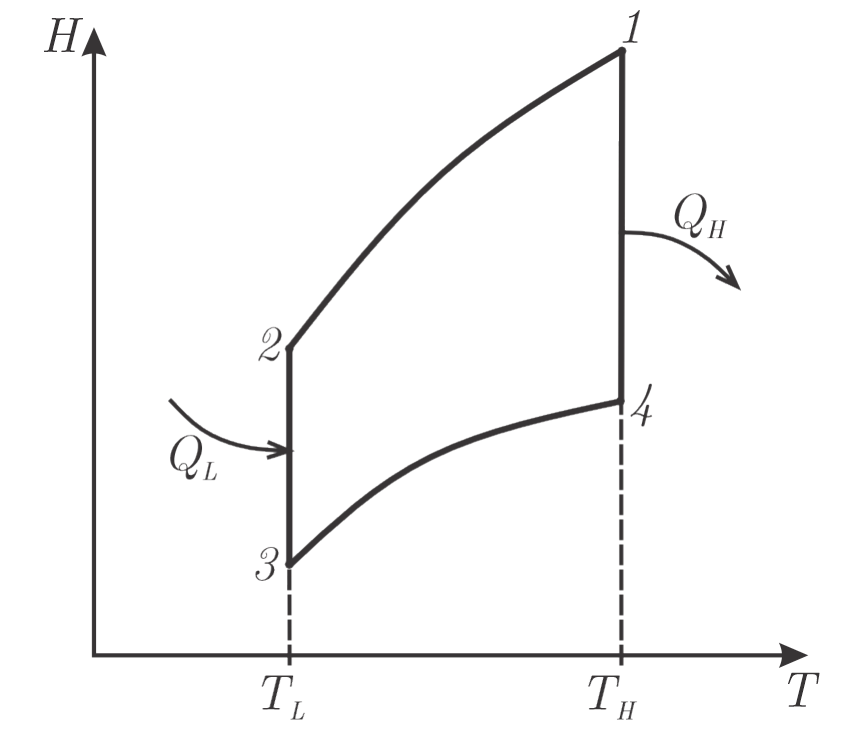
T3-C2 [1.5 pts]. In the Carnot cycle
Particularly, for the Carnot cycle of paramagnetic refrigeration, we have and . From the answer to question T3-B1,
where and are the respective temperatures of the isothermal processes and . Therefore, after substitution and simplification in the Carnot identity, we have
Since, by the equation of state, , we get
T3-C3 [0.8 pts]. By substituting the given numerical values
Hence
Hence
T3-C4 [2.0 pts]. From the Carnot cycle identity and the first law in differential form , we have
where and have been used. Hence, after separation of variables,
Integrating from () to () we get
T3-C5 [1.5 pts]. Since and ,
Therefore
Оригинал в Архива: T3.pdf · официални решения: theory_sol.pdf