ISPhO 2024, Теория — Задача 3. T3. Hydraulic jump
ISPhO — July, 2024 — T3. Hydraulic jump
Условие
A hydraulic jump is a phenomenon in which the rapid flow of fluid slows down abruptly, resulting in an elevation of the fluid level within the stream. This phenomenon can occur naturally in the flow of a river or canal. Additionally, it is utilised in the construction of dams to decelerate the speed of water flow. Furthermore, hydraulic jumping can be observed in domestic settings. For instance, when a jet of water strikes the surface of a sink, a circular formation with a thin layer of fast-flowing water is formed around it. At a certain distance from the jet, the water level rises, which is hydraulic jumping. The problem requires you to describe this phenomenon using conservation laws.
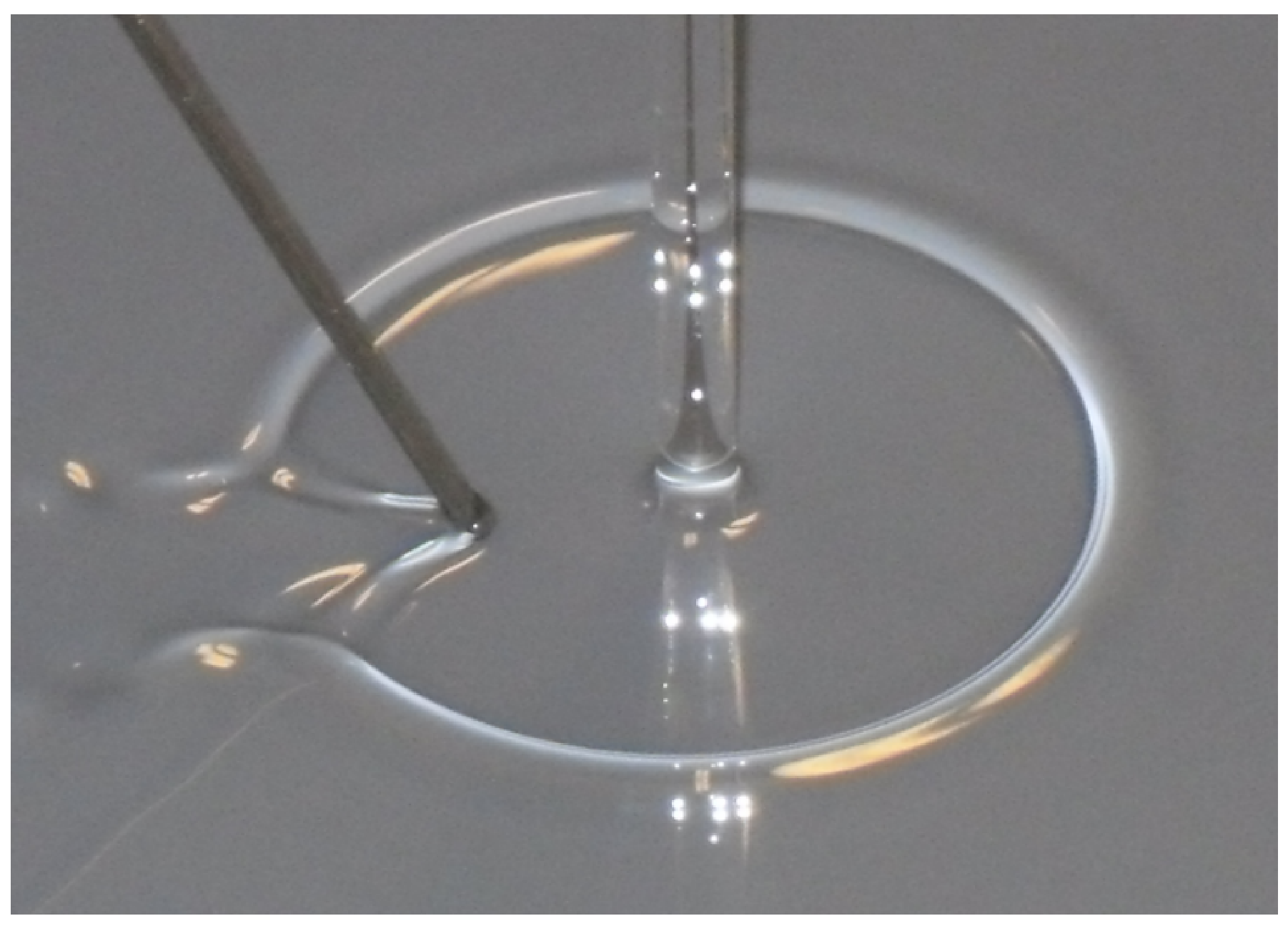
The entire problem considers the flow of water, which can be considered an incompressible fluid with a density . The acceleration of free fall is .
If energy losses are neglected, the Bernoulli equation is satisfied for stationary (time-independent) fluid flow along any current tube. This can be expressed as follows:
In this equation, represents the pressure, is the flow velocity, and denotes the height of the fluid volume under consideration. The value will be referred to as the specific energy of the given fluid element. The Froude number is employed as a dimensionless parameter to characterise the flow of a fluid, taking into account the force of gravity. This is expressed as follows:
where is the characteristic flow velocity, is the flow depth.
It should be noted that throughout the entirety of the problem, the atmospheric pressure does not affect the fluid flow. Consequently, its contribution to the Bernoulli equation and to the expressions for forces can be ignored.
Part A. Flow without energy loss In this part, we will consider the flow of a fluid along a rectangular canal of width . The fluid motion can be considered steady-state, meaning that the velocity at a given point in the canal is independent of time. The water flow through the canal (the volume of water flowing through the channel cross-section per unit time) is . It is assumed that the canal bottom is flat and that the flow velocity is uniform throughout the canal cross-section. Atmospheric pressure does not need to be taken into account.
A1 The depth of water in the canal is . Find the specific energy of the flow . The height of the canal, , should be count from the bottom. The answer should be expressed in terms of the following variables: , , , and .
A2 Determine the critical water depth, , at which the specific energy is minimal. Express it in terms of , , and .
A3 Determine the fluid velocity and Froude number in the case of critical depth. The answer should be expressed in terms of , , .
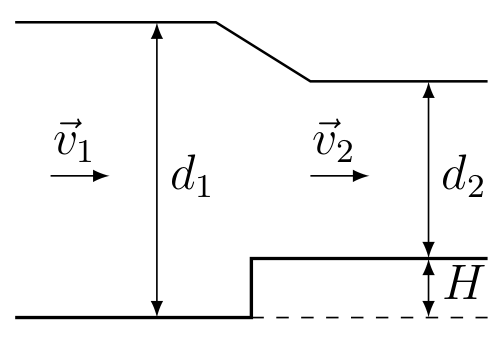
A4 Suppose now that at some point the bottom of the canal rises to a height and its width remains unchanged. Let and be the water depth and flow velocity before the change of the depth, , – after the change.
Write two equations following from the laws of conservation of mass and energy of water that relate these quantities. These equations may also include and . It is assumed that at all points of the flow the flow is laminar and Bernoulli's law is fulfilled
A5 The equations written in the previous task can not be solved exactly. Therefore, we will assume that the height is small. Consequently, and are small changes in velocity and depth of flow. In all calculations, we limit ourselves to first-order contributions of , , and . Determine the values of the ratio and the ratio .
A6 Indicate at which values of the Froude number of the flow before changing the depth of the canal the velocity increases and at which values the velocity decreases.
Part B. Theory of hydraulic jumping In this part we will examine the hydraulic jump in detail. For this purpose, we will again consider the flow of fluid along a rectangular canal of constant width . The flow area can be divided into three parts:
- an initial part of fast flow of small depth, where velocity and depth are and ;
- a transition part, the flow in which is highly turbulent and the depth changes and energy losses occur, so the Bernoulli equation cannot be used;
- a part of slow flow of constant velocity and depth .
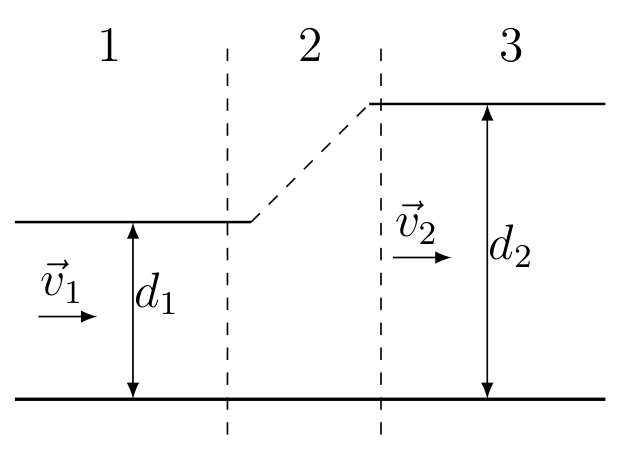
To describe the hydrodynamic jump, let us select the volume of water in the canal in such a way that the left boundary of the selected region lies in part 1 and the right boundary lies in part 3. The law of conservation of mass and the law of momentum change can be applied to the selected volume.
B1 Find the hydrostatic pressure force acting on the selected volume. It can be demonstrated that the contribution of atmospheric pressure is zero and can be disregarded (proof is not required). It is assumed that the pressure dependence on height is the same as in a stationary fluid. The answer must be expressed in terms of , , , , .
B2 Write two equations following from the law of conservation of mass and the law of change of momentum that connect , , , . The answer may also include , , .
B3 Using the equations obtained, determine the ratio of the water depth after the jump to the depth before the jump . Express the answer in terms of the Froude number of the flow before the jump .
B4 Find the difference of specific energies of the liquid before and after the jump . Express the answer in terms of , , .
B5 At what values of the Froude number is hydrodynamic jump possible?
Part C. Hydraulic jump in the sink In this part, we will use our previous results to estimate the parameters of the hydrodynamic jump that can be observed in the sink. A complete theory would be required to determine the radius of the circle on which the jump occurs. However, it is necessary to take into account fluid viscosity and surface tension. Therefore, we will consider this radius as a given value.
Let a jet with a volumetric flow rate hit a horizontal surface, the jet diameter just before contact with the surface , the jet is perpendicular to the surface. The flow is symmetric about the symmetry axis of the jet. Consider that the law of conservation of energy is fulfilled in the fluid flow up to the moment of hydraulic jump, and the flow velocity does not depend on the distance from the jet.
C1 Find the velocity of fluid flow before the hydraulic jump. Give the formula and the numerical value. The answer should be expressed in terms of and .
C2 How does the depth of water depend on the distance from the center of the jet? Express the answer in terms of , , find the numerical value when (the radius at which the jump occurs).
C3 Find the Froude number (numerical value) at the point where the hydrodynamic jump occurs. Determine how many times the water depth increases during the jump .
Отговори
A1
A2
A3
A4
A5
A6 The velocity increases when , decreases when .
B1
B2
B3
B4
B5 The jump is possible when .
C1 ≈ m/s
C2 ≈ mm
C3 6
,
Решение
A1. Let us write the expression for specific energy at the upper point of the canal. In this point, the liquid pressure is zero, and we do not take into account the atmospheric pressure (it would give a constant addition that does not affect further calculations). Then we obtain
If we used a point at an random height for the calculation, the pressure would be , so we get the same value:
The flow velocity can be expressed in terms of the volume flow rate and the cross-sectional area of the flow ,
We finally obtain
A2. To find the minimum, we differentiate the expression for by :
whence
A3. Let's substitute the found depth value into the formula for :
For the Froude number we obtain
A4. The flow of water through any cross-section of the canal is the same, so:
From Bernoulli's equation for a fluid that flows on a surface
Here it is taken into account that the height of the liquid surface in the second part of the canal is . As was shown in task A1, the same values would be obtained at any depth.
A5. Since the changes in depth and velocity are small, we can rewrite the flow conservation condition as
Let's substitute this result into Bernoulli's equation:
Expanding to first order by and reducing the same summands, we obtain
whence
Then the change in the depth of the flow
A6. It follows from the answer in the previous task that when , i.e., when , the flow velocity increases, and when – decreases. In the case of critical flow in the first order the velocity change goes to infinity.
B1. The pressure at height from the bottom is (in the left part of the system before the jump). The force that acts on the selected area on the left side can be found using the integral
Similarly, the force acting on the right side is
The total force is equal to the difference of these two forces because they act in opposite directions. Consider the force positive if it acts to the right
B2. The flow conservation condition looks exactly the same as in the previous part:
In time , a mass of fluid passes through any cross section of the flow. Then the momentum of the fluid entering the area
and the momentum of the outgoing fluid
The change of momentum is due to the force acting on the system
therefore
Reducing the common multipliers and regrouping the summands, we obtain
B3. From the flow conservation condition, let us eliminate the velocity of the fluid after the jump
then the second equation takes the form
After multiplication by , this equation reduces to a cubic equation with respect to . However, one solution to this equation is known, corresponding to the fact that there is no jump and the flow of the fluid has not changed. This allows us to isolate the common multiplier in the equation and reduce the problem to a quadratic equation:
We are not interested in solving , so the multiplier can be reduced, resulting in a quadratic equation
its solutions are
Since , only the solution with the sign is suitable. We finally find
B4. The difference of energies expressed in terms of velocities and depths is of the form
From the quadratic equation for we find
Then the velocity after the jump
Substituting these results into the energy change, we obtain
We find after simplifying
B5. In the process of motion, part of the energy can be transferred to heat due to the effects of turbulence and viscosity. At the same time, the energy cannot increase without external influence. Therefore, the condition must be fulfilled, and hence , i.e. the depth of the flow must increase, so there is indeed a jump. Hence we get the inequality
which means
so .
C1. Flow in an falling jet is related to velocity by the relation
whence the velocity of water in the jet
As given, this same velocity is equal to the velocity of the stream before the jump.
C2. Let us select a cylinder of radius centered on the symmetry axis of the system. The flux through the side of this cylinder is equal to
whence the depth of the water layer
C3. Using the equations for velocity and depth, we find
then the depth ratio
Оригинал в Архива: T3.pdf · официални решения: T3_sol.pdf