ISPhO 2026, Теория — Задача 1. Janssen effect
Theory Q1 — Janssen effect
Условие
The Janssen effect is a characteristic feature of granular materials. When granules are poured into a container, a network of contacts between particles leads to the formation of force chains (see Fig.) that redistribute the stress of the granular column towards the side walls.
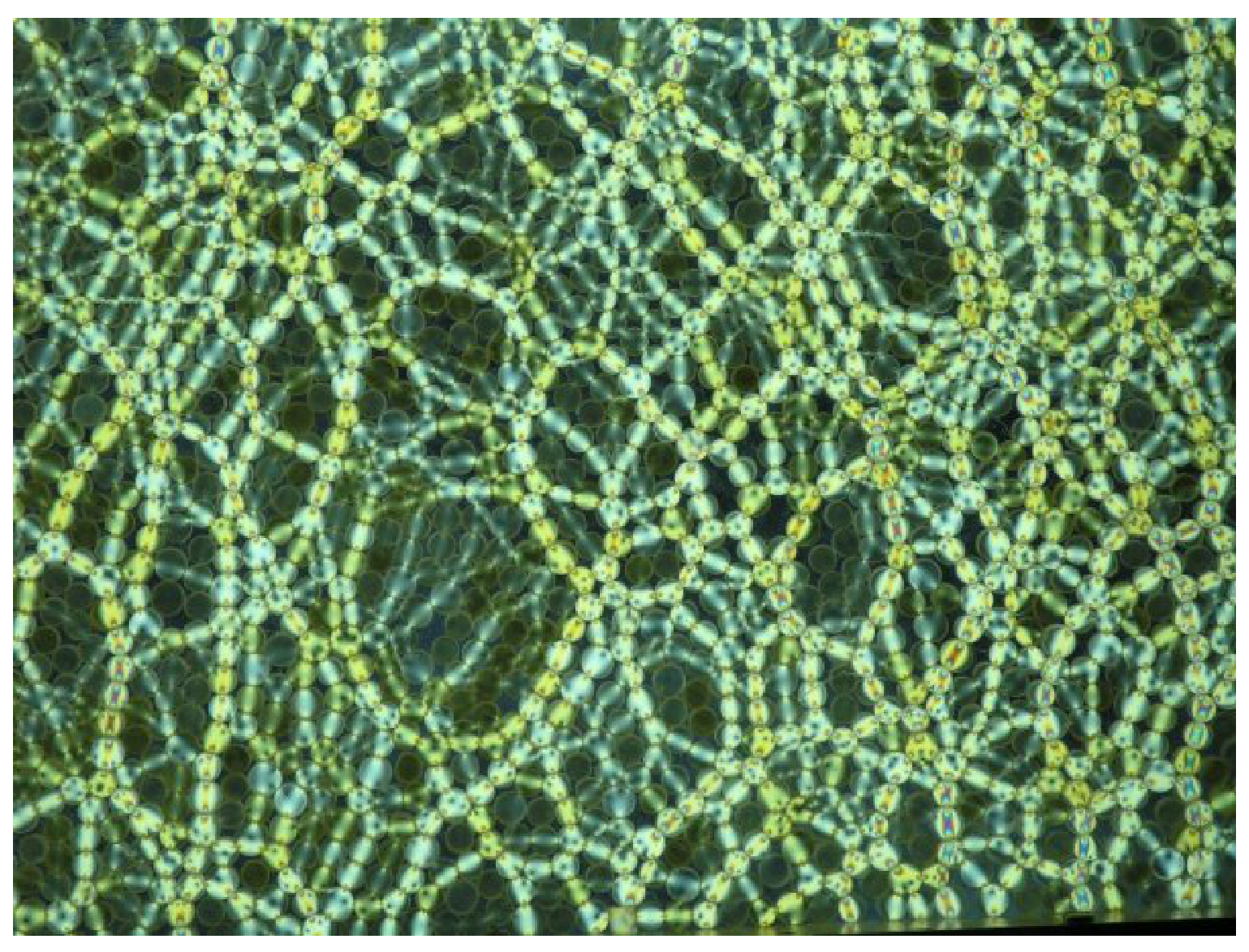
This ability of granular materials to self-organize stress distribution through force chains distinguishes them from conventional liquids and solids, making their study important for various fields of science and engineering. This is particularly important in industry, where large quantities of raw materials are typically stored as granules in silos (storage facilities for granular material).
This problem is devoted to investigating this effect by examining the behavior of spherical granules in vessels of various shapes.
Throughout the problem, disregard the contribution of atmospheric pressure. All pressures refer to gauge pressure relative to atmospheric pressure.
The following integrals may be useful:
Part A. Hydrostatics (0.5 points)
A cylindrical vessel with vertical walls and a bottom area (see Fig.) is completely filled with water of total mass . The density of the water is .
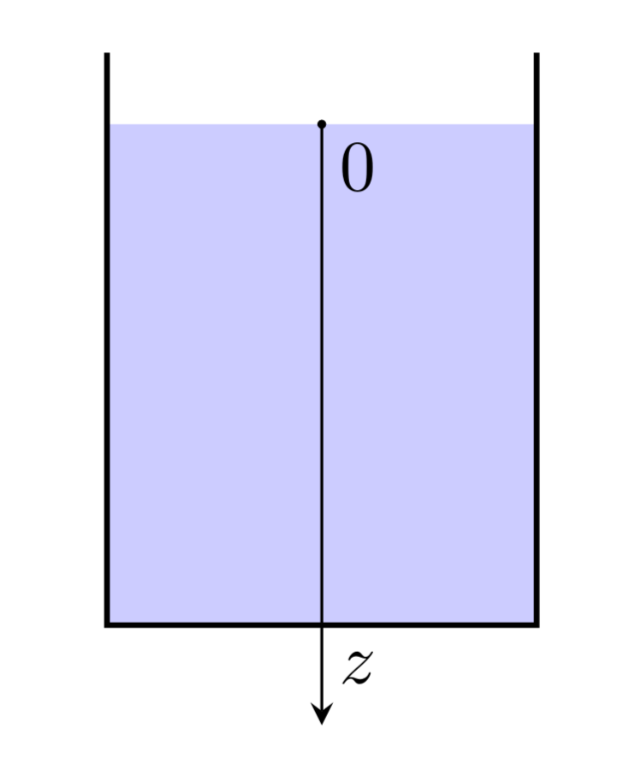
A.1 Determine the pressure at the bottom of the vessel. Express your answer in terms of , , and . [0,2 т.]
A.2 Determine the pressure on the vessel walls as a function of depth . Express the answer in terms of , , and . [0,3 т.]
Part B. Janssen effect in a cylindrical vessel with vertical walls (2.9 points)
This part investigates how the pressure exerted by the granules on the bottom of a vertical-walled cylindrical vessel depends on the mass of the granules.
For parts B, C and D of the problem, work within the following model:
- is the bulk density of the material (average mass of granules per unit volume of the vessel).
- Before the experiments, the vessel is shaken, ensuring a completely random arrangement of the granules. There is a very large number of granules, and the free surface is horizontal.
- is the depth measured from the free surface ( at the averaged granule-air interface, with the -axis directed vertically downward).
- Assume that the granular pressure against the walls is directly proportional to the vertical pressure in the vessel: . Here, is the constant coefficient. Throughout the remainder of the problem, understand the pressure of the granules as the averaged normal force acting per unit surface area. For example, for the pressure on the vessel walls:
- Assume this quantity is independent of the radial direction. Also, assume the vertical pressure is independent of the radial direction and the distance from the vessel axis.
- is the friction coefficient of the granular material against the vessel wall. Assume that the friction force acting on the granules is vertical and maximal in magnitude. Neglect the phenomenon of stagnation; that is, assume that the maximum possible value of the friction force is . In parts B and C, assume that friction minimizes the pressure on the bottom of the vessel, i.e., the friction forces acting on the granules are directed vertically upwards.
- is the inner radius of the cylindrical vessel.
- is the acceleration due to gravity.
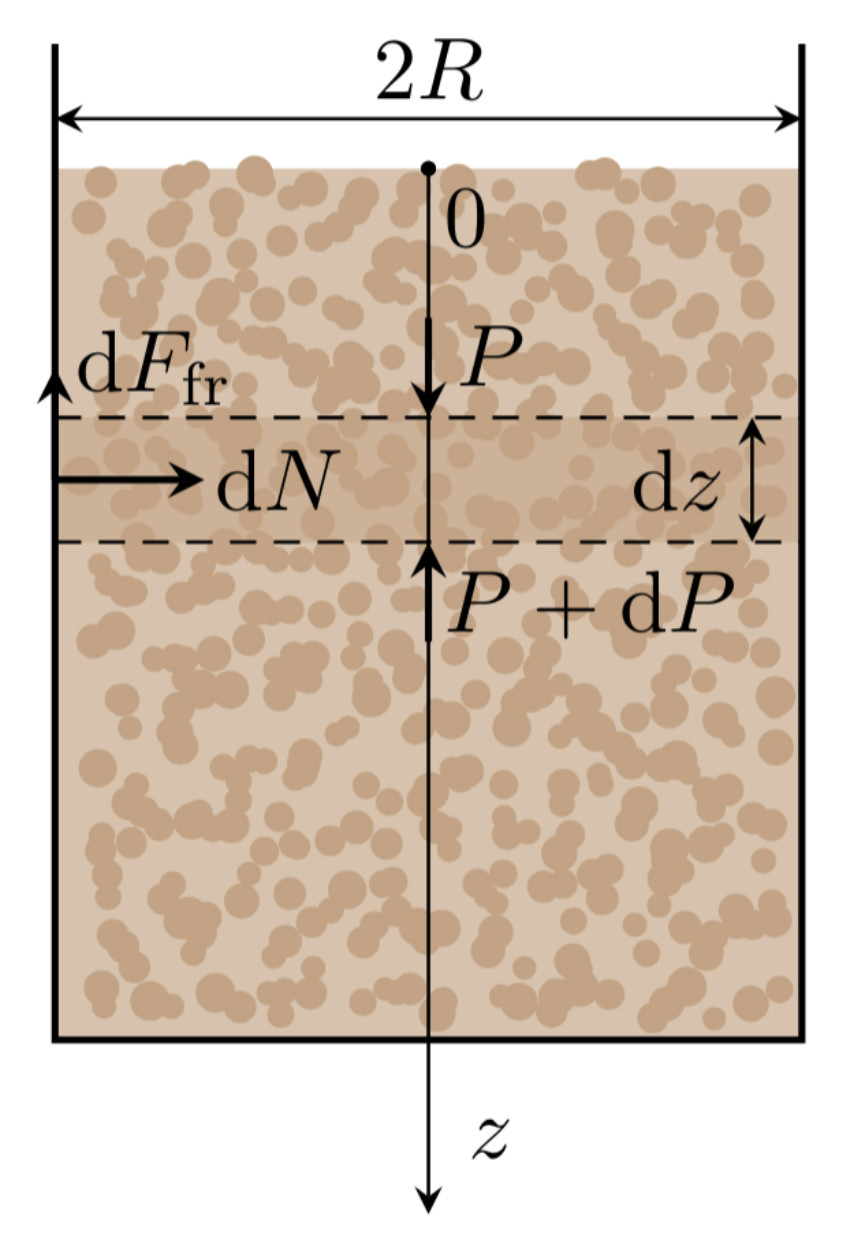
Consider a thin layer of granular material at depth with thickness . The radius of this layer is equal to the inner radius of the vessel.
B.1 Write down the equilibrium condition for this layer. The equation may include the pressures and , , the average pressure on the vessel walls , the mass of the layer , as well as , , and . [0,5 т.]
B.2 Show that the bottom pressure as a function of the fill height of the granular column can be written as:
Determine the parameters , , and . Express your answers in terms of the bulk density , as well as , , , and . [1,2 т.]
The graph below shows the dependence of the granular pressure on the bottom on the granules level in the vessel, .
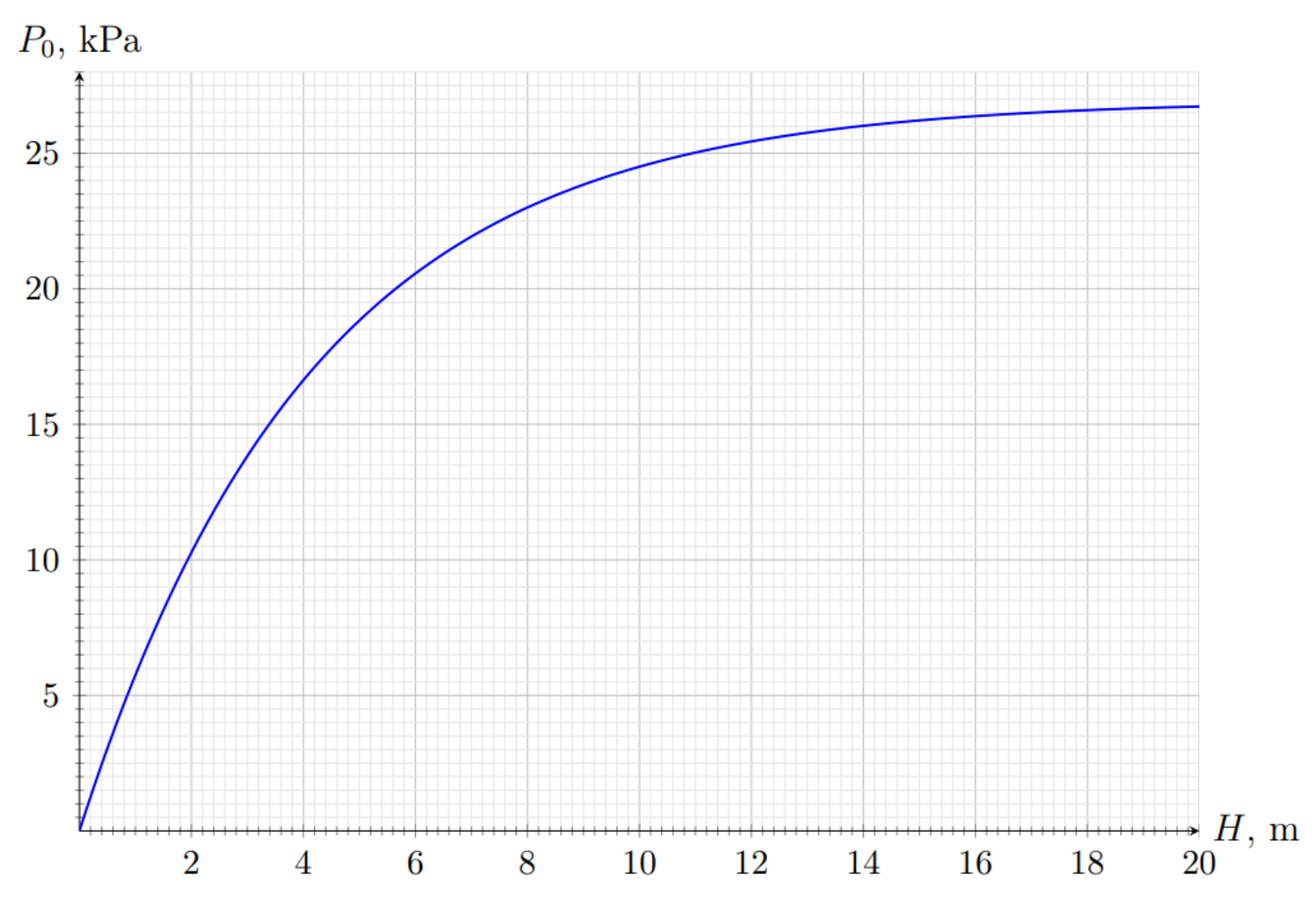
B.3 Determine the bulk density of the granules and the coefficient . Give the answers to two significant figures. For this part, assume the numerical value of the vessel radius is and the coefficient of friction is . [1,2 т.]
Part C. Conical vessel (2.3 points)
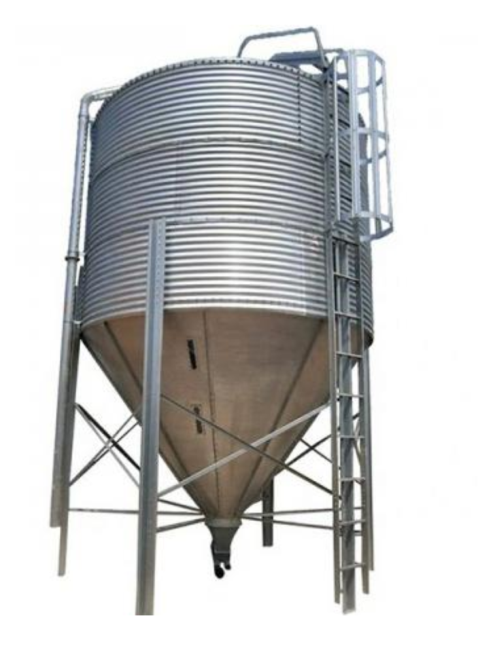
In this part of the problem, we investigate the pressure distribution of granules in a conical vessel, oriented with the bottom facing upward and completely filled with granules. This calculation is crucial, for example, for designing grain storage silos (see the figure below).
Assume the base radius and the cone's half-angle are known.
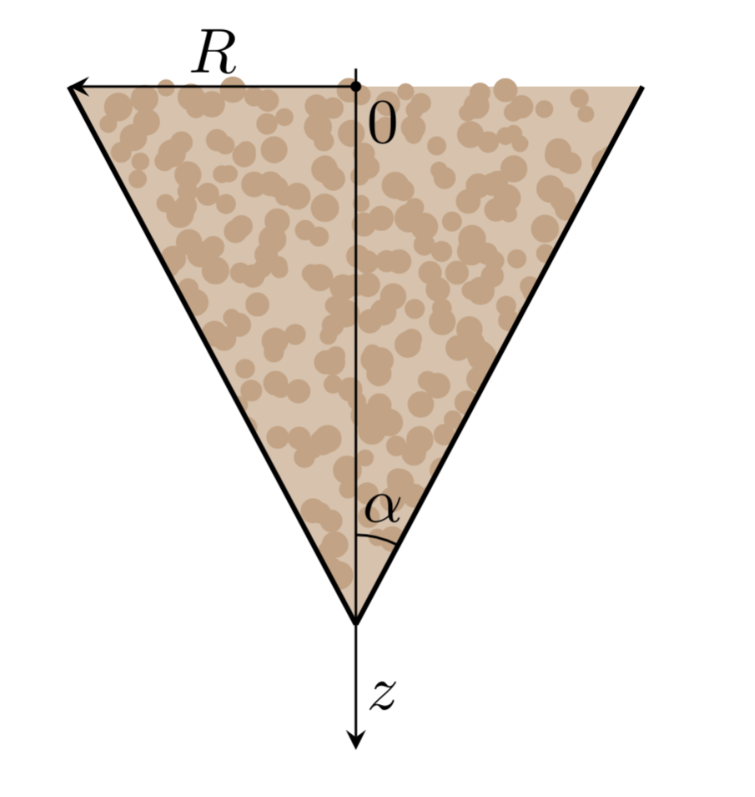
C.1 In the specified approximation, obtain the dependence of the vessel's cross-sectional radius on height . Express the answer in terms of , , and . [0,1 т.]
Let us again consider a thin layer of granular material analogous to the layer in B1.
C.2 Write down the equilibrium condition for the layer. The equation may include the pressures and , , the average pressure on the vessel walls , the mass of the layer , as well as , , , , , and . [0,6 т.]
For the remainder of this part, assume that . Note that and may be of the same order of magnitude. Let us introduce the notation:
Assume henceforth that the dependence of the vertical pressure inside the vessel on the coordinate is given by:
where , , and are constants. The system parameters are chosen such that .
C.3 Determine the parameters , , and . Express the answer in terms of the bulk density of the granules , , , , , and . [0,8 т.]
C.4 Sketch a qualitative graph of and determine the ratio of the maximum vertical pressure to for . Provide the answer to two significant figures. [0,8 т.]
Part D. What if the vessel is lifted? (1.5 points)
In this part of the problem, we again consider a vertical cylindrical massless vessel of radius .
A layer of granular material of height is poured into it. A rod of radius is vertically inserted into the center of the container, touching the bottom. The bulk density of the granules is , the coefficient of friction of the material against the container wall is , and the coefficient of friction of the material against the rod is . The rod begins to be slowly pulled upward at a constant low speed. Due to friction, the vessel with the granules begins to rise slowly. Throughout this motion, the granules remain stationary relative to the vessel.
The coefficient is still constant both for the interaction of granules with the vessel walls and for the interaction of granules with the rod.
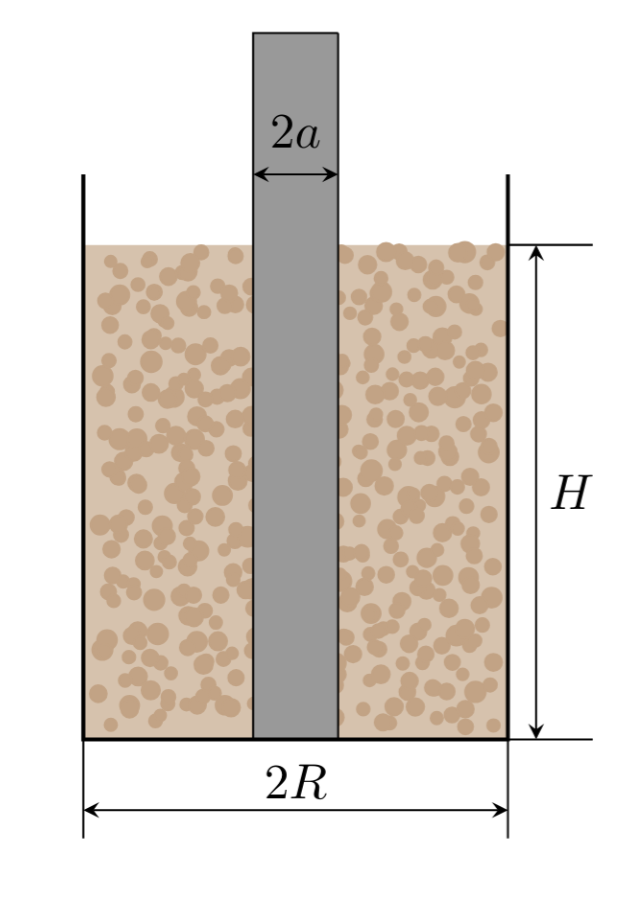
Let us again consider a thin layer of granular material analogous to the layer in B1. Now, this layer is in contact with both the vessel and the rod.
D.1 Write down the equilibrium condition for the layer. The equation may include the pressures and , , the average pressure on the rod and vessel walls , the mass of the layer , as well as , , , , and . [0,4 т.]
D.2 Show that the bottom pressure as a function of the fill height of the granular column can be written as:
Determine the parameters , , and . Express the answers in terms of the bulk density of the granules , as well as , , , , , and . [0,3 т.]
D.3 Determine the minimum level of the granules relative to the bottom at which the cylinder can be lifted as described above. Assume that . Express the answer in terms of , , , and .
Hint: You may use the following approximation:
[0,8 т.]
Part E. Fluid outflow through the wall (1.8 points)
An incompressible fluid characterized by the complete absence of internal friction (viscosity) and a constant density is termed an ideal fluid. Hereafter, we shall focus our analysis on such an ideal fluid.
Consider a stream tube within a steady flow of an ideal fluid, bounded by small cross-sections and , through which the fluid flows from left to right. Assume that the fluid pressure and velocity are uniform across any cross-section within this stream tube that is perpendicular to the fluid velocity.
Let the flow velocity , pressure , and height of this cross-section be given at . Similarly, at cross-section , the flow velocity , pressure , and height are specified. The height is measured from a fixed reference level.
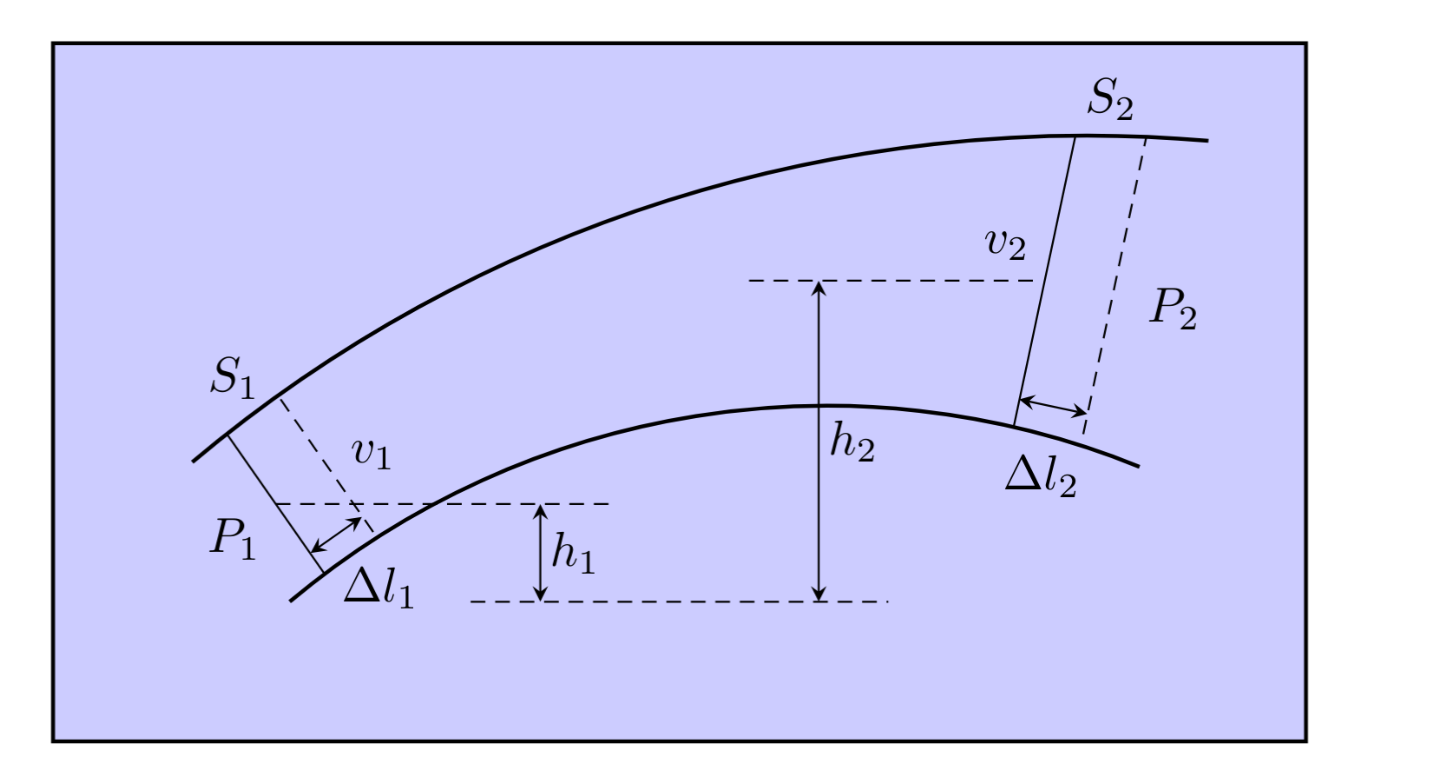
Over a small time interval, a volume of fluid moves along the stream tube, with cross-section moving to position over a distance , and cross-section moving to position over a distance .
E.1 Derive an equation relating , , , and . [0,2 т.]
E.2 Determine the total energy (the sum of kinetic and potential energies) of the selected fluid volume . Express the answer in terms of , , , , , and . Take the potential energy at as the zero reference level. [0,1 т.]
E.3 Determine the work done by pressure forces on the fluid bounded by the chosen stream tube during time . Express the answer in terms of , , , and . [0,3 т.]
E.4 Using the law of conservation of energy, express the pressure in terms of , , , , , and . The resulting equation is known as the Bernoulli equation. [0,3 т.]
Consider a cylindrical vessel with vertical walls, similar to the vessel in Part B. Its inner radius is , and an hole with diameter is made in its wall. The vessel is filled with an ideal fluid of density , and its height relative to the hole is .
E.5 Determine the fluid outflow velocity as a function of the height above the hole. Express the answer in terms of and . [0,3 т.]
At the initial time, let the fluid level above the hole be .
E.6 Determine the time required for all the fluid initially above the hole to drain through it. Express the answer in terms of , , , and . [0,6 т.]
Part F. "Flow" of granules through a wall (1 point)
In this part of the problem, we examine the “flow” of granules from a cylindrical vessel, focusing on its characteristics and differences from the flow of an ideal fluid. To do this, we again consider a cylindrical vessel with vertical walls filled with granules. Assume each granule is a sphere of diameter . A circular hole of diameter is made in the cylindrical vessel. The condition implies that the effective diameter of the opening does not decrease due to arching (accumulation of granules near it). Above the opening, there is a layer of granules of height , where is the parameter found in part B2. The vessel wall thickness is . Additionally, assume that , where is the internal radius of the vessel.
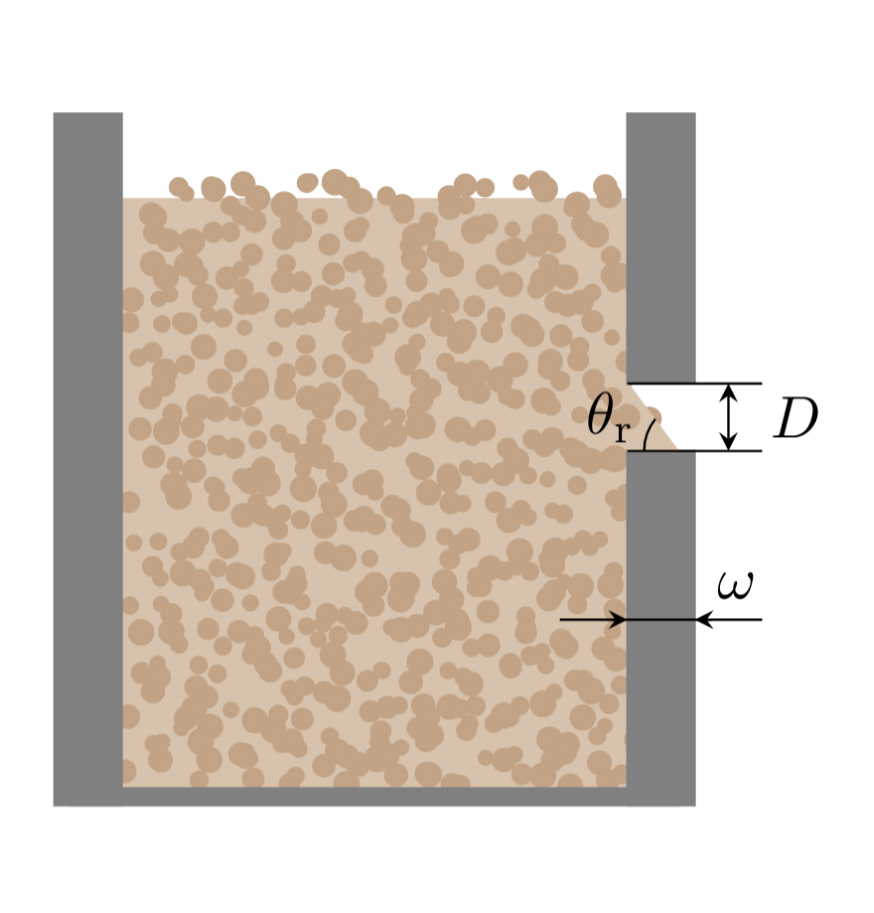
F.1 Due to internal friction between the granules, the maximum angle at which the free surface of the granular material can deviate from the horizontal is . What is the maximum wall thickness for which the flow of granules from the vessel is possible? Express the answer in terms of and . [0,2 т.]
Unlike an ideal fluid, significant energy losses occur in granular materials due to interparticle friction. Assume that the kinetic energy of the exiting particles is gained only at characteristic distances of the order of from the hole, and the characteristic acceleration of the granules during acceleration is of the order of .
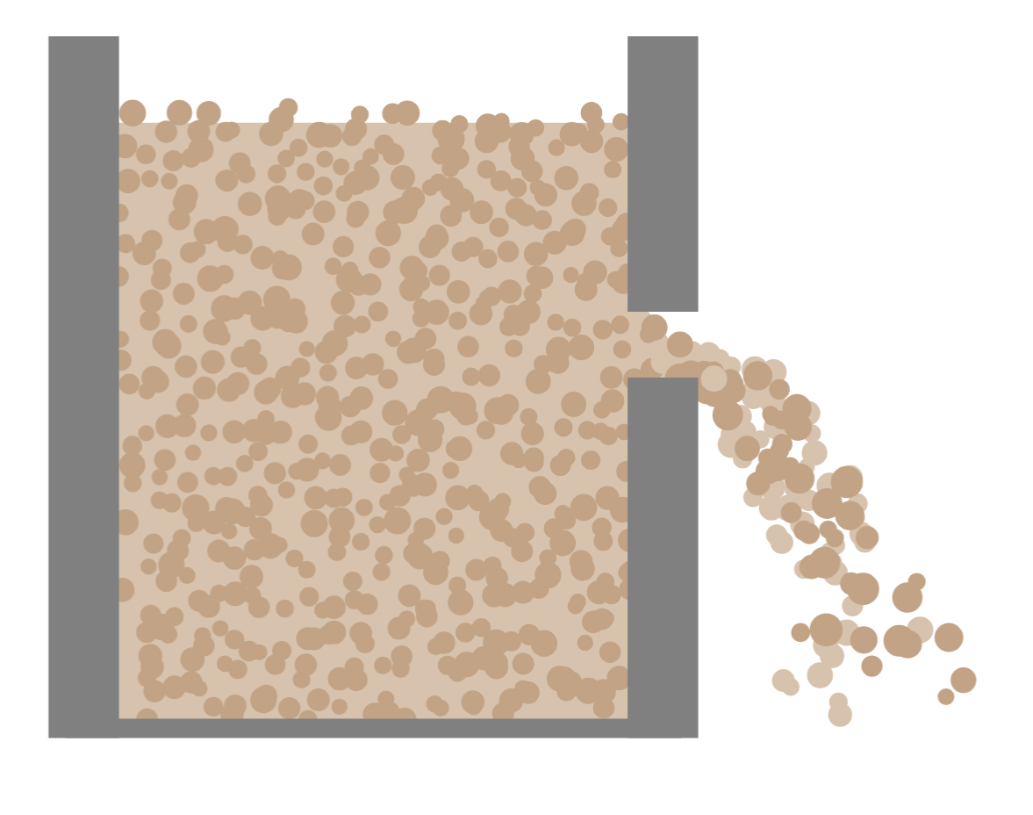
Therefore, the mass flow rate of granules exiting through the hole is expressed as:
where is a dimensional constant, and is the height of the layer of granules above the hole.
F.2 Determine and . [0,8 т.]
Решение
Внимание: Непълно решение
В архива няма официално решение на тази задача.
Оригинал в Архива: T1.pdf