ISPhO 2026, Теория — Задача 2. Air shower
ISPhO Theory Q2-1 — Air shower · 10 т.
Условие
Part A. Electromagnetic shower (2.0 points) (2 т.)
Bremsstrahlung
When passing through matter, charged particles interact with the atoms and molecules of the material and, as a result, lose their kinetic energy. There are various mechanisms of energy loss: ionization of matter, bremsstrahlung, production of electron-positron pairs, and others. The fraction of energy lost through each of these mechanisms depends on the parameters of the particle and its motion — its kinetic energy, the particle mass, and its charge. In this problem, we will consider ultrarelativistic (, ) electrons (as well as positrons — positively charged electrons), for which the main mechanism of energy loss is bremsstrahlung.
In shower physics, the concept of radiation path length is introduced. It depends not only on the distance traveled, but also on the density of the medium in which the motion takes place. In fact, the radiation path length indicates the number of "layers" of matter passed through by the particle. The radiation path length of a particle in matter can be calculated using the formula
where and are the geometric coordinates of the beginning and end of the particle's motion (in meters), and is the density of the medium.
An ultrarelativistic electron (or positron ) moving in air can spontaneously emit a photon , which carries away part of its energy. This process is probabilistic and follows an exponential distribution in length. This means that if an electron starts moving along the -axis from the point , then the probability density that a photon will be emitted at the point with coordinate is
where is the radiation length of the material. It is a constant and does not depend on the parameters of the particle's motion or on the density of the medium. In shower physics, the distance is measured not in the usual units for us (meters), but in radiation lengths:
For air, the value is .
High-energy photons passing through matter also interact with it. The interaction mechanisms include the photoelectric effect, Compton scattering, and electron-positron pair production. At high energies, the dominant energy-loss mechanism is electron-positron pair production. A photon interacts with the electric field of an atom and produces one electron and one positron. This process is also probabilistic and follows the same exponential distribution with the same radiation length as for electrons.
Heitler Model
In this problem, we will work within the simplified Heitler model. In this model, bremsstrahlung is not a probabilistic process but a deterministic one. An electron moving through matter emits one photon every time it travels a certain radiation path length , which we will call the splitting length. During this emission, the total energy of the electron is divided equally between the electron and the emitted photon. The electron continues its motion and emits one photon every splitting length until its energy falls below the critical energy , below which ionization losses in air begin to dominate and the development of the electromagnetic shower ceases. For an electron in air, . Accurate calculations show that the splitting length is related to the radiation length of the material by
The interaction of photons with matter is also simplified in this model. After traversing one splitting length (the same as for electrons), a photon (whose energy must exceed ) converts into an electron-positron pair, with the total photon energy divided equally between the two particles.
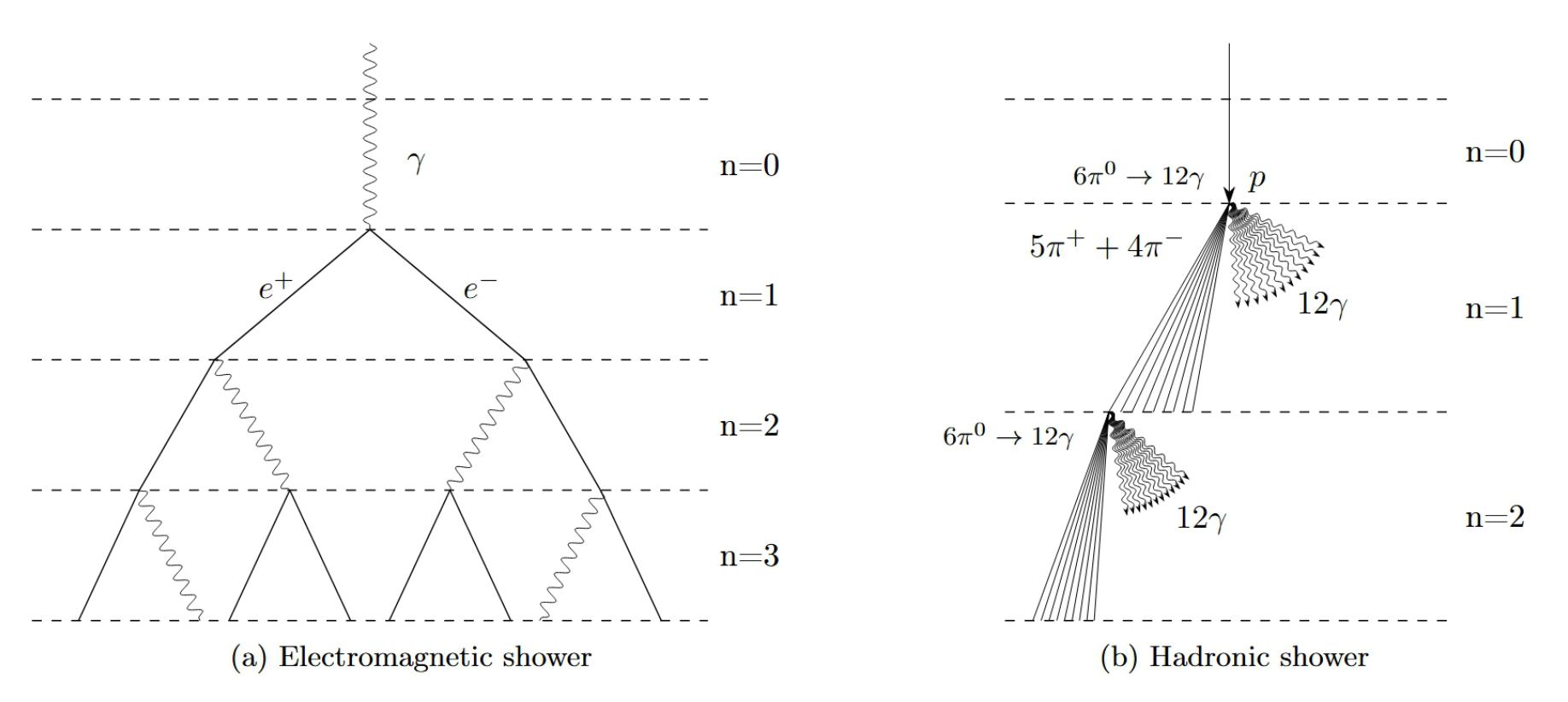
The development of an electromagnetic shower initiated by a single high-energy photon in matter is shown schematically in Fig. 1a. At the 0th step, there is one high-energy photon. After traversing one splitting length, the photon converts into an electron-positron pair. At the next step, after traversing another splitting length, the electron and positron each emit one photon, which in turn initiate their own showers. Thus, the shower continues to grow until the energies of the particles fall below the critical energy, at which point the development of the electromagnetic shower terminates.
Problem
A photon with energy enters air of constant density . The electron charge is .
A.0 Using the given value of the radiation length of air , calculate the splitting length . Express your answer in g/cm² and round it to one decimal place. [0,2 т.]
Note: We will call the number of shower generations the quantity , which denotes how many successive splittings have occurred since the beginning of the shower development.
A.1 Determine the number of shower generations after which the energy of the particles in the shower becomes less than the critical energy. [0,4 т.]
A.2 Determine the geometric distance traveled by the shower (in m) in air by the time the maximum number of particles is reached. [0,4 т.]
A.3 Determine the maximum number of particles in the shower. [0,2 т.]
A.4 Determine the total charge (in C) carried by the electrons in the shower by the time its development ceases. [0,8 т.]
Part B. Hadronic shower (2.0 points). (2 т.)
Theory
When charged hadrons (protons or pions ) pass through matter, the situation becomes somewhat more complicated. In addition to electromagnetic interactions, hadrons also undergo inelastic interactions with the nuclei of the medium via the strong interaction. An inelastic interaction means that new particles are produced in the interaction, carrying away part of the energy. For example, the interaction of a proton with a nucleus can be represented schematically as
In this problem, we will use a simplified model of inelastic interactions. Let us assume that, in an inelastic interaction with matter, the initial charged hadron (a proton or a pion ) transforms into 9 charged pions and 6 neutral pions , with the energy distributed equally among them in the direction of motion of the initial hadron. Analogously to the electromagnetic shower, such a splitting occurs every hadronic splitting length . In air, the hadronic splitting length is .
After the splitting, the neutral pions immediately decay into two photons , with the energy shared equally between them. The charged pions continue to propagate and undergo inelastic interactions with matter every splitting length until their energy falls below the critical energy . For pions in air, .
Once the critical energy is reached, the shower development ceases, and the charged pions decay into muons and neutrinos , which carry away energy without interacting with the medium:
Thus, when charged hadrons pass through air, a hadronic shower develops. It consists of an electromagnetic component (neutral pions decay into photons and initiate electromagnetic shower) and a hadronic component (charged pions generate further hadronic showers). The development of a hadronic shower initiated by a single high-energy proton in matter is shown schematically in Fig. 1b. A proton enters the medium and, after it travels one hadronic splitting length , transforms into five , four , and six mesons. Each neutral pion then decays into two photons , which initiate electromagnetic showers, while the charged pions continue propagating until, after traveling another hadronic splitting length , they generate the next generation of the hadronic shower. In this process, a produces five , four , and six mesons (just like the proton), whereas a produces four , five , and six mesons. This process continues as long as the particles have sufficient energy, that is, until their energies fall below the corresponding critical values.
Problem
In a collider experiment, a leak occurred, and a proton with energy entered the atmosphere filled with air of density .
B.1 Determine the maximum number of generations of the hadronic component of the shower . [0,4 т.]
B.2 Determine the maximum number of generations of the entire shower , taking into account the electromagnetic component. [1 т.]
B.3 Determine the fraction of the shower energy carried away by muons and neutrinos . Round your answer to two decimal places. [0,6 т.]
Part C. Air shower (3.0 points). (3 т.)
A cosmic-ray proton of ultra-high energy enters the Earth's atmosphere vertically from above and initiates a hadronic shower. Assume the atmosphere to be isothermal, with an exponential density profile:
where is the altitude (in meters) above the Earth's surface, is the air density at sea level, and is the atmospheric scale height.
C.1 Determine the altitude at which the shower development ceases. Express your answer in kilometers and round it to one decimal place. [1,3 т.]
C.2 Determine what fraction of the shower energy, , ends up in the electromagnetic component. Round your answer to two decimal places. [0,5 т.]
After the shower development ceases, its radius can be estimated as
where .
Note: The shower radius is defined as the mean value of over the shower particles:
where and are the geometric Cartesian coordinates of the shower particles relative to its center.
C.3 Estimate the shower radius at the altitude . Express your answer in meters and round it to the nearest integer. [0,2 т.]
Assume that the shower radius decreases inversely proportional to the air density as it propagates downward without energy losses:
C.4 Estimate the area of the shower at the Earth's surface. Express your answer in m² and keep 2 significant figures. [0,2 т.]
Assume that the particles propagate at the speed of light , and that the thickness of the shower front is determined by the difference in path lengths of particles diverging at an angle .
C.5 Estimate the characteristic signal duration at a detector located on the Earth's surface at the center of the shower. Express your answer in ns and round it to one decimal place. [0,8 т.]
Part D. Data Analysis (3.0 points). (3 т.)
To detect particles in high-energy physics, various types of detectors are used. In this problem, we consider a scintillation detector as an example. When a particle passes through such a detector, it produces optical photons (i.e., visible light), which are then detected by photomultiplier tubes (PMTs). In this system, a particle generates a digital signal in the detector that is proportional to its energy. One can introduce a proportionality coefficient . Neglecting detector noise, a particle with energy striking the scintillation detector is registered with an amplitude :
Problem
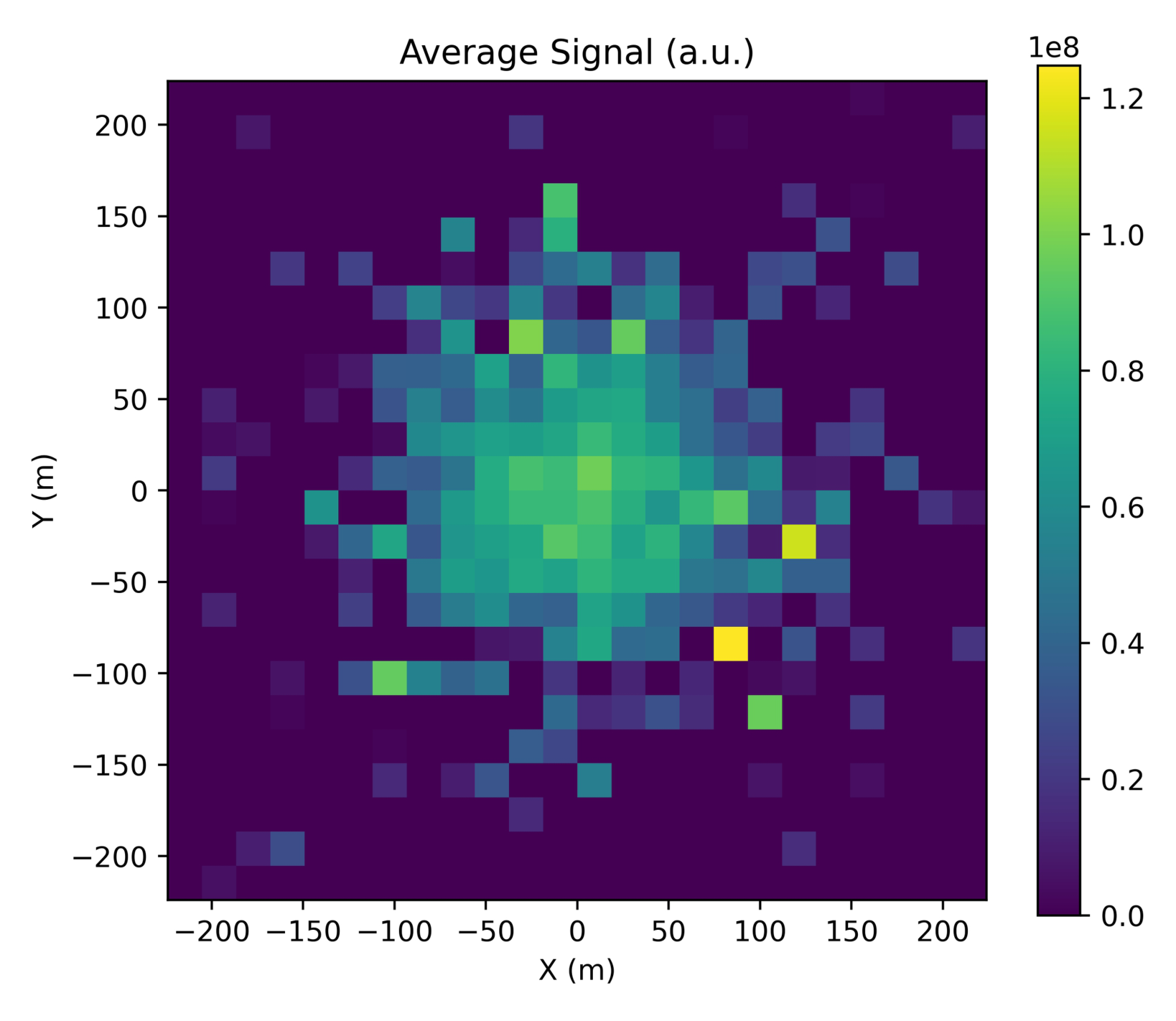
A photon with initial energy enters the Earth's atmosphere vertically downward, toward the center of the Earth, and initiates an electromagnetic shower. A highly granular scintillation detector is installed on the ground. This means that the detector consists of many cells, each of which is a system composed of a scintillator and a PMT. The arrival coordinate of a particle is determined by which detector cell was triggered, while the signal amplitude is obtained from the PMT.
You are given a table with digitized detector data. Each row contains three variables:
— signal amplitude,
— coordinate of the triggered detector along the -axis (in cm),
— coordinate of the triggered detector along the -axis (in cm).
Assume the atmosphere to be isothermal, with an exponential density profile as a function of altitude:
where is the air density at the Earth's surface and is the atmospheric scale height.
D.1 Determine the coefficient of the detector at the Earth's surface. [1 т.]
D.2 Determine the energy of the initial photon . [0,5 т.]
D.3 Calculate the atmospheric density at the Earth's surface . [1,5 т.]
Решение
Внимание: Непълно решение
В архива няма официално решение на тази задача.
Оригинал в Архива: T2.pdf