IYPT 1988, Задачи на турнира — Задача 14. Mesoscopics
Problems for the 1st International Young Physicists’ Tournament
Critical edition
Olympiets Youth Center, Moscow, Soviet Union; March 28–April 2, 1988 [1]
Critical edition: translated, restored, and commented text [2]
FINAL DRAFT. — Please do not re-publish. Suggestions and criticism welcome
Translated, edited, and commented by Ilya Martchenko. The original edition’s historical notes, sources and acknowledgments are retained with problem 1.
Епиграф
The sciences nourish young people,
Give consolation to the old,
They decorate a happy life,
And they protect one in misfortune...
M. V. Lomonosov [3]
Условие
One of the mesoscopic effects is a significant change of the resistance of a two-dimensional metal sample at low temperatures, if just a single atom within the crystal lattice is displaced. This effect can be visually illustrated if one considers the following model: small flat mirrors, with reflection coefficients equal to 1, are placed in the knots of a two-dimensional lattice , . [9] Each mirror can exist in two positions only; it can be inclined at clockwise or counter-clockwise.
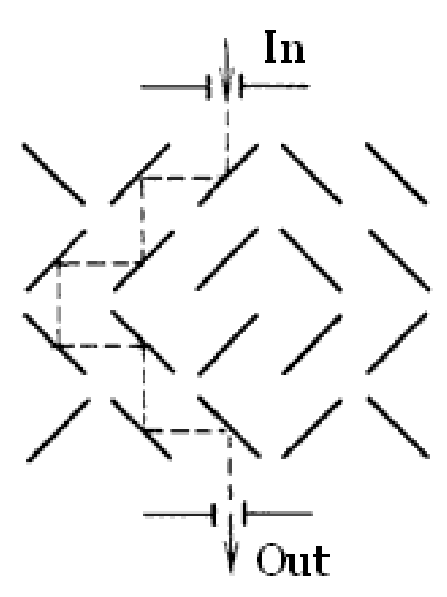
The states of the mirrors change chaotically, so the laser beam incident on a lattice knot reflects perpendicularly from the knot in both directions with the same probability. Estimate how the output light power will change if one of the knots is replaced by an absolute light-absorbing element.
Note [9]
It was stated “n≫1” in [MGU 1988], but “n≫10” in [Kvant 1987] and in [Farad 2002]. The 1996 Czech versions read here “n≫10”, while the Slovak and the 2006 English texts fully omit this detail. It may be speculated that a handwritten formula in a book published shortly before the event, and most commonly used by the participants and jurors at the competition, is somewhat more authentic
Решение
Внимание: Непълно решение
В архива няма официално решение на тази задача.
Оригинал в Архива: 1988.pdf