IYPT 1990, Задачи на турнира — Задача 2–4. Ball and piston
Problems for the 3rd International Young Physicists’ Tournament
Critical edition
Olympiets Youth Center, Moscow, Soviet Union; June 7‒14, 1990 [1]
Critical edition: translated, restored, and commented text [2]
FINAL DRAFT. — Please do not re-publish. Suggestions and criticism welcome
Translated, edited and commented by Ilya Martchenko. The original edition’s historical notes, sources and acknowledgments are retained with problem 1.
Епиграф
Victories do not attract him.
For him growth means: profound defeat
at the hands of ever greater adversaries.
R. M. Rilke [3]
Условие
A horizontal piston oscillates up and down. The coordinate of the piston’s surface is defined with an expression . At an arbitrary moment, a small ball is dropped without initial speed onto the piston from a height (Fig. 1).
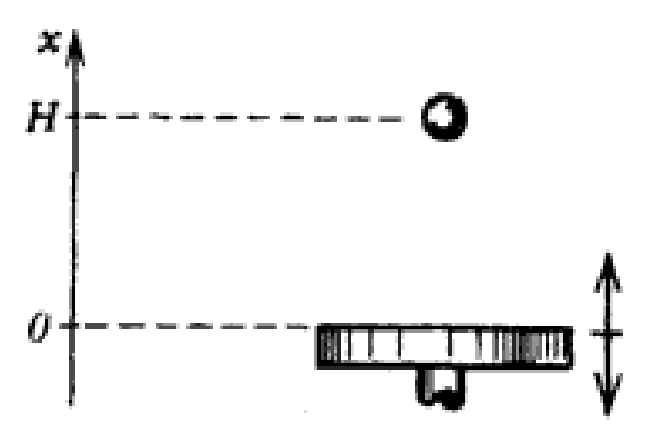
2. Up to what altitude will the ball bounce after the first collision with the piston? For this case, consider the collision as absolutely elastic, and .
3. The system “forgets” the initial conditions after a big number of collisions. Estimate up to what maximum altitude a ball may bounce after many collisions. What is the average bounce altitude? Consider that the surfaces of the ball and of the piston are not damaged at collisions.
4. Let a ceiling be at a height above the piston. In this case, stationary solutions are possible. Find some of them and research their stability. Consider , , for numerical estimations. Consider the restoration coefficient of ball collisions with the piston and with the ceiling, as .
Решение
Внимание: Непълно решение
В архива няма официално решение на тази задача.
Оригинал в Архива: 1990.pdf