IYPT 1992, Задачи на турнира — Задача 1. Invent it yourself
Problems for the 5th International Young Physicists’ Tournament
Critical edition
Protvino, Russia, June 24‒July 1, 1992 [1]
Critical edition: corrected and commented official translation [2]
FINAL DRAFT. — Please do not re-publish. Suggestions and criticism welcome
Edited and commented by Ilya Martchenko. The original edition’s historical notes, sources and acknowledgments are retained with problem 1.
Условие
“Magnetic suspension” may be used in high speed trains of the future. Design and make an experimental [4] model of such a suspension.
Note [3]
The Russian traditional title «Придумай сам» has been internationally translated as “Think up a problem yourself” at the 6th IYPT, the 7th IYPT and the 8th IYPT, but later most commonly as “Invent yourself” (at the 9th IYPT, the 10th IYPT and the 11th IYPT.) “Invent yourself” is used in the Soviet OC’s translation for the 4th IYPT. Other versions are: “Invent for yourself” (13th IYPT), “Your invention” (Soviet OC’s translation for the 3rd IYPT), “Think for yourselves” (Soviet OC’s translation of the Kvant text for 1989.) The version “Invent it yourself” is used in the known English versions of the problems for the 5th IYPT [RMF 1992], [Kopelevich 1992]
Note [4]
Just “model” in [RMF 1992], plausible misprint
Notes [1]–[2] — critical edition and text history
[1] Dates are confirmed in [Markovich 1992] and in Ivan Štoll’s report preceding [RMF 1992], both published shortly after the event
[2] The problems for all Rounds of the 5th IYPT were originally prepared and distributed to most participants in Russian language, the primary working language at the entire event (non-Russian speaking teams were assisted by interpreters.) This original Russian version has been acquired and preserved by Belarusian participant Sergei Katsev, who found and shared in September 2009 the document printed with a dot matrix printer [Katsev 1992].
An English translation, plausibly performed by the Organizing Committee in Protvino, has been typeset and printed before the event, and seemingly provided to the non-Russian speaking teams, such as the Dutch team. An original copy of this text has been preserved by Russian LOC volunteer Grigory Kopelevich and found in December 2010 [Kopelevich 1992]. The translation is quite close to the Russian text and includes cartoon-style illustrations, but has some factual discrepancies, e.g. in problems Nos. 4, 7, 9, 15, 16.
A version titled Problems for the 5th international YPT, signed by participant Jan Tichý, was published in Rozhledy mat.-fyz. in the issue dating to June‒July 1992 [RMF 1992]. The publication was, however, made after the event, as the problems were placed after the Czech-language article by Ivan Štoll Great success of Czechoslovak team at the 5th International Young Physicists’ Tournament (Velký úspěh československého družstva na 5. mezinárodním Turnaji mladých fyziků) reporting the results of the 5th IYPT. No details are reported, but the RMF version appears a copy of [Kopelevich 1992] with multiple editorial corrections, not necessarily aimed at approaching the Russian text.
An English translation is known to have circulated even among Russian-speaking participants, as the interpretation was undergone even at the Finals in 1992 [Morozov 2008], [Markovich 1992].
The list of 17 problems for Correspondence Collective Competition of the 5th International Young Physicists’ Tournament (Завочны Калектыўны Конкурс V Miжнароднага Турнiру Юных Фiзiкаў) was included into a detailed article by Leonid Markovich published shortly after the competition in Nastaŭnickaja Hazieta (Belarus) on October 28, 1992 in Belarusian language [Markovich 1992]. The Belarusian text appears an authentic and extremely accurate translation of the Russian source text, while Russian is linguistically very close to Belarusian.
The Slovak version [TMF 1996] claims to rely on the text published in RMF, but has a considerably different problem sequence from Jan Tichý’s publication. It appears unlikely that a different translation was published in RMF and included e.g. provisional problems. In comparison to the 1992 English, Russian and Belarusian texts, the Slovak text has an entirely different problem No. 3 and an additional 18th problem, placed between No. 16 and No. 17 of the respective 1992 English, Russian and Belarusian problems.
The Russian and the Slovak language versions have mutual discrepancies in word order, in details and in style that are more important than between largely literal Russian-Slovak translations of 1988, 1989, and 1990. This may cause additional uncertainty in identifying the source document for the Slovak translation. The 1996 Czech version is quite distant from both of them in terms of details, style, and terminology. The Slovak text may not be considered a literal translation from the 1996 Czech text, or vice versa.
The list of 17 problems in Czech language titled Problems for International Young Physicists’ Tournament. 5. Russia ― Protvino ― 1992 (Úlohy mezinádodního turnaje mladých fyziků. 5. Rusko ― Protvino ― 1992) was published by Zdeněk Kluiber in review book Turnaj Mladých Fyziků in 1996 [Kluiber 1996]. This Czech version, in comparison to 1992 English, Russian, Belarusian, and Slovak texts, has an entirely different problem No. 6 and factual discrepancies in the problems Nos. 3, 9, 12, 17.
An English version was published in 2006 by Silvina Simeonova in the Proceedings of the 16th IYPT on the basis of the text provided to the publishers by Zdeněk Kluiber [Proceedings 2006]. The source language and the year of translation are not reported. This version, however, may be considered translated from the 1996 Czech text as the problem No. 6 matches the Czech version, Zdeněk Kluiber is directly acknowledged by Silvina Simeonova as the source, and many linguistic nuances are similar in both versions.
The Hungarian version [Rajkovits 2003], in comparison to all other texts, includes 24 problems, enumerated as 1; 2.1; 2.2; 3.1; 3.2; 4; 5; 6.1; 6.2; 7; 8; 9; 10; 11; 12; 13; 14; 15.1; 15.2; 15.3; 16.1; 16.2; 17.1; 17.2. Many of them repeat the problems from the earlier IYPTs.
Nothing on the 5th IYPT has been published in the Kvant magazine and on the Evgeny Yunosov's Faraday Tournament website (2002.)
It was a matter of concern of what problem set was discussed at the real stages of the 5th IYPT. Similar discrepancies among versions were the case e.g. in 1989. Four different sets could have possibly matched the ultimate problems discussed in June 1992:
set of 17 problems as they appear in Russian, Belarusian, and the two 1992 English texts
set of 17 problems as they appear in 1996 Czech and 2006 English texts
set of 18 problems as they appear in the Slovak text
set of 24 problems as they appear in the Hungarian text.
There is, however, direct and conclusive evidence [Katsev 2009], [Markovich 2009] that the problems discussed during the 5th IYPT matched the Russian text and both 1992 English translations, with the problem No. 3 “Dam” and with the problem No. 6 “Matches”. There is additional evidence [Morozov 2008] that during the tournament between post-Soviet teams held at the Lesnye Polyany resort facility (outside Moscow, Russia) the problem No. 3 was “Dam”, reported then in the Finals by the team of Odessa.
The 17 problems in the list (not 18, not 24) has always been a de facto standard for IYPT and was unlikely to be questioned in 1992. It seems to be grounded to assume that additional problems presented in Slovak and Hungarian sources were not included in the “core list” of 17 problems and were either preliminary drafts, either proposed in reality as extra tasks (e.g., at Captains’ Contests.)
This edition does not include possible Problems for Captains, or Problems for Observers, that might have been proposed at certain stages of the 5th IYPT for rapid, immediate solution. There is currently little to no information about such problems at the 5th IYPT, while their existence is plausible. The challenge procedure across “standard” 17 problems is virtually confirmed [Markovich 1992].
The current document reproduces closely the “official” English translation available to the participants of the event. Although the English translation [Kopelevich 1992] might have been recognized by LOC as official, it is now felt appropriate to make minimum editorial changes to the text, due to the following reasons: a limited number of teams was using the English text before and during the 5th IYPT, serious corrections were freely done in publications like [RMF 1992], and the version thus had a limited social impact as of a “standard English edition”. The current edition, however, follows the [Kopelevich 1992] as closely as possible, with every minimum discrepancy from the Russian source and from other translations, being commented. An early draft, how retracted, of the translation has been performed in July 2008 from Belarusian and Slovak texts.
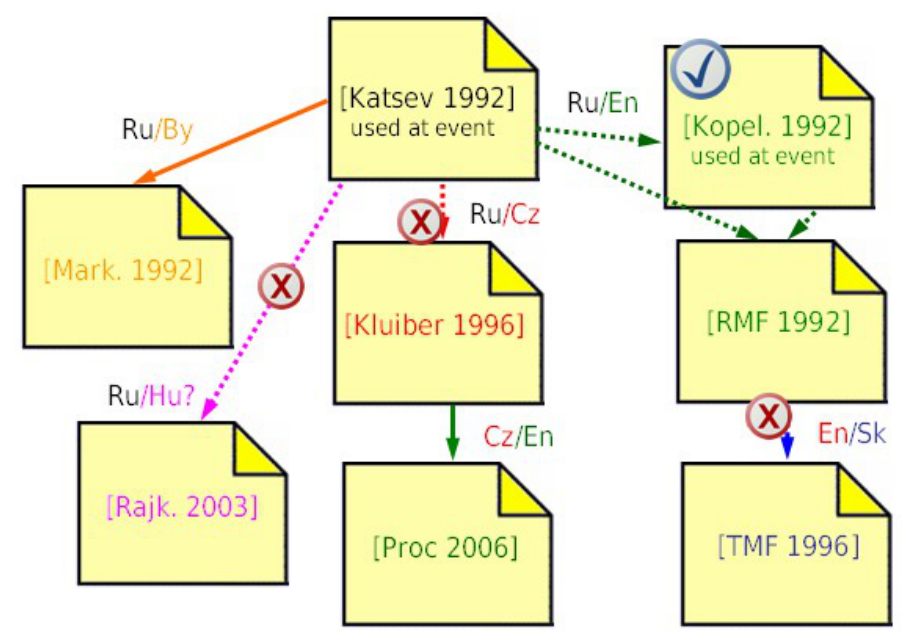
The history of text transmission: colors indicate the languages of the sources (black for the Russian, red for the Czech, blue for the Slovak, green for the English, pink for the Hungarian, orange for the Belarusian); dotted lines indicate that notable factual inaccuracies were introduced with translation or copying; the tick indicates the version taken as “standard” for the current edition; the cross indicates that the amendments were major (a few or many problems replaced or misattributed)
Sources
[RMF 1992] [Jan Tichý.] Problems for the 5th international YPT. Rozhledy matematicko- fyzikální, ročník 70, č. 3 (červenec-spren 1992), 1992, s. 134―135
[Kopelevich 1992] Problems for the V-th International YPT, a four-page English text of the problems, provided by LOC to Russian volunteer Grigory Kopelevich in 1992
[Katsev 1992] A two-page Russian text of the problems, without title, printed with a dot matrix printer, provided by LOC to Belarusian participant Sergei Katsev in 1992
[Katsev 2009] Private communication with Sergei Katsev, Belarusian participant in 1992
[Markovich 1992] Л. Г. Марковiч. У фiзбой гуляюць сапраўдныя мужчыны // Настаўнiцкая газета, 28 каст. 1992 г.
[Markovich 2010] Private communication with Leonid Markovich, Belarusian team leader in 1992
[TMF 1996] V. medzinádodný TMF ( 1991 ― 1992 ) // Juraj Braciník, Jozef Brestenský, Miroslav Helbich, Karol Macák. Turnaj mladých fyzikov : štatút a úlohy. Iuventa, Bratislava (1996), s. 30―31
[Morozov 2009] Private communication with Alexander Morozov, Ukrainian participant in 1992
[Rajkovits 2003] Zs. Rajkovits, L. Skrapits, P. Kenesei. Ifjú Fizikusok Nemzetközi Versenye: problémái (1989—2003). Retrieved at http://metal.elte.hu/~dlab/ifnv.doc
[Kluiber 1996] Úlohy mezinádodního turnaje mladých fyziků. 5. Rusko ― Protvino ― 1992 // Zdeněk Kluiber. Turnaj Mladých Fyziků. Informace o nádodní i mezinádodní soutěži studentů výrazně talentovaných pro fyziku. Gaudeamus-MAFI, Hradec Králové, 1996, s. 27―28
[Proceedings 2006] Problems for the 5th IYPT. In: Proceedings of the 19th IYPT 2006 (eds Silvina Simeonova, Myeung Hoi Kwon, Zvezdi, Sofia 2007), pp. 240‒241
Edition credits
Edited and commented by Ilya Martchenko. Originally translated from Belarusian in July 2008, the authoritative English translations shared by Jaroslav Zhouf in October 2009, by Grigory Kopelevich in December 2010, revisions made until May 2011. This edition would never have been prepared without the early work in copying, translating, publishing and preserving problems, made in different years by Evgeny Yunosov, Ivan Štoll, Jan Tichý, Leonid Markovich, Sergei Katsev, Gena Koltun, Jozef Brestenský, Zsuzsanna Rajkovits, Jaroslav Zhouf, Martin Plesch and others, without cornerstone information from Sergei Katsev, Leonid Markovich and Alexander Morozov on the ultimate problem set at the 5th IYPT, without proofreading and valuable suggestions made by Matej Ftáčnik, Tymofii Nikolaienko, Timotheus Hell, and Dahl Winters.
Authors of the IYPT problems were often reported in late 1980s and early 1990s. The 1992 official English text names them: G. Kopelevits, D. Mamontov, M. Nikolaev, A. Olchack, E. Sokolov, S. Varlamov, I. Yaminsky, E. Yunosov.
Everyone who may shed more light on early IYPTs is kindly invited to contribute.
Решение
Внимание: Непълно решение
В архива няма официално решение на тази задача.
Оригинал в Архива: 1992.pdf