IZhO 2006, Експеримент — Задача 1. Investigation of a “black box”
2nd INTERNATIONAL ZHAUTYKOV PHYSICS AND MATHEMATICS OLYMPIAD. KAZAKHSTAN, ALMATY 2006. Physics, experimental competition · 15 т.
Условие
Equipments and materials: Digital multimeters (2), 4,5 V power supply, variable resistance (voltage divider), «black box», connection wires, scaled paper.
In this work you have to find the simplest possible scheme of the “black box” and find the values of the parameters of its elements
Remarks. To carry out the problem of the experimental competition you have to:
1. Assemble the experimental scheme an carry out necessary measurements
2. To write down the obtained experimental data in the table.
3. To plot the graphs of necessary dependences.
4. Suggest the equivalent scheme of the “black box” and calculate the values of the parameters of its elements
Caution: The black box and connections of the black box are very fragile and you should handle it with care!
Отговори
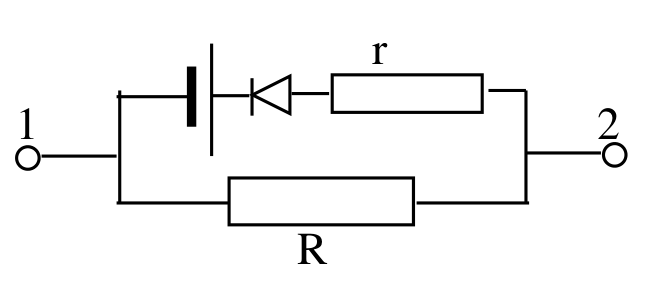
Resistance R ≈ 100 Ohm in parallel with a branch of a battery (UB ≈ 1,6 V), a diode (Uop ≈ 0,75 V) and a resistance r ≈ 25 Ohm in series.
From the official solution: UB≈1,6V, R=100Ohm, Uop≈0,75 V, r = RR2/(R−R2) ≈ 25 Ohm (circuit of Fig.4); the solution spells the diode „diod“.
Решение
Solution
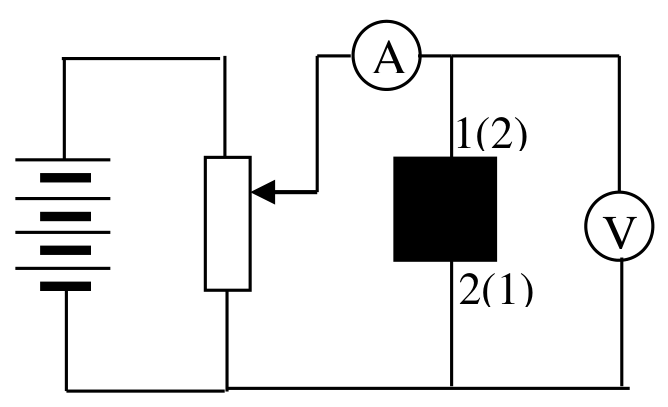
- The scheme of the circuit for carrying out measurements is presented on fig.1
2 The data on VA characteristics of the “black box” connected to 1-2 (2-1) are given in table
Table 1
| № | U, B | , mA | , mA |
|---|---|---|---|
| 1-2 connection | 2-1 conection | ||
| 1 | 0,0 | 0,0 | 0,0 |
| 2 | 0,2 | 1,3 | 1,3 |
| 3 | 0,4 | 3,1 | 3,5 |
| 4 | 0,6 | 5,5 | 5,5 |
| 5 | 0,8 | 7,7 | 7,4 |
| 6 | 1,0 | 9,6 | 9,5 |
| 7 | 1,2 | 11,5 | 11,5 |
| 8 | 1,4 | 13,5 | 13,7 |
| 9 | 1,6 | 15,5 | 15,8 |
| 10 | 1,8 | 17,4 | 17,6 |
| 11 | 2,0 | 19,4 | 19,4 |
| 12 | 2,2 | 21,4 | 21,5 |
| 13 | 2,4 | 23,5 | 26,2 |
| 14 | 2,6 | 25,6 | 34,8 |
| 15 | 2,8 | 27,1 | 45,1 |
| 16 | 3,0 | 29,1 | 54,1 |
| 17 | 3,2 | 31,3 | 65,7 |
| 18 | 3,4 | 33,1 | 73,1 |
| 19 | 3,6 | 35,0 | 86,4 |
3 The graphs of the VA dependences:
A) The VA dependence for the connection 1-2 (see fig.1) is presented on fig.2.
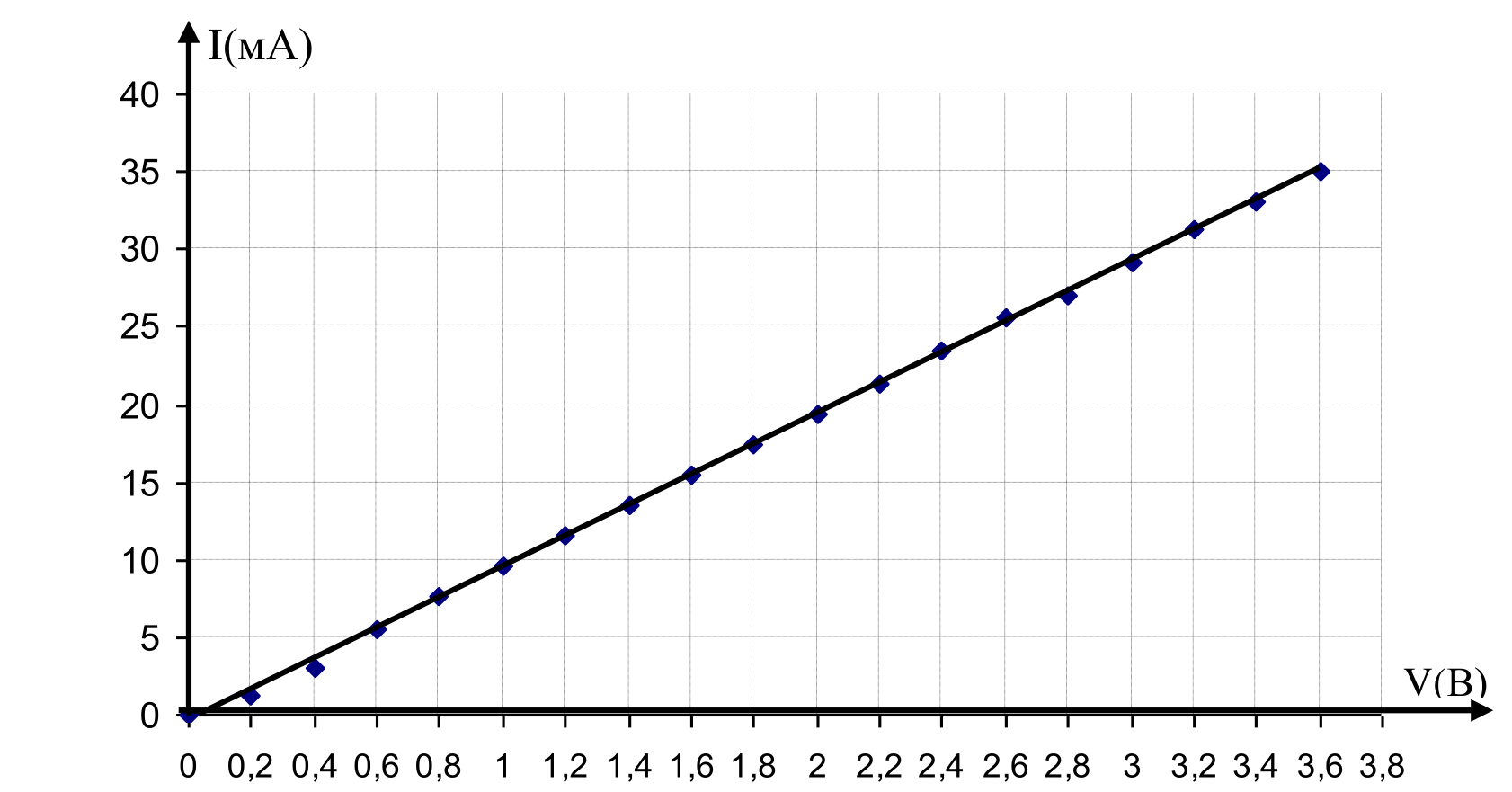
The straight line on the figure was obtained by the method of least squares and its equation is . The linear dependence of the VA characteristics indicates that there is a constant resistance in the black box with
B) The VA dependence for the connection 2-1 (see fig.1) is presented on fig.3.The equations of the straight line are given by and . They intersect at a point with . The fact that the currents for opposite directions differ can be explained by the presence of the diod in the circuit. The resistances, corresponding to the different parts of the VA characteristics are equal to
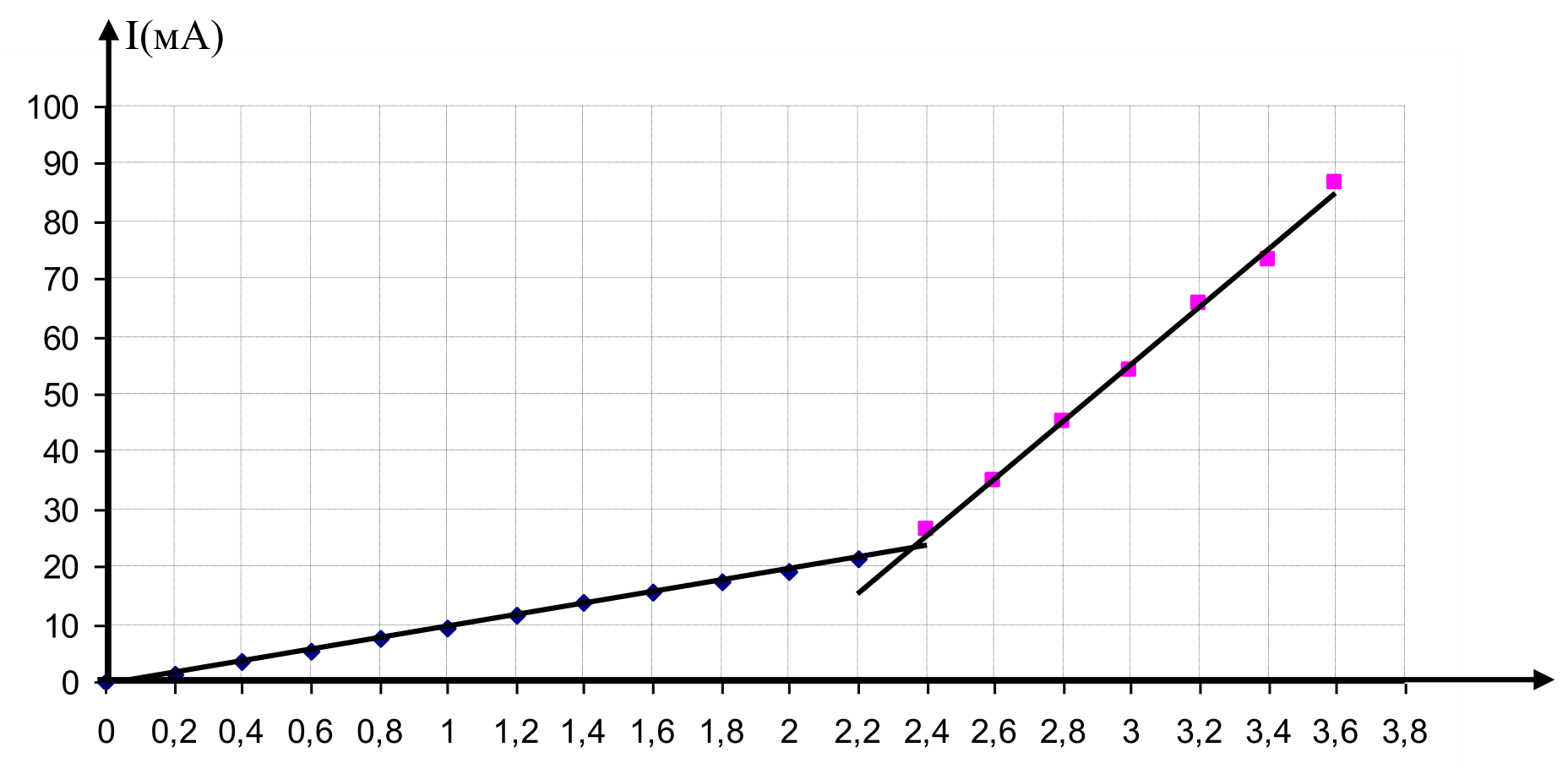
Since , we can deduce that the diod is connected in parallel to that resistance and is closed until the value of the voltage . As the characteristic values for opening of the diod are no greater than 1V, we can suggest that there is a battery connected in series to that diod. If we assume that it is a standard battery with , then we will find that the diod opens at , which is of the order of the voltages of the silicon diods. The value of shows that there is also another resistance connected in series with the battery and diod.
4 Thus the simplest possible circuit of the “black box” is that shown on fig .4. The values of the elements are: , , , . Note that is the sum of the resistances of the battery, diod and additional resistance.
Marks for the experiment
| marks | marks | |||
|---|---|---|---|---|
| 1 | 1 | Electric circuit | ||
| 2 | 2 | Tables in the range of 0-3,5V | N≥ 10 points in 1-2 (N≥ 18 in 2-1) | 2 |
| 6≤N≤9 (12≤N≤17) | 1,5 | |||
| N≤5 (N≤11) | 1 | |||
| 3 | 3 | Graphs | 1-2 connection | 1,5 |
| 1-2 | 1,5 | |||
| 4 | 5 | Elements of black box | а)Resistance R | 1 |
| b) Resistance r | 1 | |||
| c) Diod | 1,5 | |||
| d) Battery | 1,5 | |||
| 5 | 4 | Parameters of the elements | a) Resistance Ohm | 1 |
| b) Resistance Ohm | 1,5 | |||
| c) Battery V | 1,5 |
Оригинал в Архива: IZhO-2006_Exp_eng.doc · официални решения: IZhO-2006_Exp_eng_sol.doc