IZhO 2010, Теория, английски — Задача 2. The Tolmen-Stewart experiment
VI International Zhautykov Olympiad. Theoretical Competition · 13 януари 2010 г. · 10 т.
Please read this first:
THEORETICAL COMPETITION
January 13, 2010
The time available for the theoretical competition is 4 hours. There are three questions.
Use only the pen provided.
You can use your own calculator for numerical calculations. If you don’t have one, please ask for it from Olympiad organizers.
You are provided with Writing sheet and additional paper. You can use the additional paper for drafts of your solutions but these papers will not be checked. Your final solutions which will be evaluated should be on the Writing sheets. Please use as little text as possible. You should mostly use equations, numbers, figures and plots.
Use only the front side of Writing sheets**.** Write only inside the bordered area.
Begin each question on a separate sheet.
Fill the boxes at the top of each sheet of paper with your country (Country), your student code (Student Code), the question number (Question Number), the progressive number of each sheet (Page Number), and the total number of Writing sheets used (Total Number of Pages). If you use some blank Writing sheets for notes that you do not wish to be evaluated, put a large X across the entire sheet and do not include it in your numbering.
At the end of the exam, arrange all sheets for each problem in the following order:
- Used Writing sheets in order;
- The sheets you do not wish to be evaluated
- Unused sheets and the printed question.
Place the papers inside the envelope and leave everything on your desk. You are not allowed to take any paper out of the room.
Условие
In 1916 Tolmen and Stewart carried out their famous experiment proving that the electric current in metals was caused by freely moving electrons. The sketch of the experimental setup is shown on the left hand side.
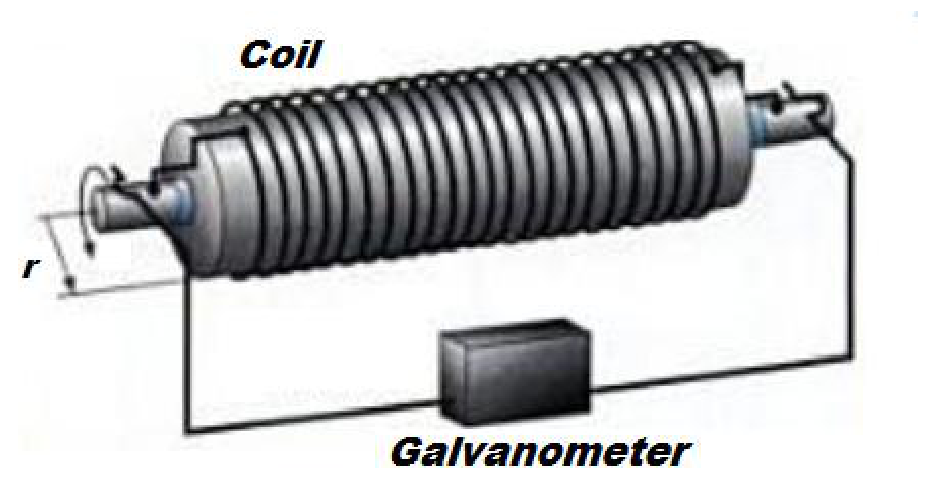
A long coil of the radius and the length has an inertia moment . The coil is reeled up by a single layer of the metal wire of the length and mass such that the number of loops on the unit length equals . The both ends of the wire are abridged to the galvanometer by the sliding contacts. The coil together with the wire is set rotating with the angular velocity and, then, the friction force with the torque is applied to stop the coil rotation. The total resistance of the circuit is and its capacity is assumed negligible.
Part 1. In this part of the problem you can neglect the inductance of the coil and assume that the Ohm’s law holds at any time.
1. [1 point] Determine the total inertia moment of the coil together with the wire. Express your answer in terms of .
2. [1 point] Determine the dependence of the angular velocity of the coil on time . Express your answer in terms of .
3. [1 point] Determine the dependence of the electric current strength on time . Express your answer in terms of with being the mass and the electric charge of electron, respectively.
4. [2 points] During the experiment the galvanometer has registered the electric charge passed in the circuit. Express the charge-to-mass ratio of the electron in terms of .
Part 2. In this part of the problem you have to take into account the small inductance of the coil which is supposed to be quite long to neglect the side effects.
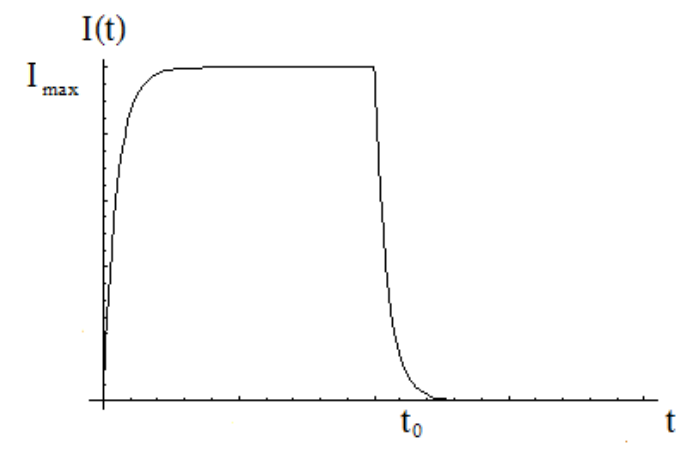
5. [1 point] Find the maximal electric current strength in the coil. Express your answer in terms of . Plot a qualitative dependence .
6. [1 point] Find the maximal energy stored in the coil during the experiment. Express your answer in terms of and the magnetic constant .
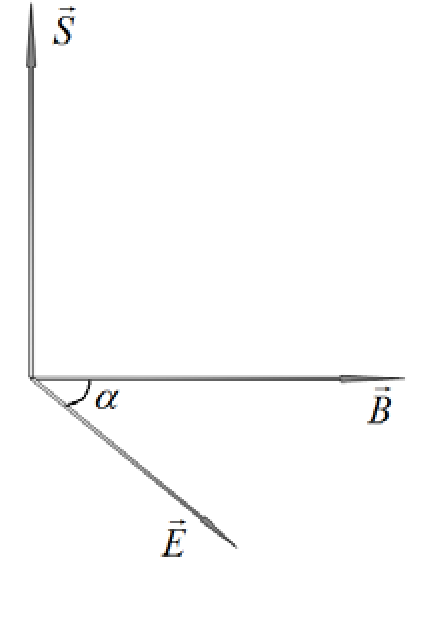
7. [3 points] The flux of the electromagnetic energy through the unit area is determined by the Pointing vector which is perpendicular to both electric and magnetic fields with the module , where is the electric field strength vector, is the magnetic induction vector and is the angle between them (see the picture on the right). Find the electromagnetic energy passing through the lateral surface for the time period while the electric current increases and the electromagnetic energy passing through the lateral surface for the time period while the electric current decreases. Express your answer in terms of .
Отговори
- 1.
- 2.
- 3.
- 4.
- 5.
- 6.
- 7.
Решение
Theoretical Question 2
Solution
- [1 point] The total inertia moment with respect to the rotation axis is a sum of the inertia moment of the coil itself and the metallic wire
- [1 point] The equation of the coil rotation as a rigid bode takes the form
where is the angular acceleration.
It follows from equation (2) that the coil stops at the time moment
Finally, the dependence of the angular velocity on time is found as
- [1 point] At the stoppage of the coil, electrons keep on moving due to their inertia, as a result the galvanometer registers the electric current.. Let be the linear acceleration of the coil rim. If the coil is tightly reeled up and the wire is rather thin that linear acceleration is directed along the wire. At the stoppage process electrons are subjected to the inertial force opposite to the linear acceleration of the coil. This inertial force can be interpreted as an effective electric field
Thus, the effective electromotive force in the coil caused by the inertia of freely moving electrons is obtained as
Therefore, the Ohm’s law for the electric circuit is written as
Taking into account solution of 2, one gets
- [2 points] The electric charge, registered by the galvanometer, is found from (8) as
The charge-to-mass ratio of electron is simply obtained as
- [1 point] In this case equation (7) is rewritten as follows
where is the coil inductance.
It follows from equation (11) that the maximal electric current strength is
The qualitative dependence of the electric current strength is plotted below
- [1 point] The maximal electromagnetic energy stored in the coil equals
- [3 points] In the stationary regime the magnetic field inductance
remains constant in the coil and the electric field is absent. This is not true for initial time moments while the electric current increases from 0 to its maximal value determined by formula (12). According to (14) the varying magnetic field generates the vortex electric field which causes the flux of the electromagnetic energy to appear. The strength of the vortex electric field at the lateral surface of the coil is found from the electromagnetic induction law of Faradey
as
The mutual orientation of the vectors и is shown below.
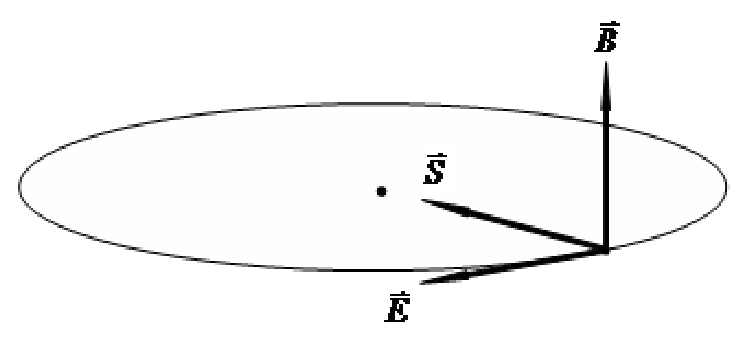
Substituting expressions (14) and |(16) into the expression for the Pointing vector and taking into account that the vectors and are perpendicular, one obtains
Thus, the electromagnetic energy, going inward the lateral surface of the coil while the electric current increases, is given by the summation (or integrating) of (17) as
It is obvious that the same amount of the electromagnetic energy goes outward while the electric current strength decreases
Marking scheme
| № | Content | Points |
|---|---|---|
| 1 | Total inertia moment (1) | 1 |
| 2 | Equation of motion (2) | 0.25 |
| 3 | Stoppage time (3) | 0.25 |
| 4 | Dependence (4) of the angular velocity on time | 0.5 |
| 5 | Expressions for the effective electric field (5) or (6) | 0.25 |
| 6 | The Ohm’s law (7) | 0.25 |
| 7 | Dependence (8) of the electric current strength on time | 0.5 |
| 8 | Charge (9) registered by the galvanometer | 1 |
| 9 | Charge-to-mass ratio (10) for electron | 1 |
| 10 | Equation (11) for the electric current strength | 0.25 |
| 11 | Maximal electric current strength (12) | 0.25 |
| 12 | Qualitative dependence of the electric current strength | 0.5 |
| 13 | Maximal energy (13) | 1 |
| 14 | Magnetic field induction (14) | 0.5 |
| 15 | Electromagnetic induction law (15) | 0.5 |
| 16 | Vortex electric field strength (16) | 0.5 |
| 17 | Pointing vector (17) | 0.5 |
| 18 | Electromagnetic energy (18) | 0.5 |
| 19 | Electromagnetic energy (19) | 0.5 |
Оригинал в Архива: IZhO-2010-Theory_eng.pdf · официални решения: IZhO-2010-Theory_eng_sol.pdf