IZhO 2013, Теория, английски — Задача 2. Square frame
IX International Zhautykov Olympiad/Theoretical Competition · 15 януари 2013 г. · 10 т.
Please read this first:
The time available for the theoretical competition is 4 hours. There are three questions.
Use only the pen provided.
You can use your own calculator for numerical calculations. If you don’t have one, please ask for it from Olympiad organizers.
You are provided with Writing sheet and additional paper. You can use the additional paper for drafts of your solutions but these papers will not be checked. Your final solutions which will be evaluated should be on the Writing sheets. Please use as little text as possible. You should mostly use equations, numbers, figures and plots.
Use only the front side of Writing sheets. Write only inside the boxed area.
Begin each question on a separate sheet of paper.
Fill the boxes at the top of each sheet of paper with your country (Country), your student code (Student Code), the question number (Question Number), the progressive number of each sheet (Page Number), and the total number of Writing sheets used (Total Number of Pages). If you use some blank Writing sheets for notes that you do not wish to be evaluated, put a large X across the entire sheet and do not include it in your numbering.
At the end of the exam, arrange all sheets for each problem in the following order:
- Used Writing sheets in order;
- The sheets you do not wish to be evaluated
- Unused sheets and the printed question.
Place the papers inside the envelope and leave everything on your desk. You are not allowed to take any paper out of the room.
Условие
A square frame of side is placed in a uniform magnetic field of generated by a permanent magnet. Completely neglect edge effects, assuming that the magnetic field between the poles of the magnet is uniform and is equal to zero outside of it. In all parts of the problem assume that at the initial time moment the frame of mass is at rest at the edge of the poles of the magnet, see figure.
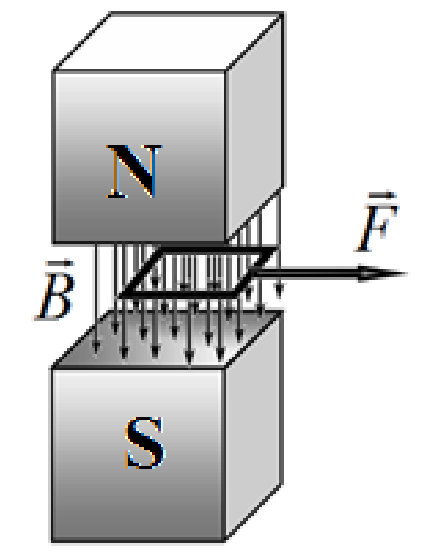
1. Redraw schematically the figure on the right to identify which of the poles of the magnet is the north and which is the south . [0,2 т.]
Part A
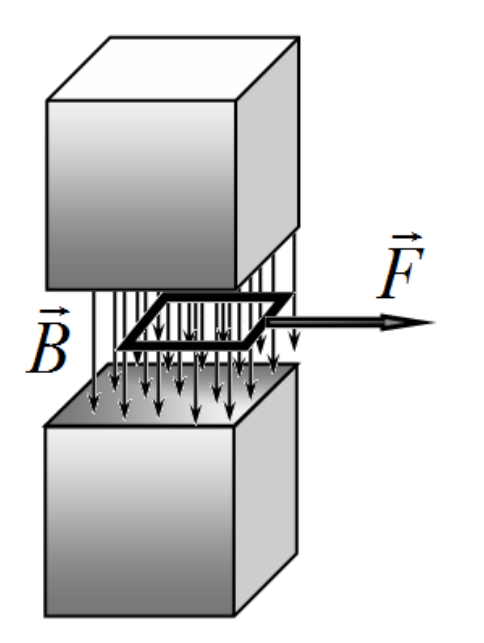
Let the frame be made of a conductive material with the resistance ohm and a negligible inductance. At the time moment the frame is subject to the constant force , which pulls the frame out of the magnetic field.
2. Find an analytical dependence of the frame velocity on time assuming that the frame remains at all times between the poles of the magnet. Express your answer in terms of and . [1,2 т.]
3. Write down an exact equation to determine the time interval at which the frame moves between the poles of the magnet. Express your answer in terms of and . Estimate . [0,8 т.]
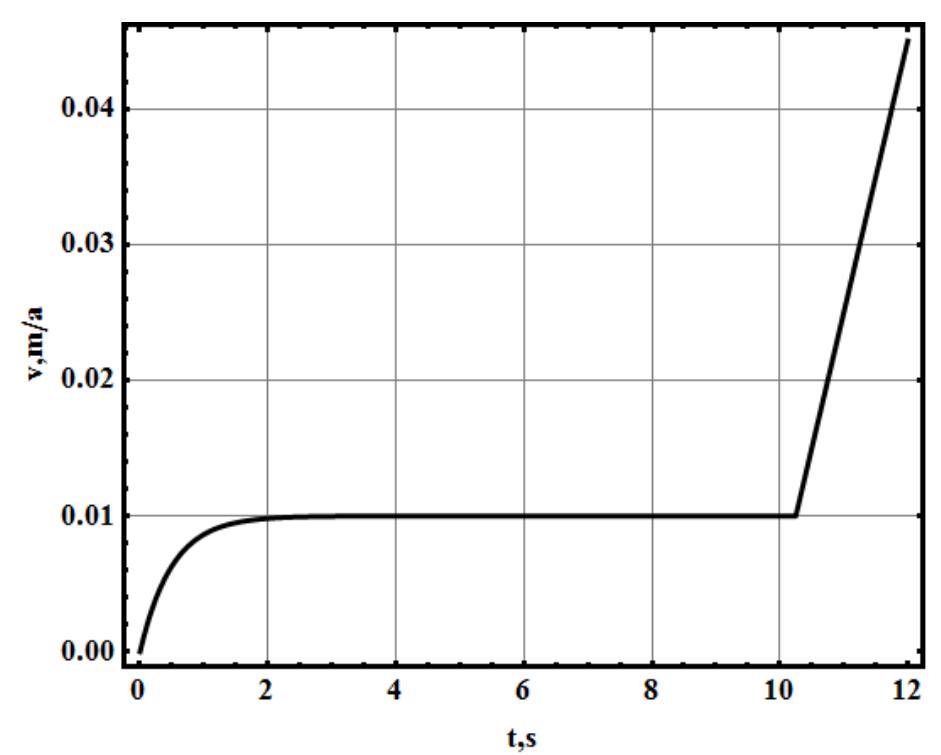
4. Draw a graph of the frame velocity on time in the interval from 0 to 12s. [1,2 т.]
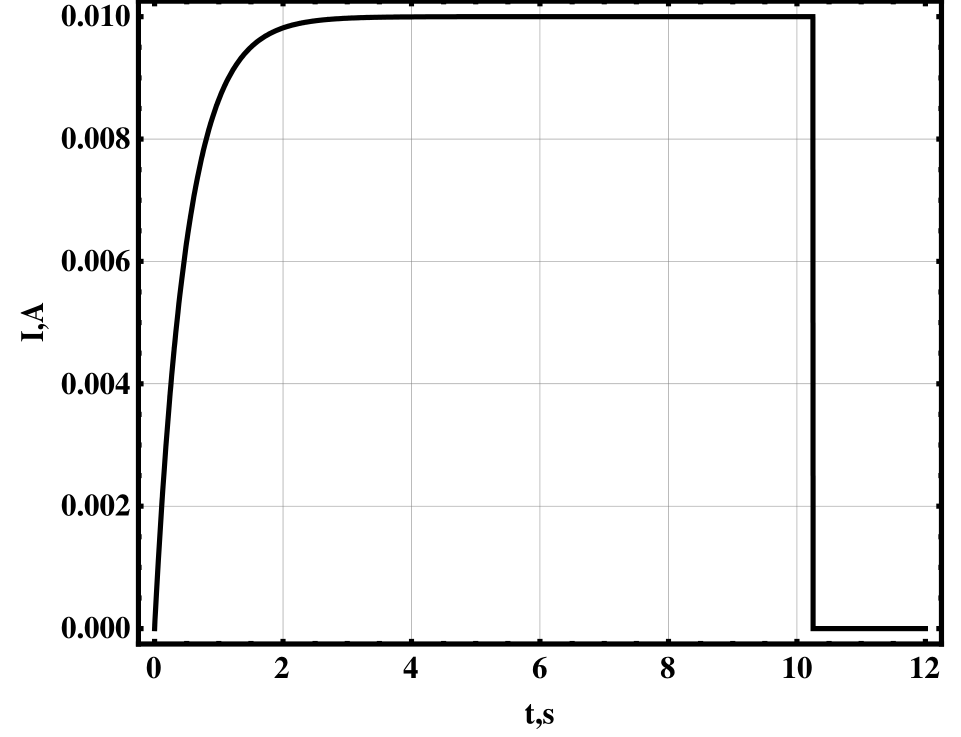
5. Draw a graph of the frame current on time in the interval from 0 to 12s. [1,2 т.]
Part B
Let the frame be made of a superconducting material with the inductance of , the same mass and sizes. At the time moment s the frame is subject to a constant force which pulls the frame out of the magnetic field.
6. Find the minimum force with which the frame can be pulled out of the magnet. Express your answer in terms of and calculate its numerical value. [1,8 т.]
7. At the assumptions of section 6 find the minimum time interval of the maximum departure of the frame out of the magnet. Express your answer in terms of and calculate its numerical value. [0,6 т.]
8. Draw a graph of the frame current on time in the interval from 0 to . [1 т.]
Part C
A square frame with sides is made of a conductive material with the inductance , the resistance and the mass . At the time moment the frame is given an initial velocity directed exactly as the force in the figure above. It is known that at the time moment when the frame almost leaves the magnet its velocity turns zero.
9. Find an analytical expression for the frame current at the time moment when the frame velocity turns zero. Express your answer in terms of and . [2 т.]
Отговори
2.
3. 10.5 s
Exact equation: t0 + (mR/B²a²)[exp(−B²a²t0/mR) − 1] = B²a³/(FR); the estimate gives 10.25 s, the numerical solution 10.5 s (printed unit „с“).
6. ≈ N
Printed unit is the Cyrillic „Н“.
7. ≈ s
Printed unit is the Cyrillic „с“.
9.
Решение
Square frame
- In physics, it is agreed that the magnetic field lines begin at the north pole and ends at the South pole. Therefore, the drawing should look like this
- When the frame is removed from the uniform magnetic field, the induced emf can be found from the Faraday law
On the other hand Ohm’s law is written as
Thus, we get the relation between the current and the velocity
The frame is affected by the force that pulls the frame back into the magnetic field. It is found from Ampere's law
Thus, the equation of motion is written as
Solution of equation (5) with the initial condition is
- Integrating (6) we get following relation
When the frame leaves the magnetic field
Thus, we get an equation for
Equation (9) is transcendental and cannot be solved analytically. To estimate we can see from equation (6) that for the characteristic time the frame reaches the steady velocity . We assume that from 0 to the frame moves with the constant acceleration , then it moves with the steady velocity . Hence, we get an estimate
Note that numerical solution of equation (9) gives с.
- After the the frame continues its motion with the constant acceleration . At the same time the speed should be a continuous function of time, so the time dependence is written as
The corresponding graph is plotted as
- While the frame is between the magnetic poles, the current is determined by the equations (3) and (6). After that, the frame current vanishes instantaneously. Thus,
The corresponding graph is plotted as
- As in the previous part, when the frame is removed from the constant magnetic field, the emf (1) is induced. There is another emf appearing due to the self-induction of the superconductive frame
Since the resistance of the superconductive frame is zero, Ohm's law for the frame becomes
Taking into account that when we get from equations (13) and (14)
The corresponding force is given by
Thus, the equation of motion is written as
Expression (17) is an equation of simple harmonic oscillations with the frequency
that are performed near the new equilibrium position with the coordinate
Obviously, the force is minimal when
whence
- From previous section 6, the frame reaches the edge of the magnet for a half period of oscillations, thus
- Solution of equation (17) with the initial conditions is written as
According to equation (15) the frame current varies as
The corresponding graph is plotted as
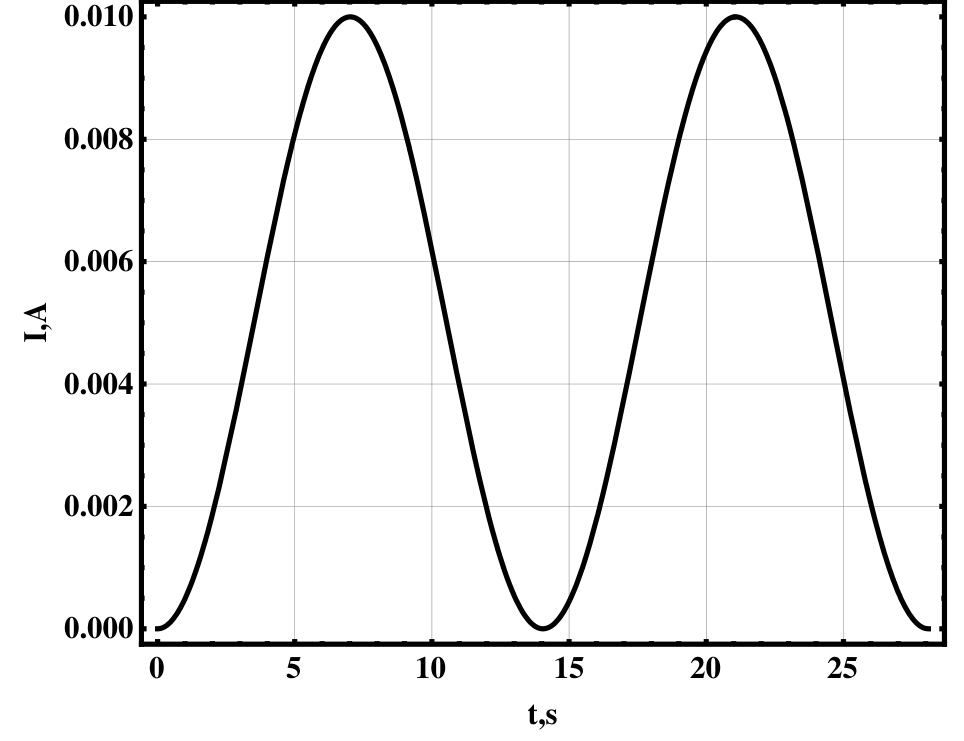
- Ohm's law for the frame is written as
and its equation of motion is as follows
Equations (25) and (26) can be rewritten in finite differences as follows
where is the charge flown through the circuit.
Solving (27) and (28) together, we obtain
Marking scheme
| № | Description | points | |
|---|---|---|---|
| 1 | Properly set northern N and southern S poles | 0.2 | 0.2 |
| 2 | Eq (1) | 0.2 | 1.2 |
| Eq (2) | 0.2 | ||
| Eq (3) | 0.2 | ||
| Eq (4) | 0.2 | ||
| Eq (5) | 0.2 | ||
| Solution (6) | 0.2 | ||
| 3 | Eq (7) | 0.2 | 0.8 |
| Eq (8) | 0.2 | ||
| Eq (9) | 0.2 | ||
| Numerical value of | 0.2 | ||
| 4 | Eq (11) | 0.2 | 1.2 |
| Graph of : axis signed and digitized | 0.2 | ||
| Graph of : there is a part with a constant velocity | 0.2 | ||
| Graph of : there is a part with constant acceleration | 0.2 | ||
| Graph of : continuous | 0.2 | ||
| Graph of : correct numerical values | 0.2 | ||
| 5 | Eq (12) | 0.2 | 1.2 |
| Graph of : axis signed and digitized | 0.2 | ||
| Graph of : there is a part with constant current | 0.2 | ||
| Graph of : there is a part with zero current | 0.2 | ||
| Graph of : discontinuous | 0.2 | ||
| Graph of : correct numerical values | 0.2 | ||
| 6 | Eq (13) | 0.2 | 1.8 |
| Eq (14) | 0.2 | ||
| Relationship (15) | 0.2 | ||
| Quasi-elastic force (16) | 0.2 | ||
| Eq of motion (17) | 0.2 | ||
| Equilibrium point (19) | 0.2 | ||
| Condition (20) | 0.2 | ||
| Eq (21) for | 0.2 | ||
| Numerical value | 0.2 | ||
| 7 | Frequency (18) | 0.2 | 0.6 |
| Eq (22) | 0.2 | ||
| Numerical value of | 0.2 | ||
| 8 | Eq (23) | 0.2 | 1.0 |
| Eq (24) | 0.2 | ||
| Graph of : axis signed and digitized | 0.2 | ||
| Graph of : two periods of current oscillation | 0.2 | ||
| Graph of : correct value of amplitude | 0.2 | ||
| 9 | Ohm’s Law (25) | 0.2 | 2.0 |
| Eq of motion (26) | 0.2 | ||
| Eq (27) | 0.7 | ||
| Eq (28) | 0.7 | ||
| Expression (29) | 0.2 | ||
| Total | 10,0 |
Оригинал в Архива: IZhO_2013_Theory_eng_fiz.doc · официални решения: IZhO_2013_Theory_eng_sol_fiz.doc