IZhO 2015, Теория — Задача 3. Delay and attenuation
XI International Zhautykov Olympiad -Theoretical Competition- · 13 януари 2015 г. · 16 т.
Внимание: Бележка към темата
The separate answer sheets with figures 1.1, 1.2 and 1.3 of Problem 1 are not included in the archived problems file.
Please read this first:
The time available for the theoretical competition is 4 hours. There are three Problems.
Use only the pen provided.
You can use your own calculator for numerical calculations. If you don’t have one, please ask for it from Olympiad organizers.
You are provided with Writing sheet and additional paper. You can use the additional paper for drafts of your solutions but these papers will not be checked. Your final solutions which will be evaluated should be on the Writing sheets. Please use as little text as possible. You should mostly use equations, numbers, figures and plots.
Use only the front side of Writing sheets. Write only inside the boxed area.
Begin each Problem solution on a separate sheet of paper.
Fill the boxes at the top of each sheet of paper with your country (Country), your student code (Student Code), the question number (Problem Number), the progressive number of each sheet (Page Number), and the total number of Writing sheets used (Total Number of Pages). If you use some blank Writing sheets for notes that you do not wish to be evaluated, put a large X across the entire sheet and do not include it in your numbering.
At the end of the exam, arrange all sheets for each problem in the following order:
- Used Writing sheets in order;
- The sheets you do not wish to be evaluated
- Unused sheets and the printed question.
Place the papers inside the envelope and leave everything on your desk. You are not allowed to take any paper out of the room.
Условие
In this problem, do not take into account the finiteness of the propagation speed of the electromagnetic interaction.
Part 1: Magnet
1.1 Theoretical introduction
The magnetic field generated by a uniformly magnetized ferromagnetic cylinder (permanent magnet) is equivalent, at very large distances, to the field produced by a circular coil with a constant electric current.
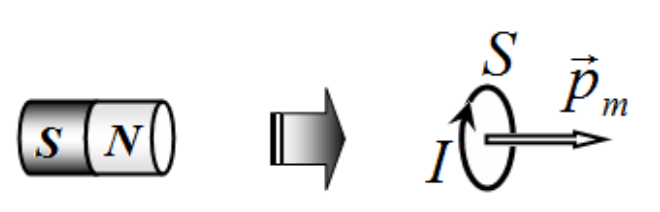
The cylindrical magnet, as well as the coil with the current, are characterized by magnetic moment , which is defined for the current loop as the product of the current and the area of the loop,
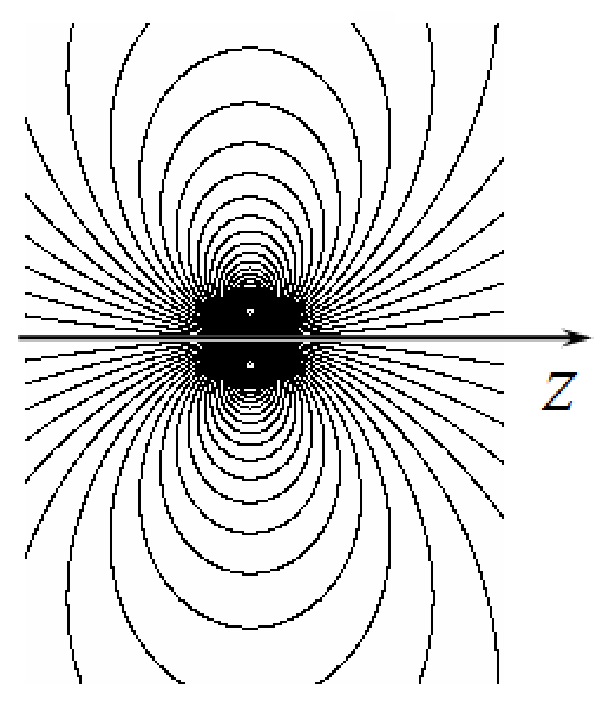
Such a source of magnetic field is also referred to as a magnetic dipole. The figure shows the magnetic field lines of such a dipole.
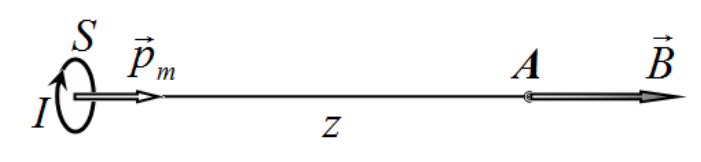
1.1.1. Show that the magnetic field, , on the axis of the dipole is determined at large distances by the formula
where is the coordinate measured along the axis of the dipole from its center. Find the values of the parameters and in the above formula. [0,75 т.]
1.1.2. Let the coil with a current (i.e., magnetic dipole) with the magnetic moment is influenced by an inhomogeneous axially symmetric field, the induction of which along the z-axis depends on as function . Dipole axis coincides with the axis of symmetry of the field. Show that the force acting on the dipole from the magnetic field is given by
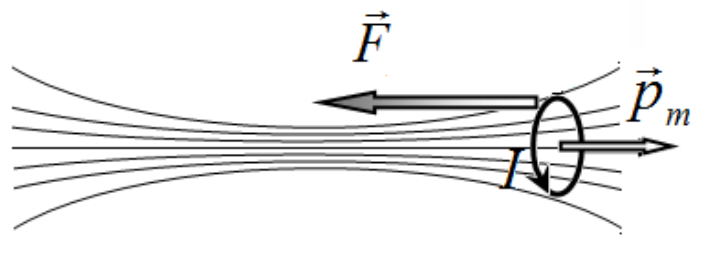
[1 т.]
1.2 Oscillations of the magnet
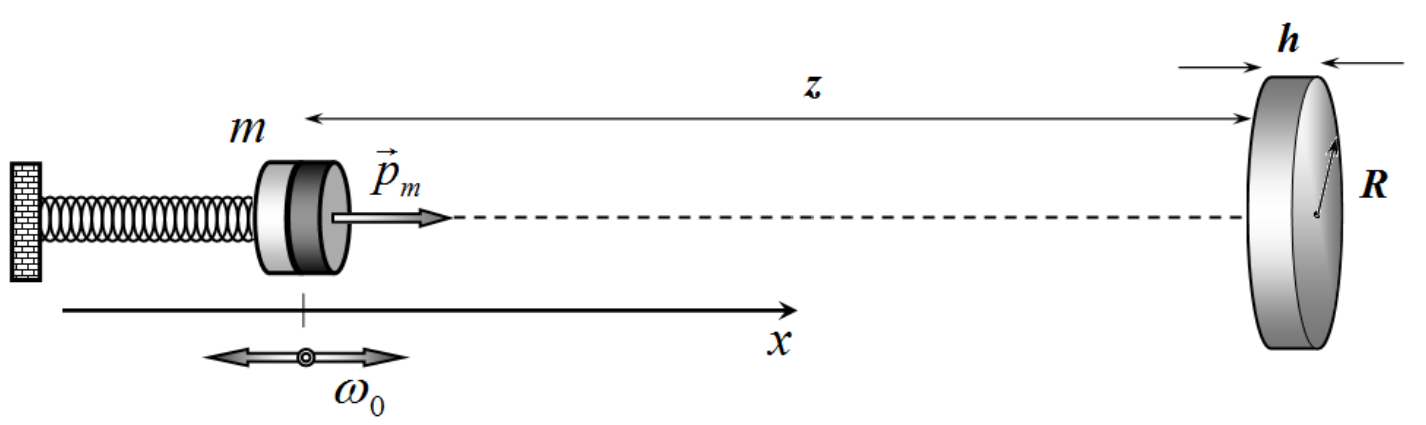
Cylindrical magnet of mass and magnetic moment , is attached to the spring of stiffness such that it can oscillate along the horizontal axis which is directed along the magnetic moment.
1.2.1. Find the frequency of free oscillations of the magnet in the absence of external fields. [0,25 т.]
At some distance from the equilibrium position of the magnet a small metal disc is placed such that its axis coincides with the axis of the magnet. The disk has radius and thickness (), the electrical resistivity of the disk material is ρ, and the magnetic permeability is put equal to . The magnet is moved from the equilibrium position and starts performing small oscillations described by function , where .
1.2.2. Find the force exerted by the disc on the magnet as a function of its coordinate and velocity . Write down the equation of motion of the magnet. [2 т.]
1.2.3. Find the relative change in the oscillation frequency of the magnet caused by the influence of the disc. [0,75 т.]
1.2.4. Assuming that the attenuation is rather weak, obtain the characteristic attenuation time of the oscillations of the ball. [0,25 т.]
1.2.5. Show that the loss of the mechanical energy of the magnet is equal to the amount of heat released in the disk for the same time period. [1,5 т.]
Mathematical tip
The equation of attenuating oscillations
has the solution
where is the frequency of attenuating oscillations, is the characteristic attenuation time, and the parameters are determined by the initial conditions.
It is known that if the following approximate inequality holds .
Part 2: Electric
2.1 Theoretical introduction
The system of two identical in magnitude and opposite in sign charges , located at some fixed distance from each other is called an electric dipole and is characterized by the dipole moment
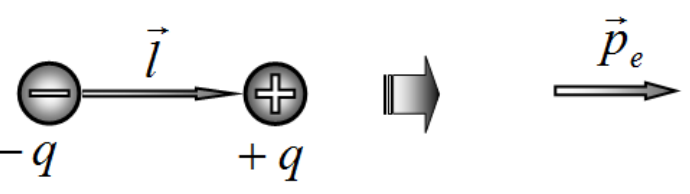
2.1.1. The electric field generated by the dipole on its axis at the distance , is defined by the formula
Obtain the parameters in this formula. [0,75 т.]
2.2 Fluctuations of charged ball
A small ball of mass carrying the electric charge is attached to a non-conductive spring of stiffness and can oscillate along the horizontal axis . At some distance from the position of the equilibrium of the ball, a small metal perfectly conducting disk is fixed such that its axis coincides with the axis. The disc has radius and thickness ().
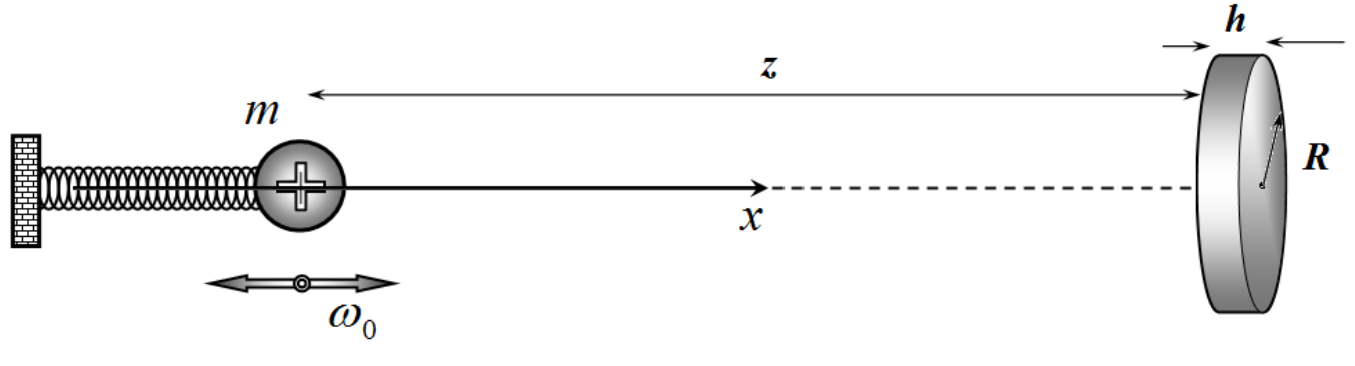
2.2.1. Find the shift of the equilibrium position of the ball caused by the influence of the disc. [0,75 т.]
2.2.2. Find the relative change in the oscillation frequency of the ball, , caused by the influence of the disc. [0,75 т.]
Assume now that the electrical resistivity of the material of the disk is (not zero).
2.2.3. Obtain an equation describing the time variation of the induced dipole moment of the disc (i.e., the equation relating the dipole moment of the disk and its rate of change over time ). [1,5 т.]
2.2.4. Assuming that the disk is a capacitor whose plates are connected to each other by a resistor, obtain the characteristic time of the equivalent -circuit. Express your answer in terms of resistivity of the material of the disk. [0,25 т.]
Assume in the following that the characteristic time obtained in 2.2.4 is much smaller than the oscillation period of the ball.
2.2.5. Write down the relation between and expressing the above stated assumption. [0,25 т.]
In the case of ideal conductivity of the disk the oscillations of the ball do not attenuate. At low resistivity of the material of the disc the attenuation of oscillations should also be small, and such oscillation can be approximately regarded as harmonic ones.
2.2.6. Using this approximation and the equation derived in 2.2.3, obtain the expression of the dipole moment of the disk via coordinate and the speed of the ball. [2 т.]
2.2.7. Find expression for the force exerted on the ball by the disk. Write down the equation of motion of the ball. [1,5 т.]
2.2.8. Find the characteristic attenuation time of the oscillations of the ball. [0,25 т.]
2.2.9. Show that the loss of mechanical energy of the ball is equal to the heat generated in the disk for the same time period. [1,5 т.]
Отговори
- 1.1.1.
- 1.1.2. Proof: and .
- 1.2.1.
- 1.2.2.
- 1.2.3.
- 1.2.4.
- 1.2.5. Joule heat power equals the power of the braking force (16).
- 2.1.1.
- 2.2.1.
- 2.2.2.
- 2.2.3.
- 2.2.4.
- 2.2.5.
- 2.2.6.
- 2.2.7.
- 2.2.8.
- 2.2.9. Joule heat power equals the power of the force .
Решение
1.1.1 It seems simpler to find the magnetic induction of the ring with the current using Biot-Savart law and the superposition principle. The projection of the magnetic field vector generated by an arbitrary element of the ring is found as
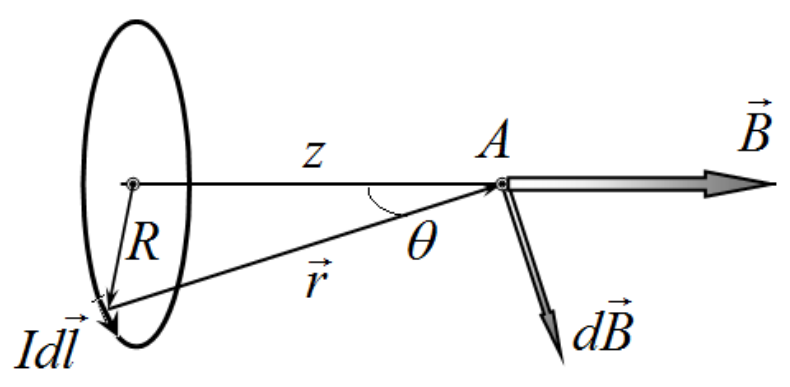
Using the geometry, one obtains
Summation over all elements of the ring is held elementary to eventually get
At it simplifies to
and finally,
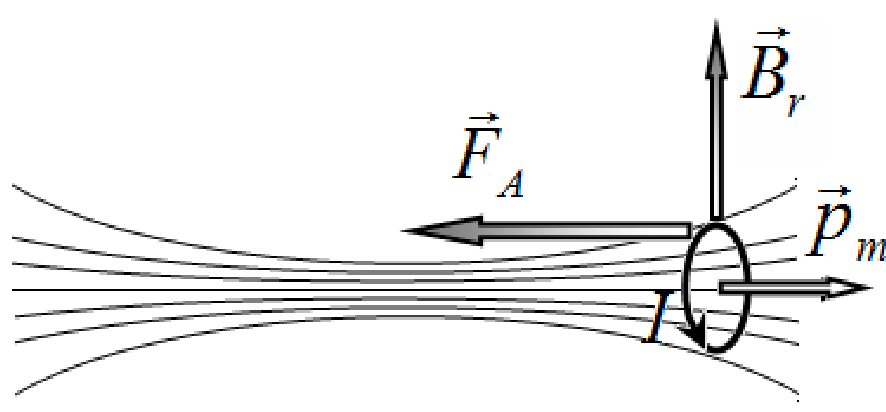
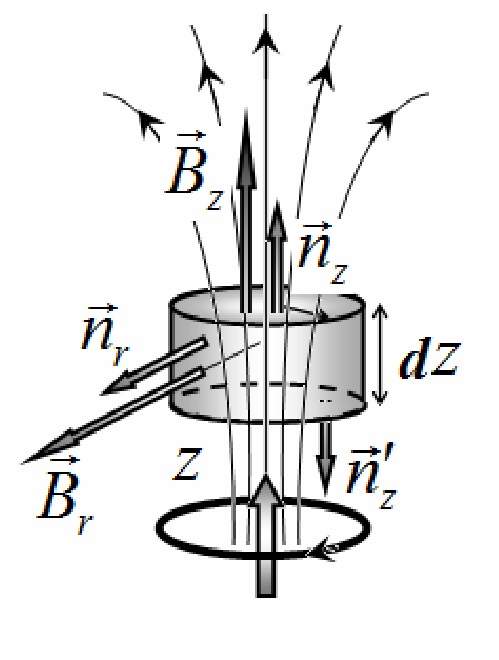
1.1.2 It is obvious that the resulting Ampere force is due to the radial component of the magnetic field vector. At a short distance from the axis this component can be expressed in terms of the axial component of the field with the help of the magnetic flux theorem.
Selecting the surface shaped as a thin cylinder whose axis coincides with the axis of the field, then writing the expression for the magnetic flux through this surface and equating it to zero yields
It is thus found from this equation that
Using Ampere's law, it is easy to write the equation for the force acting on the ring as
1.2.1 The frequency of oscillations is determined by the well-known formula for the oscillation frequency of the spring pendulum
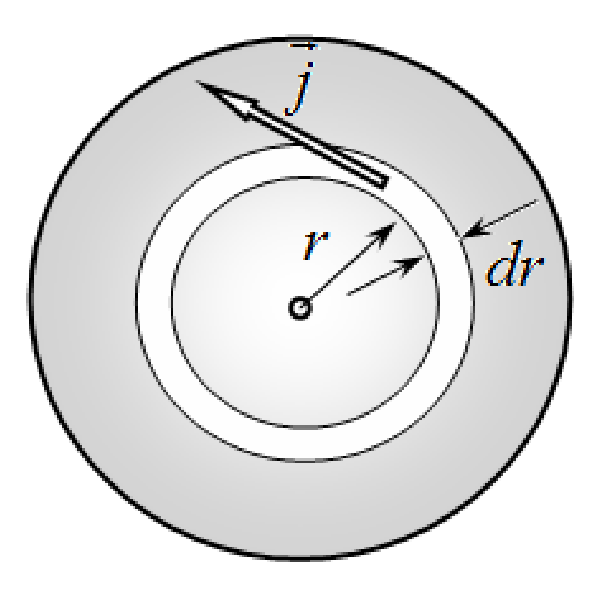
1.2.2 The feedback mechanism from the disc to the magnet is described as follows: when the magnet moves the rotational electric field is induced in the disk which gives rise to eddy currents. The magnetic field of those eddy currents is a source of force acting on the magnet. For the calculation of the magnetic field generated by eddy currents in the disk, it should be noted that the size of the disk is small compared with the distance to the magnet, so the disk can also be considered as a magnetic dipole. Therefore, it suffices to find the induced magnetic moment of the disk, and then to use formula (4) for calculation of the induction field.
Let us consider a thin ring of radius and thickness . The strength of the vortex electric field within this ring is found from Faraday's law of induction as:
It is assumed here that within the entire disc one can neglect the variation of the axial component of the magnetic field generated by the magnet, which is also determined by formula (4). Thus, if the magnet coordinate is , then the magnetic field at its position is obtained as
Substituting this expression into (10) and calculating the derivative gives rise to
In the last formula it is taken into account that .
The current density in the ring under consideration is determined by Ohm's law as
Since the current in the ring is , the magnetic moment of the ring is equal to
Integrating over the disk, one obtains its total magnetic moment as:
To calculate the force acting on the magnet, formula (8) is applied wherein the magnitude of the magnetic field induction is calculated by formula (4). These substitutions lead to the expression
The equation of the magnet motion with the influence of the disc has the form
where is the coefficient determined in formula (16).
1.2.3 Using the solution of the equation of attenuating oscillations provided in the problem formulation, one gets
where . From this expression the relative frequency shift is found as
1.2.4 The characteristic attenuation time is thus equal to
1.2.5 According to Joule’s law, the instantaneous power of heat loss in the disk is derived as
and is equal to the product of force (16) on the magnet speed.
Part 2: Electric
2.1.1 The electric field of the dipole is calculated according to the principle of superposition as
At rather large , it simplifies to
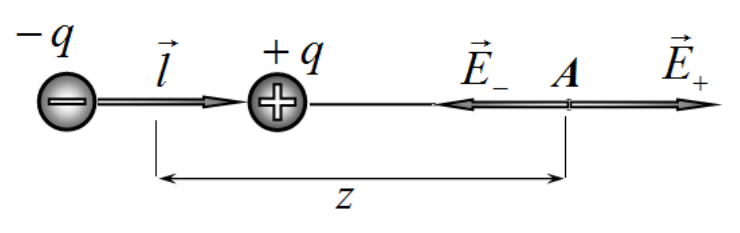
Thus,
2.2.1 Let us derive an expression for the force exerted on the ball by the disc.
The electric field inside the conducting disc should be absent. The field of the point charge induces the surface charge densities on the disc surfaces, which generate an electric field equal in magnitude but opposite in direction to the field of the point charge. Given that the size of the disk is small compared to the charge separation, it is possible to neglect the variation electric field vector at the site of the disc. Therefore, the field should be considered uniform, and the surface density of the induced charges should be treated constant.
The electric field strength of the point charge is determined by the formula , and the electric field strength of the induced charges is related to their surface density as . Equating these two expression the surface density of the induced charges is found as and the magnitude of the induced charge on each side of the disc , where stands for the disc area. Thus, the induced dipole moment of the disc is finally obtained as
Therefore, the force acting on the ball is
Since the ball moves, in the last formula should be replaced by . Given that the resulting expression for the force simplifies to
The equation of the ball motion in this case takes the form
The first term results in the additional displacement of the equilibrium position, which, within the approximations used, is equal to
2.2.2 The second term in equation (24) determines the frequency shift of the oscillations as
which yields the relative frequency shift in the form
2.2.3 The surface charge density σ on the disk surface changes due to the current in the disc, which is determined by the electric field strength in the disk (). The electric field in the disc is generated by the ball
and the oppositely directed field of the induced charges
Ohm's law can be thus written as
Taking into account the equalities and () he required equation is finally derived as
2.2.4
2.2.5 or ..
2.2.6 For harmonic oscillations, the ratio of the amplitude of to the amplitude of is equal to ,, i.e. it is very small. Therefore, the zero-order approximation in the equation
the first member can be neglected to yield
The next approximation is obtained by substituting into the initial equation
Note that the solution using the vector diagram is also possible.
2.2.7 The force exerted on the ball by the disk is
The equation of motion of the ball is thus written as
or
2.2.8
2.2.9 According to Joule’s law, the instant power heat production in the disk is found as
which is again equal to the power of force ().
Marking scheme
| № | Content | points | |
|---|---|---|---|
| 1.1.1 | The field is found on the axis | 0,25 | 1 |
| Simplification uses z≫R | 0,25 | ||
| Correct | 0,25 | ||
| Correct β | 0,25 | ||
| 1.1.2 | Relation between and | 0,25 | 1 |
| Radial component is found (the sign is important) If the minus sign in the above expression is absent | 0,5 0.2 | ||
| (the sign is unimportant) | 0,25 | ||
| 1.2.1 | 0,25 | 0,25 | |
| 1.2.2 | (the sign important) | 0,75 | 2 |
| Ohm’s law in differential form | 0,25 | ||
| Magnetic moment | 0,4 | ||
| Force If the minus sign in the above expression is absent Coefficient in the above expression is 21/32 instead of 9/32 | 0,4 0.1 0.2 | ||
| ma = -kx-bv | 0,2 | ||
| 1.2.3 | The frequency changes due to attenuation | 0,3 | 1 |
| 0,3 | |||
| δ=b/2m | 0,2 | ||
| Correct answer | 0,2 | ||
| 1.2.4 | 0,25 | 0,25 | |
| 1.2.5 | Energy losses in the disc are found | 0,5 | 1 |
| The power of the friction force is found | 0,4 | ||
| They are equal | 0,1 | ||
| 2.1.1 | The field of the dipole is found | 0,25 | 1 |
| Simplification uses z≫R | 0,25 | ||
| Correct | 0,25 | ||
| Correct α | 0,25 | ||
| 2.2.1 | The constant component of the force is found | 0,5 | 0,75 |
| 0,25 | |||
| 2.2.2 | The component of the force is found | 0,5 | 0,75 |
| 0,25 | |||
| 2.2.3 | 0,3 | 1,5 | |
| If the minus sign in the above expression is absent | 0,2 0.1 | ||
| 0,2 | |||
| 0,2 | |||
| 0,2 | |||
| 0,4 | |||
| 2.2.4 | 0,25 | ||
| 2.2.5 | 0,5 | ||
| 2.2.6 | 0,5 | 2 | |
| 1 | |||
| 0,5 | |||
| 2.2.7 | 0,5 | 1,5 | |
| 0,5 | |||
| 0,5 | |||
| 2.2.8 | 0,25 | ||
| 2.2.9 | Energy losses in the disc are found | 0,5 | 1 |
| The power of the friction force is determined | 0,4 | ||
| They are equal | 0,1 | ||
| Total | 16 |
Оригинал в Архива: IZhO-2015-Theory_eng.pdf · официални решения: IZhO-2015-Theory_eng_sol.pdf