IZhO 2019, Теория — Задача 2. Conductors in an electric field
XV International Zhautykov Olympiad/Theoretical Competition · 11 януари 2019 г. · 10 т.
Please read this first:
THEORETICAL COMPETITION
January 11, 2019
The time available for the theoretical competition is 4 hours. There are three questions.
Use only the pen provided.
You can use your own calculator for numerical calculations. If you don’t have one, please ask for it from Olympiad organizers.
You are provided with Writing sheet and additional paper. You can use the additional paper for drafts of your solutions but these papers will not be checked. Your final solutions which will be evaluated should be on the Writing sheets. Please use as little text as possible. You should mostly use equations, numbers, figures and plots.
Use only the front side of Writing sheets**.** Write only inside the boxed area.
Begin each question on a separate sheet of paper.
Fill the boxes at the top of each sheet of paper with your country (Country), your student code (Student Code), the question number (Question Number), the progressive number of each sheet (Page Number), and the total number of Writing sheets used (Total Number of Pages). If you use some blank Writing sheets for notes that you do not wish to be evaluated, put a large X across the entire sheet and do not include it in your numbering.
At the end of the exam, arrange all sheets for each problem in the following order:
- Used Writing sheets in order.
- The sheets you do not wish to be evaluated.
- Unused sheets.
- The printed problems.
Place the papers inside the envelope and leave everything on your desk. You are not allowed to take any paper out of the room.
SOLUTIONS TO THE PROBLEMS OF THE THEORETICAL COMPETITION
Attention. Points in grading are not divided!
Условие
When a conductor is placed in a constant external electric field, electric charges appear on its surface. This phenomenon is called an electrostatic induction, and the charges themselves are then called induced. This phenomenon is explained by a large number of free charge carriers in the conductor, usually electrons, which can move freely inside.
The distribution of the induced charges for a conductor of an arbitrary shape can be quite complex, but the following statements hold:
- The electric field strength inside the conductor is exactly zero;
- The electric field strength near the surface of the conductor is directed along the surface normal;
- The induced charges are only located on the conductor surface;
- All of the conductor points have the same electric potential.
In this problem, we consider several methods for calculating electric fields in the presence of conductors and apply them to a specific physical situation. Consider the vacuum permittivity known.
Conductive ball and point charge
A conducting ball of radius is grounded and a point-like charge is placed at a distance from it. In this case, in accordance with the foregoing, induced charges appear on the ball surface, which distort the electric field of the point-like charge . The image method is applicable to this situation, whose essence is described as follows. The electric field outside the ball can be represented as a superposition of the field of the point-like charge and the field of some fictitious point-like charge located somewhere inside the ball at a distance from its center and on the line connecting the point-like charge to the ball center. To evaluate the total electric field, we make use of the Cartesian coordinate system on the plane shown in the figure below. This is quite enough, since the system has axial symmetry.
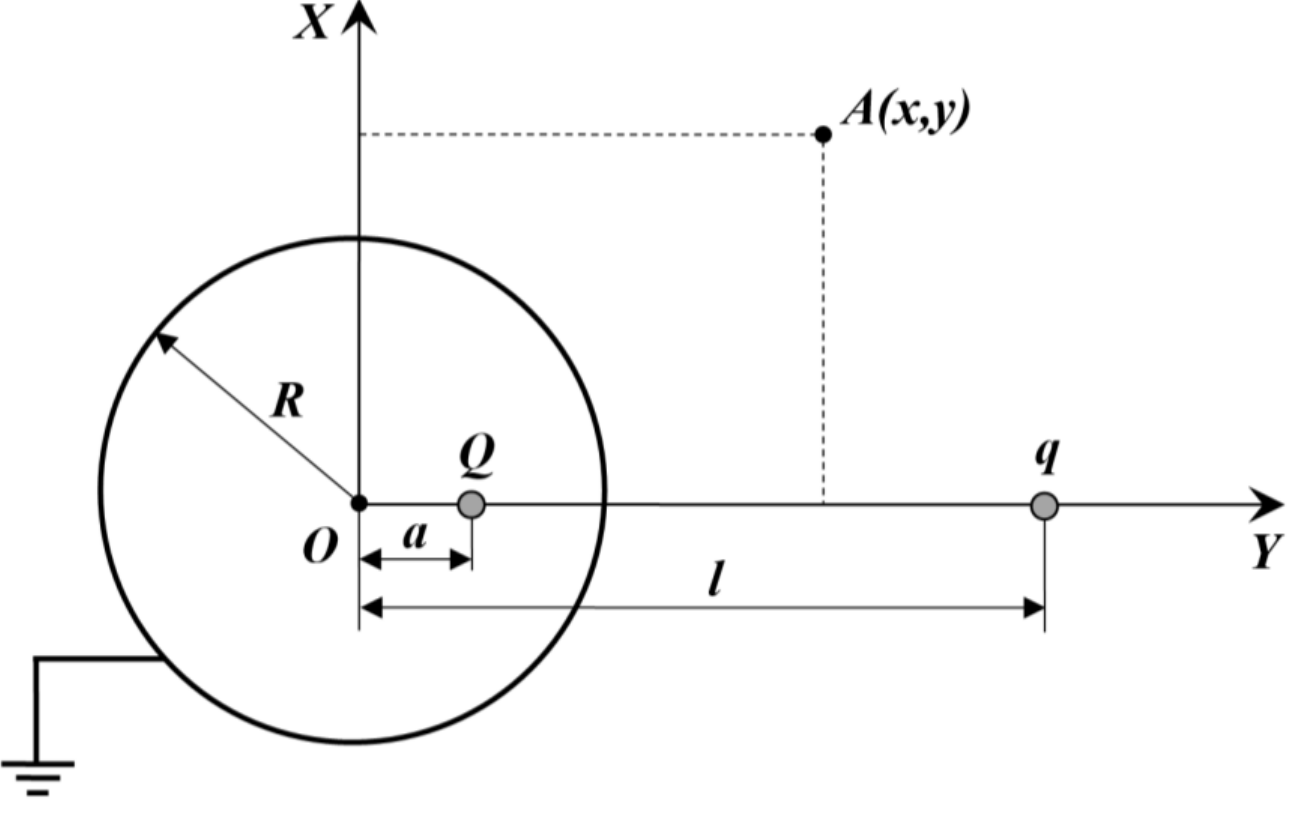
2.1 Calculate the electric field potential at an arbitrary point with coordinates lying outside the ball. Express your answer in terms of .
2.2 Using the above expression, evaluate the electric field potential on the ball surface. Express your answer in terms of .
2.3 Using your answer from 2.2, find the charge and the distance , expressing them in terms of .
2.4 Calculate the work that needs to be done on the point-like charge in order to very slowly move it to infinity. Express your answer in terms of .
2.5 Find the interaction energy of the induced charges with one another and express it in terms of .
Conductive ball in a uniform electric field
A conducting ball of radius is placed in an external uniform electric field of strength . In this case, the field of induced electric charges can be represented as a superposition of the field of two fictitious uniformly charged balls of the same radius located at a very small distance from each other. The net charge of these two balls is , of course, zero due to the charge conservation law, so one of them can be assumed to be charged with the bulk charge density , whereas the other is to be charged with the bulk charge density .
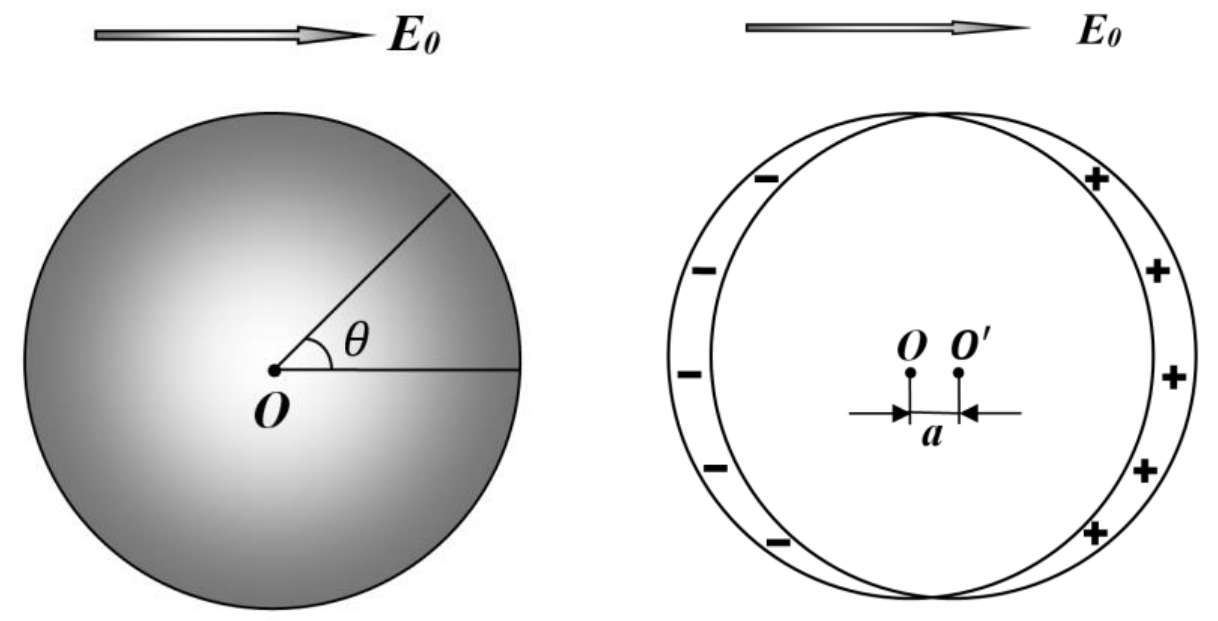
2.6 Calculate the electric field strength inside a uniformly charged ball with the bulk charge density at a distance from its center. Express your answer in terms of .
2.7 Calculate the electric field strength at the intersection of two fictitious balls mentioned above. Express your answer in terms of .
2.8 Find the surface density of the induced charges as a function of the angle shown in the figure above. Express your answer in terms of .
2.9 Find the electric field outside the ball and just near its surface point, characterized by the angle . Express your answer in terms of .
Conductive ball and charged ring
A thin ring of radius is charged uniformly along its length by a charge . An uncharged small conducting ball of radius and mass can slide without friction along the long non-conducting needle, coinciding with the axis of the ring.
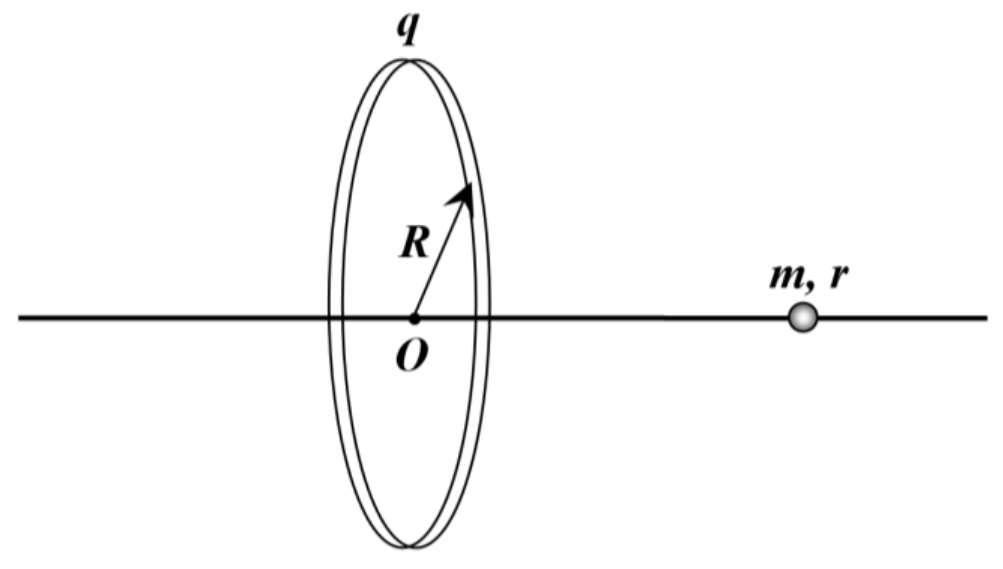
2.10 Calculate the frequency of small oscillations of the ball near its equilibrium position on the needle. Express your answer in terms of .
2.11 The ball is initially located at the ring center and is at rest. Find the work , which must be done to very slowly push the ball along the needle to infinity. Express your answer in terms of .
Отговори
- Conductive ball and point charge, 2.1
- Conductive ball and point charge, 2.2
- Conductive ball and point charge, 2.3
- Conductive ball and point charge, 2.4
- Conductive ball and point charge, 2.5
- Conductive ball in a uniform electric field, 2.6
- Conductive ball in a uniform electric field, 2.7
- Conductive ball in a uniform electric field, 2.8
- Conductive ball in a uniform electric field, 2.9
- Conductive ball and charged ring, 2.10
- Conductive ball and charged ring, 2.11
Решение
Conductive ball and point charge
2.1 The electric potential of the point-like charge is equal to
whereas the electric potential of the fictitious point-like charge is found to be
According to the principle of superposition, the full potential is just a sum of equations (1) and (2)
2.2 The equation of the circle corresponding to the surface of the ball is written as
Eliminating with the help of relation (4) and substituting it into formula (3) yield
2.3 The potential of the ball is zero, since it is grounded, i.e.
Equating expression (5) to zero, it can be rewritten in the form
Raising equation (7) in the square, one gets the following equation
Equation (8) should be satisfied for all , and this is possible only if the coefficient at the linear term and the free term are separately equal to zero, i.e.
Solving the set of equations (9) and (10), the following two solutions are obtained
Only solution (12) is nonzero, so we finally get
2.4 The force acting on the point-like charge reads as
and, therefore, the work sought is found by integrating as
2.5 Let the point-like charge be slowly moved from the initial position to infinity such that the resulting current strength in the ball is negligibly small and the release of Joule heat can be omitted. Let be the energy of the point-like charge , be the sought interaction energy of induced charges, be the interaction energy of the point charge with the induced charges, which is simply obtained as
When the charge is removed to infinity, the law of energy conservation must be satisfied, which in this case has the form
The set of equations (16)-(18) finally provides the following result
Conductive ball in a uniform electric field
2.6 To find the electric field inside a uniformly charged ball, the Gauss theorem is written for a spherical volume of radius . The charge inside this volume is easily derived as
and the electric field flux is found to be
According to the Gauss theorem
which ultimately entails
The last expression takes into account that the electric field strength vector is collinear to the vector .
2.7 Now consider the two fictitious balls with the bulk charge densities of opposite signs and evaluate the electric field in the domain of their intersection. Take an arbitrary point inside this domain and draw the radii of the vectors from the centers of the balls, denoting them and , respectively. Then, applying formula (23) for each ball results in
The net electric field is found with the help of the superposition principle as
where stands for the vector, drawn from the center of the negatively charged ball to the center of the positively charged ball.
2.8 The field strength inside the conducting ball must be zero. The induced charges create, according to formula (26), a uniform electric field, which must completely compensate for the external electric field, whence we obtain that
The charges of the fictitious balls are fully compensated with the exception of a thin layer near their surfaces, which can be considered a surface charge. The layer thickness depends on the angle and, due to the smallness of , is equal to
Hence, the magnitude of the surface charge near the angle is equal to
It immediately follows from equations (27)-(29) that
2.9 Consider a thin cylinder near the surface of the conductor and apply the Gauss theorem to it. Since the field inside the conductor is absent, and is directed normally just outside of it, then according to the Gauss theorem
which yields
Conductive ball and charged ring
2.10 The conducting ball is very small, so that the electric field of the ring in its vicinity can be considered almost uniform. It has been shown in the previous part of this problem that its polarization can be represented as two fictitious balls of opposite charge. These two balls behave in an external field as a dipole with the moment
where
Using (27), formulas (33) and (34) produce
Let us evaluate the electric field of the ring in the vicinity of the ball as a function of its distance to the center. Obviously, the ring field is directed along the needle. Dividing the ring into small parts that carry an electric charge the projection of their field on the direction of the needle has the form
Taking into account
and summing over all elements of the ring, one gets
The force acting on the dipole is obtained as
Substituting formulas (35) and (38) into (39) gives rise to
It follows from expression (40) that there are three equilibrium positions, which are determined by the points
A simple analysis proves that the equilibrium position (41) is unstable, and the symmetric positions (42) are both stable.
Near the position of the stable equilibrium, expression (40) for the force simplifies to
where
Newton's equation for the motion of the ball along the needle at small deviations has the form
which is a harmonic equation with the frequency
2.11 There is no need to integrate formula (40). In the initial position, the conducting ball is not polarized and in the final state it is also not polarized, since at zero and at infinity separations the electric field of the ring vanishes. Therefore, it is immediately inferred from the law of energy conservation that
It is natural that integrating expression (40) from zero to infinity gives the same answer.
| Part | Content | Points | |
|---|---|---|---|
| 2.1 | Formula (1) | 0,2 | 0,6 |
| Formula (2) | 0,2 | ||
| Formula (3) | 0,2 | ||
| 2.2 | Formula (4) | 0,2 | 0,4 |
| Formula (5) | 0,2 | ||
| 2.3 | Formula (6) | 0,2 | 1,8 |
| Formula (7) | 0,2 | ||
| Formula (8) | 0,2 | ||
| Formula (9) | 0,2 | ||
| Formula (10) | 0,2 | ||
| Formula (11) | 0,2 | ||
| Formula (12) | 0,2 | ||
| Formula (13) | 0,2 | ||
| Formula (14) | 0,2 | ||
| 2.4 | Formula (15) | 0,2 | 0,4 |
| Formula (16) | 0,2 | ||
| 2.5 | Formula (17) | 0,2 | 0,6 |
| Formula (18) | 0,1 | ||
| Formula (19) | 0,3 | ||
| 2.6 | Formula (20) | 0,1 | 0,4 |
| Formula (21) | 0,1 | ||
| Formula (22) | 0,1 | ||
| Formula (23) | 0,1 | ||
| 2.7 | Formula (24) | 0,1 | 0,4 |
| Formula (25) | 0,1 | ||
| Formula (26) | 0,2 | ||
| 2.8 | Formula (27) | 0,2 | 0,8 |
| Formula (28) | 0,2 | ||
| Formula (29) | 0,2 | ||
| Formula (30) | 0,2 | ||
| 2.9 | Formula (31) | 0,2 | 0,4 |
| Formula (32) | 0,2 | ||
| 2.10 | Formula (33) | 0,4 | 3,8 |
| Formula (34) | 0,2 | ||
| Formula (35) | 0,4 | ||
| Formula (36) | 0,2 | ||
| Formula (37) | 0,2 | ||
| Formula (38) | 0,4 | ||
| Formula (39) | 0,4 | ||
| Formula (40) | 0,2 | ||
| Formula (41) | 0,2 | ||
| Formula (42) | 0,2 | ||
| Formula (43) | 0,4 | ||
| Formula (44) | 0,2 | ||
| Formula (45) | 0,2 | ||
| Formula (46) | 0,2 | ||
| 2.11 | Formula (47) | 0.4 | 0,4 |
| Formal integral of formula (40) without the correct answer | (0.1) | ||
| Total | 10,0 |
Mathematical hint for the theoretical competition
You may need to know the following integrals:
Оригинал в Архива: IZhO-2019-Theory_eng.pdf · официални решения: IZhO-2019-Theory_eng_sol.pdf