IZhO 2020, Теория — Задача 1
XVI International Zhautykov Olympiad/Theoretical Competition · 10 януари 2020 г. · 10 т.
Please read this first:
THEORETICAL COMPETITION
January 10, 2020
Please read this first:
The time available for the theoretical competition is 4 hours. There are three questions.
Use only the pen provided.
You can use your own calculator for numerical calculations. If you don’t have one, please ask for it from Olympiad organizers.
You are provided with Writing sheet and additional paper. You can use the additional paper for drafts of your solutions but these papers will not be checked. Your final solutions which will be evaluated should be on the Writing sheets. Please use as little text as possible. You should mostly use equations, numbers, figures and plots.
Use only the front side of Writing sheets. Write only inside the boxed area.
Begin each question on a separate sheet of paper.
Fill the boxes at the top of each sheet of paper with your country (Country), your student code (Student Code), the question number (Question Number), the progressive number of each sheet (Page Number), and the total number of Writing sheets used (Total Number of Pages). If you use some blank Writing sheets for notes that you do not wish to be evaluated, put a large X across the entire sheet and do not include it in your numbering.
At the end of the exam, arrange all sheets for each problem in the following order:
- Used Writing sheets in order.
- The sheets you do not wish to be evaluated.
- Unused sheets.
- The printed problems.
Place the papers inside the envelope and leave everything on your desk. You are not allowed to take any paper out of the room.
SOLUTIONS TO THE PROBLEMS OF THE THEORETICAL COMPETITION
SOLUTIONS TO THE PROBLEMS OF THE THEORETICAL COMPETITION
Attention. Points in grading are not divided!
Условие
This problem consists of three independent parts.
1.1 Problem 1.1 (4.0 points)
A mathematical pendulum is located on the equator of the Earth. Denote the period of its oscillations at midday , and at midnight . Find the relative difference of these periods . Use the following approximations and numerical values: Earth is an ideal ball of radius ; the Earth’s orbit is a circle of radius with the center located in the center of the Sun; the axis of rotation of the Earth is perpendicular to the plane of the Earth’s orbit; the influence of the Moon and other planets is neglected; acceleration of gravity at the Earth’s pole is ; the period of revolution of the Earth around its axis is 1 day; the period of revolution of the Earth around the Sun is 1 year. [4 т.]
1.2 Problem 1.2 (3.0 points)
The space between two concentric well conductive spheres of radii and is filled with a substance whose specific resistance depends only on the distance to the spheres’ common center. An electric current of strength flows in between the spheres, such that the bulk density of Joule heat losses in the substance is the same at all points and is equal to . Determine the average density of the space charge accumulated in the volume of the substance over a sufficiently long time of the electric current flow. [3 т.]
1.3 Problem 1.3 (3.0 points)
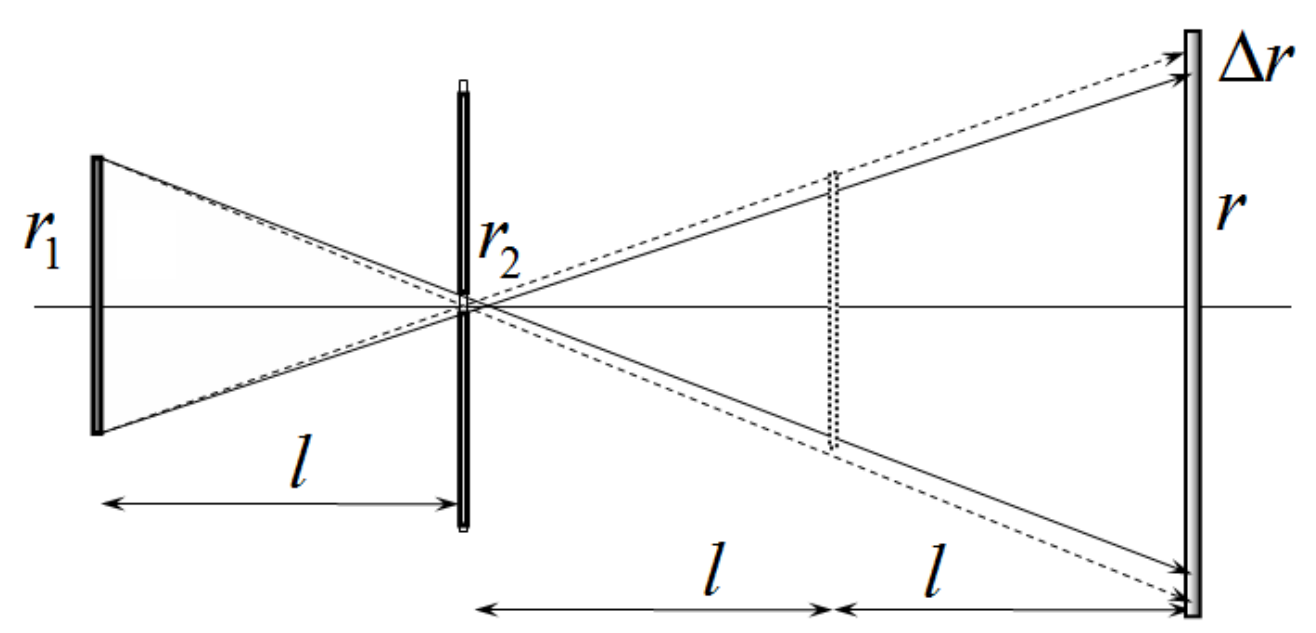
At equal distances in between the screen and the flat mirror , a flat matte source emitting white light only towards the mirror is placed. The planes of the screen, mirror and source are all parallel to one other. The source has the shape of a five-pointed star inscribed in a circle of radius , whereas the mirror has a regular triangle shape inscribed in a circle of radius . The source and mirror centers lie on the same axis perpendicular to the screen plane. Draw a schematic image of the source on the screen, keeping its orientation in accordance with the figure below. Estimate the sizes of all elements of the image.
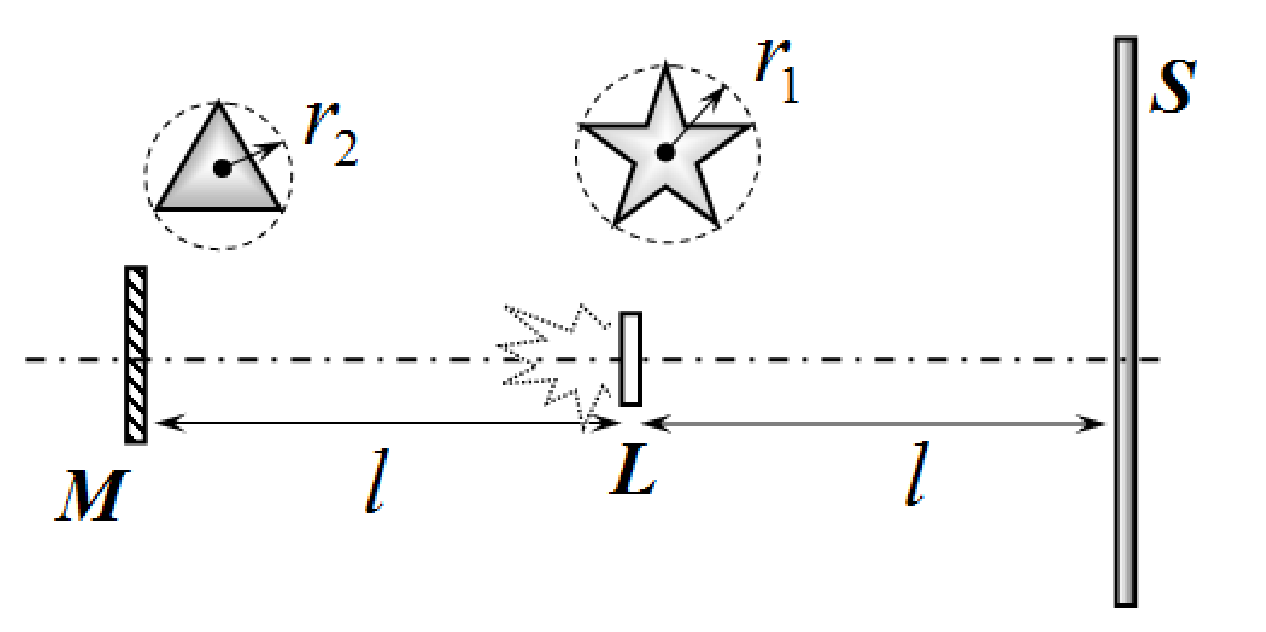
Consider only two specific cases:
1.3.1 and ;
1.3.2 and . [3 т.]
Отговори
- 1.1
- 1.2
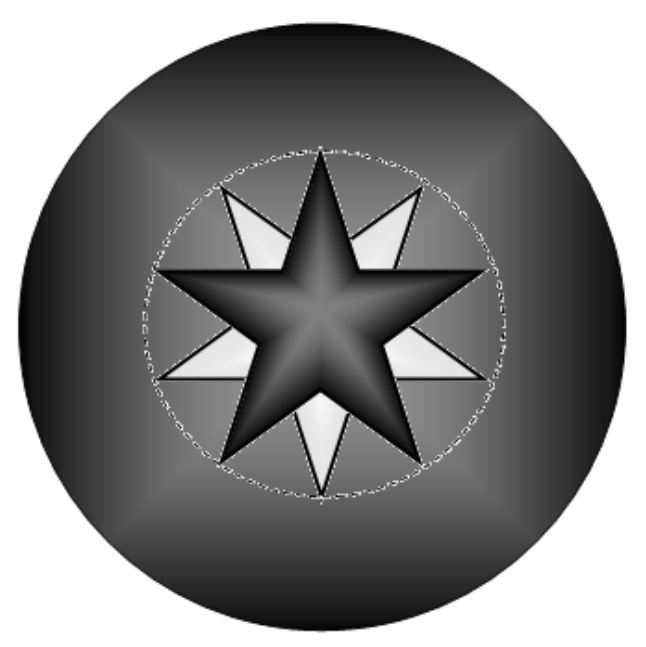
- 1.3 1.3.1: an inverted regular triangle inscribed in a circle of radius r = 3r2 = 30 mm, bordered by a semi-illuminated strip of width Δr ≈ 3r1 = 3 mm, with a blurred shadow of the source in the center of radius rS ≈ 2r1 = 2 mm. 1.3.2: an inverted star inscribed in a circle of radius r = 2r1 = 20 mm with a border Δr = 2r2 = 0.2 mm; the non-inverted shadow of the source of the same size covers part of it, so only five irregular quadrangles remain illuminated.
Решение
Problem 1.1 (4.0 points)
The oscillation period of a mathematical pendulum is determined by the formula
where stands for the acceleration of gravity at a given time of day.
The difference in the periods of oscillation of the pendulum at midday and midnight is due to the influence of the Sun: gravitational attraction and centrifugal force due to the Earth’s motion around the Sun. Using formula (1) for the period of pendulum oscillation the relative change in the periods can be represented as
where denotes the acceleration of gravity at midday and midnight, respectively.
The directions of the Earth's rotation around its own axis and around the Sun coincide, as shown in Figure 1. The directions of action of gravitational and centrifugal forces are different at midday and midnight, as shown in Figure 2.
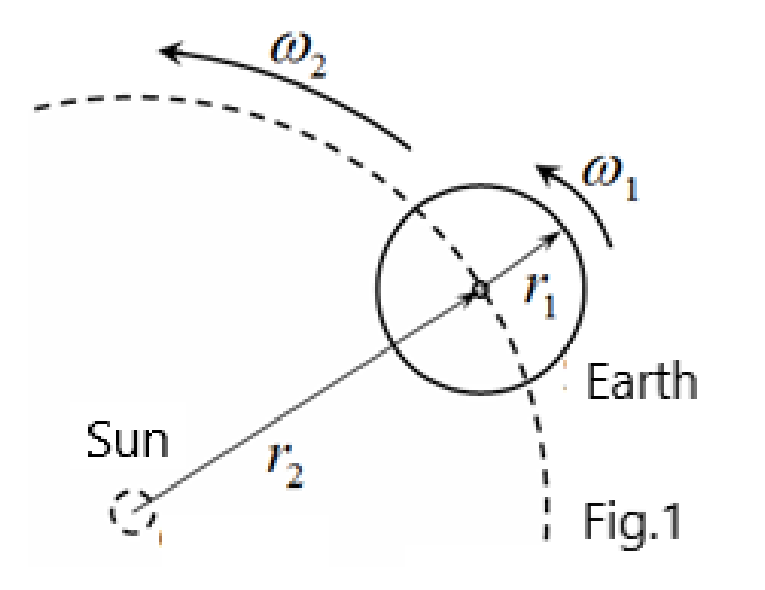
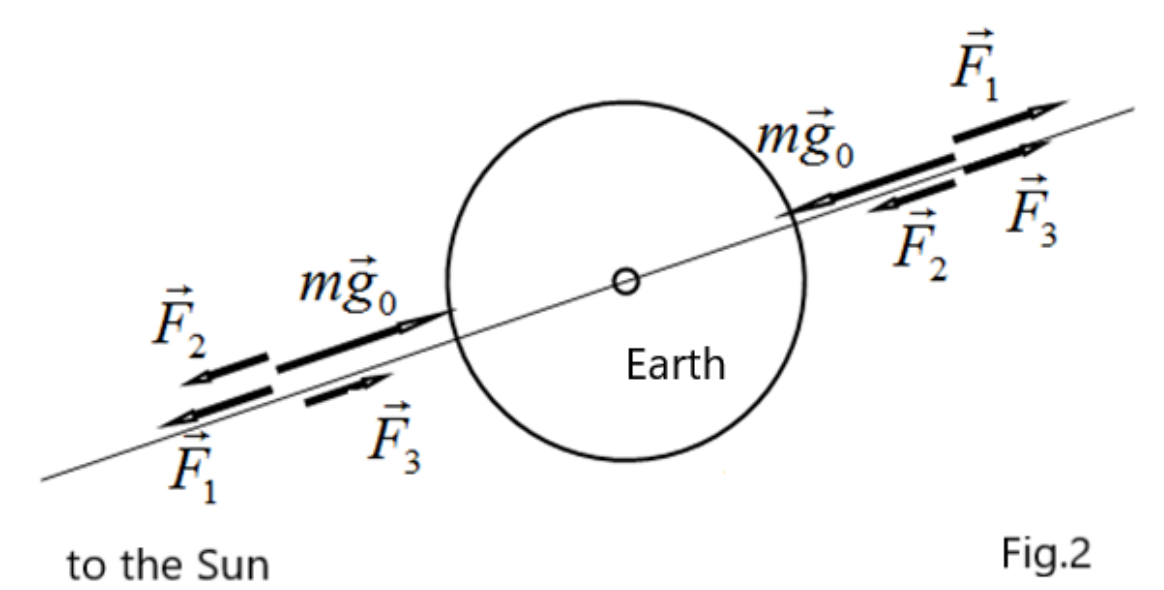
In Figure 2: is the force of gravitational attraction to the Earth; is the centrifugal force due to the rotation of the Earth around its own axis; is the force of gravitational attraction to the Sun; is the centrifugal force due to the motion of the Earth around the Sun.
Then the acceleration of gravity, taking into account the influence of the Sun, are determined by the expressions:
At midday:
At midnight:
In the above formulas designates the mass of the Sun and signifies the gravitational constant.
To simplify the obtained expressions, we use the equation describing the motion of the Earth around the Sun in the following form
Given this relation, the acceleration difference is represented as
Note that in this case, in order to obtain a nonzero result in the power series expansions, it is necessary to keep the second order terms, i.e. , such that:
Thus, the relative change in the periods of oscillations due to the influence of the Sun is equal
so that the final relation is derived as
| Content | Points |
|---|---|
| Formula (1): | 0,2 |
| Formula (2): | 0,2 |
| Earth’s gravity is accounted for | 0,2 |
| Sun's gravity is accounted for | 0,2 |
| Centrifugal force due to the Earth motion around the Sun is accounted for | 0,2 |
| Centrifugal force due th the Earth rotation is accounted for | 0,2 |
| Formula (3): | 0,4 |
| Formula (4): | 0,4 |
| Formula (5): | 0,3 |
| Formula (6): | 0,3 |
| Formula (7): | 0,4 |
| Formula (8): | 0,3 |
| Formula (9): | 0,3 |
| Numerical value in formula (9): | 0,4 |
| Total | 4,0 |
Problem 1.2 (3.0 points)
Consider a conductor with a resistivity , length and a cross section area in which the current flows. According to the Joule-Lenz law, the heat power dissipated in a conductor per unit of time is equal to
where the current density is defined as
and the resistance is found by the formula
It follows from formulas (1)-(3) that the heat power per unit volume is determined by the expression
On the other hand, Ohm's law is written as
in which the voltage across the conductor is expressed in terms of the field strength in the form
Hence, equation (5), taking into account (2), (3) and (6), is written in the following differential form
Thus, according to the Joule-Lenz law, the heat power dissipated per unit of volume of the substance is
where the current density is determined by the expression
with denotes the dependence of the resistivity on the distance to the common center of spheres.
On the other hand, Ohm's law (7) is written in the differential form as
where stands for the electric field strength in the substance.
It follows from relations (8)-(10) that the electric field strength has the form
To determine the charge inside the conducting substance, we use the Gauss theorem for the closed volume, which is practically enclosed between spheres of radii and
where symbolizes the total charge inside the conductive substance.
Since the volume of the substance enclosed between the two spheres is equal to
Then, the average charge density in the conducting substance is obtained as
| Content | Points |
|---|---|
| Formula (1): | 0,2 |
| Formula (2): | 0,2 |
| Formula (3): | 0,2 |
| Formula (4): | 0,2 |
| Formula (5): | 0,2 |
| Formula (6): | 0,2 |
| Formula (7): | 0,2 |
| Formula (8): | 0,2 |
| Formula (9): | 0,2 |
| Formula (10): | 0,2 |
| Formula (11): | 0,2 |
| Formula (12): | 0,3 |
| Formula (13): | 0,2 |
| Formula (14): | 0,3 |
| Total | 3,0 |
Problem 1.3 (3.0 points)
To analyze the image on the screen, it is more convenient to build first the image of the source in the mirror. This image is located at the distance from the mirror and has the same dimensions as the real source.
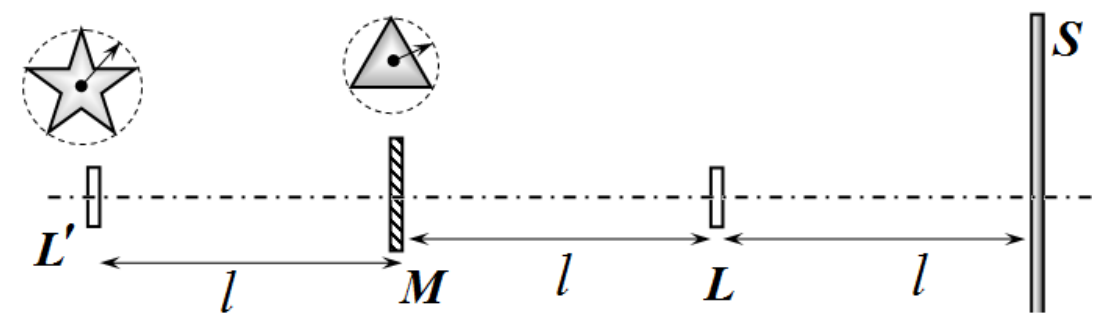
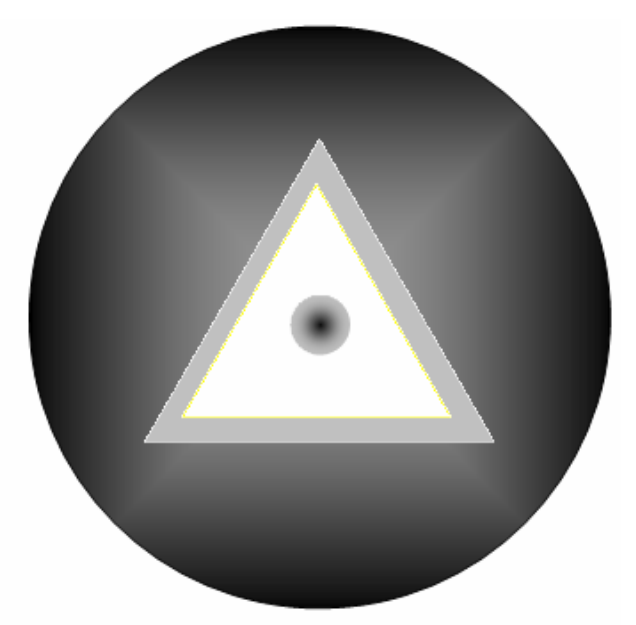
1.3.1 In this case, the source size is much smaller than the size of the mirror. As a first approximation, the source can be considered point-like. Therefore, the illuminated area on the screen has the form of a regular triangle repeating the shape of the mirror (see. fig.).
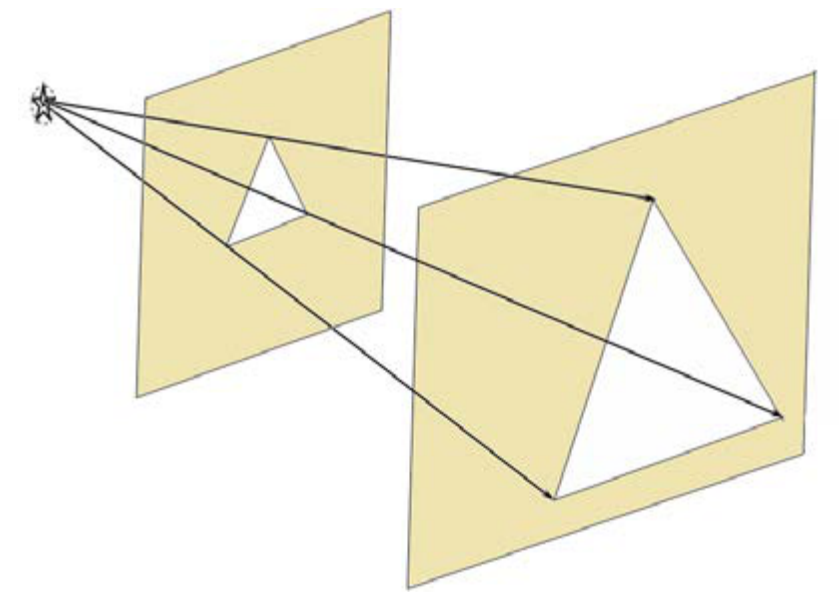
It follows from simple geometric constructions that the size of the triangle is 3 times the size of the mirror, i.e. a triangle on the screen can be inscribed in a circle of radius .
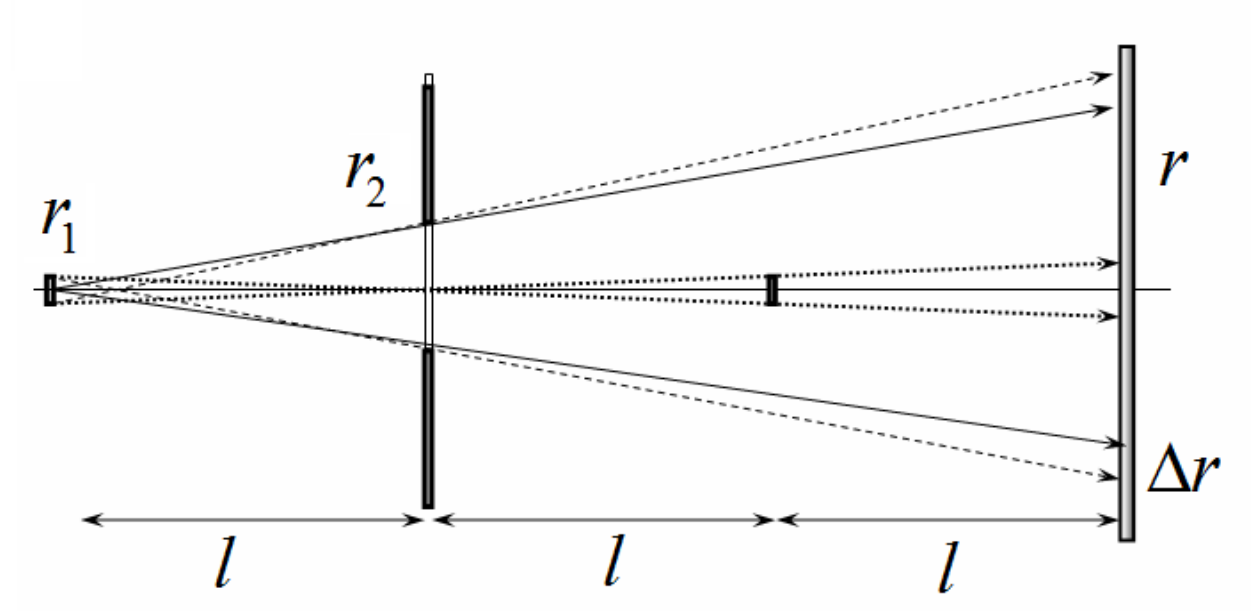
Since the source has, albeit small, but finite dimensions, the image of the triangle is to be slightly blurry, i.e. bordered by a semi-illuminated strip (border). The width of this strip is approximately equal to . It can be imagined that each source point gives an image in the form of a triangle, these images are displaced relative to each other by the twice displacement of the source points.
In the center of the triangle there should be a blurred shadow from the source (shadow and semi shadow) whose radius is .
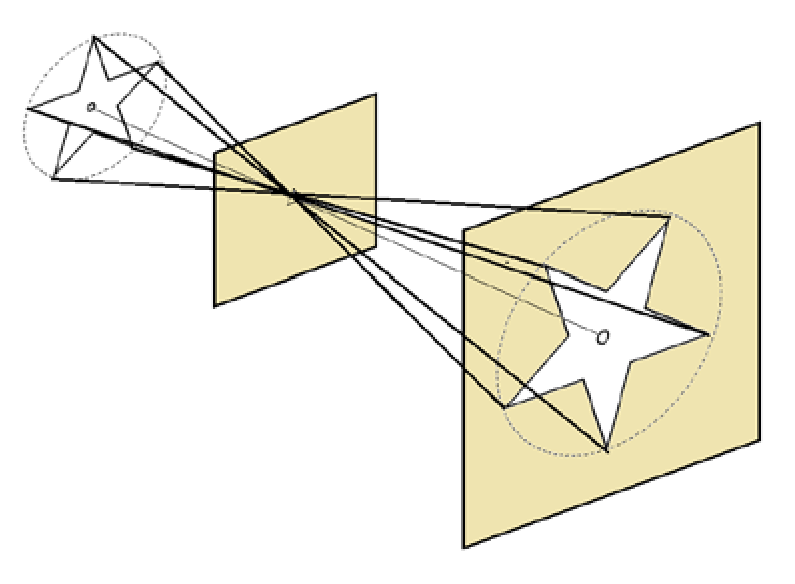
1.3.2 In this case, the size of the source is much larger than the size of the mirror, which in the first approximation can be considered as a very small “point” hole that forms an inverted image of the source. Such an effect is used in a pinhole camera, which also forms an inverted image.
It follows from geometric constructions that a star can be inscribed in a circle of radius . The final dimensions of the source lead to slight blurring of the image with the width of the semi-illuminated strip (border) approximately equal to . Further, it should be noted that the real source creates a shadow on the screen in the form of the same five-pointed star and of the same size! However, this shadow is not inverted. Therefore, only part of the bright star is closed, as shown in the figure. Thus, only five irregular quadrangles remain illuminated on the screen.
| Content | Points | ||
|---|---|---|---|
| 1.3.1 | The rays are correctly constructed (the image of the source, or the correct reflection of the rays); | 0.3 | 1.3 |
| Image grading: the main part is an inverted triangle; (if not, then the rest in this paragraph is not counted); | 0,3 | ||
| Triangle size - numerical value (side or radius); | 0,1 | ||
| There is a semi-illuminated border; | 0,2 | ||
| Border width; | 0,1 | ||
| There is a blurred shadow in the center; | 0,2 | ||
| The size of the shadow (partial shade) is the radius in the range of 1-2 mm; | 0,1 | ||
| 1.3.2 | The rays are correctly constructed (the image of the source, or the correct reflection of the rays); | 0,2 | 1.7 |
| Image grading The main part is an inverted star; (if not, then the rest in this paragraph is not counted); | 0,4 | ||
| The radius of the star (numerical value); | 0,2 | ||
| There is a border; | 0,1 | ||
| Estimation of the border thickness; | 0,2 | ||
| There is a shadow from the source; | 0,2 | ||
| Shadow is not an inverted star; | 0,1 | ||
| The size of the shadow coincides with the size of the inverted star; | 0,2 | ||
| Illuminated areas - 5 quadrangles; | 0,1 | ||
| Total | 3,0 |
Mathematical hints for the theoretical problems
Mathematical hints for the theoretical problems
The following integrals may be useful:
Оригинал в Архива: IZhO-2020-Theory_eng.pdf · официални решения: IZhO-2020-Theory_eng_sol.pdf