IZhO 2022 — Задача 1. Dry friction — Experiment 1: Sliding friction
Автор: Olympiads XYZ · транскрипция на официалните материали
Проверена срещу оригинала на 13.9.2026 от същия модел, който я е транскрибирал (без независима проверка)
XVIII International Zhautykov Olimpiad/Experimental Competition · 17 февруари 2022 г.
Условие
You are provided with Writing sheet and additional white sheets of paper. You can use the additional sheets of paper for drafts of your solutions, but these sheets will not be graded. Your final solutions should be written on the Writing sheets. Please use as little text as possible. You should mostly use equations, numbers, figures, and plots.
Use only the front side of Writing sheets. Write only inside the boxed areas.
Start putting down your solution to each problem on a new Writing sheet.
Graphs must be drawn on Writing sheets with the graph paper. All drawings must be done with a pen, not a pencil!
Fill in the boxes at the top of each Writing sheet with your country (Country), your student code (Student Code), problem number (Question Number), the progressive number of each Writing sheet (Page Number), and the total number of Writing sheets used (Total Number of Pages). If you use some blank Writing sheets for notes that you do not wish to be graded, put a large X across the entire sheet and do not include it in your numbering.
To measure the coefficient of sliding friction, the rolling of a solid homogeneous cylinder on an inclined plane is studied at various angles of inclination of the plane to the horizon. We assume that the force of sliding friction is described by the well-known Coulomb-Amonton law:
where stands for the normal reaction force and denotes the coefficient of sliding friction.
Consider the experimental setup to be a wide flat steel plate, whose angle of inclination to the horizon can be arbitrarily varied. The error in setting the angle of inclination of the plane to the horizon is .
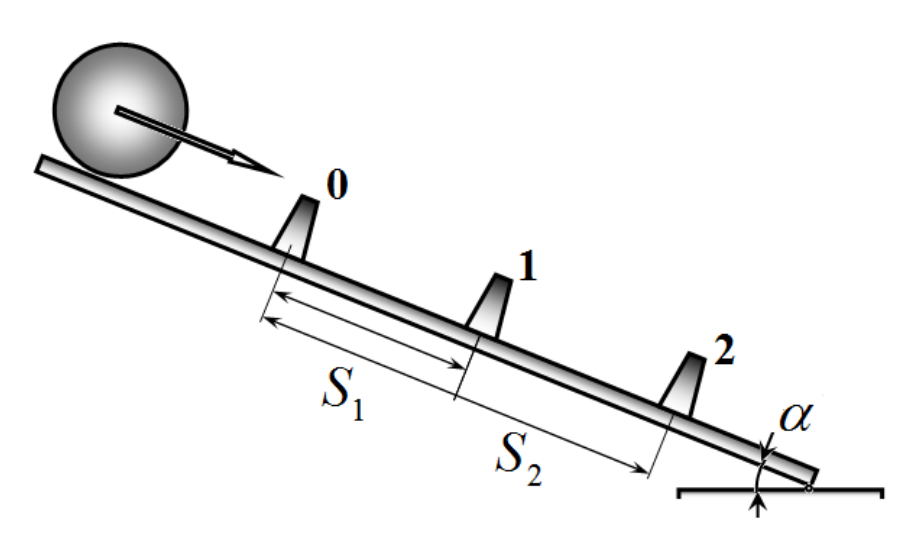
The solid homogeneous steel cylinder can roll down the plate with its axis remaining horizontal all the time. To measure the acceleration, three optical sensors (0, 1, 2) are fixed on the plate. Each sensor consists of a light source and a photodetector, which are mounted on the identical stands. The solid homogeneous cylinder is placed on the plate and released. The cylinder moves down between these stands and blocks the light beam so that at the moment of light interruption, an electrical impulse is generated that controls an electronic stopwatch (not shown in the figure). When the cylinder passes sensor 0, a stopwatch is started, when the cylinder passes sensors 1 and 2, the times of these passages are recorded.
Thus, the following time intervals are measured in the experiment:
– cylinder motion time interval from sensor 0 to sensor 1;
– cylinder motion time interval from sensor 0 to sensor 2.
These time intervals are recorded with 4 significant digits. The instrumental error in measuring time intervals and is equal .
The distances between the sensors are measured as:
from sensor 0 to sensor 1 ;
from sensor 0 to sensor 2 .
When making numerical calculations, assume that the free fall acceleration is equal .
The results of measuring time intervals and are given in Table 1 for different angles of inclination of the plate to the horizon.
Table 1. Time intervals of the cylinder motion.
| , s | , s | |
|---|---|---|
| 20 | 0,4546 | 0,7187 |
| 25 | 0,3936 | 0,6290 |
| 30 | 0,3462 | 0,5589 |
| 35 | 0,3229 | 0,5211 |
| 40 | 0,3358 | 0,5283 |
| 45 | 0,3084 | 0,4911 |
| 50 | 0,2682 | 0,4347 |
| 55 | 0,2816 | 0,4432 |
| 60 | 0,2600 | 0,4113 |
| 65 | 0,2461 | 0,3908 |
| 70 | 0,2308 | 0,3675 |
| 75 | 0,2218 | 0,3542 |
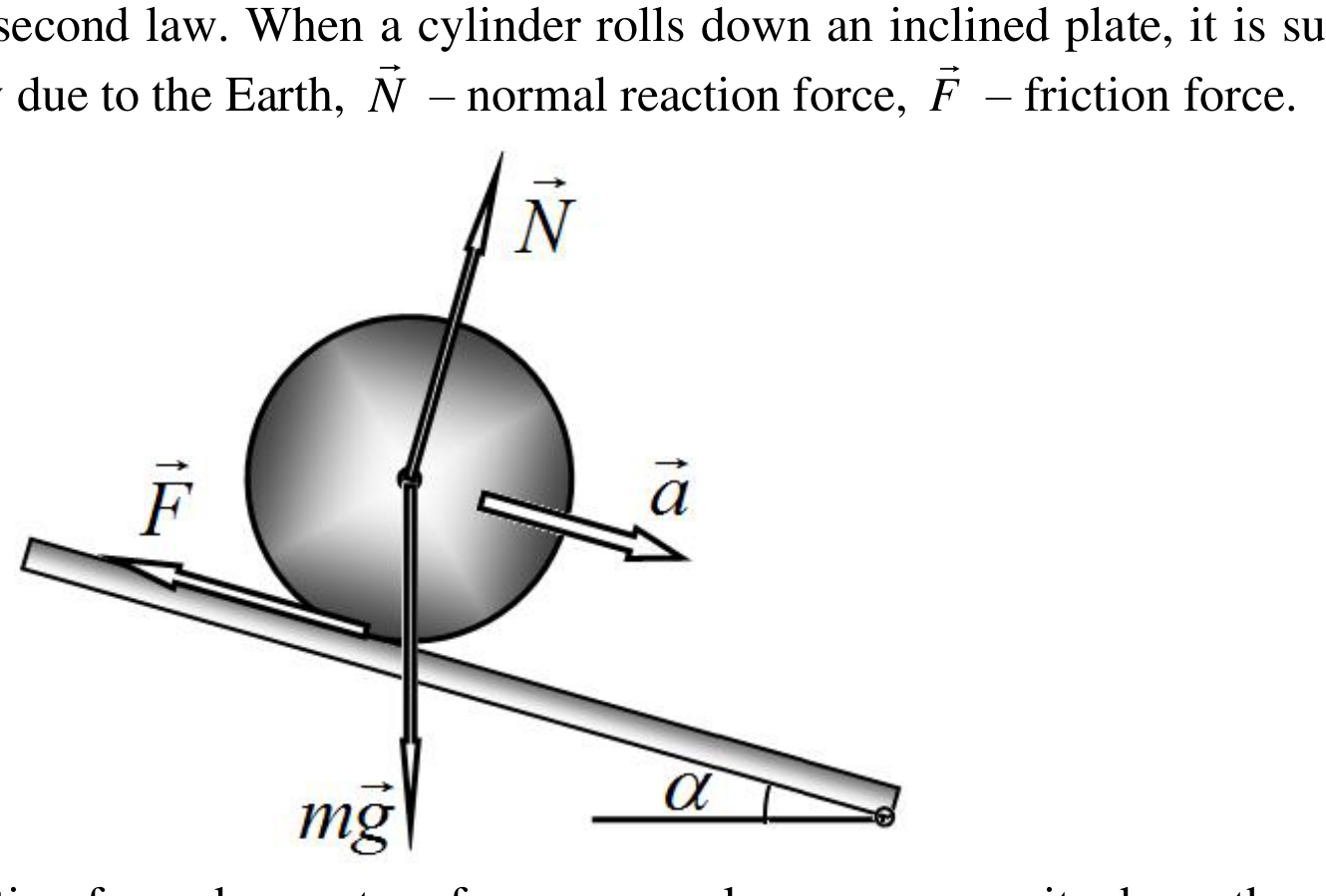
1.1 Derive formulas for the acceleration of the cylinder axis in two cases: A) the motion of the cylinder occurs without slipping – acceleration ; B) when moving along the plate, the cylinder slips – acceleration . Express your answers in terms of .
1.2 Express the maximum angle of inclination of the plate, at which the motion of the cylinder still occurs without slipping, in terms of the coefficient of friction .
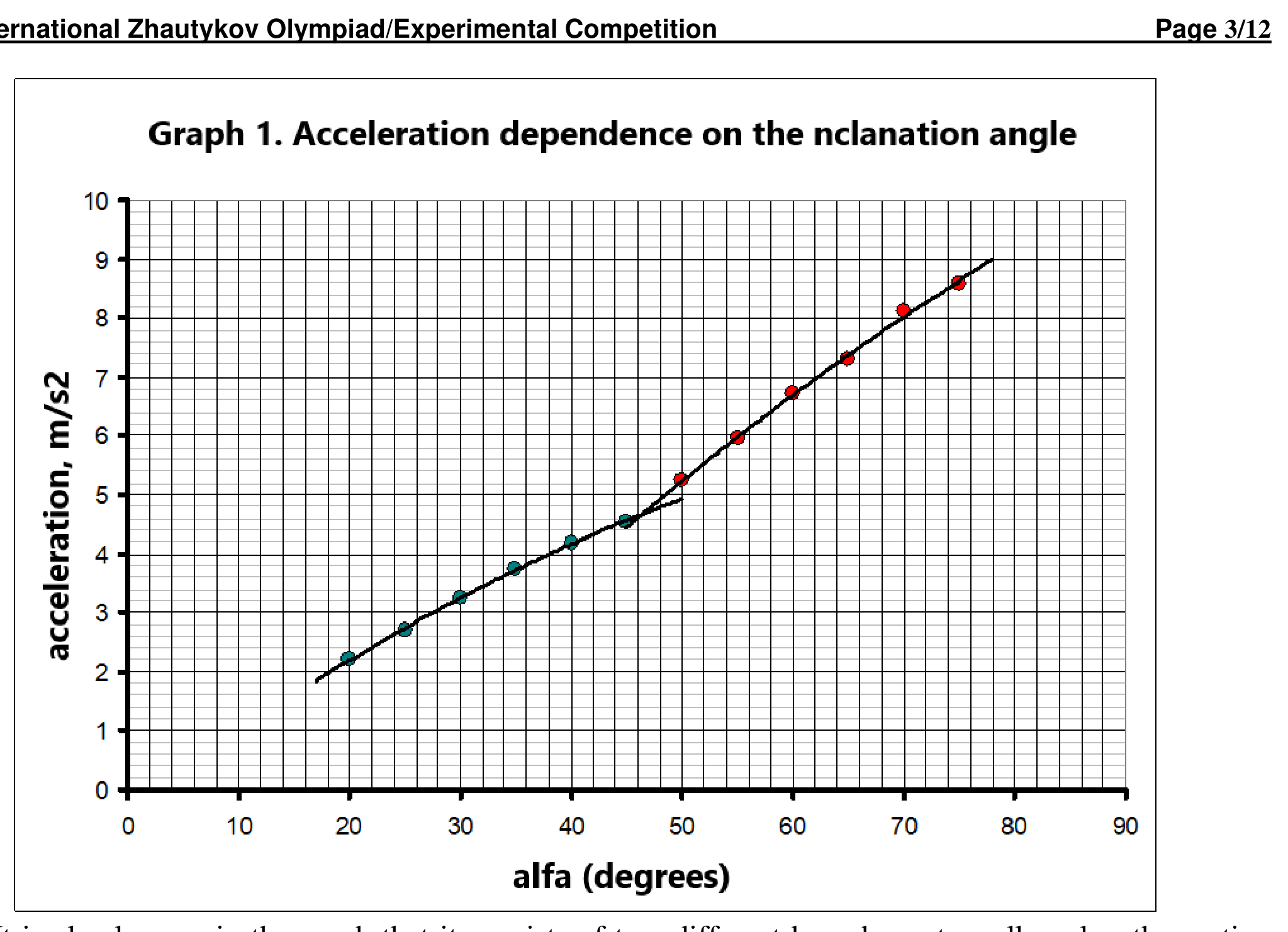
1.3 Using the measurement results given in Table 1, calculate the acceleration with which the cylinder axis moved for each angle of inclination of the plate. Put down the formula for the acceleration, according to which the calculations are carried out. Draw a graph of the acceleration versus the angle and with its aid find an approximate value of the critical .
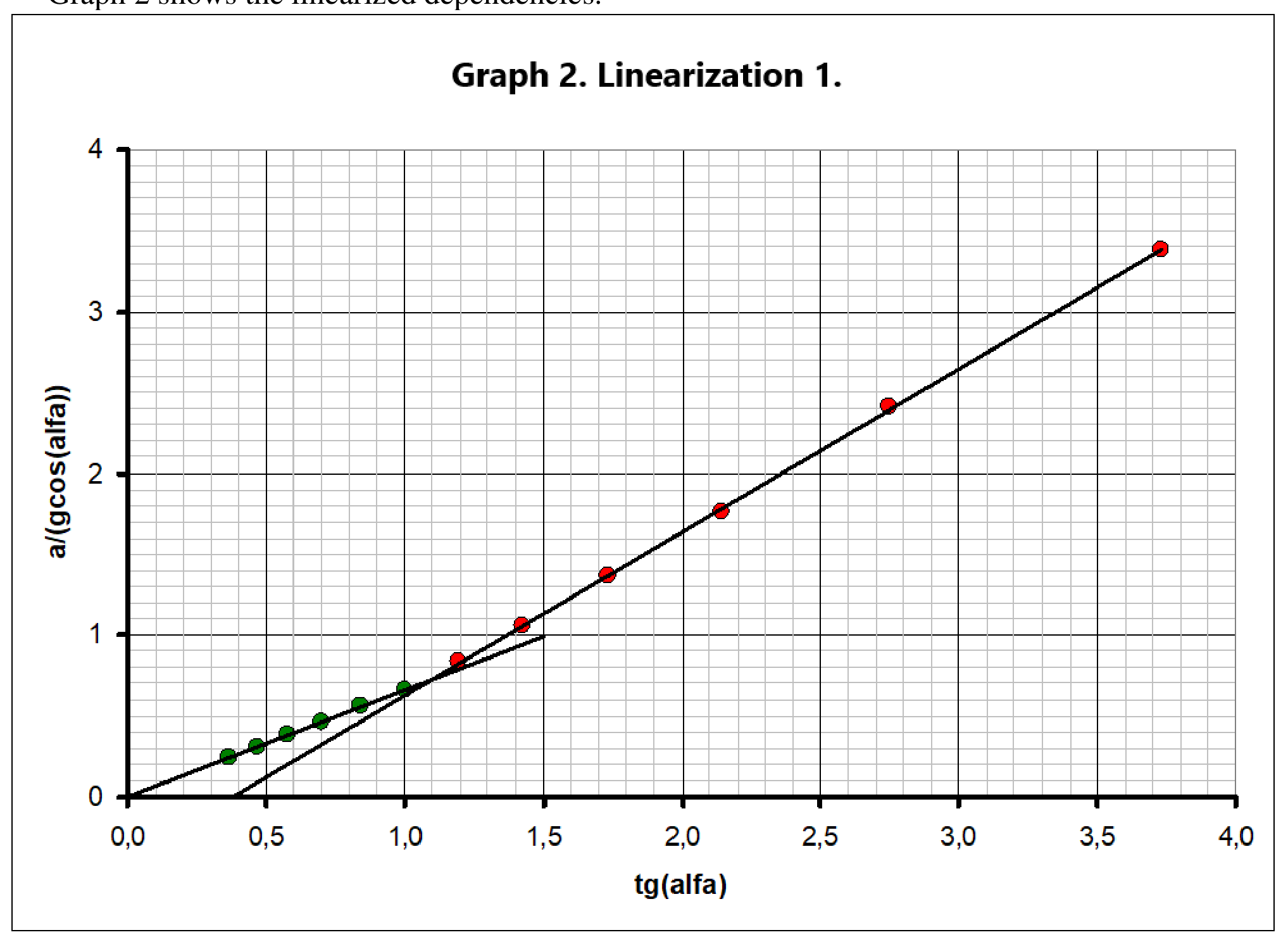
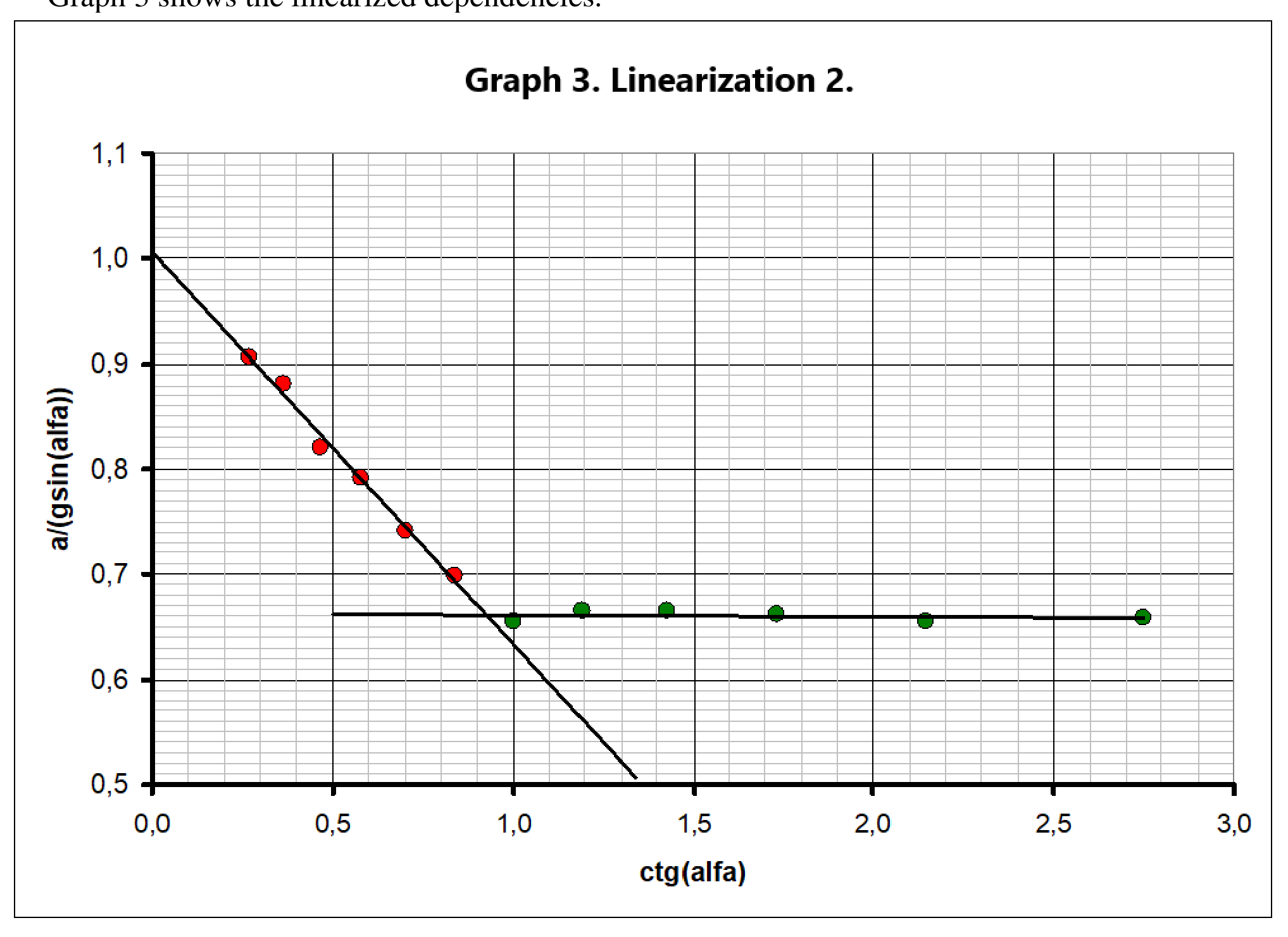
1.4 Carry out the linearization of the obtained dependence, i.e. find such values and so that the dependence turns linear for the both cases when the cylinder moves without slipping and with slipping. Draw a linearized dependence for all experimental points.
1.5 Using the linearized relationship , calculate the coefficient of friction between the cylinder and the plate. Estimate the error of the obtained value. Put down the formulas used in your calculations.
1.6 Using the linearized relationship , calculate the value of the critical angle , at which the cylinder starts to slip. Estimate the error of the obtained value. Put down the formulas used in your calculations.
Решение
Покажи официалното решение
Оригинал в Архива: IZhO-2022-Exp_eng.pdf · официални решения: IZhO-2022-Exp_eng_sol.pdf