IZhO 2022, Теория — Задача 1. Problem 1
XVIII International Zhautykov Olympiad/Theoretical Competition · 16 февруари 2022 г. · 10 т.
Please read this first:
The duration of the theoretical competition is 4 hours. There are three problems.
You can use your own calculator for numerical calculations.
You are provided with Writing sheet and additional white sheets of paper. You can use the additional sheets of paper for drafts of your solutions, but these sheets will not be graded. Your final solutions should be written on the Writing sheets. Please use as little text as possible. You should mostly use equations, numbers, figures, and plots.
Use only the front side of Writing sheets. Write only inside the boxed areas.
Start putting down your solution to each problem on a new Writing sheet.
Fill in the boxes at the top of each Writing sheet with your country (Country), your student code (Student Code), problem number (Question Number), the progressive number of each Writing sheet (Page Number), and the total number of Writing sheets used (Total Number of Pages). If you use some blank Writing sheets for notes that you do not wish to be graded, put a large X across the entire sheet and do not include it in your numbering.
Условие
This problem consists of three independent parts.
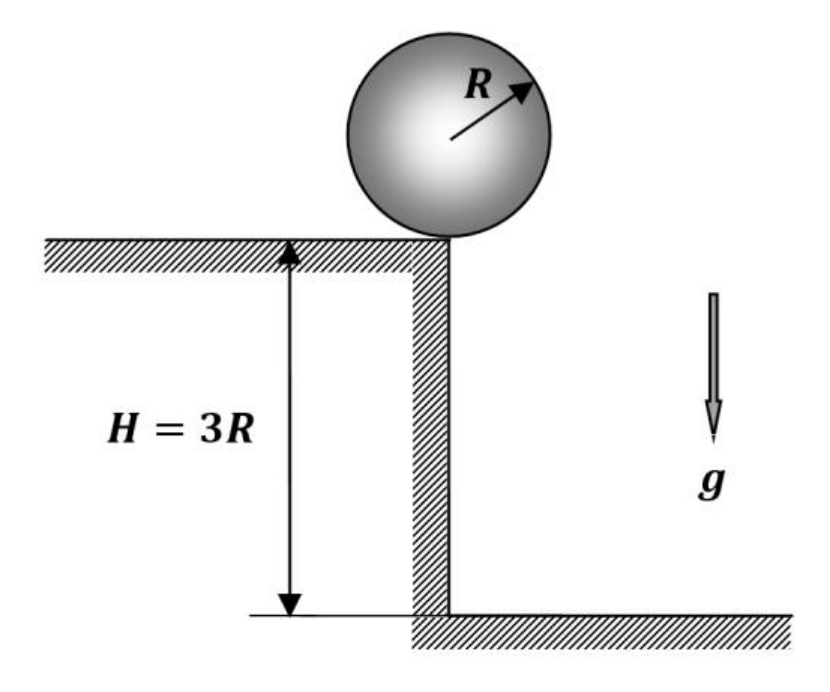
Problem 1.1 A ball of radius rests on the edge of a horizontal table of height . The ball starts to fall without a significant initial push, and there is no slipping with the edge during the entire time of motion. Find at what distance from the base of the table the ball first touches the floor. The free fall acceleration is equal to , air resistance is negligible. It is known that the kinetic energy of a ball rolling without slipping is equal to , where denotes the speed of the ball center with being its mass. [4 т.]
Problem 1.2 A quasi-static process is carried out with one mole of an ideal monatomic gas, as a result of which its initial volume increases four times, and the initial pressure decreases two times. It is known that for each small section of the quasi-static process, the ratio of work to the change in internal energy is a constant value. Find the total work done by the gas in this process. [3 т.]
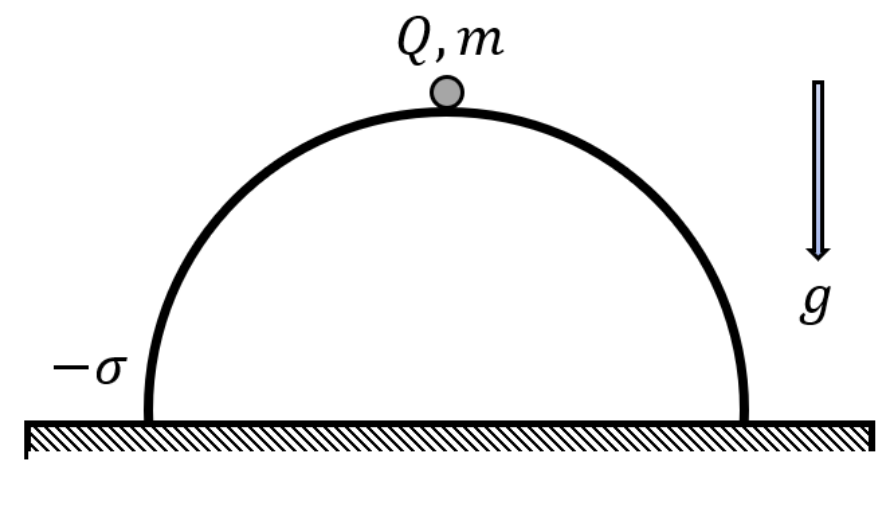
Problem 1.3 A thin-walled dielectric hemisphere, negatively charged with the surface density , is placed on the horizontal table. A point-like ball of mass is carefully placed on its top. Determine the minimum positive charge of the ball, such that it is still in a state of stable equilibrium at the top of the hemisphere. The charges between the hemisphere and the ball are not redistributed. The free fall acceleration is . [3 т.]
Отговори
Problem 1.1
Official solution, formula (12).
Problem 1.2 200000 J
Official solution, formula (11): A = 2p0V0 = 2.0×10⁵ J.
Problem 1.3
Official solution, formula (9).
Решение
Attention. Points in grading are not divided!
Problem 1 (10.0 points)
Problem 1.1 (4.0 points)
At the initial moment of time, the ball rotates as a whole around the point of its contact with the table. Let the ball rotate through a certain angle , then the change in the potential energy of the center of mass of the ball is written as
(1)
and it turns into kinetic energy
(2)
where is the speed of the center of mass of the ball.
According to the law of conservation of energy, we get
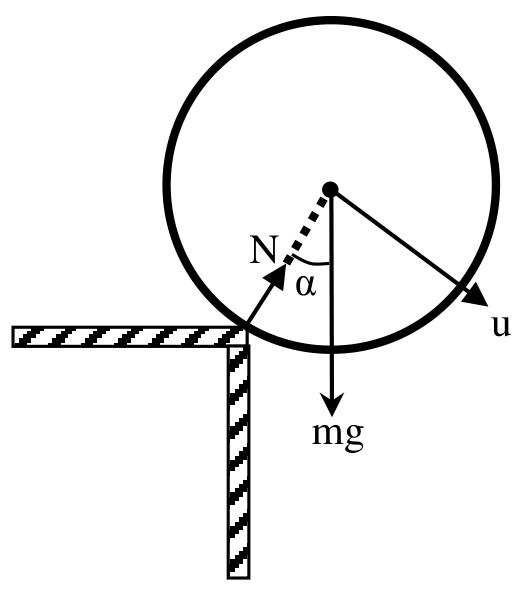
(3)
At further motion, the ball is separated from the table. The equation of motion of the center of mass of the ball (Newton's second law) in the projection on the radial direction has the form
(4)
where stands for the normal reaction force of the table, and the friction force is not shown in the figure.
The condition for the separation of the ball from the table is defined as
(5)
Solving jointly equation (1)-(5), we find the separation angle and the speed of the ball at this moment
(6)
(7)
The further motion of the ball is the free fall of its center of mass in the Earth's gravitational field. The initial horizontal and vertical velocities are respectively equal to
(8)
(9)
The flight range is determined by the formulas of uniformly accelerated motion in the earth's gravity field as
(10)
(11)
where denotes the free flight time.
Eliminating time from equations (10) and (11), we find
(12)
| Content | Points |
|---|---|
| Formula (1): | 0.3 |
| Formula (2): | 0.2 |
| Formula (3): | 0.2 |
| Formula (4): | 0.3 |
| Formula (5): | 0.4 |
| Formula (6): | 0.4 |
| Formula (7): | 0.4 |
| Formula (8): | 0.2 |
| Formula (9): | 0.2 |
| Formula (10): | 0.4 |
| Formula (11): | 0.4 |
| Formula (12): | 0.6 |
| Total | 4.0 |
Problem 1.2 (3.0 points)
The work done by the gas when its volume changes by reads as
(1)
where denotes the gas pressure.
The change in the internal energy of one mole of an ideal monatomic gas is associated with a change in its temperature by the relation
(2)
According to the formulation of the problem, the following relation holds
(3)
which, along with the ideal gas equation
(4)
leads to the following relation
(5)
Equation (5) is easily integrated and reduced to the form
(6)
In the initial state, the ideal gas equation gives
(7)
whereas in the final state
(8)
and, therefore, the temperature of the gas in the final state is obtained as
(9)
From equations (6) and (9) it is easy to find the coefficient
(10)
The total work of the gas in the process is determined by the integral of equation (1) and is equal to
(11)
Note: The process described in this problem is polytropic, i.e. it occurs at a constant heat capacity. Indeed, since the work done by the gas is a fixed part of the change in the internal energy, this means that the heat capacity of the gas remains constant throughout the process. In this case, the polytropic equation is valid under the chosen conditions of the problem with , and the work of the gas, obviously, does not depend on its type, whether it is a monatomic or polyatomic gas.
| Content | Points |
|---|---|
| Formula (1): | 0.2 |
| Formula (2): | 0.2 |
| Formula (3): | 0.2 |
| Formula (4): | 0.2 |
| Formula (5): | 0.2 |
| Formula (6): | 0.4 |
| Formula (7): | 0.2 |
| Formula (8): | 0.2 |
| Formula (9): | 0.2 |
| Formula (10): | 0.4 |
| Formula (11): | 0.4 |
| Numerical value in formula (11): | 0.2 |
| Total | 3.0 |
Problem 1.3 (3.0 points)
To study the problem of the stability of the equilibrium position, consider a situation in which the ball deviates from the top position by a very small angle and determine the forces acting on it.
The first force is electrostatic, but to study the equilibrium we need only its component directed tangentially to the surface of the hemisphere. The idea of its calculation is based on the fact that in the projection onto the radial direction, the electrostatic forces are compensated from two symmetrical regions of the hemisphere I and II with respect to the new ball position, so that the only uncompensated force is due to the segment of the hemisphere, cut off by an inclined plane passing at an angle . The left figure below shows the corresponding section in the vertical plane.
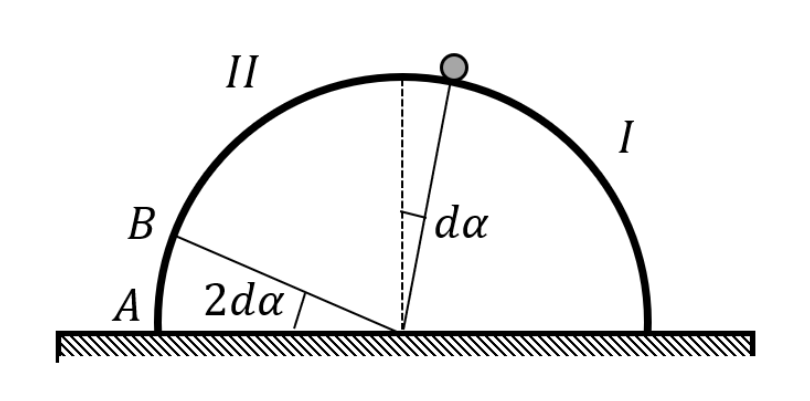
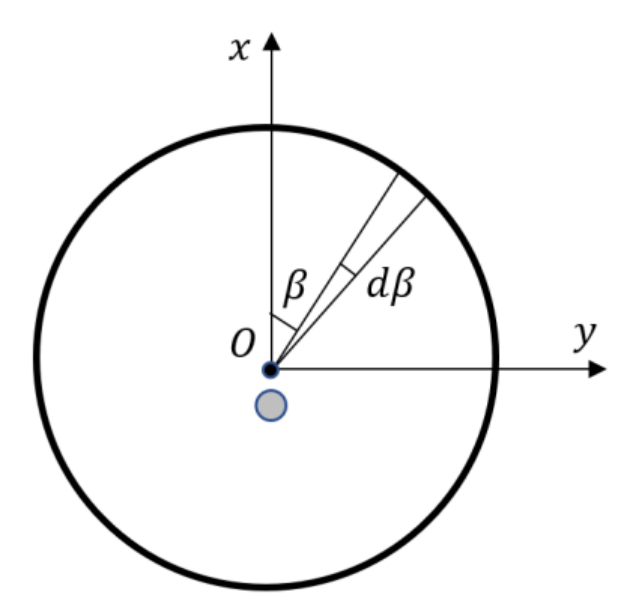
Let us consider a part of the sphere segment (see the right figure above, which shows the top view), cut off additionally by the angles amd , such that its area is found as
(1)
with the electric charge being equal to
(2)
In the Cartesian coordinate system, whose origin coincides with the top of the hemisphere, and the axis is directed vertically downwards, the radius vector, directed from the point where the ball is located to the selected part of the sphere segment, is determined by the coordinates
(3)
and hence the vector of the desired force is derived as
(4)
This force has the following projection on the tangential direction
(5)
therefore, integration over from to provides the total module of the electrostatic force from the entire segment in the form
(6)
The second force acting on the ball is the force of gravity, whose projection on the tangential direction is obtained as
(7)
The minimum charge of the ball is determined by the equality of forces
(8)
which leads to the final answer
(9)
Obviously, for larger charges the equilibrium position is stable.
| Content | Points |
|---|---|
| Formula (1): | 0.3 |
| Formula (2): | 0.3 |
| Formula (3): | 0.2 |
| Formula (4): | 0.2 |
| Formula (5): | 0.3 |
| Formula (6): | 0.5 |
| Formula (7): | 0.2 |
| Formula (8): | 0.5 |
| Formula (9): | 0.5 |
| Total | 3.0 |
Mathematical hints for the theoretical problems
The following formulas may be useful:
where is a fixed number, refers to an arbitrary constant
where stands for an arbitrary constant
for and any value of
for
Оригинал в Архива: IZhO-2022-Theory_eng.docx · официални решения: IZhO-2022-Theory_eng_sol.pdf