IZhO 2023, Експеримент — Задача 2. Monochromatic radiation of a known wavelength as an instrument calibration
XIX International Zhautykov Olimpiad/Experimental Competition · 3 февруари 2023 г. · 8 т.
Внимание: Бележка към темата
Figures 1–3 and Tables 1–3 with the registered signals were printed on the separate Writing sheets, which are not in the archive.
Please read this first:
February 3, 2023
- The duration of the experimental competition is 4 hours. There is one problem.
- You can use your own calculator for numerical calculations.
- You are provided with white sheets of paper for drafts of your solutions, but these sheets will not be graded. Your final solutions must only be written on the Writing sheets. You can write very short explanations using equations, numbers, letters.
- Use only the front side of Writing sheets. Write only inside the boxed areas.
- Graphs must be drawn on Writing sheets within the graph paper area. All drawings must be done with a pen, not a pencil! If you need additional Writing sheets with the graph paper, you can find them at the end of your worksheet.
- Fill in the boxes at the top of each Writing sheet with your country (Country), your student code (Student Code), problem number (Question Number), the progressive number of each Writing sheet (Page Number), and the total number of Writing sheets used (Total Number of Pages). If you use some blank Writing sheets that you do not wish to be graded, put a large X across the entire sheet and do not include it in your numbering.
Условие
Figure 1 shows the dependence of the light intensity on the time when the interferometer is illuminated with monochromatic radiation with the wavelength . Table 1 shows the times at which the light intensity is extreme (maxima and minima), as well as the signal values at corresponding time moments.
2.1 Determine the division value of the device in milliseconds.
In the following, all calculations must only be carried out in the units of the instrument scale.
2.2 On the basis of the given experimental data, show that the motion of the mirror can be described by the function
Find the values of the parameters of this function: period in units of the instrument scale; oscillation amplitude in micrometers; point in time at which . Plot a linearized graph of dependence (1), proving the applicability of the above formula to describe the oscillations of the mirror. Estimate the error in determining the amplitude of oscillations.
Function (1) with the found values of the parameters should be used when performing the following parts of the problem.
Отговори
2.1 0.03 ms
2.2 T = 1668, t0 = 486, A = (4.23 ± 0.01) μm
From the official solution: T = 2(tmax − tmin) = 1668, t0 = 486, A = (4.23 ± 0.01) μm (least squares).
Решение
2.1 It follows from the given figure that the extreme positions of the mirror correspond to the values of the times
This shift occurs in half the period of the mirror oscillation, so
On the other hand, the oscillation period can be expressed in terms of a given mirror oscillation frequency :
Equating expressions (8) and (9), we find that the division value of the time scale is equal to
2.2 Приведенный график зависимости интенсивности от времени симметричен относительно «центрального» максимума, номер которого равен The given figure of the intensity dependence on time is symmetrical with respect to the "central" maximum, whose number is equal to
and this maximum corresponds to the time
For further calculations, we choose 13 extrema (to round it off), approximately symmetrical with respect to the central maximum, see Table 1.
Table 1.
| , мкм | |||||
|---|---|---|---|---|---|
| 1 | 118 | -26 | -368 | -0,983 | -4,16 |
| 5 | 224 | -22 | -262 | -0,834 | -3,52 |
| 10 | 302 | -17 | -184 | -0,639 | -2,72 |
| 15 | 361 | -12 | -125 | -0,454 | -1,92 |
| 20 | 414 | -7 | -72 | -0,268 | -1,12 |
| 25 | 465 | -2 | -21 | -0,079 | -0,32 |
| 27 | 486 | 0 | 0 | 0,000 | 0,00 |
| 30 | 515 | 3 | 29 | 0,109 | 0,48 |
| 35 | 567 | 8 | 81 | 0,300 | 1,28 |
| 40 | 623 | 13 | 137 | 0,493 | 2,08 |
| 45 | 684 | 18 | 198 | 0,679 | 2,88 |
| 50 | 766 | 23 | 280 | 0,870 | 3,68 |
| 53 | 855 | 26 | 369 | 0,984 | 4,16 |
Let us carry out the following calculations:
Extremum number relative to the center ;
Temporal shift from the center ;
The mirror coordinates at intensity extrema .
To test the applicability of the law of motion
we plot the dependence of coordinates on . It should be noted that when choosing points for plotting, you should:
- select points with the maximum range of coordinates change;
- do not include utmost extremes, since they may not satisfy condition (6).
Below is a graph of this relation.
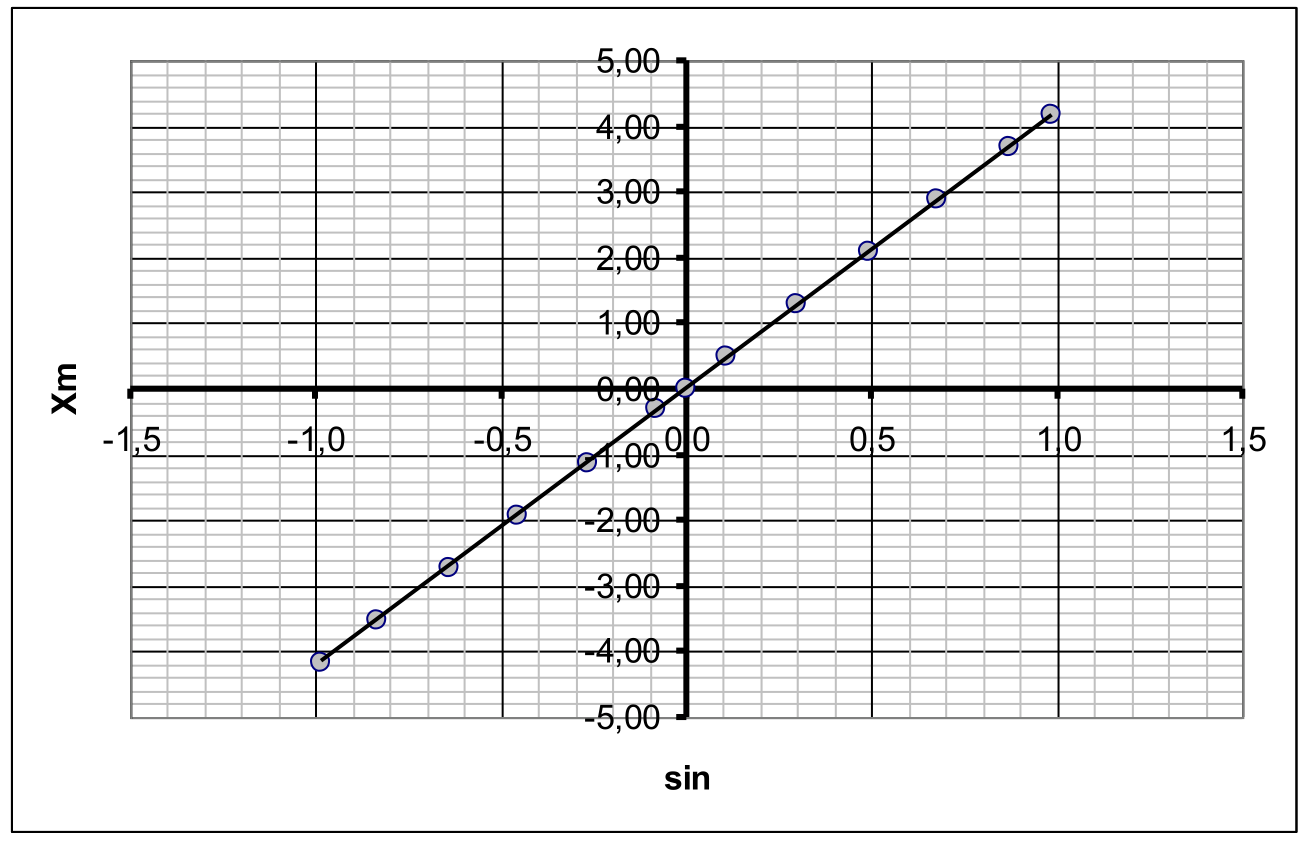
The linearity of this graph confirms the applicability of formula (13) for describing the law of mirror motion. The parameters of this dependence calculated by the least squares method have the following numerical values:
The slope coefficient is the amplitude of the mirror oscillation. When this numerical value of the shift parameter is less than its error, therefore, it can be assumed that , and the analyzed dependence is directly proportional.
| № | Content | For the part | points |
|---|---|---|---|
| 2. Monochromatic radiation of a known wavelength as an instrument calibration | 8,0 | ||
| 2.1 | Determination of the division value: - maxima 0 and 54 – utmost positions of the mirror – 0,4; - the motion time – half the oscillation period – 0,2; - period calculation in relative units - 0,1; - calculation of the period in seconds - 0,1; - calculation of the division value - 0,2 | 1,0 | |
| 2.2 | Determination of the law of motion | ||
| Using the found oscillation period; | 0,5 | ||
| determination of the center point: - the number of the maximum - 0,3; - time when passing the center point - 0,2; | 0,5 | ||
| Choice of points: - 10 or more points are used 0,3 (5 or more -0,1); - outmost points not included - 0,2; - maximum range used - 0,3; - points are roughly symmetrical - 0,2; | 1,0 | ||
| coordinate determination method: - distance between adjacent extrema - - 0,5; - перенумерация максимумов от среднего – 0,2; - formula for calculating coordinates - 0,3; | 1,0 | ||
| coordinate calculation (the correct calculation are carried out for all selected points; the allowable calculation error is 10%) | 1,0 | ||
| dependence linearization: - dependence on - 0,4; - sines are calculated 0,6; | 1,0 | ||
| graph plotting: (graded if calculations are graded); - axes signed and ticked – 0,1; - all points are plotted in accordance with the table – 0,2; - linear dependence is obtained -0.2; - smoothing straight line drawn – 0,2; | 0,7 | ||
| calculation of the amplitude of the mirror oscillations: LSM used – 0,3 (graphically, or averaging over all points – 0,2; using 2 points 0,1); (calculation carried out according to the number of extrema – 0,1); numerical value obtained in the range 4,2 – 4,3 μm – 0,5 (in the range of 4,0 – 4,5 μm – 0,3; out of the range - 0); | 0,8 | ||
| amplitude error calculation: - LSM used -0,3 (other methods -0,2); - numerical value of the order - 0,3; | 0,5 |
Оригинал в Архива: IZhO 2023 PhysExp_eng.pdf · официални решения: IZhO-2023-Exp_multi_sol.pdf