IZhO 2025, Теория — Задача 2. First estimate of the age of the Earth
XXI International Zhautykov Olympiad/Theoretical Competition · 14 януари 2025 г. · 10 т.
Please read this first:
- The time available for the theoretical competition is 4 hours. There are three questions.
- You can use your own calculator for numerical calculations. If you don’t have one, please ask for it from Olympiad organizers.
- You are provided with Writing sheet and additional paper. You can use the additional paper for drafts of your solutions but these papers will not be checked. Your final solutions which will be evaluated should be on the Writing sheets. Please use as little text as possible. You should mostly use equations, numbers, figures and plots.
- Use only the front side of Writing sheets. Write only inside the boxed area.
- Each task should be solved starting from a new page of the Writing sheets
- Fill the boxes at the top of each sheet of paper with your country (Country), your student code (Student Code), the question number (Question Number), the progressive number of each sheet (Page Number), and the total number of Writing sheets used (Total Number of Pages). If you use some blank Writing sheets for notes that you do not wish to be evaluated, put a large X across the entire sheet and do not include it in your numbering.
Условие
Fourier's law of thermal conductivity
Thermal conductivity characterizes the ability of a body to transfer thermal energy from one point to another if there is a temperature difference between them. Let us consider a flat homogeneous plate with a cross-sectional area and a thickness , whose surfaces have the temperature difference . The phenomenon of thermal conductivity in a one-dimensional stationary case is described by Fourier's law, which has the following form:
where is the amount of heat transferred during time through the plate surface in the direction of the normal coinciding with the direction of decreasing temperature. The constant is called the thermal conductivity coefficient and depends on the plate material, and the value refers to the modulus of the heat flux, which is a vector directed towards the heat transfer.
2.1 The left end of the rod, enclosed in a heat-insulating shell, is maintained at a temperature of , whereas its right end is kept at a temperature of . The rod itself consists of two parts of the same length, but different thermal conductivities. The thermal conductivity coefficient of the left part is twice as high as the thermal conductivity coefficient of the right part. Calculate the temperature of the contact surface of the rod parts. [1 т.]
2.2 A rod of length with a heat-insulated side surface consists of a material whose thermal conductivity coefficient varies along according to the law , where is a certain constant. The ends of the rod are maintained at temperatures and . Determine the dependence of temperature on the coordinate , which is the distance from the rod end with temperature . [1 т.]
2.3 Estimate the time it takes for an ice crust of thickness cm to form on the surface of a lake at an ambient air temperature of . The thermal conductivity coefficient of ice is , its density is , and the specific melting heat is . [1 т.]
Electrothermal analogy
Electrothermal analogy is a method for calculating thermal systems based on replacing thermal quantities with their electrical analogues. The method is based on the identity of the mathematical apparatus of thermal physics and electrical engineering: the propagation of heat and electric current are described by the same differential equations, while measuring the electrical characteristics of real objects is much simpler.
2.4 Find Below a table of correspondence between thermal and electrical quantities. Thermal quantities are written out explicitly, and you need to transfer the table to your solution and write the corresponding electrical quantities in front of them: electric current density , specific conductivity , electric charge , electric field potential .
| Thermal quantity | Electrical quantity |
|---|---|
| temperature | |
| amount of heat | |
| heat flux | |
| thermal conductivity coefficient |
[0,8 т.]
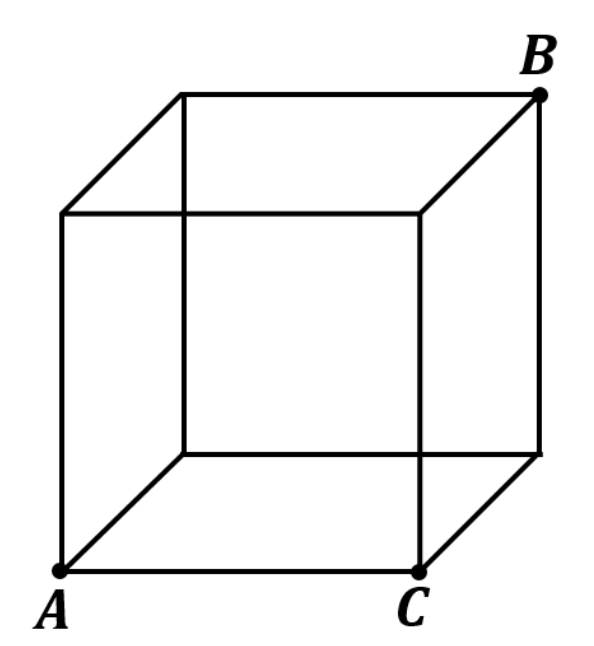
2.5 A cube consists of identical thin rods with thermally insulated side surfaces. Two vertices of the cube and are maintained at constant temperatures and respectively. Determine the temperature at vertex , see Figure 2.1 below. [1 т.]
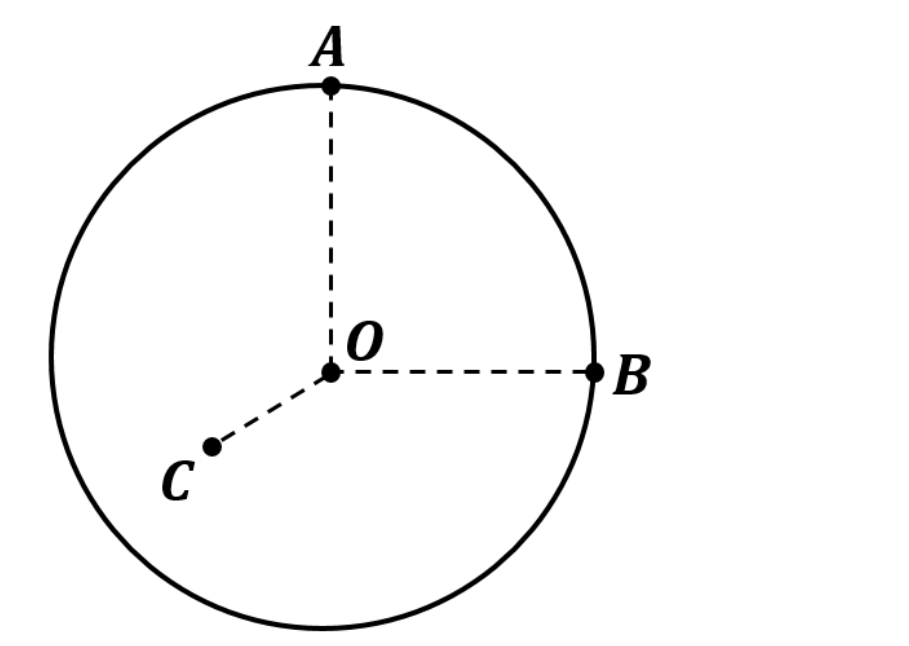
2.6 A thin heat-conducting sphere of radius is made of a material with the wall thickness . Thermal power is supplied to point of the sphere, and the same thermal power is removed at point of the sphere. Neglecting heat losses, determine the modulus of the heat flux at point of the sphere, see Figure 2.2 below ( is the sphere center, ). [1 т.]
The first estimate of the Earth age
In the 18th century, there lived a famous naturalist, Georges-Louis Leclerc, Count de Buffon (1707-1788), who was a member of the Paris Academy of Sciences, the French Academy, a member of the Royal Society of London, and also a foreign honorary member of the St. Petersburg Academy of Sciences. He published his works in a multi-volume work, Natural History, in which he attempted to systematize the knowledge gained to that time in a variety of fields of science, and also expressed a number of advanced ideas. His interests included geology, and he was the first to formulate the problem of determining the age of the Earth. In particular, Leclerc developed a hypothesis about the origin of the planets through the collision of celestial bodies, which should have led to their heating and subsequent cooling. It was through the process of temperature change over time that the first estimate of the Earth age in history was obtained.
Of course, Leclerc did not know the laws of physics in their modern form and did not have a sufficient command of the mathematical apparatus, but he had a keen physical sense.
2.7 Let a teapot have a spherical shape with a radius cm and after heating water in it to the boiling point, it cools down to the room temperature in a time of h. Let us imagine a hypothetical situation: the teapot is proportionally increased to the size of the Earth, the radius of which is km. Estimate the cooling time τ of such a hypothetical "teapot" under the same external conditions. [1 т.]
Unlike Count de Buffon, we are familiar with the modern physics laws, so let us consider the simplest model of the Earth, whose radius is equal to km. Inside the Earth there is a core with a radius of km, whose substance perfectly conducts heat () and has a specific heat capacity of J / (kg · K) at a density of . Outside the core, right up to the Earth's surface, is the mantle, whose substance has zero specific heat capacity and a thermal conductivity coefficient of . Neglect the influence of the Earth's crust, and assume that the Sun has no thermal effect on the Earth, which can be considered an absolutely black body being in a vacuum.
2.8 At the present moment in time, the Earth's surface temperature is known to be K. Calculate the temperature of the Earth's core within the framework of the presented model. [1 т.]
2.9 Calculate the temperature of the mantle at a depth of km from the Earth's surface. [1 т.]
2.10 Calculate how much the temperature of the Earth's surface differs from what it was years ago. [1,2 т.]
Отговори
- Fourier's law of thermal conductivity, 2.1 50 °C
- Fourier's law of thermal conductivity, 2.2
- Fourier's law of thermal conductivity, 2.3
- Electrothermal analogy, 2.4 T — electric field potential φ; Q — electric charge q; jQ — electric current density jE; κ — specific conductivity σ
- Electrothermal analogy, 2.5 60 °C
- Electrothermal analogy, 2.6
- The first estimate of the Earth age, 2.7 τ = (RE/r0)τ0 = 2.56·10⁸ h = 2.92·10⁴ years
- The first estimate of the Earth age, 2.8 K
- The first estimate of the Earth age, 2.9 18600 K
- The first estimate of the Earth age, 2.10 0.0314 K
Решение
Fourier's Law of Thermal Conductivity
2.1 According to Fourier's law, the heat flux in the left rod is equal to
and the heat flux in the right rod is found as
In steady state the heat flux should be the same in both rods
from which we find
2.2 The heat flux along the rod must remain constant, which yields the differential equation
whose solution has the form
where is a constant of integration.
Taking into account the boundary conditions
we obtain the following final expression for the temperature dependence
2.3 When ice forms near its contact with the lake water, the temperature is , which causes a temperature difference of . Let us consider a portion of ice surface of the area , assuming its thickness to be . Then the amount of heat released into the environment at the point of contact during time is equal to
During the process of water crystallization at the point of contact with ice, the amount of heat released is found as
By equating these amounts of heat , we obtain the formula
which after integration gives the final answer
Electrothermal analogy
2.4 Ohm's law for the electric current density has the form , and the electric current density itself is associated with the flow of electric charge, so the table of correspondence between thermal and electrical quantities takes the form shown below.
| Thermal value | Electrical quantity |
|---|---|
| temperature | electric field potential |
| amount of heat | electric charge |
| heat flux | electric current density |
| thermal conductivity coefficient | specific conductivity |
2.5 It follows from the electrothermal analogy that the cube can be represented as an equivalent electrical circuit, shown in the figure below.
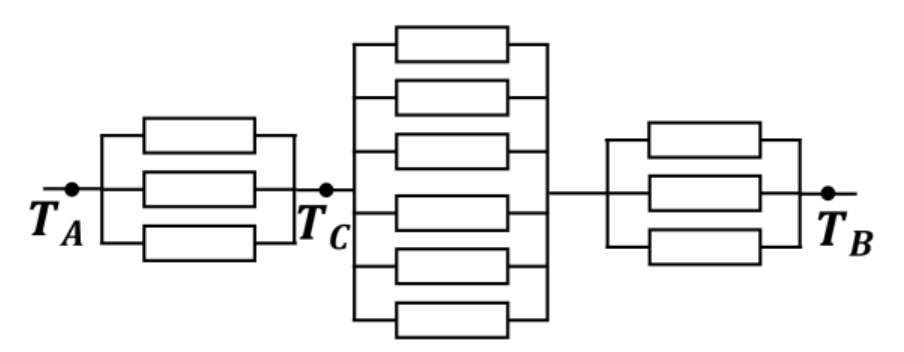
Since the temperature in the electrothermal analogy is a potential, and the resistances of all ribs are the same, we obtain the relation
whence
2.6 Let us add another heat source to the system at point , which is located diametrically opposite to point , and also another heat sink at point , diametrically opposite to point , see the figure below, which shows the side view.
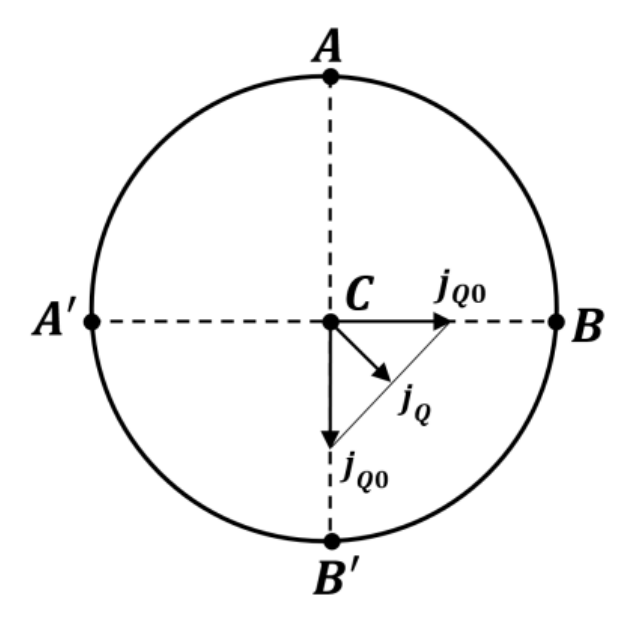
Obviously, each of the pairs and makes the same contribution to the heat flux at point , equal in magnitude
On the other hand, the total heat flux at point is equal to the vector sum of two mutually perpendicular fluxes , and it, as follows from the symmetry, is exactly twice the desired one, therefore
The first estimate of the Earth age
2.7 The amount of heat stored in a kettle is proportional to the cube of its size , that is,
and the power lost by it due to heat transfer is proportional to its surface area
Therefore, the required time is proportional to the size of the teapot and is
2.8 Since the thermal conductivity of the core is infinite, its temperature is the same everywhere, including at the boundary with the mantle. According to the electrothermal analogy, the temperature difference is the potential difference (voltage), and the radiation power from the Earth's surface is determined by the Stefan-Boltzmann law
and is similar to electric current, so there is a linear relationship between them
where the quantity represents the so-called thermal resistance.
Using the same electrothermal analogy, thermal resistance is written as
from which we finally obtain the temperature of the Earth's core
2.9 Since the transferred heat (current strength) is the same, we obtain the proportion for the temperature
where the thermal resistance of a spherical layer of thickness is given by the expression
Thus, we obtain the temperature at depth as
The actual core temperature is, of course, much lower, since the thermal balance with the Sun must be taken into account.
2.10 The change over time in the amount of heat stored in the core is equal to
where the mass of the core is obtained as
According to the law of energy conservation we have
where is given by expression (21).
The core temperature is given by formula (24), in which the first term can be neglected (), so we finally obtain
By integrating and expanding the exponential, we find
| Content | Points | ||
|---|---|---|---|
| 2.1 | Formula (1): | 0.2 | 1.0 |
| Formula (2): | 0.2 | ||
| Formula (3): | 0.2 | ||
| Formula (4): | 0.2 | ||
| Numerical value in formula (4): | 0.2 | ||
| 2.2 | Formula (5): | 0.2 | 1.0 |
| Formula (6): | 0.2 | ||
| Formula (7): | 0.2 | ||
| Formula (8): | 0.2 | ||
| Formula (9): | 0.2 | ||
| 2.3 | Formula (10): | 0.2 | 1.0 |
| Formula (11): | 0.2 | ||
| Formula (12): | 0.2 | ||
| Formula (13): | 0.2 | ||
| Numerical value in formula (13): | 0.2 | ||
| 2.4 | 0.2 for each correct value in the table | 4x0.2 | 0.8 |
| 2.5 | Correct equivalent circuit | 0.4 | 1.0 |
| Formula (14): | 0.2 | ||
| Formula (15): | 0.2 | ||
| Numerical value in formula (15): | 0.2 | ||
| 2.6 | Formula (16): | 0.5 | 1.0 |
| Formula (17): | 0.5 | ||
| 2.7 | Formula (18): | 0.2 | 1.0 |
| Formula (19): | 0.2 | ||
| Formula (20 | 0.3 | ||
| Numerical value in formula (20): | 0.3 | ||
| 2.8 | Formula (21): | 0.2 | 1.0 |
| Formula (22): | 0.2 | ||
| Formula (23): | 0.2 | ||
| Formula (24): | 0.2 | ||
| Numerical value in formula (24): | 0.2 | ||
| 2.9 | Formula (25): | 0.3 | 1.0 |
| Formula (26): | 0.2 | ||
| Formula (27): | 0.3 | ||
| Numerical value in formula (27): | 0.2 | ||
| 2.10 | Formula (28): | 0.2 | 1.2 |
| Formula (29): | 0.2 | ||
| Formula (30): | 0.2 | ||
| Formula (31): | 0.2 | ||
| Formula (32): | 0.2 | ||
| Numerical value in formula (32): | 0.2 | ||
| Total | 10.0 |
Mathematical hint for the theoretical competition
The following formulas may be useful:
, where is a fixed number, refers to an arbitrary constant;
, where stands for an arbitrary constant;
, where a – constant, – arbitrary constant;
, for and any value of ;
, for ;
, for .
List of physical constants
Speed of light in vacuum m/s;
Reduced Planck constant J·s;
Magnetic constant H·m;
Electric constant F/m;
Stefan-Boltzmann constant ;
Elementary charge C;
Electron mass kg.
Оригинал в Архива: IZhO 2025 Theory_eng.pdf · официални решения: IZhO 2025 Theory_eng_sol.pdf