IZhO 2026 — Задача 1. Torsion: Construction of the Potential Curve
Автор: Olympiads XYZ · транскрипция на официалните материали
Проверена срещу оригинала на 13.9.2026 от същия модел, който я е транскрибирал (без независима проверка)
XXII International Zhautykov Olympiad/Experimental competition — EXPERIMENTAL COMPETITION · 12 януари 2026 г.
Внимание: Бележка към темата
Решението на задача 1 е непълно в този прозорец — липсват стр. 7–12 от файла с решения.
Условие
Please read the instructions first:
- The Experimental competition consists of one problem. This part of the competition lasts 4 hours.
- Please only use the pen that is provided to you.
- You can use your own non-programmable calculator for numerical calculations. If you don't have one, please ask for it from Olympiad organizers.
- You are provided with Writing sheet and additional papers. You can use the additional paper for drafts of your solutions but these papers will not be checked. Your final solutions which will be evaluated should be on the Writing sheets. Please use as little text as possible. You should mostly use equations, numbers, figures and plots.
- Use only the front side of Writing sheets. Write only inside the bordered area.
- Fill the boxes at the top of each sheet of paper with your country (Country), your student code (Student Code), the question number (Question Number), the progressive number of each sheet (Page Number), and the total number of Writing sheets (Total Number of Pages). If you use some blank Writing sheets for notes that you do not wish to be evaluated, put a large X across the entire sheet and do not include it in your numbering.
- At the end of the exam, arrange all sheets for each problem in the following order:
- Used Writing sheets in order.
- The sheets you do not wish to be evaluated.
- Unused sheets.
- The printed problems.
Place the papers inside the envelope and leave everything on your desk. You are not allowed to take any paper or equipment out of the room.
Torsion: Construction of the Potential Curve
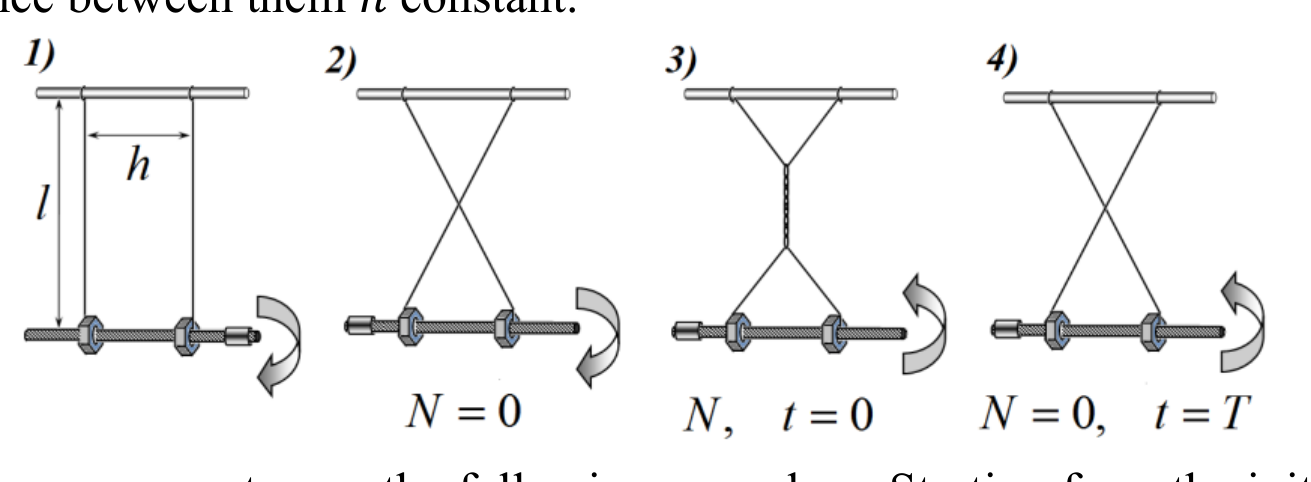
The behavior of mechanical systems with one degree of freedom is completely determined by the dependence of the system's potential energy on the coordinate, the graph of which is called the potential curve. In many cases, a theoretical calculation of this dependence can be complicated and sometimes even impossible. In such situations, the potential curve can be obtained on the basis of experimental data. In this work, you are required to determine the dependence of the potential energy on the coordinate for the free rotation of a metal rod suspended by two vertical threads. During all experiments, keep the thread length and the distance between them constant.
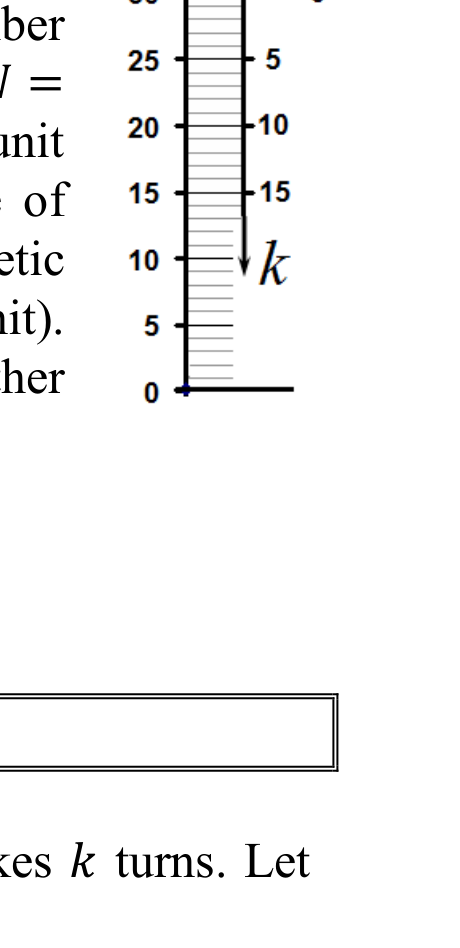
To carry out the measurements, use the following procedure. Starting from the initial position, when the threads are vertical (1), rotate the rod by half a turn (2), so that the threads come into contact. Then continue rotating the rod so that the threads are twisted, making the required number of full turns (3). After that, rotate the rod by an additional quarter turn and release it. Start the stopwatch only when, during unwinding, the rod again reaches position (3). After that, measure the time for the required number of rotation turns until position (4). In the calculations, assume that the angular velocity of the rod in the initial position (3) is zero, despite the additional quarter turn. In this problem, two interrelated coordinates are used: — the number of turns during the twisting of the threads, counted from the lower position of the rod (2) upward; — the number of turns made by the rod during the unwinding of the threads, counted from position (3) at downward. The unit of measurement for the coordinates is "one turn." Accordingly, the unit of velocity is "number of turns per second," with dimension . As a measure of energy, the square of the velocity is used, which is proportional to the rotational kinetic energy of the rod. Let us call the unit of energy in this case — Ku (Kazakhstani unit). The potential energy of the rod is taken to be zero at position (3) for , unless another "zero" position is specified.
Part 1. Theoretical Introduction
The mass of the rod is g, and the mass of one nut is g.
During the measurements, you need to measure the times over which the rod makes turns. Let this dependence be approximately described by the formula where are constants.
Let the potential energy be taken as zero at position (2), and let its dependence on the coordinate be approximately described by the formula: Denote by the time required for the rod to unwind from the initial position (3) to the lower position (4). Under these conditions, the approximate dependence is given by the formula
Part 2. Study of the Law of Motion
Set the rod in the initial position (3) with . Release the rod and use a stopwatch with lap memory to record the times during which the rod makes turns from the initial position. Perform the measurements in the range to 30, taking data every three turns.
To calculate the rod's velocity from the experimental data, use the symmetric formula
Part 3. Step-by-Step Probing
In this part, estimation of uncertainties is not required. To determine the parameters of the dependences, use the graphical method. The smaller the interval, the more accurately the approximate (fitting) formulas describe the motion. In this part of the work, you are required to study the motion of the rod over small intervals of variation of the coordinate , the boundaries of which are specified in the Writing Sheets. The larger value corresponds to the initial position. For each interval, you must measure the law of motion, namely, the times during which the rod makes turns from the initial position. Within each given interval of the coordinate , the coordinate varies from 1 to 10. Perform the measurements with a step . Use a stopwatch with lap memory and record the time after each turn of the rod. For each interval, assume that the obtained dependence can be approximately described by the function with its own values of the parameters and , which you must determine. For each of the specified intervals, perform the following tasks.
Summarize the obtained results. To this end, assume that the rod unwinds from the initial position .
Part 4. Unwinding Time
In this part, you are required to investigate the dependence of the total unwinding time of the rod on the initial value until the lower position (4).
Assume that the unwinding of the rod starts from the position .
Choose the value of the coefficient in the formula such that the value of the kinetic energy at coincides with the value of this energy calculated in Section 3.6.
1.1 Express the energy unit Ku in joules and calculate its numerical value.
1.2 Derive a formula for calculating the velocity and kinetic energy in Ku units as a function of the coordinate , which may be formally treated as continuous. Express them in terms of the parameters , , and .
1.3 Express the exponent in terms of the exponent .
2.1 Enter the measured values into Table 1.
2.2 Plot the graph of the law of motion .
2.3 Using the experimental data, calculate the values of the kinetic energy for all measured values of the coordinate . Enter the results into Table 1 in the column "E(k) (exp.)."
2.4 Plot the resulting dependence . Label it as No. 1.
2.5 Write down the formula for the potential energy of the rod , expressing it in terms of .
2.6 Plot the dependence of on the number of turns using a logarithmic scale.
2.7 Calculate the values of the parameters and , and estimate their uncertainties.
2.8 Using the obtained values of the parameters and , calculate the kinetic energy values in accordance with Section 1.2. Enter the results into Table 1 in the column "E(k) (theor.)."
2.9 Plot the calculated dependence of the rod's kinetic energy on the same graph as in Section 2.4. Label it as No. 2.
3.1 Measure the values of the times during which the rod makes turns from the initial position.
3.2 Plot the dependence on the prepared sections of the Writing Sheets using a logarithmic scale.
3.3 Draw a smoothing straight line through the last six points (for values of from 5 to 10).
3. Using the constructed linear graph, determine the values of the parameters and , indicating the formulas used for their calculation.
3.5 Calculate the change in the kinetic energy of the rod as the coordinate changes from 5 to 10. Provide the formula used to calculate this quantity.
3.6 Using the data obtained in this part, calculate the values of the rod's kinetic energy after and turns. Plot, on the graph from Section 2.4, the dependence obtained in this part. Label it as No. 3.
4.1 Measure the dependence of the total unwinding time of the rod on the number of turns for
4.2 Estimate the uncertainty in the measurement of the unwinding time for . To do this, perform at least five measurements of this time.
4.3 Plot the obtained dependence using a logarithmic scale.
4.4 Assuming that this dependence is described by the formula , determine the exponent in this formula.
4.5 Using the obtained value of the exponent , calculate the value of the exponent in the formula for the dependence of the potential energy on the coordinate, .
4.6 Calculate the values of the rod's kinetic energy after turns. Provide the formulas that you used to calculate .
4.7 Plot, on the graph from Section 2.4, the dependence obtained in this part. Label it as No. 4.
Решение
Внимание: Непълно решение
The marking scheme continues past page 11 of the solutions document (page 12 is outside this window).
Покажи официалното решение
Оригинал в Архива: IZhO-2026-Exp_eng.pdf · официални решения: IZhO-2026-Exp_eng_sol.pdf