NBPhO 2023, Теория и експеримент — Задача 1. Curling
Nordic-Baltic Physics Olympiad 2023 · 8 т.
Условие
— Oskar Vallhagen.
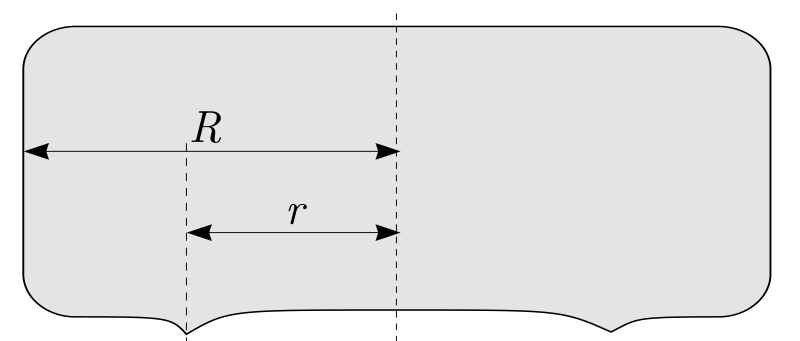
In the sport of curling, participants take turns sliding near-cylindrical stones across an ice court towards a target, trying to get their stones as close to the target as possible after using a set of stones. A vertical cross section of a stone is depicted below, showing that the stone is in contact with the ice on a thin ring of radius . The full radius of the stone is , the mass of the stone is and the coefficient of friction with the ice is .
Consider the case when the stone is released at a speed with the aim of knocking out an opponent’s stone at a distance .
i) Give an expression for the sliding speed as a function of the time since the stone was released until the stone hits the opponent’s stone. [1 т.]
ii) What is the sliding speed just before the stone hits the opponent’s stone? [1 т.]
Now the stone is given a small rotation at the initial angular speed (this can be done to alter the deflection angle of the stone when it hits the opponent’s stone). Assume that the rotation speed remains small throughout the sliding motion: . Keep only the main non-vanishing terms in your calculations, i.e. among the terms with a factor , keep only the term with the smallest . Depending on your approach you may use the following approximations for : , , . You may also need the integral .
iii) By how much does the friction force on the stone change due to its rotation? Express your answer in terms of the current angular speed and sliding speed . [2 т.]
iv) Give an expression for the torque exerted on the stone. [2 т.]
v) What is the angular speed of the stone just before it hits the opponent’s stone? [2 т.]
Решение
— Solution by Jaan Kalda, Oskar Vallhagen, grading schemes by Oskar Vallhagen.
i) (1 т.)
As the stone is gliding over the ice everywhere on the contact surface, the friction force is , i.e. the acceleration is , directed in the negative -direction (with the -direction pointing towards the target stone). Thus, we get
Grading:
- Correct friction force (0.5 pts)
- Correct acceleration (0.2 pts)
- correct (0.3 pts)
ii) (1 т.)
The simplest way to obtain the final velocity is to use energy conservation, noting that the friction force does a work . Thus, we get
Grading:
- Idea of using energy conservation (0.2 pts)
- Calculating the work done by the friction force (0.3 pts)
- Correct total energy conservation equation (0.3 pts)
- Correct (0.2 pts)
Alternatively, one can first calculate the time before the stone hits the opponents stone. Integrating the expression for up to this time gives
Solving for , we get
(the solution with the plus sign gives a negative velocity). Inserting back into the expression for and simplifying gives
Grading:
- Integration of the expression for (0.4 pts)
- Solving for (0.4 pts)
- Inserting into expression for and final answer (0.2 pts)
iii) (2 т.)
Consider the motion of a point at the ring in contact with the ice at an angle from the -axis, moving at a velocity as depicted in the figure below. The components of this motion along the and axes can be seen to be and , respectively.
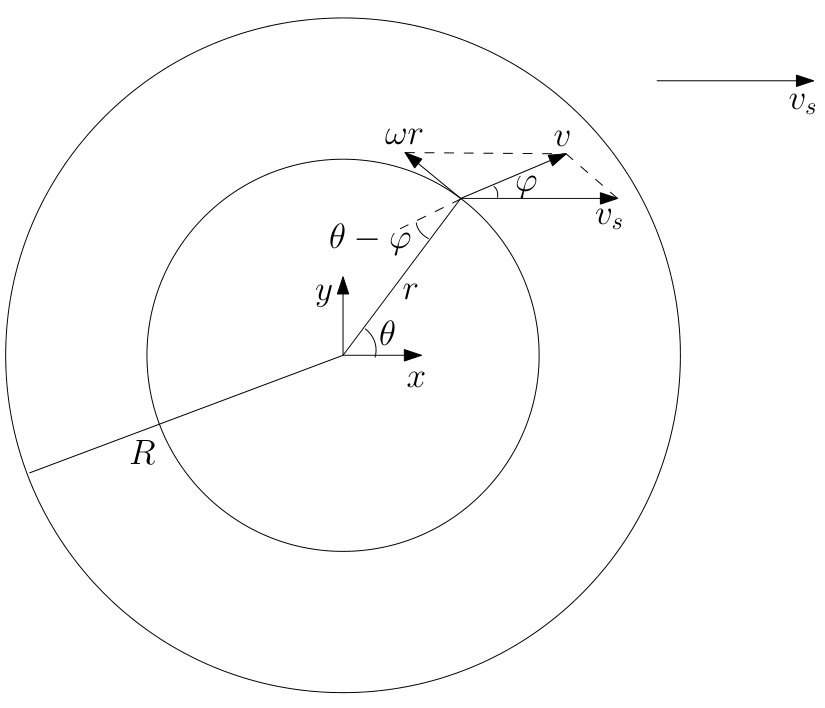
The friction force per unit length has the magnitude
everywhere on the circle in contact with the ice, as before, but is now directed opposite to the local velocity rather than the sliding velocity . The component of the force density in the -direction thus becomes
From this point on, there are two ways to work out the mathematical calculations. First, consider an infinitesimal arc of the contact ring of central angle ; the friction force exerted on it has magnitude . The total force is obviously directed antiparallel to the velocity of the stone as -directional components of the acting on arcs at and cancel pairwise out. The projection of the friction force acting on our arc is given by
Using the small parameter , we conclude that , hence we can use approximation
The angle can be found from the sine theorem assuming : . Alternatively, a similarly accurate expression cab be found by noting that
Thus,
Recognising that , this can be integrated to obtain
so that the final answer is
The second way is by continuing
To second order in , we get, using the approximation suggested in the problem text for and doing some elementary algebra,
The total friction force can now be obtained by integrating over the length element of size along the ring in contact with the ice, yielding, after simplifying and re-inserting the expression for ,
Grading:
- Understanding that the friction force is everywhere antiparallel with the local velocity (0.4 pts)
- Calculating the magnitude of the force per unit length (0.3 pts)
- Correct expression for the component (0.2 pts)
First solution:
- Approximate expression for or for small (0.3 pts)
- Expressing in terms of and (0.5 pts)
- Correct integral and final answer (0.3 pts)
Second solution:
- Expressing or in terms of and (0.3 pts)
- Approximate expression for or for small (0.5 pts)
- Correct integral and final answer (0.3 pts)
iv) (2 т.)
For the torque per unit length (around the central axis of the stone), we see from the figure that the angle between the local force per unit length and the radius is , yielding
From here on, there are again two ways to continue. First, we can use Taylor series and keep only the linear term: ; by using the previously obtained expression , we can express
integration of which yields
The second way is to write
which, using the above expressions for and , can be simplified to
Applying the same approximation as in the previous part and keeping only the first, now leading, order terms in , we get
Integrating to find the total torque, we get
Grading:
- Finding the angle between the local force per unit length and the radius (0.5 pts)
- Correct expression for (0.4 pts)
First solution:
- Approximate expression for or for small (0.3 pts)
- Expressing in terms of and (0.5 pts)
- Correct integral and final answer (0.3 pts)
Second solution:
- Expressing or in terms of and (0.3 pts)
- Approximate expression for or for small (0.5 pts)
- Correct integral and final answer (0.3 pts)
v) (2 т.)
The equation describing the rotation is, now expressed in terms of and rather than ,
where the moment of inertia is . As the correction to is only of second order in , to the first, leading order approximation, we may neglect the effect of rotation on . Thus, the sliding speed has the same time dependenca as in part i). The equation above can then be separated as
which, recognising that , yields
Grading:
- Correct equation of motion for the rotation (0.5 pts)
- Realising that is unaffected by the rotation to leading order (0.5 pts)
- Using separation of variabels (0.5 pts)
- Final answer (0.5 pts)
Оригинал в Архива: NBPhO_2023_problems.pdf · официални решения: NBPhO_2023_solutions.pdf