NBPhO 2024, Теория и експеримент — Задача 1. Four charges
Nordic-Baltic Physics Olympiad 2024 · 7 т.
Условие
— Päivo Simson, Jaan Kalda.
Four identical particles are initially in the corners of a square, as shown in the figure below. All particles have the same charge , mass , and the same magnitude of initial velocity . The directions of the initial velocities are indicated in the figure. You can assume and ignore gravity.
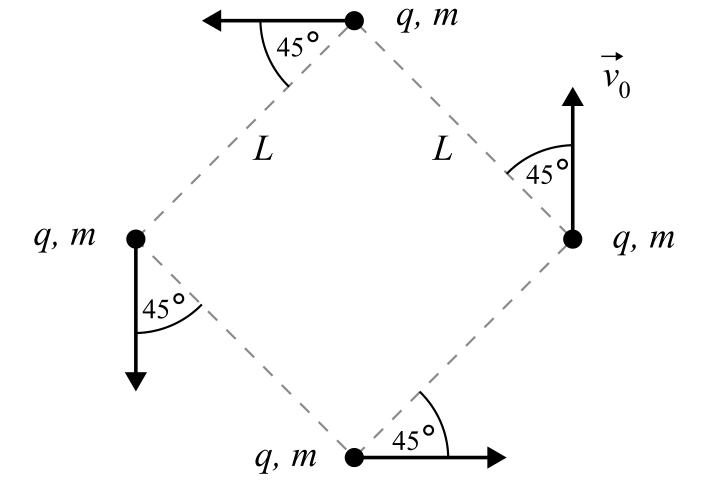
i) After a long time has passed, what is the magnitude of the final velocity of the particles with respect to the center of mass of the system? [2 т.]
ii) What is the angle between the initial velocity and the final velocity of a particle? [5 т.]
Решение
— Solution by Päivo Simson, grading schemes by Päivo Simson, Oleg Košik and Lasse Franti.
i) (2 т.)
Assuming and ignoring gravity, the initial total energy of the system is the sum of classical kinetic and potential energies
After the particles have moved infinitely far from each other, the potential energy becomes zero and the total energy is only kinetic:
Since the total energy does not change we have from the equality of these two expressions
Grading:
- Idea of using energy conservation (0.2 pts)
- Idea of symmetry and equality of quantities (0.2 pts)
- Idea of total energy as a sum of kinetic and electrostatic (0.2 pts)
- Formula for electrostatic energy including the two different distances (0.3 pts)
- Factor from pairings (0.4 pts)
- Final energy is purely kinetic (0.4 pts)
- Correct final answer (0.3 pts)
- If only dimensionless factors missing and final answer is reasonable (0.2 pts)
ii) (5 т.)
Let the required angle be .
The expression for the total energy reveals that the particles behave effectively independent of each other as if they are only subject to a central field generated by a single effective charge
fixed at the center of mass of the system, and initially at a distance from each particle. This observation allows us to reduce the initial four-body problem into four independent (and identical) two-body problems involving only the spatially fixed charge and one moving charge .The trajectories are therefore hyperbolas with one focus located at the position of the effective charge. Since the force is repulsive, the effective charge is at the focus as shown in the following figure.
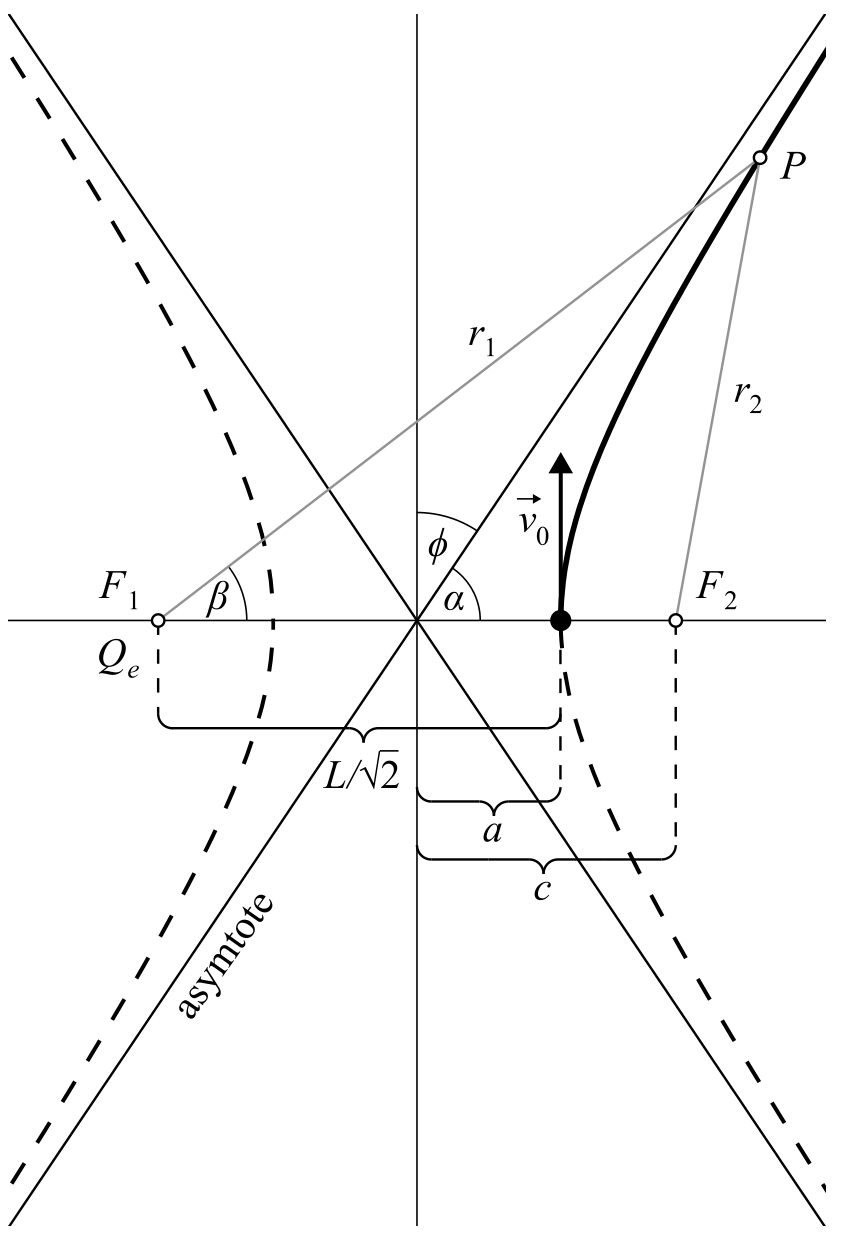
Let’s now calculate the asymptote angle , since the required angle is just .
A hyperbola is defined as a set of points , such that the absolute difference of the distances from to two fixed points and (the foci) is constant. Let the distances be and . From the figure it is easy to see that the constant is equal to : if we take the point on the -axis, then .
To determine the asymptote angle , let us look at the triangle . From the law of cosines, we have
Solving for and using we get
As , then , and we get the expression for the cosine of the asymptote angle:
Now using and knowing that
(the vis-viva equation for the hyperbola), from which
we finally get
Grading:
- Effective repulsive central force pointing from the COM (explicit expression or statement is required) (1 pts)
- Realising hyperbolic motion (0.5 pts)
- Central charge is located at the correct focus (0.5 pts)
- Expression for the angle or in terms of geometrical parameters e.g. , (1 pts)
- Vis-viva equation OR angular momentum conservation (1 pts)
- Deriving final answer (1 pts)
Subpoints for angular momentum conservation:
- Mentioned that angular momentum is conserved (0.3 pts)
- Writes initial angular momentum around COM using and (0.3 pts)
- Writes final angular momentum around COM using (0.4 pts)
Variation 1.
If the student doesn’t know the vis-viva equation for the hyperbola
which differs from the corresponding equation for the ellipse only by the sign of the total energy, it can be derived as follows.
From the asymptote angle formula
the geometric relationships shown in the following figure follow immediately.
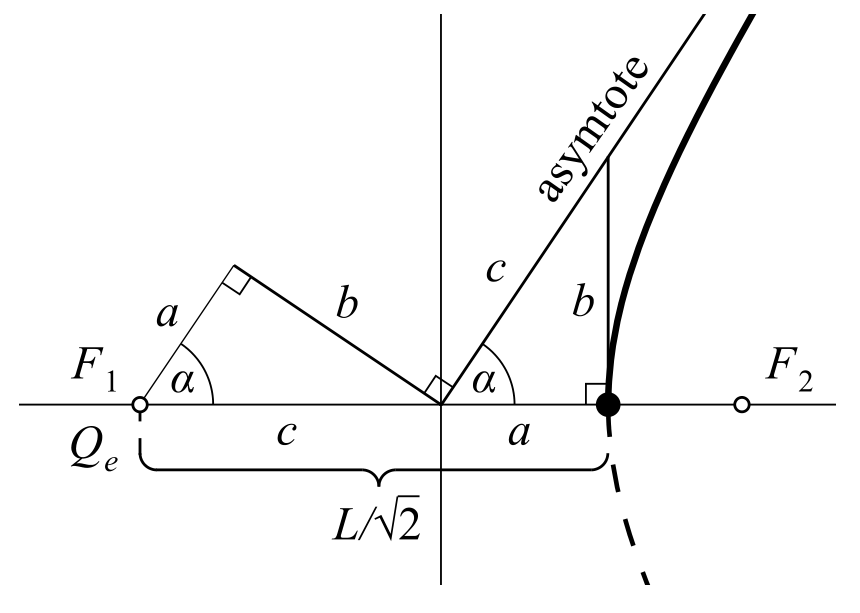
We see that the two right triangles on the figure are identical.
From the conservation of angular momentum (with respect to the point ) we have
and from the conservation of energy using
from which
Inserting this into the total energy expression we finally get
Variation 2.
Using the algebraic equation for the hyperbola
and knowing that , we get
Variation 3.
The vis-viva equation step can be done using conservation of angular momentum around COM, as all the forces are radial.
since we already know , , we can solve for the hyperbolas parameters.
Оригинал в Архива: NBPhO_2024_problems_v1.0.pdf · официални решения: NBPhO_2024_solutions_v0.98.pdf