NBPhO 2024, Теория и експеримент — Задача 3. Sticky ball
Nordic-Baltic Physics Olympiad 2024 · 4 т.
Условие
— Jaan Kalda.
A glass ball of radius rests on a flat glass plate. A tiny droplet of water (of surface tension ) is injected with a syringe so that water forms a small thin neck between the ball and the plate. Both the ball and the plate are perfectly hydrophilic, i.e. the contact angle of water is . Find the increase of the normal force between the plate and the ball caused by the presence of the neck of water.
Решение
— Solution by Jaan Kalda, Tudor Plopeanu, grading schemes by Eppu Leinonen.
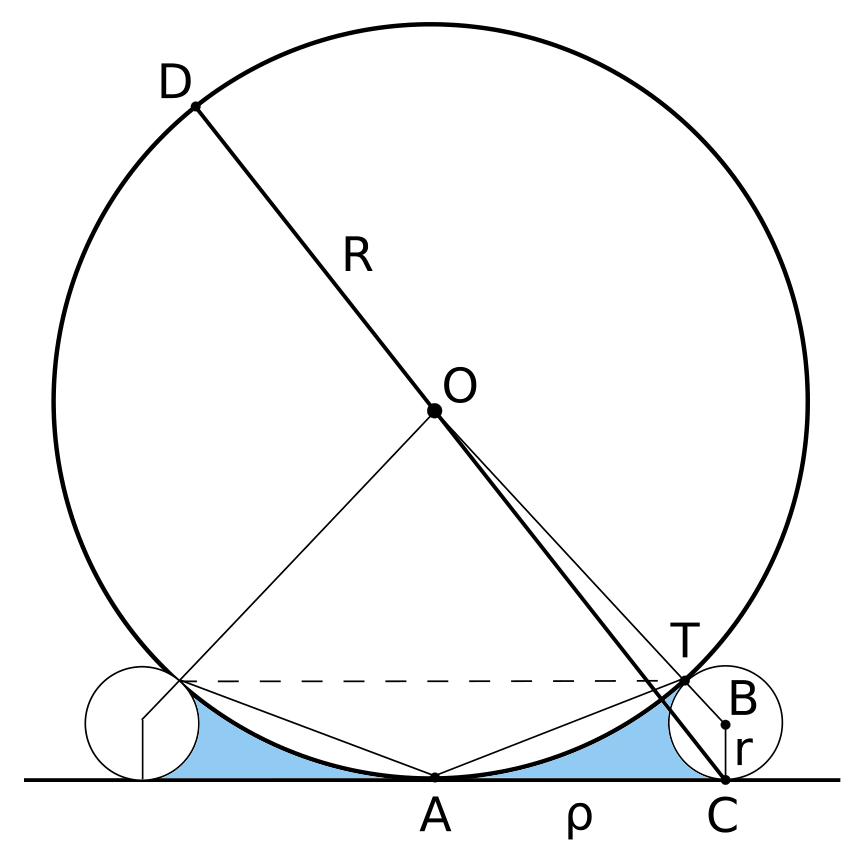
Let the radius of the neck be thus the force from surface tension at the contact of the sphere is negligible (angle to the horizontal ). Then, the curvature radius of the meniscus can be found from the intersecting secants theorem applied on a point on the bottom edge of the neck relative to the ball and approximating that the point is (near) the intersection of and the circle: . On the drawing, and we approximate as , as , and as . The pressure difference between the water and the surrounding air is . Its total vertical component is equal to its amplitude times the vertical cross-section . As such, the total vertical force on the ball difference between the two cases (with and without water) is .
Grading: (preliminary) Note that differing sign conventions are tolerated
- Stating that the meniscus is (roughly) inverse spherical or usage of constant to characterise the meniscus as inverse spherical (0.5 pts)
- (0.1 pts)
- Stating that surface tension from from contact is negligible or comes from the pressure difference (either explicitly or implicitly) (0.5 pts)
- (0.7 pts) (if not found, partial points can be earned as below)
- (0.1 pts)
- (0.1 pts)
- (0.2 pts)
- or statement of intersecting secants theorems (0.3 pts)
- (1 pts) (if not found, partial points can be earned as below)
- or any attempt to use a form of the Laplace-Young equation (0.2 pts)
- (0.3 pts)
- (correct effective are for pressure) (0.5 pts)
- (0.5 pts)
- (0.2 pts) (0.1 pts for each of the following)
- or noting that the contact force increases
- Correct dimensionless factor of and correct dimensions (only if approach is correct)
Solution 2 by Eppu Leinonen
The position of the meniscus can be parameterised using the angle . The meniscus is small as the amount of water is small. Thus and the radii can be approximated as and . The change in normal force due to surface tension is . Using the Young-Laplace equation . Thus the total change in normal force due to pressure difference is . I.e. .
Grading: (preliminary) Note that differing sign conventions are tolerated
- Stating that the meniscus is (roughly) inverse spherical or usage of constant to characterise the meniscus as inverse spherical (0.5 pts)
- (0.1 pts)
- (0.2 pts)
- (0.2 pts)
- (0.3 pts)
- or any statement that the force from surface tension is negligible or (0.5 pts)
- (1 pts) (if not found, partial points can be earned as below)
- or any attempt to use a form of the Laplace-Young equation (0.2 pts)
- (0.3 pts)
- (correct effective area for pressure) (0.5 pts)
- (0.5 pts)
- (0.2 pts) (0.1 pts for each of the following)
- or noting that the contact force increases
- Correct dimensionless factor of and correct dimensions (only if approach is correct)
Note: A common approach was to use the method of virtual displacement to solve for the force caused by the meniscus. However, it turns out that (the area of the meniscus-air interface is roughly half of a spherical toroid with radii and ) which means that the change in potential energy due to the change in surface area is negligible (). Thus the virtual work done by lifting the sphere only counteracts the virtual work done by the pressure, which reduces the problem back to either solution 1 or solution 2. Thus no points are granted for just mentioning this approach and telling that .
Solution 3 using virtual displacement (by Jaan Kalda). Let us denote the contact area of water and plate with ; then, the contact area of water and ball is also approximately . Let the ball touch initially the plate, and then be raised by . Since the volume of water is conserved, no work is made by atmospheric pressure, and , where is the change of the contact area; hence, . Meanwhile, for zero contact angle, the difference of surface energies at the air-solid interface, and at the water-solid interface equals to the surface energy of the water-air interface. This fact can be expressed in terms of the three surface tension coefficients denoted with , , and , respectively: . During our virtual displacement, the air-water interface remains almost constant; meanwhile, air-solid interface is increased by (contributed equally by the ball and plate surfaces). Therefore, the surface energy is increased by . Now we can find force as . This is the same expression we obtained from Young-Laplace equation. From this point on, the solution follows the steps made above.
Grading: (preliminary) Note that differing sign conventions are tolerated.
- Only the contact area between the solid and the liquid changes notably (0.5 pts)
- (0.5 pts)
- (0.2 pts)
- (0.3 pts)
- (only if has been identified correctly) (0.3 pts)
- (0.2 pts)
These replace noting that , and from the other solutions.
Оригинал в Архива: NBPhO_2024_problems_v1.0.pdf · официални решения: NBPhO_2024_solutions_v0.98.pdf