NBPhO 2025, Теория и експеримент — Задача 2. Evaporation
Nordic-Baltic Physics Olympiad 2025 · 7 т.
Условие
— Jaan Kalda.
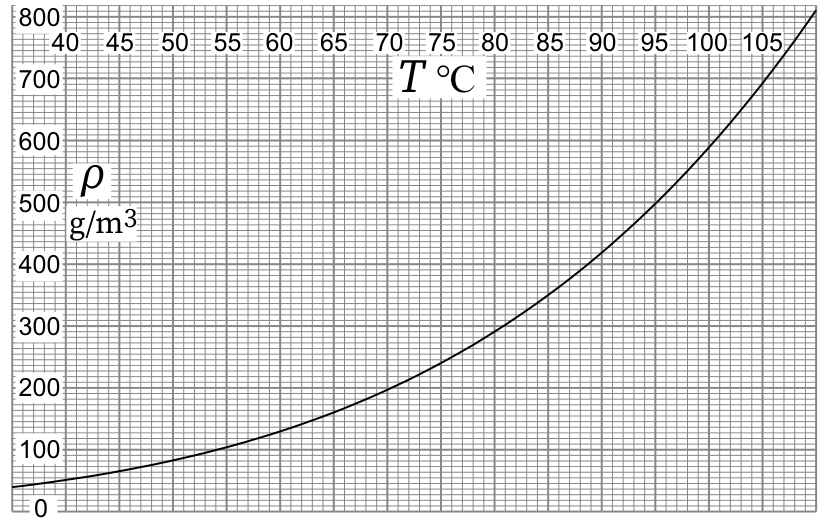
For the subsequent tasks, the graph shows how the density of saturated water vapour in depends on the temperature in .
You may also use the following characteristics of water. Specific heat capacity ; latent heat of vaporization ; density ; molar mass of water . You may also assume water vapour to behave as an ideal gas. The universal gas constant is .
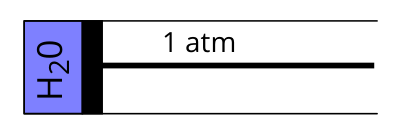
i) A cylinder contains a certain amount of water at temperature , see the figure. The cross-sectional area of the piston is . What is the minimum pulling force required to move the piston? The pressure of the surrounding air is .
[2 т.]
ii) If the piston is pulled so that it shifts by , the water cools to a temperature of ; what is the mass of the water under the piston? [2 т.]
Water evaporation has a cooling effect the intensity of which depends on the relative humidity and air convection intensity. It appears, however, that once a dynamical thermal equilibrium is reached, the equilibrium temperature of a wet surface depends only on the relative humidity and the temperature of air and does not depend on the convection speed (as long as the convection is not too weak). This is so because the two competing processes determining the equilibrium state both depend on the thickness of the laminar (non-turbulent) surface layer exactly in the same way. In what follows we shall use the following assumptions. (a) Atop a wet surface (such as a sweating bare skin), there is a layer with a laminar flow of a certain thickness . (b) Atop the laminar layer, the surrounding turbulent flow keeps a constant temperature and relative humidity , both equal to the respective values in the bulk of the surrounding air. (c) Heat flux from beneath the wet surface (e.g. through the skin) can be neglected. (d) The heat conductivity of air at (neglect the temperature dependence), and the diffusivity of water molecules in air . Neglect the dependence of on the temperature. Note that the particle flux (net number of molecules passing a cross-section in –-plane per second and per cross-sectional area) can be found as , where denotes the number density (number of molecules per volume).
iii) Determine the temperature of sweating human skin in a sauna if the air temperature and . [3 т.]
Решение
— Solution by Jaan Kalda, grading schemes by Mattias Bjerklöv, Marko Tsengov, Eppu Leinonen.
i) (2 т.)
Water is in a good approximation incompressible; hence, when the piston starts moving, the growing volume must be filled by gas which can be only the water vapours. Thus, the water starts boiling: these vapours must be in equilibrium with water, hence the vapour pressure must be equal to the pressure inside the piston. We can read from the graph that at , the vapour density is ; this corresponds to the pressure . With atmospheric pressure , the force needed to pull the piston is .
- Realize that the pressure inside the the cylinder equals the saturated vapour pressure of water at temperature . 0.8 pts
- Read the density from the graph, in the range . 0.2 pts
- Use the ideal gas law to find an expression for the pressure at temperature . 0.4 pts
- Correct expression for the force: . 0.4 pts
- Correct numerical answer. 0.2 pts
ii) (2 т.)
When the piston is pulled by displacement , creating new volume , the water partially evaporates to fill this volume with vapour and the remaining liquid water cools from temperature to . The mass of vapour needed to fill the new volume can be calculated using the vapour density as . For the heat balance, the energy needed for evaporation must come from the cooling of the remaining liquid water:
here we have neglected the dependence of on temperature, and heat capacity of water vapours, because (but we have not neglected the work done by piston, because is actually the enthalpy of evaporation already includes ). Similarly, since , we can neglect in the right-hand-side and express
- Read the vapour density from the graph (). 0.2 pts
- Correct expression for mass of water vapour. 0.3 pts
- Correct expression for the latent heat (). 0.3 pts
- Correct expression for heat lost by water (.) 0.3 pts
- Expression for energy conservation. 0.4 pts
- Correct expression for mass of water . 0.3 pts
- Correct numerical answer (with correct dimension). 0.2 pts
iii) (3 т.)
At the thermal equilibrium, there is as much heat flux to the skin as there is heat loss due to evaporation. The former (per area) equals to and the latter (per area) — to where is the mass of one molecule, which we find to be to get . Note that the minus sign comes from the fact that the particles diffuse from higher density areas to lower density areas. Now from the ideal gas law to get . Now the pressure of the water vapour is related to through , where denotes the saturation pressure of vapour. So,
where denotes the water vapour saturation pressure at the local air temperature; hence by integrating over we obtain
where the index denotes quantities evaluated at the skin surface. Also, we have used the fact that , because at the skin surface, the air is in direct contact with water (due to sweating, skin is wet), so that . Substituting we obtain
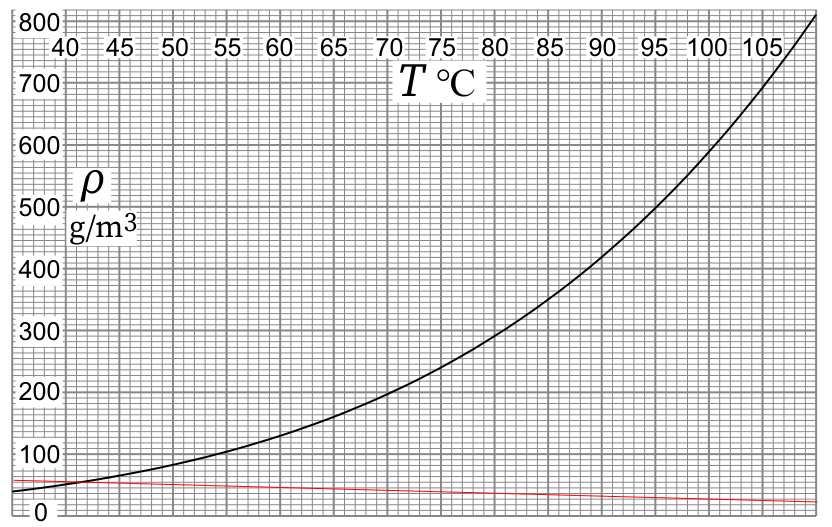
Here we evaluate from the graph and . Now we can draw this straight line onto the graph provided to find the intersection point at .
Grading: (preliminary)
NB! the substitution can be done earlier so the schemes below represent only the relevant observations which can be done with already. Also equivalent forms will give points (i.e. if using and instead of in the middle steps)
- heat going away from skin (up) = heat going to skin (down) at the equilibrium 0.4 pts
- Heat flux down 0.2 pts
- Heat flux up magnitude (partial points available for the equivalents to the steps below) 0.5 pts
- Magnitude of heat flux up is 0.3 pts
- 0.1 pts
- 0.1 pts
- Deducing that the direction of the heat flow is opposite to (explicitly mentioned or with the existence of the minus sign in the equations) 0.1 pts
- 0.1 pts
- (i.e. integrating correctly) 0.4 pts
- Or doing a change from in the derivatives has to be motivated properly (i.e. for heat conductivity no need for any explicit explanation but for Fick’s law one must state that is constant (due to the amount of particles is conserved)).
- 0.1 pts
- Reading correctly ()) 0.2p pts
- Graphical method 0.8 pts
- Noticing that defines a straight line in 0.8 pts
- Any other valid numerical method that is explained is accepted
- Correct final result 0.2 pts
If working with earlier on one can show that that the heat flux up magnitude is
Solution 2 by Eppu Leinonen: One can also work directly with through the fact that . Then the heat flux magnitude will directly become , where is the density of the water vapour. Then with correct signs we get
from which by integrating and using we get
and the solution proceeds the same way as in solution 1.
The following grading scheme is given to provide exact correspondences to the scheme of solution 1. Grading:
- heat going away from skin (up) = heat going to skin (down) at the equilibrium 0.4 pts
- Heat flux down 0.2 pts
- Heat flux up magnitude (partial points available for the equivalents to the steps below) 0.6 pts
- Working with directly 0.1 pts
- Magnitude of heat flux up is 0.3 pts
- 0.1 pts
- 0.1 pts
- Deducing that the direction of the heat flow is opposite to (explicitly mentioned or with the existence of the minus sign in the equations) 0.1 pts
- 0.1 pts
- (i.e. integrating correctly) 0.4 pts
- Or doing a change from in the derivatives has to be motivated properly (i.e. for heat conductivity no need for any explicit explanation but for Fick’s law one must state that is constant (due to the amount of particles is conserved)).
- Reading correctly ()) 0.2p pts
- Graphical method 0.8 pts
- Noticing that defines a straight line in 0.8 pts
- Any other valid numerical method that is explained is accepted
- Correct final result 0.2 pts
Оригинал в Архива: NBPhO_2025_problems_v1.0.pdf · официални решения: NBPhO_2025_solutions_v1.0.pdf