NBPhO 2026, Теория и експеримент — Задача 6. Pull-up bar rope
Nordic-Baltic Physics Olympiad 2026 · 5 т.
Practicalities for moderation.
When you are called to the moderation table to discuss your request with the graders, bring an item-by-item breakdown of the points you are claiming, following the detailed grading scheme — e.g., for P9 part (i): out of . Without this breakdown, the moderation discussion will not proceed.
Условие
— Jaan Kalda. A rope is thrown over a horizontal pull-up bar at height above the frictionless floor. One end of the rope is tied to a heavy weight resting on the floor; the other end is pulled so that the length of the rope between the bar and the weight decreases at a constant rate . At a given moment, this segment makes an angle with the vertical (see figure); the weight is still in contact with the floor. Gravitational acceleration is .
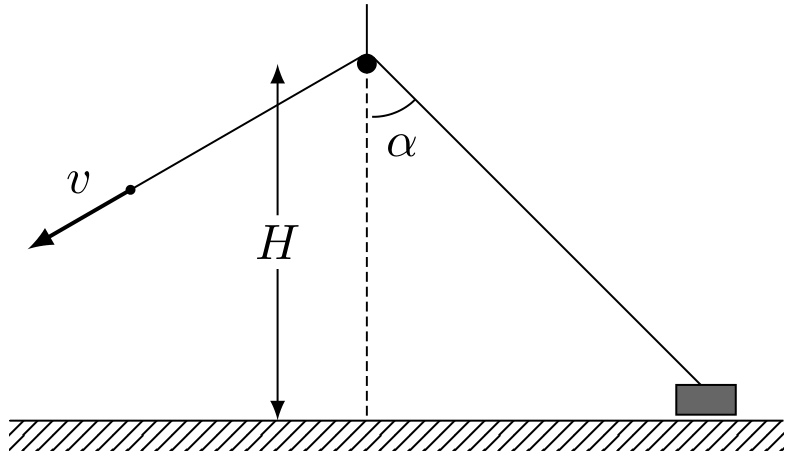
i) Find the speed of the weight. [1 т.]
ii) Find the magnitude of the acceleration of the weight. [1 т.]
iii) Find the angle at which the weight lifts off the floor. [3 т.]
Решение
— Solution by Jaan Kalda.
i) (1 т.)
Place the bar at the origin of a coordinate system where is the horizontal distance from the bar to the weight along the floor, and is the height of the bar above the floor. The length of the bar-to-weight rope segment is
Method 1 (inextensibility / velocity projection). Since the rope is inextensible, the velocity components of its two endpoints along the rope direction must match: whatever rate one end recedes from a point on the rope, the other end must approach it at the same rate. The puller’s hand pulls the rope along its own direction at speed , so the rope shortens at rate . The weight moves horizontally toward the bar at speed ; its velocity component along the rope (which makes angle with the vertical, hence angle with the floor) is . Equating:
Method 2 (implicit differentiation). Differentiating with respect to time:
With (the segment shortens at constant rate) and :
Grading (Method 1).
- Recognising that the velocity components of the rope endpoints along the rope direction must match (rope inextensibility) 0.4 pts
- Identifying the projection for the weight’s velocity along the rope 0.3 pts
- Final answer 0.3 pts
Grading (Method 2).
- Setting up with 0.3 pts
- Correctly differentiating to obtain 0.4 pts
- Final answer 0.3 pts
ii) (1 т.)
Method 1 (continuing from ). Differentiate again, with constant (so ):
Since , we have : the weight accelerates toward the bar. With and :
- Correctly differentiating an incorrect result from the previous part 0.5 pts.
Method 2 (direct differentiation of ). The angle changes in time as the weight slides; introduce (positive as decreases). The weight’s position is , so its speed is
Combined with :
Differentiating with respect to time:
Substituting :
Grading (Method 1).
- Differentiating to obtain 0.5 pts
- Substituting and to obtain final answer 0.5 pts
Grading (Method 2).
- Introducing as the angular rate of the rope direction 0.2 pts
- Relating the weight’s speed to : 0.2 pts
- Deriving from 0.2 pts
- Differentiating to obtain 0.2 pts
- Substituting and obtaining final answer 0.2 pts
iii) (3 т.)
While the weight is on the floor, the only horizontal force on it is the horizontal component of the rope tension , directed toward the bar. Newton’s second law in the horizontal direction:
Vertically, , where is the normal force from the floor. The weight lifts off when , i.e., :
Grading.
- Identifying that the only horizontal force on the weight is 0.3 pts
- Writing Newton’s second law horizontally: 0.3 pts
- Substituting the expression for from part (ii) 0.2 pts
- Isolating to obtain 0.2 pts
- Correctly setting up the vertical force balance 0.5 pts
- Correct lift-off condition , i.e., 0.5 pts
- Algebraic manipulation to 0.5 pts
- Final answer 0.5 pts
Оригинал в Архива: NBPhO_2026_problems.pdf · официални решения: NBPhO_2026_solutions.pdf